Loading...
Abdel Aziz al-Rantisi vs Nikolai Bulganin
Nikolai Bulganin leads by 1.9 pts · 2 figures compared
…

Abdel Aziz al-Rantisi
Politician · Modern
40.2Total
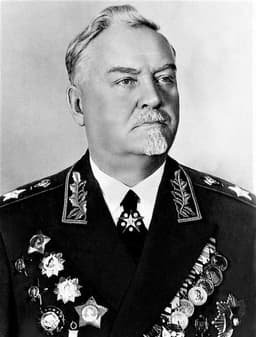
Nikolai Bulganin
Politician · Modern
42.1Total
Basic Information
Born
1947
1895
Died
—
1975
Era
Modern
Modern
Nationality
Palestine
Russia
Occupation
Politician
Politician
Civilization
Middle Eastern
Western
Score Comparison
Military (10%)
38.3
12.6
Political (20%)
26.4
48.0
Influence (20%)
50.2
48.6
Legacy (20%)
39.2
38.3
Leadership (15%)
31.2
53.2
Strategy (15%)
53.8
39.7
TOTAL
40.2
42.1
Abdel Aziz al-Rantisi — Complete Timeline
2004 AD
Assassination by Israeli StrikeWar
Rantisi was killed in an Israeli airstrike on April 17, 2004, just weeks after succeeding Yassin. The strike targeted his car in Gaza City, killing him and his bodyguard. His death marked a major blow to Hamas leadership.
AssassinationIsraelGaza
Impact: regionaltragic
Succeeded Ahmed Yassin as Hamas LeaderPolitical Action◆ Major
Rantisi became the leader of Hamas in Gaza immediately after Yassin's assassination in March 2004. He vowed to continue armed resistance against Israel, escalating rocket attacks from Gaza.
HamasLeadershipGaza
Impact: regional
Nikolai Bulganin — Complete Timeline
1955 AD
Appointment as Premier of the Soviet UnionPolitical Action◆ Major
Bulganin succeeded Malenkov as Chairman of the Council of Ministers (Premier) in February 1955. He served as a figurehead leader while Khrushchev held real power, representing the Soviet Union in diplomatic engagements during the early Cold War.
Soviet LeadershipAppointmentCold War
Impact: national
1956 AD
Role in the Hungarian Revolution of 1956Political Action◆ Major
As Premier, Bulganin supported the Soviet decision to crush the Hungarian Revolution in November 1956. He authorized the military intervention that suppressed the uprising, resulting in thousands of deaths and the installation of a pro-Soviet government.
Cold WarHungarian RevolutionIntervention
Impact: regionaldestructive
1958 AD
Removal from Power and ExpulsionPolitical Action◆ Major
Bulganin was removed from the premiership in March 1958 and replaced by Khrushchev. He was later expelled from the Communist Party in 1961 for his involvement in the 'Anti-Party Group' that opposed Khrushchev, ending his political career.
Power StruggleKhrushchevExpulsion
Impact: nationaldestructive
Expert Analysis
Origins
Abdel Aziz al-Rantisi was born in 1947 in Jaffa, Palestine, into a family displaced during the 1948 Arab-Israeli war. He grew up in a refugee camp in Gaza, which shaped his militant worldview. He studied medicine at Alexandria University in Egypt, becoming a pediatrician, and later joined the Muslim Brotherhood. His early life was marked by the trauma of displacement and the rise of Palestinian nationalism.
Nikolai Bulganin was born in 1895 in Nizhny Novgorod, Russia, into a middle-class family. He joined the Bolshevik Party in 1917 and worked in the Cheka (secret police) and later in industrial management. His early career was defined by loyalty to Stalin and administrative roles, including mayor of Moscow. He lacked military or ideological prominence, rising through bureaucratic competence.
Rise to Power
Al-Rantisi rose to prominence as a co-founder of Hamas in 1987, during the First Intifada. He was a key figure in the organization's military and political wings. He was arrested by Israel in 1988 and imprisoned for several years. After release, he continued to lead Hamas's activities. His major turning point came in March 2004 when he succeeded Ahmed Yassin as Hamas leader after Yassin's assassination. He held the position for only 24 days before being killed.
Bulganin rose through the Soviet hierarchy under Stalin. He served as chairman of the State Bank and later as deputy premier. After Stalin's death, he became a close ally of Nikita Khrushchev. In February 1955, he was appointed Premier (Chairman of the Council of Ministers) as a figurehead while Khrushchev held real power. His rise was a result of political maneuvering, not popular support.
Leadership & Governance
Al-Rantisi's leadership was brief and focused on armed resistance. As Hamas leader, he vowed to continue attacks against Israel and rejected any peace negotiations. He had no formal governance role, as Hamas controlled only parts of Gaza. His leadership style was uncompromising, emphasizing religious ideology and military action. He scored 31.2 in leadership and 53.8 in strategy, reflecting tactical focus but limited administrative scope.
Bulganin's leadership was largely ceremonial. As Premier, he chaired meetings but deferred to Khrushchev on major decisions. He supported the suppression of the Hungarian Revolution in 1956, authorizing military intervention. He also advocated for economic reforms, but they were overshadowed by Khrushchev's initiatives. His leadership score of 53.2 reflects his role as a loyal administrator rather than an independent leader.
Triumph & Tragedy
Al-Rantisi's greatest success was helping establish Hamas as a major force in Palestinian resistance. His greatest failure was his inability to consolidate power or achieve political gains; his assassination within weeks of becoming leader left his legacy incomplete. He scored 38.3 in military, reflecting limited operational success, and 39.2 in legacy.
Bulganin's triumph was his role in the post-Stalin transition, contributing to de-Stalinization and economic reforms. His tragedy was being a mere figurehead; he was removed from power in 1958 when Khrushchev consolidated control, and later expelled from the party in 1961. His legacy score of 38.3 reflects his secondary role.
Character & Destiny
Al-Rantisi was a committed ideologue, unbending in his views. His character—determined but inflexible—led him to a path of resistance but also made him a target. His destiny was tied to the cycle of assassination that decimated Hamas leadership. He scored 50.2 in influence, indicating his symbolic importance.
Bulganin was a pragmatic bureaucrat, loyal and cautious. His character allowed him to survive Stalin's purges but also made him a tool for Khrushchev. His destiny was to be overshadowed by more powerful figures. He scored 48.6 in influence, reflecting his role in a major power.
Legacy
Al-Rantisi's legacy is as a martyr in Palestinian narrative. His brief leadership solidified Hamas's commitment to armed struggle. He is remembered as a symbol of resistance, but his practical impact was limited by his short tenure. His total score is 40.2.
Bulganin's legacy is as a transitional figure in Soviet history. He is remembered for his role in the Hungarian Revolution and economic reforms, but his name is often forgotten. He scored 42.1 overall, slightly higher than al-Rantisi.
Conclusion
While al-Rantisi and Bulganin both had limited direct impact, Bulganin's role in the Soviet Union—a global superpower—gives him an edge in influence. His scores in political (48.0) and leadership (53.2) exceed al-Rantisi's (26.4 and 31.2). However, al-Rantisi's influence (50.2) and strategy (53.8) are comparable. Considering the scale of their environments, Bulganin had greater impact on world events, even if his name is less known. The data supports Bulganin as the more impactful historical figure.
Rankings
🥇
Nikolai BulganinLeader
Mil: 12.6Pol: 48.0Inf: 48.6
42.1
🥈
Abdel Aziz al-Rantisi
Mil: 38.3Pol: 26.4Inf: 50.2
40.2
+1.9 behind
How This Comparison Works
Algorithm
Each figure is scored on 6 dimensions (0—100 scale) based on structured historical data: Military (10%), Political (20%), Influence (20%), Legacy (20%), Leadership (15%), Strategy (15%). The weighted total produces the final ranking.
Data Sources
Scores are computed from structured sub-indicators in the database. Scale factors adjust for era (Ancient ×0.85, Modern ×1.0) and civilization size (Eastern ×1.05, Other ×0.80) to account for differences in population and military scale.
Maximum 3 Figures
Comparisons are limited to 2—3 figures to ensure readability and statistical meaningfulness.
Error Margins
±5 points per dimension — Sub-scores are derived from historical records with inherent uncertainty. Two figures within 5 points on a dimension should be considered roughly equivalent in that area.
Total Score Accuracy
±3 points overall — The weighted combination of 6 dimensions produces a total score with approximately ±3 points of uncertainty. Differences of less than 3 points are not statistically significant— the figures are effectively tied.
Known Limitations
- Historical records are incomplete and uneven across civilizations
- Figures from oral-tradition societies may be underrepresented
- Occupation labels can misclassify multi-role figures
- Scores measure capability and impact, not moral character
- Quantitative scoring is a comparison tool, not absolute truth
Capability Radar
Military (10%) — Battles & Warfare
Battles
5
20
Win Rate
5
27
Expansion
10
25
Political (20%) — Governance & Reform
Reform
15
40
Diplomacy
15
50
Economy
5
30
Influence (20%) — Cultural & Global Reach
Cultural
20
10
Global
20
20
Legacy (20%) — Historical Impact
Historical
20
20
Longevity
15
10
Leadership (15%) — Power & Stability
Tenure
10
60
Stability
5
40
Strategy (15%) — Tactics & Innovation
Strategy
10
32
Tactics
10
33
Reform
15
39
Similar Comparisons
Comments & Discussion
No comments yet. Be the first to share your thoughts!