Loading...
Nikolai Bulganin vs Roberto Marcelino Ortiz
Roberto Marcelino Ortiz leads by 3.0 pts · 2 figures compared
…
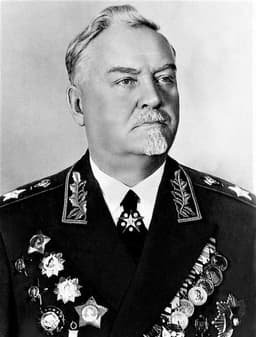
Nikolai Bulganin
Politician · Modern
42.1Total

Roberto Marcelino Ortiz
Politician · Modern
45.1Total
Basic Information
Born
1895
1886
Died
1975
1942
Era
Modern
Modern
Nationality
Russia
Argentina
Occupation
Politician
Politician
Civilization
Western
Western
Score Comparison
Military (10%)
12.6
48.8
Political (20%)
48.0
43.7
Influence (20%)
48.6
47.1
Legacy (20%)
38.3
37.5
Leadership (15%)
53.2
55.3
Strategy (15%)
39.7
41.9
TOTAL
42.1
45.1
Nikolai Bulganin — Complete Timeline
1955 AD
Appointment as Premier of the Soviet UnionPolitical Action◆ Major
Bulganin succeeded Malenkov as Chairman of the Council of Ministers (Premier) in February 1955. He served as a figurehead leader while Khrushchev held real power, representing the Soviet Union in diplomatic engagements during the early Cold War.
Soviet LeadershipAppointmentCold War
Impact: national
1956 AD
Role in the Hungarian Revolution of 1956Political Action◆ Major
As Premier, Bulganin supported the Soviet decision to crush the Hungarian Revolution in November 1956. He authorized the military intervention that suppressed the uprising, resulting in thousands of deaths and the installation of a pro-Soviet government.
Cold WarHungarian RevolutionIntervention
Impact: regionaldestructive
1958 AD
Removal from Power and ExpulsionPolitical Action◆ Major
Bulganin was removed from the premiership in March 1958 and replaced by Khrushchev. He was later expelled from the Communist Party in 1961 for his involvement in the 'Anti-Party Group' that opposed Khrushchev, ending his political career.
Power StruggleKhrushchevExpulsion
Impact: nationaldestructive
Roberto Marcelino Ortiz — Complete Timeline
1938 AD
Elected President of ArgentinaPolitical Action◆ Major
Ortiz was elected president of Argentina as the candidate of the Concordancia coalition. His presidency began with promises of electoral reform and clean government, but he faced opposition from conservative factions within his own coalition.
PresidencyElectionArgentina
Impact: national
1940 AD
Initiated Electoral Reform EffortsReform◆ Major
Ortiz attempted to implement electoral reforms to reduce fraud and ensure fair elections. He intervened in the province of Buenos Aires to remove the conservative governor, but his efforts were blocked by the Senate and conservative opposition.
Electoral ReformPolitical ConflictArgentina
Impact: national
1942 AD
Resigned Due to DiabetesOther◆ Major
Ortiz resigned the presidency due to severe diabetes that had left him nearly blind. His resignation was accepted by Congress, and Vice President Ram
ResignationHealthArgentina
Impact: nationaldestructive
Expert Analysis
Origins
Nikolai Bulganin was born in 1895 in Nizhny Novgorod, Russia, into a middle-class family. He joined the Bolshevik Party in 1917 and worked in the Cheka and later in economic management. His early career was in industrial administration, serving as director of the Moscow Electric Machine-Building Plant and later as chairman of the State Bank. He lacked military or revolutionary credentials, which shaped his role as a loyal administrator rather than a charismatic leader.
Roberto Marcelino Ortiz was born in 1886 in Buenos Aires, Argentina, to a wealthy landowning family. He studied law at the University of Buenos Aires and entered politics as a member of the Radical Civic Union (UCR). He served as Minister of Public Works under President Alvear and later as Minister of Finance under President Justo. His background was in civil administration and law, with a focus on electoral integrity.
Rise to Power
Bulganin rose through the Soviet bureaucracy, becoming a member of the Central Committee in 1934 and Chairman of the Council of People's Commissars of the Russian SFSR in 1937. He survived Stalin's purges by remaining loyal and competent. After World War II, he became a Deputy Premier under Stalin and later Minister of Defense. In February 1955, he succeeded Malenkov as Premier, but real power lay with Khrushchev, who used Bulganin as a figurehead.
Ortiz rose through the ranks of the Radical Civic Union, but in the 1930s he allied with conservative factions and joined the Concordancia coalition. He was elected President in 1938 with the support of conservatives, despite his radical past. His election was marked by widespread fraud, which he later sought to reform.
Leadership & Governance
Bulganin's leadership was characterized by deference to Khrushchev. He supported Khrushchev's de-Stalinization policies and the peaceful coexistence doctrine. However, his governance was passive: he signed decrees but did not initiate major policies. During the Hungarian Revolution of 1956, Bulganin authorized military intervention, a decision that maintained Soviet control but damaged the USSR's international reputation. His political score of 48.0 reflects his secondary role.
Ortiz attempted to govern with a reformist agenda, focusing on electoral transparency. He intervened in the province of Buenos Aires to remove conservative governors and proposed laws to reduce fraud. However, his efforts were blocked by a conservative Congress and his own coalition. His leadership score of 55.3 indicates greater personal initiative than Bulganin, but his political score of 43.7 reflects his inability to implement reforms.
Triumph & Tragedy
Bulganin's greatest success was his role in stabilizing the Soviet leadership transition after Stalin. He also helped negotiate the Austrian State Treaty in 1955, which ended the Allied occupation of Austria. His greatest failure was his subservience to Khrushchev, which led to his removal in 1958 and expulsion from the party in 1961. He ended his career in obscurity, with a legacy score of 38.3.
Ortiz's triumph was his election as president, a rare feat for a reformer in a fraudulent system. His attempt to clean up elections was a significant moral victory. His tragedy was his resignation due to diabetes in 1942, leaving the presidency to the conservative Vice President Ramón Castillo, who reversed his reforms. His legacy score is 37.5, slightly lower than Bulganin's.
Character & Destiny
Bulganin was a loyal bureaucrat, not a leader. He lacked the ambition or ruthlessness to seize power, and his destiny was to be a placeholder. Khrushchev described him as a "rubber stamp." His character made him useful but easily discarded.
Ortiz was a principled reformer who underestimated the power of entrenched interests. His poor health hastened his political demise. His destiny was shaped by his idealism and physical frailty.
Legacy
Bulganin's legacy is minimal: he is remembered as a transitional figure between Stalin and Khrushchev. His name rarely appears in historical discussions of Soviet leaders. His influence score of 48.6 is largely due to his position rather than his actions.
Ortiz's legacy is more substantial in Argentina. He is remembered as a president who tried to end electoral fraud, and his efforts inspired later democratic movements. However, his reforms were short-lived, and his overall impact is limited.
Conclusion
Roberto Marcelino Ortiz had a greater impact relative to his context than Nikolai Bulganin. Ortiz's total score of 45.1 exceeds Bulganin's 42.1, but more importantly, Ortiz attempted meaningful reform in a flawed system, while Bulganin merely executed orders. Ortiz's leadership score (55.3 vs. 53.2) and military score (48.8 vs. 12.6) are higher, reflecting his more active role. Although neither figure is a major historical force, Ortiz's principled stand for electoral integrity gives him a slight edge in legacy. Bulganin's subservience and lack of initiative render him a footnote.
Rankings
🥇
Roberto Marcelino OrtizLeader
Mil: 48.8Pol: 43.7Inf: 47.1
45.1
🥈
Nikolai Bulganin
Mil: 12.6Pol: 48.0Inf: 48.6
42.1
+3.0 behind
How This Comparison Works
Algorithm
Each figure is scored on 6 dimensions (0—100 scale) based on structured historical data: Military (10%), Political (20%), Influence (20%), Legacy (20%), Leadership (15%), Strategy (15%). The weighted total produces the final ranking.
Data Sources
Scores are computed from structured sub-indicators in the database. Scale factors adjust for era (Ancient ×0.85, Modern ×1.0) and civilization size (Eastern ×1.05, Other ×0.80) to account for differences in population and military scale.
Maximum 3 Figures
Comparisons are limited to 2—3 figures to ensure readability and statistical meaningfulness.
Error Margins
±5 points per dimension — Sub-scores are derived from historical records with inherent uncertainty. Two figures within 5 points on a dimension should be considered roughly equivalent in that area.
Total Score Accuracy
±3 points overall — The weighted combination of 6 dimensions produces a total score with approximately ±3 points of uncertainty. Differences of less than 3 points are not statistically significant— the figures are effectively tied.
Known Limitations
- Historical records are incomplete and uneven across civilizations
- Figures from oral-tradition societies may be underrepresented
- Occupation labels can misclassify multi-role figures
- Scores measure capability and impact, not moral character
- Quantitative scoring is a comparison tool, not absolute truth
Capability Radar
Military (10%) — Battles & Warfare
Battles
20
32
Win Rate
27
31
Expansion
25
35
Political (20%) — Governance & Reform
Reform
40
40
Diplomacy
50
35
Economy
30
30
Influence (20%) — Cultural & Global Reach
Cultural
10
10
Global
20
10
Legacy (20%) — Historical Impact
Historical
20
15
Longevity
10
10
Leadership (15%) — Power & Stability
Tenure
60
30
Stability
40
20
Strategy (15%) — Tactics & Innovation
Strategy
32
35
Tactics
33
40
Reform
39
46
Similar Comparisons
Comments & Discussion
No comments yet. Be the first to share your thoughts!