Loading...
Huang Xing vs Prem Tinsulanonda
Huang Xing leads by 0.3 pts · 2 figures compared
…
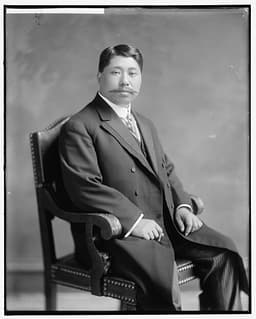
Huang Xing
General · Modern
57.5Total
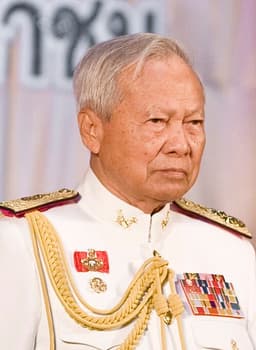
Prem Tinsulanonda
General · Modern
57.2Total
Basic Information
Born
1874
1920
Died
1916
—
Era
Modern
Modern
Nationality
China
Thailand
Occupation
General
General
Civilization
Eastern
Eastern
Score Comparison
Military (10%)
46.7
50.0
Political (20%)
53.8
59.3
Influence (20%)
62.0
54.9
Legacy (20%)
56.0
47.5
Leadership (15%)
62.0
78.0
Strategy (15%)
60.0
60.0
TOTAL
57.5
57.2
Huang Xing — Complete Timeline
1905 AD
Co-founded the TongmenghuiPolitical Action◆ Major
Huang Xing co-founded the Tongmenghui (Revolutionary Alliance) in Tokyo with Sun Yat-sen. He became its military leader, organizing armed uprisings against the Qing dynasty.
TongmenghuiRevolutionMilitary
Impact: nationalconstructive
1911 AD
Led the Wuchang UprisingWar
Huang Xing led the Wuchang Uprising, which sparked the Xinhai Revolution. He commanded revolutionary forces against Qing troops, securing initial victories that led to the dynasty's collapse.
Xinhai RevolutionUprisingMilitary
Impact: nationalconstructive
1912 AD
Served as Minister of War in the RepublicPolitical Action◆ Major
Huang Xing served as Minister of War in the provisional government of the Republic of China. He worked to organize a national army and defend the republic against counter-revolutionary forces.
GovernmentMilitaryRepublic
Impact: nationalconstructive
1913 AD
Led the Second Revolution Against Yuan ShikaiWar◆ Major
Huang Xing led the Second Revolution, an armed uprising against President Yuan Shikai's authoritarian rule. The rebellion failed due to lack of coordination and military inferiority, forcing Huang into exile.
Second RevolutionYuan ShikaiExile
Impact: nationaltragic
1916 AD
Died in Exile in ShanghaiPolitical Action
Huang Xing died in Shanghai after returning from exile in Japan and the United States. His death marked the loss of a key military leader of the Chinese revolution, though his legacy endured.
DeathExileRevolution
Impact: nationaltragic
Prem Tinsulanonda — Complete Timeline
1980 AD
Appointed Prime Minister after a coupPolitical Action◆ Major
Prem Tinsulanonda was appointed Prime Minister of Thailand by the military after a coup. He served for over eight years, overseeing a period of political stability and economic growth.
Prime MinisterMilitary RuleStability
Impact: national
1981 AD
Survived a coup attemptPolitical Action◆ Major
Prem survived a coup attempt by military officers loyal to the 'Young Turks' faction. The coup failed due to lack of support and the loyalty of key military units, allowing Prem to remain in power.
Coup AttemptPolitical CrisisMilitary
Impact: national
1988 AD
Resigned as Prime MinisterPolitical Action◆ Major
Prem resigned as Prime Minister after the general election, handing over power to a civilian government led by Chatichai Choonhavan. His resignation marked a rare peaceful transition of power in Thai politics.
ResignationDemocratic TransitionPeaceful
Impact: nationalconstructive
2016 AD
Appointed Regent of ThailandPolitical Action
After the death of King Bhumibol, Prem was appointed Regent of Thailand until the ascension of King Maha Vajiralongkorn. He served as a key figure in the transition of the monarchy.
RegentMonarchyTransition
Impact: national
Expert Analysis
Huang Xing vs Prem Tinsulanonda
# The General and the Statesman: Prem Tinsulanonda and Huang Xing in the Shadow of Revolution
On an autumn morning in 1981, Prem Tinsulanonda sat in his Bangkok office as tanks rumbled toward the capital. A coup was unfolding—led by the very "Young Turks" who had helped install him a year earlier. Across the decades, another general faced his own reckoning: Huang Xing, in 1913, watching his Second Revolution crumble against the overwhelming forces of Yuan Shikai, his dream of a democratic China slipping away. One man would survive to become a revered regent; the other would die in exile, his name half-forgotten. What made the difference? The answer lies not in the clash of arms, but in the quieter battles of character, timing, and the elusive art of political survival.
Origins
Prem Tinsulanonda was born in 1920 in Songkhla, southern Thailand, into a family of modest means but deep loyalty to the monarchy. The son of a schoolteacher, he grew up in a kingdom that had never been colonized, where the Chakri dynasty provided a stable center of gravity. His education at the Chulachomklao Royal Military Academy instilled in him a reverence for hierarchy and order. Huang Xing, born in 1874 in Hunan, China, came of age in a collapsing empire. The Qing Dynasty was rotting from within, humiliated by foreign powers. Where Prem saw a nation to defend, Huang saw a civilization to rebuild from ash. Huang’s early studies in Japan exposed him to revolutionary ideas, and he returned to China with a burning conviction: the Manchu monarchy must fall.
Rise to Power
Prem’s ascent was methodical, a slow climb through the ranks of the Thai army. By 1980, when a coup ousted the civilian government, the military turned to him—a general known for his integrity and ties to King Bhumibol. He was not a revolutionary; he was a stabilizer. Huang Xing’s rise was explosive. In 1905, he co-founded the Tongmenghui in Tokyo alongside Sun Yat-sen, becoming the movement’s military architect. His moment came in 1911 when he led the Wuchang Uprising, a desperate gamble that, against all odds, toppled the Qing. Huang was the sword of the revolution; Prem was the shield of the establishment.
Leadership & Governance
As prime minister from 1980 to 1988, Prem governed with a light hand. He survived the 1981 coup attempt not by crushing his enemies, but by outwaiting them—the coup failed because the military, and crucially the monarchy, withdrew support. His political wisdom lay in knowing when to yield. He legalized labor unions, encouraged foreign investment, and, in 1988, resigned after a free election, handing power to a civilian government. Huang Xing, as Minister of War in 1912, faced an impossible task: building a national army from scratch while Yuan Shikai maneuvered to destroy the republic. Huang was a brilliant battlefield commander but a poor political tactician. He trusted too much in loyalty, too little in alliances. Where Prem played the long game, Huang fought every battle as if it were the last.
Triumph & Tragedy
Prem’s greatest triumph was his survival. He navigated coups, economic crises, and the delicate politics of a monarchy in transition. In 2016, after King Bhumibol’s death, he was appointed regent—the ultimate symbol of trust. Huang’s triumph was the Wuchang Uprising, a spark that lit a revolution. But his tragedy was the Second Revolution of 1913, a premature rebellion that ended in rout. He fled to Japan, then the United States, and died in Shanghai in 1916 at age 42, broken and in exile. Prem died in old age, surrounded by honor; Huang died young, his body worn out by defeat.
Character & Destiny
Prem was a man of patience and restraint. He once said, "A leader must know when to step forward and when to step back." His personality was a mirror of Thailand’s political culture: hierarchical, cautious, and deferential to the crown. Huang Xing was impulsive and passionate. His friend Sun Yat-sen called him "the soul of the revolution." But that soul burned too bright. Huang’s willingness to risk everything—his health, his family, his life—made him a hero but also a martyr. Prem’s destiny was shaped by a stable state; Huang’s by a shattered one.
Legacy
Today, Prem is remembered as a pillar of Thailand’s modern stability, a general who chose democracy over dictatorship. His legacy is the peaceful transition of power. Huang Xing is a footnote in China’s revolutionary history, overshadowed by Sun Yat-sen and later by Mao Zedong. Yet his role was indispensable. Without Huang, there might have been no Republic of China. One man built a bridge; the other lit a fire.
Conclusion
Standing at the crossroads of revolution and stability, Prem Tinsulanonda and Huang Xing embody two faces of leadership in turbulent times. Prem’s story whispers that survival is a form of victory; Huang’s cries out that some victories are only visible in defeat. In the end, the difference between them was not courage or intelligence—it was the soil in which they were planted. One grew in a kingdom that endured; the other in an empire that fell. Both were generals. Only one became a statesman.
Rankings
🥇
Huang XingLeader
Mil: 46.7Pol: 53.8Inf: 62.0
57.5
🥈
Prem Tinsulanonda
Mil: 50.0Pol: 59.3Inf: 54.9
57.2
+0.3 behind
How This Comparison Works
Algorithm
Each figure is scored on 6 dimensions (0—100 scale) based on structured historical data: Military (10%), Political (20%), Influence (20%), Legacy (20%), Leadership (15%), Strategy (15%). The weighted total produces the final ranking.
Data Sources
Scores are computed from structured sub-indicators in the database. Scale factors adjust for era (Ancient ×0.85, Modern ×1.0) and civilization size (Eastern ×1.05, Other ×0.80) to account for differences in population and military scale.
Maximum 3 Figures
Comparisons are limited to 2—3 figures to ensure readability and statistical meaningfulness.
Error Margins
±5 points per dimension — Sub-scores are derived from historical records with inherent uncertainty. Two figures within 5 points on a dimension should be considered roughly equivalent in that area.
Total Score Accuracy
±3 points overall — The weighted combination of 6 dimensions produces a total score with approximately ±3 points of uncertainty. Differences of less than 3 points are not statistically significant— the figures are effectively tied.
Known Limitations
- Historical records are incomplete and uneven across civilizations
- Figures from oral-tradition societies may be underrepresented
- Occupation labels can misclassify multi-role figures
- Scores measure capability and impact, not moral character
- Quantitative scoring is a comparison tool, not absolute truth
Capability Radar
Military (10%) — Battles & Warfare
Battles
35
20
Win Rate
30
25
Expansion
20
10
Political (20%) — Governance & Reform
Reform
60
55
Diplomacy
55
60
Economy
30
50
Influence (20%) — Cultural & Global Reach
Cultural
40
30
Global
40
30
Legacy (20%) — Historical Impact
Historical
55
40
Longevity
45
35
Leadership (15%) — Power & Stability
Tenure
40
65
Stability
25
60
Strategy (15%) — Tactics & Innovation
Strategy
45
30
Tactics
40
30
Reform
50
35
Similar Comparisons
Comments & Discussion
数据之眼6/16/2026
拿一个战区司令和一个幕后国务活动家比?维度根本不对等。Huang Xing在辛亥年亲自指挥阳夏保卫战,以仅有的5000临时兵对抗北洋精锐,硬拖到各省光复;Prem则是在1980年代通过国王的“御敕”整合军方派系,没开一枪就压住了政变。一个军功是实打实的血肉,一个是制度内的权谋。把这两者用一个“生存术”标签归拢,说明摘要作者根本没消化原始数据。
Antikythera Ghost6/16/2026
Let’s be clear: Prem was only a “revered regent” because his Thailand had a functioning throne to stabilize around. Huang Xing’s China in 1913 was a crackpot constitutional experiment run by a restored emperor and a wannabe dictator. Prem could survive by playing bureaucratic chess because the board wasn’t on fire. Huang had no same board—Yuan Shikai’s Beiyang Army was the fire itself. So the comparison collapses into a simple truth: one man had a monarchy to protect him, the other had a revolut
铁幕拾荒者6/16/2026
绝不是什么“性格差距”,这是殖民与未殖民的底层范式差异。泰国的军队、国王、文官系统在近代从未被撕裂重组,Prems的整条政治路线是continuity的游戏。而黄兴面对的辛亥革命,本质是一场撕裂、再造、又半途退潮的拓扑突变。他把日本学来的军队编练经验和会党融资术搬到中华民国——一个尚未凝固的政治生态——自然扛不住严整的北洋机器。Prem的成功,是系统没碎;黄兴的失败,是连框架都没有。
Centurion’s Blunt6/16/2026
Prem understood that in Bangkok, the king’s photo on the wall was a more reliable weapon than a tank battalion. Huang Xing, for all his battlefield courage at Wuchang in 1911, never learned the most basic lesson of revolutionary China: that a republic needs more than rifles and a rousing speech—it needs institutions, cash, and a stable chain of command. Prem had all three via the palace; Huang had only a band of idealists and borrowed arms. No contest.
Chronicler58276/16/2026
Prem was a master of playing the long game while Huang was a martyr to the moment. Prem survived the 1981 coup precisely because he knew when to lie low and let the monarchy absorb the shock—he let the Young Turks burn themselves out. Huang, by contrast, charged into the Second Revolution of 1913 without securing the foreign loans or regional warlord alliances he desperately needed. One understood power as endurance; the other, as action. That’s not just temperament—it’s strategic literacy.