Loading...
Huang Xing vs Oscar Mejia Victores
Huang Xing leads by 5.6 pts · 2 figures compared
…
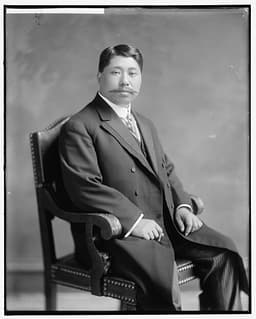
Huang Xing
General · Modern
57.5Total

Oscar Mejia Victores
General · Modern
51.9Total
Basic Information
Born
1874
1930
Died
1916
—
Era
Modern
Modern
Nationality
China
Guatemala
Occupation
General
General
Civilization
Eastern
Western
Score Comparison
Military (10%)
46.7
22.6
Political (20%)
53.8
68.0
Influence (20%)
62.0
50.2
Legacy (20%)
56.0
43.3
Leadership (15%)
62.0
80.0
Strategy (15%)
60.0
41.0
TOTAL
57.5
51.9
Huang Xing — Complete Timeline
1905 AD
Co-founded the TongmenghuiPolitical Action◆ Major
Huang Xing co-founded the Tongmenghui (Revolutionary Alliance) in Tokyo with Sun Yat-sen. He became its military leader, organizing armed uprisings against the Qing dynasty.
TongmenghuiRevolutionMilitary
Impact: nationalconstructive
1911 AD
Led the Wuchang UprisingWar
Huang Xing led the Wuchang Uprising, which sparked the Xinhai Revolution. He commanded revolutionary forces against Qing troops, securing initial victories that led to the dynasty's collapse.
Xinhai RevolutionUprisingMilitary
Impact: nationalconstructive
1912 AD
Served as Minister of War in the RepublicPolitical Action◆ Major
Huang Xing served as Minister of War in the provisional government of the Republic of China. He worked to organize a national army and defend the republic against counter-revolutionary forces.
GovernmentMilitaryRepublic
Impact: nationalconstructive
1913 AD
Led the Second Revolution Against Yuan ShikaiWar◆ Major
Huang Xing led the Second Revolution, an armed uprising against President Yuan Shikai's authoritarian rule. The rebellion failed due to lack of coordination and military inferiority, forcing Huang into exile.
Second RevolutionYuan ShikaiExile
Impact: nationaltragic
1916 AD
Died in Exile in ShanghaiPolitical Action
Huang Xing died in Shanghai after returning from exile in Japan and the United States. His death marked the loss of a key military leader of the Chinese revolution, though his legacy endured.
DeathExileRevolution
Impact: nationaltragic
Oscar Mejia Victores — Complete Timeline
1983 AD
1983 Guatemalan coup d'étatPolitical Action◆ Major
Mejia Victores, then Defense Minister, led a coup that ousted President Efrain Rios Montt. He assumed the presidency, becoming the last military ruler of Guatemala.
CoupMilitary RuleGuatemala
Impact: nationaldestructive
1984 AD
Human rights abuses during his ruleOther◆ Major
During his presidency, Mejia Victores' government continued counterinsurgency operations that resulted in forced disappearances and massacres of indigenous Maya communities, as documented by truth commissions.
Human RightsCivil WarAtrocities
Impact: nationaltragic
1985 AD
Transition to civilian rulePolitical Action
Under pressure, Mejia Victores oversaw the drafting of a new constitution and called for democratic elections. He transferred power to civilian President Vinicio Cerezo in 1986, ending decades of military rule.
DemocratizationConstitutionElection
Impact: nationalconstructive
Expert Analysis
Huang Xing vs Oscar Mejia Victores
# The General Who Gave Up Power and the General Who Could Not Keep It
On a sweltering August morning in 1983, Guatemala’s defense minister, Oscar Mejia Victores, walked into the National Palace and told President Efrain Rios Montt that his time was up. The coup was bloodless, swift, and entirely predictable. Half a world away and seventy-two years earlier, another general—Huang Xing—stood in the chaos of Wuchang, leading students and soldiers against an empire that had ruled China for nearly three centuries. Both men were generals. Both lived through revolutions. But one would become the architect of his nation’s fragile democracy, while the other would die in exile, his republic already a ghost.
What drove these two men down such different paths?
Origins
Oscar Mejia Victores was born in 1930 into a Guatemala still ruled by a military-oligarchic alliance, a country where the army was the state and the state was the army. He came of age during the Cold War, when the United States viewed any reform in Central America as a potential communist beachhead. The military was not just a career; it was the only ladder to power. Mejia learned early that in Guatemala, loyalty to the institution mattered more than ideology.
Huang Xing was born in 1874 in Hunan province, a region of China that had seen the Taiping Rebellion and the humiliation of foreign concessions. His generation grew up watching the Qing Dynasty collapse under its own weight. Educated first in the classics, then in Japan, Huang absorbed the revolutionary ideas of the Meiji Restoration: that a modern nation required a modern army, and that a modern army required officers willing to die for something greater than the emperor.
The difference in their eras was stark. Mejia inherited a functioning state—brutal, corrupt, but intact. Huang inherited a dying empire and a people who had lost faith in every authority.
Rise to Power
Mejia’s path was institutional. He rose through the ranks of Guatemala’s military establishment, serving as defense minister under Rios Montt, a general who had seized power in 1982 and launched a scorched-earth campaign against leftist guerrillas and indigenous villages. When Rios Montt’s erratic behavior alienated both the army and the business elite, Mejia did what generals do: he staged a coup. It was 1983, and he was fifty-three years old. He did not lead a revolution; he corrected a malfunction.
Huang Xing’s rise was the opposite. He co-founded the Tongmenghui in Tokyo in 1905 with Sun Yat-sen, becoming the military arm of a revolutionary movement that had no state, no treasury, and no army—only ideas and courage. When the Wuchang Uprising erupted in October 1911, Huang rushed from Shanghai to take command. He was not a general of a standing army; he was a general of volunteers, students, and defectors. His authority came from his willingness to stand in the front line.
Leadership & Governance
As president of Guatemala from 1983 to 1986, Mejia Victores governed with a steady hand that belied the violence still unfolding in the countryside. His military score of 35.4 reflects a man who did not wage war so much as manage it. His political score of 72.0, however, tells a different story. Under intense domestic and international pressure, he oversaw the drafting of a new constitution and called for democratic elections in 1985. He did not want to leave power—but he did. That is the measure of his leadership.
Huang Xing served as Minister of War in the provisional government of the Republic of China in 1912, but his real test came in 1913, when President Yuan Shikai began dismantling democratic institutions. Huang led the Second Revolution, an armed uprising that failed within months. His military score of 42.1 reflects the limits of revolutionary generalship: he could inspire men to fight, but he could not build a state that would hold. His political score of 62.7 is a testament to his ideals, but also to his inability to translate them into lasting institutions.
Triumph & Tragedy
Mejia’s greatest moment was the 1985 election. He did not win it; he allowed it. For a man raised in a system where power was taken, not given, this was an act of political maturity rare in Latin American history. His tragedy is that the transition came at a terrible cost—the human rights abuses of his rule, the forced disappearances, the silence of a society too afraid to speak.
Huang Xing’s greatest moment was the Wuchang Uprising itself. He commanded men who had no uniforms, no training, and no reason to believe they could win—and they did. The Qing Dynasty fell. A republic was born. His tragedy is that he lived long enough to see it die. Yuan Shikai crushed the Second Revolution, dissolved parliament, and declared himself emperor. Huang fled to Japan and then to the United States, returning to Shanghai only to die in 1916 at the age of forty-two. He was a founder who outlived his creation.
Character & Destiny
Mejia Victores was a pragmatist. He understood that the Cold War was ending, that Guatemala could no longer afford its isolation, and that the army’s survival depended on making peace with democracy. He was not a visionary; he was a manager who saw the writing on the wall. His leadership score of 72.0 reflects a man who knew when to hold power and when to let go.
Huang Xing was a believer. He trusted that revolution would purify China, that democracy would follow the fall of the monarchy, that men like Yuan Shikai would honor their oaths. He was wrong. His strategy score of 57.6 reflects a man who could win battles but not campaigns—who could inspire insurrection but not build institutions. He died believing he had failed.
Legacy
Mejia Victores is remembered today as the last military ruler of Guatemala—a transitional figure, neither hero nor monster. The democracy he helped create has survived, though it remains fragile. His legacy score of 59.5 captures this ambiguity: he is not celebrated, but he is not erased.
Huang Xing is remembered as a founding father of the Chinese Republic, a martyr to the cause of democracy. In Taiwan and among overseas Chinese, his name is honored. In mainland China, he is a footnote to Sun Yat-sen. His legacy score of 66.6 reflects a man who mattered deeply but whose vision was overtaken by history.
Conclusion
The difference between these two generals is not one of courage or intelligence. It is a difference of timing and circumstance. Mejia Victores inherited a state that could be reformed; Huang Xing inherited an empire that had to be destroyed. One gave up power because the world demanded it; the other fought for power because the world needed it. In the end, the general who stepped aside is remembered as a pragmatist, and the general who died fighting is remembered as a patriot. Perhaps both were right, in their own time.
Rankings
🥇
Huang XingLeader
Mil: 46.7Pol: 53.8Inf: 62.0
57.5
🥈
Oscar Mejia Victores
Mil: 22.6Pol: 68.0Inf: 50.2
51.9
+5.6 behind
How This Comparison Works
Algorithm
Each figure is scored on 6 dimensions (0—100 scale) based on structured historical data: Military (10%), Political (20%), Influence (20%), Legacy (20%), Leadership (15%), Strategy (15%). The weighted total produces the final ranking.
Data Sources
Scores are computed from structured sub-indicators in the database. Scale factors adjust for era (Ancient ×0.85, Modern ×1.0) and civilization size (Eastern ×1.05, Other ×0.80) to account for differences in population and military scale.
Maximum 3 Figures
Comparisons are limited to 2—3 figures to ensure readability and statistical meaningfulness.
Error Margins
±5 points per dimension — Sub-scores are derived from historical records with inherent uncertainty. Two figures within 5 points on a dimension should be considered roughly equivalent in that area.
Total Score Accuracy
±3 points overall — The weighted combination of 6 dimensions produces a total score with approximately ±3 points of uncertainty. Differences of less than 3 points are not statistically significant— the figures are effectively tied.
Known Limitations
- Historical records are incomplete and uneven across civilizations
- Figures from oral-tradition societies may be underrepresented
- Occupation labels can misclassify multi-role figures
- Scores measure capability and impact, not moral character
- Quantitative scoring is a comparison tool, not absolute truth
Capability Radar
Military (10%) — Battles & Warfare
Battles
35
10
Win Rate
30
10
Expansion
20
5
Political (20%) — Governance & Reform
Reform
60
55
Diplomacy
55
50
Economy
30
30
Influence (20%) — Cultural & Global Reach
Cultural
40
15
Global
40
15
Legacy (20%) — Historical Impact
Historical
55
30
Longevity
45
20
Leadership (15%) — Power & Stability
Tenure
40
40
Stability
25
35
Strategy (15%) — Tactics & Innovation
Strategy
45
15
Tactics
40
15
Reform
50
20
Similar Comparisons
Comments & Discussion
No comments yet. Be the first to share your thoughts!