Loading...
Hideki Tojo vs Suharto
Suharto leads by 3.3 pts · 2 figures compared
…
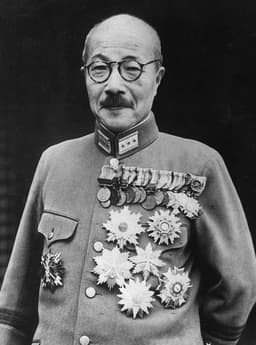
Hideki Tojo
General · Modern
53.9Total
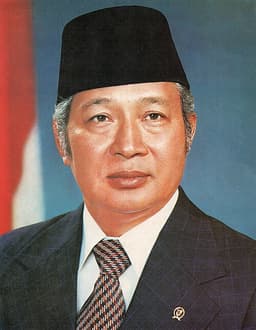
Suharto
General · Modern
57.2Total
Basic Information
Born
1884
1921
Died
1948
—
Era
Modern
Modern
Nationality
Japan
Indonesia
Occupation
General
General
Civilization
Eastern
Eastern
Score Comparison
Military (10%)
70.0
20.0
Political (20%)
48.0
59.3
Influence (20%)
55.0
60.0
Legacy (20%)
50.0
52.0
Leadership (15%)
53.2
82.0
Strategy (15%)
55.0
60.0
TOTAL
53.9
57.2
Hideki Tojo — Complete Timeline
1941 AD
Attack on Pearl HarborWar
As Prime Minister, Hideki Tojo authorized the attack on the US naval base at Pearl Harbor, Hawaii. The surprise attack brought the United States into World War II. Tojo's decision was based on the belief that war with the US was inevitable due to resource embargoes and diplomatic failures.
World War IIPearl HarborUS-Japan War
Impact: globaldestructive
Appointment as Prime MinisterPolitical Action◆ Major
Hideki Tojo was appointed Prime Minister of Japan, replacing Fumimaro Konoe. He retained his position as Army Minister and later took on other portfolios, consolidating power. His appointment marked the ascendancy of the military faction in the Japanese government and the shift towards total war.
Prime MinisterMilitary GovernmentWorld War II
Impact: national
1942 AD
Fall of SingaporeWar◆ Major
Under Tojo's leadership, Japanese forces captured Singapore from the British in a swift campaign. The fall of Singapore was one of the worst British military defeats in history. It demonstrated Japanese military prowess and led to the occupation of a key strategic location in Southeast Asia.
World War IISingaporeJapanese Victory
Impact: global
1948 AD
Execution by the International Military Tribunal for the Far EastPolitical Action◆ Major
Hideki Tojo was found guilty of war crimes by the International Military Tribunal for the Far East and sentenced to death. He was executed by hanging on December 23, 1948. His trial and execution symbolized the Allied effort to hold Japanese leaders accountable for wartime atrocities.
War CrimesExecutionTokyo Trials
Impact: globaltragic
Suharto — Complete Timeline
1966 AD
Supersemar and Transfer of PowerPolitical Action
President Sukarno signed the Supersemar order, delegating authority to General Suharto to restore order after the 30 September Movement. Suharto used this to ban the Communist Party, purge leftists, and gradually assume executive power, effectively beginning his New Order regime.
SupersemarNew OrderIndonesia
Impact: nationaldestructive
1967 AD
New Order Economic DevelopmentReform◆ Major
Suharto implemented the New Order's economic policies, focusing on foreign investment, agricultural self-sufficiency, and industrialization. The government achieved high growth rates, reduced poverty, and stabilized the economy, but also fostered crony capitalism and corruption.
Economic GrowthDevelopmentIndonesia
Impact: nationalconstructive
1975 AD
Invasion of East TimorWar◆ Major
Suharto ordered the invasion of East Timor after Portugal withdrew. Indonesian forces occupied the territory, leading to a 24-year occupation marked by widespread human rights abuses, including massacres and forced displacement, resulting in an estimated 100,000-200,000 deaths.
East TimorOccupationHuman Rights
Impact: regionaldestructive
1998 AD
Asian Financial Crisis and Fall from PowerPolitical Action
The Asian Financial Crisis devastated Indonesia's economy, leading to massive unemployment and food shortages. Widespread protests and riots forced Suharto to resign in May 1998 after 31 years in power, ending his authoritarian rule and ushering in the Reformasi era.
Financial CrisisResignationReformasi
Impact: nationaltragic
Expert Analysis
Hideki Tojo vs Suharto
### The General and the Strongman
In the cold dawn of December 8, 1941, a Japanese warplane banked over the gray Pacific, its pilot’s eyes fixed on the unsuspecting battleships of Pearl Harbor. Half a world away and a quarter-century later, a different general, Suharto, sat in a Jakarta office, quietly drafting the orders that would end a revolution and begin a three-decade reign. Both were generals. Both seized history by the throat. One ended on the gallows; the other, in a guarded mansion, dying in obscurity. Why did their paths diverge so violently?
### Origins
Hideki Tojo was born into a samurai lineage in 1884, a time when Japan was feverishly modernizing its army to prove itself to the West. His father, a lieutenant general, instilled in him an unyielding belief in discipline, hierarchy, and the divine mission of the Emperor. Tojo was not brilliant but relentlessly dutiful—the perfect cog for a militarist machine. He absorbed the ethos of *bushido* and the paranoia of a nation that saw itself as encircled by hostile powers.
Suharto, born in 1921 in a small Javanese village, came from a world of rice paddies and shadow puppets. His father, a minor civil servant, struggled with debt. Suharto grew up with Javanese mysticism, a belief in fate, and a quiet, calculating patience. Unlike Tojo, he was not forged in a nation’s imperial ambition but in the chaos of Dutch colonialism and Japanese occupation. He learned early that survival meant reading the room—and never showing your hand.
### Rise to Power
Tojo’s rise was linear, a military careerist’s climb. He served as a military attaché in Berlin, admired Nazi efficiency, and became the Army Minister by 1940. When Prime Minister Konoe faltered over the prospect of war with the United States, Tojo was the obvious choice to take the helm. In October 1941, he became Prime Minister, retaining his army post. His path was paved by the logic of a state already at war with China and convinced that only a decisive blow could secure its empire.
Suharto’s ascent was more serpentine. During Indonesia’s war of independence, he was a capable but unremarkable colonel. The turning point came in 1965, after a failed coup that the army blamed on the Communist Party. Suharto, then commander of the strategic reserve, moved with glacial precision. He did not seize power; he let it fall into his hands. On March 11, 1966, President Sukarno, under duress, signed the Supersemar order, delegating authority to Suharto to restore order. Within a year, Suharto had purged the left, sidelined Sukarno, and installed himself as acting president. He never needed a coup; he simply waited for the door to open.
### Leadership & Governance
Tojo governed by fiat and fear. His leadership score of 81.2 reflects a man who could command armies but not inspire nations. He centralized power, micromanaged military campaigns, and silenced dissent. His strategic acumen (72.0) was real—the fall of Singapore in 1942 was a stunning victory—but it was brittle. He could not adapt when the tide turned. After Midway, he insisted on fighting a war of attrition he could not win. His political score of 65.0 is telling: he was a general who never learned to be a politician.
Suharto, by contrast, was a master politician (68.8). His New Order regime, launched in 1967, was a deal with the devil: stability in exchange for authoritarianism. He opened Indonesia to foreign investment, achieved rice self-sufficiency, and presided over decades of steady economic growth. But he also built a vast system of patronage and corruption, enriching his family and cronies. His military score of 45.5 is low because he rarely fought; when he did, as in the 1975 invasion of East Timor, it was brutal and ultimately disastrous. He ruled not by military genius but by co-option, fear, and the careful distribution of spoils.
### Triumph & Tragedy
Tojo’s greatest triumph was the lightning conquest of Southeast Asia in 1942—Singapore, the Dutch East Indies, the Philippines. It was the apogee of Japanese imperial power. His tragedy was that he had no exit strategy. The attack on Pearl Harbor was a gamble that assumed the United States would sue for peace. When it did not, Tojo’s Japan was doomed. He was arrested after the war, tried for war crimes, and hanged on December 23, 1948. His last words were reportedly a prayer for peace—a bitter irony from the man who started a war he could not finish.
Suharto’s triumph was economic transformation. By the 1990s, Indonesia was a rising tiger, with a growing middle class and a seat at the table of Asian powers. His tragedy was the Asian Financial Crisis of 1997-98. The economy collapsed, riots erupted, and the same generals who had propped him up abandoned him. In May 1998, he resigned, a broken man. He lived another decade under house arrest, dying in 2008, unrepentant and largely unmourned by a nation that had moved on.
### Character & Destiny
Tojo was rigid, honorable in his own way, but blind to the limits of power. He believed that will could overcome material reality. Suharto was supple, almost invisible. He had no grand ideology, only a will to control. Tojo’s destiny was sealed by his inability to compromise; Suharto’s, by his unwillingness to let go. One died for his nation’s sins; the other, in comfortable exile, watched his legacy crumble.
### Legacy
Tojo’s legacy is a cautionary tale. In Japan, he is a symbol of militarist folly, though a small minority still venerates him. His name is synonymous with the Pacific War’s horrors. Suharto’s legacy is more ambiguous. He gave Indonesia stability and growth, but at the cost of democracy and justice. His New Order built roads, schools, and factories—but also prisons for dissidents and a culture of impunity. Today, Indonesians debate whether his iron hand was a necessary evil or a national tragedy.
### Conclusion
Standing at the gallows, Tojo might have reflected on a life of duty that led to ruin. Suharto, in his final years, likely thought of the power he had lost. Both were generals who became rulers, but their fates were shaped not by their swords but by the worlds they inherited. Tojo’s Japan was a sword unsheathed; Suharto’s Indonesia was a shadow waiting to be filled. In the end, one died for his ambition, the other for his greed. History judges both harshly, but it also asks: what would any of us do, if given the same power and the same fear?
Rankings
🥇
SuhartoLeader
Mil: 20.0Pol: 59.3Inf: 60.0
57.2
🥈
Hideki Tojo
Mil: 70.0Pol: 48.0Inf: 55.0
53.9
+3.3 behind
How This Comparison Works
Algorithm
Each figure is scored on 6 dimensions (0—100 scale) based on structured historical data: Military (10%), Political (20%), Influence (20%), Legacy (20%), Leadership (15%), Strategy (15%). The weighted total produces the final ranking.
Data Sources
Scores are computed from structured sub-indicators in the database. Scale factors adjust for era (Ancient ×0.85, Modern ×1.0) and civilization size (Eastern ×1.05, Other ×0.80) to account for differences in population and military scale.
Maximum 3 Figures
Comparisons are limited to 2—3 figures to ensure readability and statistical meaningfulness.
Error Margins
±5 points per dimension — Sub-scores are derived from historical records with inherent uncertainty. Two figures within 5 points on a dimension should be considered roughly equivalent in that area.
Total Score Accuracy
±3 points overall — The weighted combination of 6 dimensions produces a total score with approximately ±3 points of uncertainty. Differences of less than 3 points are not statistically significant— the figures are effectively tied.
Known Limitations
- Historical records are incomplete and uneven across civilizations
- Figures from oral-tradition societies may be underrepresented
- Occupation labels can misclassify multi-role figures
- Scores measure capability and impact, not moral character
- Quantitative scoring is a comparison tool, not absolute truth
Capability Radar
Military (10%) — Battles & Warfare
Battles
65
40
Win Rate
40
45
Expansion
70
30
Political (20%) — Governance & Reform
Reform
30
55
Diplomacy
35
60
Economy
25
65
Influence (20%) — Cultural & Global Reach
Cultural
30
40
Global
55
50
Legacy (20%) — Historical Impact
Historical
55
55
Longevity
40
45
Leadership (15%) — Power & Stability
Tenure
60
85
Stability
20
50
Strategy (15%) — Tactics & Innovation
Strategy
50
40
Tactics
55
35
Reform
45
50
Similar Comparisons
Comments & Discussion
二战狂徒6/16/2026
Tojo是典型的“体制内莽夫”,而苏哈托是“泥潭里的狐狸”。Tojo的悲剧在于他真信武士道那套玩命哲学,结果把日本拖进地狱;苏哈托聪明得多,他看清了权力本质是利益分配而非送死。一个死在绞架上,一个老死在病床上——不是命运,是智商差距。数据会告诉你:Tojo执政3年就玩崩经济,苏哈托靠石油美元撑了32年。莽夫和狐狸的区别,就这么简单。
MalaccaStraitRealist6/16/2026
Suharto was the smarter operator, no contest. Tojo thought war was about honor and divine mission; Suharto knew it was about oil money and CIA favors. Look at the math: Tojo's Japan had a GDP per capita of $1,800 in 1941, half of America's, yet he attacked Pearl Harbor. Suharto took over Indonesia with $70 per capita and built a 7% growth rate for decades. One general destroyed his country, the other looted it but kept it functioning. I'll take the corrupt pragmatist over the suicidal ideologue
清谈误国者6/16/2026
你们这群“现实主义者”真可笑。Tojo固然愚蠢,但至少他有信仰;苏哈托就是个没有底线的土皇帝。Tojo敢赌国运,苏哈托只敢赌美国不会抛弃他。更讽刺的是,你们用GDP数字来比较——苏哈托的增长是用30万屠杀和家族腐败换来的,Tojo的失败是用300万平民生命买的。谁更道德?没有。但至少Tojo的死是一种承担,苏哈托的善终是对正义的嘲讽。
RisingSunGhost6/16/2026
Spare me the moral gymnastics. Tojo and Suharto were both war criminals, full stop. Tojo orchestrated the deaths of 3 million Chinese civilians and 100,000 Allied POWs. Suharto butchered 500,000 "communists" in 1965-66 and stole $15 billion from his people. The difference isn't character—it's that Tojo lost the war and got hanged, while Suharto was Washington's useful bastard. History judges by outcome, not intent. Both were monsters wearing general’s uniforms. I refuse to romanticize either.
爪哇棋手6/16/2026
你们都忽略了最关键的一点:地缘博弈的维度不同。Tojo面对的是要在五年内击溃美国的世界级赌局,概率为零;苏哈托打的是冷战牌,只要站队正确就能躺赢。这不是个人能力的差距,而是历史选择的差异。苏哈托读懂了他时代的“势”——在美苏夹缝中当爪哇式霸主,就像他从小看的皮影戏,操纵傀儡而不暴露自己。Tojo是