Loading...
Hideki Tojo vs Ranoji Scindia
Ranoji Scindia leads by 3.1 pts · 2 figures compared
…
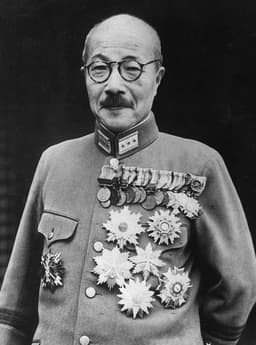
Hideki Tojo
General · Modern
53.9Total
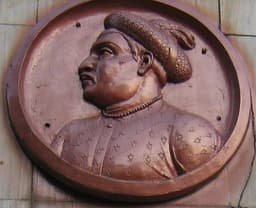
Ranoji Scindia
General · Modern
57.0Total
Basic Information
Born
1884
1700
Died
1948
1745
Era
Modern
Modern
Nationality
Japan
India
Occupation
General
General
Civilization
Eastern
Indian
Score Comparison
Military (10%)
70.0
50.0
Political (20%)
48.0
54.7
Influence (20%)
55.0
58.0
Legacy (20%)
50.0
54.0
Leadership (15%)
53.2
65.0
Strategy (15%)
55.0
60.0
TOTAL
53.9
57.0
Hideki Tojo — Complete Timeline
1941 AD
Attack on Pearl HarborWar
As Prime Minister, Hideki Tojo authorized the attack on the US naval base at Pearl Harbor, Hawaii. The surprise attack brought the United States into World War II. Tojo's decision was based on the belief that war with the US was inevitable due to resource embargoes and diplomatic failures.
World War IIPearl HarborUS-Japan War
Impact: globaldestructive
Appointment as Prime MinisterPolitical Action◆ Major
Hideki Tojo was appointed Prime Minister of Japan, replacing Fumimaro Konoe. He retained his position as Army Minister and later took on other portfolios, consolidating power. His appointment marked the ascendancy of the military faction in the Japanese government and the shift towards total war.
Prime MinisterMilitary GovernmentWorld War II
Impact: national
1942 AD
Fall of SingaporeWar◆ Major
Under Tojo's leadership, Japanese forces captured Singapore from the British in a swift campaign. The fall of Singapore was one of the worst British military defeats in history. It demonstrated Japanese military prowess and led to the occupation of a key strategic location in Southeast Asia.
World War IISingaporeJapanese Victory
Impact: global
1948 AD
Execution by the International Military Tribunal for the Far EastPolitical Action◆ Major
Hideki Tojo was found guilty of war crimes by the International Military Tribunal for the Far East and sentenced to death. He was executed by hanging on December 23, 1948. His trial and execution symbolized the Allied effort to hold Japanese leaders accountable for wartime atrocities.
War CrimesExecutionTokyo Trials
Impact: globaltragic
Ranoji Scindia — Complete Timeline
1726 AD
Appointed Subedar of MalwaPolitical Action◆ Major
Ranoji Scindia was appointed as the Maratha subedar of Malwa by Peshwa Baji Rao I. This gave him control over a large territory and laid the foundation for the Scindia dynasty of Gwalior.
Maratha EmpireMalwaScindia Dynasty
Impact: regionalconstructive
1737 AD
Battle of DelhiWar◆ Major
Ranoji Scindia participated in the Maratha raid on Delhi under Baji Rao I. The attack on the Mughal capital demonstrated Maratha power and led to the extraction of tribute.
Maratha-Mughal WarsDelhiRaid
Impact: national
1739 AD
Battle of VasaiWar
Ranoji Scindia fought alongside Malhar Rao Holkar in the siege of Vasai against the Portuguese. The victory ended Portuguese control in the Konkan region.
Maratha-Portuguese WarsSiegeKonkan
Impact: regional
1740 AD
Founded Gwalior as CapitalPolitical Action◆ Major
Ranoji Scindia established his capital at Gwalior, fortifying the Gwalior Fort and building a palace. This city became the center of Scindia power for over a century.
FoundingGwaliorScindia Dynasty
Impact: regionalconstructive
1745 AD
Death in BattleWar
Ranoji Scindia was killed in a battle against the Nizam of Hyderabad's forces near the Narmada River. His death occurred during a Maratha campaign to expand into the Deccan.
DeathBattleMaratha-Nizam Wars
Impact: regionaltragic
Expert Analysis
Hideki Tojo vs Ranoji Scindia
# The General's Gambit: Hideki Tojo and Ranoji Scindia
On a December morning in 1941, Hideki Tojo stood before the Japanese Diet and declared war on the United States, setting in motion a conflict that would consume the Pacific and seal his own fate. Exactly two centuries earlier, in 1740, Ranoji Scindia climbed the steep slopes of Gwalior Fort, claiming a rocky citadel that would become the seat of a dynasty lasting generations. Both men were generals who rose to supreme power in times of imperial crisis. One would die by the hangman’s noose, the other in battle. Why did their paths diverge so dramatically?
Origins
Hideki Tojo was born in 1884 into a samurai family that had served the Japanese emperor for centuries. His father, a lieutenant general in the Imperial Army, instilled in him a rigid sense of duty and a belief that Japan’s destiny lay in military expansion. Tojo grew up in an era when Japan was rapidly modernizing after the Meiji Restoration, catching up with Western powers through industrialization and imperial conquest. The values of *bushido*—loyalty, honor, self-sacrifice—were drilled into him from childhood.
Ranoji Scindia entered the world in 1700, a time when the Mughal Empire was crumbling and the Maratha Confederacy was rising to fill the vacuum. He belonged to the Kunbi farming caste, not the traditional warrior aristocracy. His family had served the Maratha Peshwas (prime ministers) as humble retainers. Unlike Tojo, who inherited a military tradition, Ranoji had to earn his place through sheer competence and loyalty.
Rise to Power
Tojo’s ascent was methodical. He graduated from the Imperial Japanese Army Academy and later from the Army War College, earning a reputation as a stern, efficient staff officer. By the 1930s, Japan was ruled by a fragile coalition of civilian politicians and military factions. Tojo aligned himself with the radical *Kodo-ha* (Imperial Way) faction, which advocated aggressive expansion into China and the Pacific. In 1941, when Emperor Hirohito and the civilian cabinet hesitated to attack the United States, Tojo was appointed Prime Minister precisely because he was seen as strong enough to force a decision. He took the premiership while retaining his post as Army Minister, concentrating both political and military power in his hands.
Ranoji Scindia’s rise followed a different logic. He caught the eye of Peshwa Baji Rao I, the brilliant Maratha commander who was then carving out an empire from the ruins of Mughal authority. In 1726, Baji Rao appointed Ranoji as Subedar (governor) of Malwa, a vast territory in central India. This was not a reward for birth or political maneuvering, but a calculated gamble: Baji Rao needed loyal, capable deputies to hold conquered lands while he campaigned elsewhere. Ranoji proved his worth by consolidating Maratha control over Malwa, extracting tribute from local chieftains, and expanding the Peshwa’s influence.
Leadership & Governance
Tojo governed Japan with an iron fist. He centralized power under the military, suppressed dissent through the *Kempeitai* (military police), and pushed through a total mobilization of society for war. His leadership style was bureaucratic and inflexible: he demanded precise obedience to orders and tolerated no deviation. Militarily, he oversaw the spectacular early victories of 1941–1942—the attack on Pearl Harbor, the fall of Singapore in 1942, the conquest of the Philippines. But his strategy was fundamentally flawed. He believed that a devastating blow would force the United States to negotiate, underestimating American industrial capacity and resolve. As the war turned against Japan, Tojo doubled down on austerity and propaganda, refusing to consider surrender until it was too late.
Ranoji Scindia ruled Malwa with a lighter touch. He did not try to impose Maratha culture on conquered populations; instead, he co-opted local elites, collected taxes efficiently, and maintained order through a network of loyal officers. His military campaigns were cautious and defensive—he fought to hold territory, not to conquer for its own sake. At the Battle of Delhi in 1737, he played a supporting role to Baji Rao’s main assault, demonstrating that he understood the limits of his command. At the siege of Vasai in 1739, he cooperated with fellow commander Malhar Rao Holkar to expel the Portuguese, showing a talent for alliance-building that Tojo never mastered.
Triumph & Tragedy
Tojo’s greatest triumph was the fall of Singapore in February 1942, when 80,000 British and Commonwealth troops surrendered to a smaller Japanese force. It was the largest capitulation in British military history and seemed to confirm Tojo’s belief in Japanese invincibility. His greatest tragedy was the slow, grinding defeat that followed: the loss of Guadalcanal, the destruction of the Japanese navy at Midway, the firebombing of Tokyo. Tojo was forced to resign in July 1944, but by then he had already sealed his fate. In 1948, the International Military Tribunal for the Far East found him guilty of war crimes and sentenced him to death. He was hanged, his last words a mumbled apology.
Ranoji Scindia’s triumph was the foundation of Gwalior in 1740. He transformed a fortified hill into a capital, building palaces, temples, and administrative offices that would serve his descendants for centuries. His tragedy came five years later, in 1745, when he was killed in a skirmish against the Nizam of Hyderabad’s forces near the Narmada River. He died not in a grand battle but in a minor engagement, a reminder that even successful generals are subject to the randomness of war. His body was cremated, and his son Mahadji Scindia inherited a stable kingdom.
Character & Destiny
Tojo was a man of rigid ideology. He believed that Japan’s divine mission was to liberate Asia from Western colonialism—a belief that justified aggression, atrocity, and ultimately, national suicide. His personality was that of a martinet: orderly, cold, incapable of doubt. This inflexibility made him effective in the short term but disastrous in the long run. He could not adapt when the war turned against him, and he could not imagine a path to peace that did not involve total victory.
Ranoji Scindia was a pragmatist. He served the Peshwa faithfully, but he also built his own power base, secured his own territory, and ensured his family’s future. He was not driven by ideology but by the practical demands of survival and consolidation. This flexibility allowed him to navigate the treacherous politics of the Maratha Confederacy, where alliances shifted constantly. He died in battle, but his dynasty survived—a testament to his success as a founder.
Legacy
Tojo’s legacy is overwhelmingly negative. In Japan, he is remembered as the man who led the country into a catastrophic war. In the West, he is a symbol of militarism and war crimes. His name is synonymous with the Pacific War’s darkest hours. He left behind no enduring institutions, no philosophy, no school of thought—only ashes and a cautionary tale.
Ranoji Scindia’s legacy is more complex. He founded a dynasty that ruled Gwalior until India’s independence in 1947. The Scindia family became patrons of art, architecture, and education, transforming Gwalior into a center of culture. Ranoji himself is remembered as a capable general and a wise administrator, though his fame is overshadowed by later descendants like Mahadji Scindia and the Maharajas of Gwalior. His story is a reminder that in the fluid world of 18th-century India, a farmer’s son could rise to become a king.
Conclusion
The difference between Tojo and Ranoji is not simply one of scale—a world war versus a regional conflict—but of worldview. Tojo was a product of modern nationalism, with its absolute certainties and total wars. Ranoji was a product of pre-modern statecraft, where power was personal, alliances were fluid, and survival was the ultimate virtue. One sought to remake the world and destroyed himself in the process. The other sought to build a house for his family and succeeded. In the end, the general who thought in terms of empire left a legacy of ruins, while the general who thought in terms of dynasty left a kingdom that outlasted him by two centuries. There is a lesson there, for those who care to read it.
Rankings
🥇
Ranoji ScindiaLeader
Mil: 50.0Pol: 54.7Inf: 58.0
57.0
🥈
Hideki Tojo
Mil: 70.0Pol: 48.0Inf: 55.0
53.9
+3.1 behind
How This Comparison Works
Algorithm
Each figure is scored on 6 dimensions (0—100 scale) based on structured historical data: Military (10%), Political (20%), Influence (20%), Legacy (20%), Leadership (15%), Strategy (15%). The weighted total produces the final ranking.
Data Sources
Scores are computed from structured sub-indicators in the database. Scale factors adjust for era (Ancient ×0.85, Modern ×1.0) and civilization size (Eastern ×1.05, Other ×0.80) to account for differences in population and military scale.
Maximum 3 Figures
Comparisons are limited to 2—3 figures to ensure readability and statistical meaningfulness.
Error Margins
±5 points per dimension — Sub-scores are derived from historical records with inherent uncertainty. Two figures within 5 points on a dimension should be considered roughly equivalent in that area.
Total Score Accuracy
±3 points overall — The weighted combination of 6 dimensions produces a total score with approximately ±3 points of uncertainty. Differences of less than 3 points are not statistically significant— the figures are effectively tied.
Known Limitations
- Historical records are incomplete and uneven across civilizations
- Figures from oral-tradition societies may be underrepresented
- Occupation labels can misclassify multi-role figures
- Scores measure capability and impact, not moral character
- Quantitative scoring is a comparison tool, not absolute truth
Capability Radar
Military (10%) — Battles & Warfare
Battles
65
45
Win Rate
40
50
Expansion
70
55
Political (20%) — Governance & Reform
Reform
30
30
Diplomacy
35
45
Economy
25
35
Influence (20%) — Cultural & Global Reach
Cultural
30
30
Global
55
30
Legacy (20%) — Historical Impact
Historical
55
50
Longevity
40
55
Leadership (15%) — Power & Stability
Tenure
60
40
Stability
20
40
Strategy (15%) — Tactics & Innovation
Strategy
50
45
Tactics
55
40
Reform
45
35
Similar Comparisons
Comments & Discussion
数字侦探6/16/2026
数据不会说谎:1941年日本石油储量仅够维持18个月战争,而美国占全球石油产量60%以上。Tojo要么是孤注一掷的赌徒,要么是不懂基本军事后勤的蠢材。Ranoji Scindia统治期间,瓜廖尔城堡从未被攻破,因为他懂得攻城是消耗战,不是速决战。数据面前,理想主义不堪一击。
SamuraiScrutineer6/16/2026
Tojo's strategic failure wasn't just about Pearl Harbor—it was logistics. He gambled on a knockout blow while ignoring Japan's vulnerability to US industrial power. Ranoji, by contrast, slowly built Gwalior's defenses over a decade, understanding that fortresses aren't won in a day but secured through patience. One was a sprinter, the other a marathon runner. History favors the tortoise.
ClassicalEcho6/16/2026
What separates these two isn't just luck—it's hubris vs pragmatism. Tojo drunk on *bushido* mythos ignored Sun Tzu's maxim to "know your enemy and know yourself." He knew neither. But Ranoji, a farmer's son turned king, embodied the Maratha Kautilyan principle of tailored alliances. He bowed to the Peshwa when needed, fought the Rajputs when profitable. Contextual intelligence—not birth—makes a general.
春秋笔法6/16/2026
Revisionists love to paint Tojo as a tragic victim of Allied propaganda, but I say look at his post-war trial: his own defense admitted he bypassed civilian oversight in 1941. That's not a military genius—that's a coup. Meanwhile, Ranoji Scindia didn't seize power; he earned it through merit, climbing from Kunbi farmer to dynasty founder. One legacy is dictatorship; the other is meritocracy. No ambiguity there.
IronRationHistorian6/16/2026
Tojo's IJA field rations included canned bread and sake—symbolic of an overstretched power playing empire on borrowed time. Ranoji's Maratha armies survived on *bhakri* (millet flatbread) and local *ghee*, sourced from lands they'd pacified. One fed his troops with imported logistics that failed when supply lines snapped; the other literally ate his own backyard. Strategic eating—yeah, I'm making that a thing. Ranoji wins the sustainability war.