Loading...
Afonso de Albuquerque vs Hideki Tojo
Afonso de Albuquerque leads by 25.7 pts · 2 figures compared
…
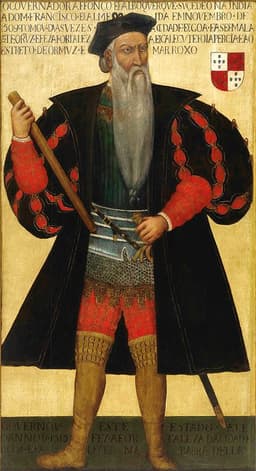
Afonso de Albuquerque
General · Medieval
79.6Total
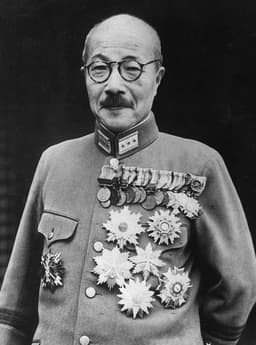
Hideki Tojo
General · Modern
53.9Total
Basic Information
Born
1453
1884
Died
1515
1948
Era
Medieval
Modern
Nationality
Portugal
Japan
Occupation
General
General
Civilization
Western
Eastern
Score Comparison
Military (10%)
77.5
70.0
Political (20%)
88.0
48.0
Influence (20%)
80.0
55.0
Legacy (20%)
75.0
50.0
Leadership (15%)
78.0
53.2
Strategy (15%)
82.0
55.0
TOTAL
79.6
53.9
Afonso de Albuquerque — Complete Timeline
1503 AD
First voyage to IndiaWar◆ Major
Afonso de Albuquerque led a fleet to India, establishing the first Portuguese fort at Cochin. This voyage laid the foundation for Portuguese control of the Indian Ocean trade.
ExplorationColonialismIndia
Impact: global
1510 AD
Conquest of GoaWar◆ Major
Albuquerque captured Goa from the Sultan of Bijapur. He made Goa the capital of Portuguese India, a position it held for over 400 years.
ConquestColonialismIndia
Impact: regional
1511 AD
Conquest of MalaccaWar◆ Major
Albuquerque led a Portuguese fleet to capture the strategic port of Malacca. This gave Portugal control of the spice trade route between the Indian Ocean and the Pacific.
ConquestSpice TradeSoutheast Asia
Impact: global
1513 AD
Siege of AdenWar
Albuquerque attempted to capture Aden in Yemen but failed. This failure prevented Portugal from controlling the entrance to the Red Sea and limited their influence in the region.
SiegeFailureRed Sea
Impact: regional
1515 AD
Death at seaOther◆ Major
Afonso de Albuquerque died at sea off the coast of Goa, possibly from illness or poison. His death left the Portuguese Empire in the Indian Ocean without its most capable leader.
DeathLeadershipEmpire
Impact: regionaltragic
Hideki Tojo — Complete Timeline
1941 AD
Attack on Pearl HarborWar
As Prime Minister, Hideki Tojo authorized the attack on the US naval base at Pearl Harbor, Hawaii. The surprise attack brought the United States into World War II. Tojo's decision was based on the belief that war with the US was inevitable due to resource embargoes and diplomatic failures.
World War IIPearl HarborUS-Japan War
Impact: globaldestructive
Appointment as Prime MinisterPolitical Action◆ Major
Hideki Tojo was appointed Prime Minister of Japan, replacing Fumimaro Konoe. He retained his position as Army Minister and later took on other portfolios, consolidating power. His appointment marked the ascendancy of the military faction in the Japanese government and the shift towards total war.
Prime MinisterMilitary GovernmentWorld War II
Impact: national
1942 AD
Fall of SingaporeWar◆ Major
Under Tojo's leadership, Japanese forces captured Singapore from the British in a swift campaign. The fall of Singapore was one of the worst British military defeats in history. It demonstrated Japanese military prowess and led to the occupation of a key strategic location in Southeast Asia.
World War IISingaporeJapanese Victory
Impact: global
1948 AD
Execution by the International Military Tribunal for the Far EastPolitical Action◆ Major
Hideki Tojo was found guilty of war crimes by the International Military Tribunal for the Far East and sentenced to death. He was executed by hanging on December 23, 1948. His trial and execution symbolized the Allied effort to hold Japanese leaders accountable for wartime atrocities.
War CrimesExecutionTokyo Trials
Impact: globaltragic
Expert Analysis
Afonso de Albuquerque vs Hideki Tojo
### The Conqueror and the Condemned
In the annals of history, two generals stand as bookends to vastly different epochs of imperial ambition. One, a Portuguese nobleman, died at sea in 1515, his body returning to the Indian Ocean he had turned into a Portuguese lake. The other, a Japanese prime minister, faced a hangman’s noose in 1948, his ashes scattered by Allied victors. Afonso de Albuquerque and Hideki Tojo both built empires through blood and strategy, yet one is remembered as a founder, the other as a war criminal. What drove such divergent outcomes? The answer lies not merely in their actions, but in the eras that shaped them and the moral frameworks that judged them.
### Origins
Albuquerque was born in 1453, the year Constantinople fell to the Ottomans—a world where the boundaries between piracy, trade, and holy war were fluid. He came from Portuguese minor nobility, raised in a court obsessed with crusading and spices. The Reconquista had just ended, and Portugal’s kings dreamed of outflanking Islam by sea. Albuquerque absorbed this ethos: a blend of religious zeal, mercantile greed, and ruthless pragmatism. His was an age where a man could carve a kingdom with a sword and a charter.
Tojo was born in 1884, in a Japan hurtling from feudal isolation to industrial empire. His father was a samurai-turned-army officer, and the young Tojo was steeped in the cult of Bushido—but now filtered through modern nationalism. Japan had humiliated China in 1895 and stunned Russia in 1905. Tojo grew up believing that military expansion was Japan’s destiny, and that the West was a hypocritical predator. Unlike Albuquerque, who sailed into a world of fragmented sultanates, Tojo faced a world of rigid nation-states, colonial powers, and emerging international law. That difference would prove fatal.
### Rise to Power
Albuquerque’s path was forged at sea. In 1503, he led his first fleet to India, establishing a fort at Cochin—a toehold that became a springboard. He was not a king’s favorite; he was a commander who delivered results. King Manuel I appointed him Governor of Portuguese India in 1509, but only after Albuquerque had already proven he could capture cities and sink fleets. His rise was meritocratic, driven by audacity and a clear vision: control the choke points of the Indian Ocean trade.
Tojo’s rise was bureaucratic and political. He climbed the ranks of the Imperial Japanese Army, serving as a military attaché in Germany and later as chief of the Kwantung Army’s secret police. He was known as “the Razor” for his sharp, efficient mind. In 1941, with Japan locked in a quagmire in China and facing American oil sanctions, Emperor Hirohito appointed Tojo Prime Minister—replacing the hesitant Fumimaro Konoe. Tojo did not seize power; he was given it precisely because he promised decisive action. Where Albuquerque commanded ships, Tojo commanded a state apparatus already geared for war.
### Leadership & Governance
Albuquerque governed through terror and marriage. After capturing Goa in 1510, he encouraged Portuguese soldiers to marry local women, creating a mixed-race population loyal to Lisbon. He built fortresses, standardized trade passes, and even tried to divert the Nile to starve the Mamluks. His strategy was total: military conquest married to commercial monopoly. He failed at Aden in 1513, but that failure only highlighted his ambition. He was a builder, not merely a destroyer.
Tojo governed through centralized control. He kept his post as Army Minister while serving as Prime Minister, concentrating power in a way that stifled dissent. His leadership was efficient but brittle. The fall of Singapore in 1942 was his greatest triumph—a swift campaign that humiliated the British Empire. But Tojo’s governance could not adapt. He micromanaged the war, ignored naval realities, and suppressed any whisper of negotiation. His regime was a machine that could only accelerate toward destruction. When the tide turned at Midway and Guadalcanal, Tojo had no fallback, no political flexibility.
### Triumph & Tragedy
Albuquerque’s greatest moment was the conquest of Malacca in 1511. With a small fleet, he seized the strategic hub of the spice trade, forever altering global commerce. His tragedy was dying at sea in 1515, possibly poisoned, just as his empire needed his hand. He left a legacy of forts and policies, but also a system that would eventually decay into corruption.
Tojo’s triumph was Pearl Harbor, December 7, 1941—a stunning tactical victory that unified Japan in euphoria. But it was also his tragedy. The attack united America in fury, ensured a war Japan could not win, and ultimately led to the firebombing of Tokyo and the atomic bombs. Tojo’s greatest success contained the seeds of his nation’s annihilation. He resigned in July 1944 after the fall of Saipan, but the machine he built ground on without him.
### Character & Destiny
Albuquerque was audacious, visionary, and cruel by modern standards—but he operated in a world without Geneva Conventions. He burned captured ships and executed prisoners, but he also built hospitals and churches. His character matched his era: a Renaissance man of action, unburdened by guilt, driven by a sense of providential mission.
Tojo was disciplined, patriotic, and narrow. He lacked Albuquerque’s imaginative scope; he was a staff officer who became a warlord. His tragedy was that his virtues—loyalty, decisiveness, sacrifice—were harnessed to a criminal enterprise. The International Military Tribunal for the Far East sentenced him to death in 1948, not for being a general, but for waging aggressive war. Where Albuquerque’s violence was retroactively excused as empire-building, Tojo’s was condemned as a crime against peace.
### Legacy
Albuquerque is remembered as the founder of Portuguese India, a national hero whose statue stands in Lisbon and Goa. His legacy is complex—imperialist, but also a bridge between worlds. Tojo is remembered as a symbol of militarism, his name synonymous with wartime atrocities. In Japan, his legacy is contested; some see him as a scapegoat, others as a villain. His grave is unmarked, his reputation in ruins.
### Conclusion
The difference between these two conquerors is not one of character but of context. Albuquerque built an empire in an age when the strong took what they could, and history applauded the strong. Tojo built an empire in an age when the world had begun to judge the strong by a new standard—one that called aggression a crime. Both men shed blood, both dreamed of glory, but one died in his bed and the other on the gallows. The true lesson is not about good and evil, but about the shifting tides of history, which can turn a conqueror into a founder or a war criminal with equal indifference.
Rankings
🥇
Afonso de AlbuquerqueLeader
Mil: 77.5Pol: 88.0Inf: 80.0
79.6
🥈
Hideki Tojo
Mil: 70.0Pol: 48.0Inf: 55.0
53.9
+25.7 behind
How This Comparison Works
Algorithm
Each figure is scored on 6 dimensions (0—100 scale) based on structured historical data: Military (10%), Political (20%), Influence (20%), Legacy (20%), Leadership (15%), Strategy (15%). The weighted total produces the final ranking.
Data Sources
Scores are computed from structured sub-indicators in the database. Scale factors adjust for era (Ancient ×0.85, Modern ×1.0) and civilization size (Eastern ×1.05, Other ×0.80) to account for differences in population and military scale.
Maximum 3 Figures
Comparisons are limited to 2—3 figures to ensure readability and statistical meaningfulness.
Error Margins
±5 points per dimension — Sub-scores are derived from historical records with inherent uncertainty. Two figures within 5 points on a dimension should be considered roughly equivalent in that area.
Total Score Accuracy
±3 points overall — The weighted combination of 6 dimensions produces a total score with approximately ±3 points of uncertainty. Differences of less than 3 points are not statistically significant— the figures are effectively tied.
Known Limitations
- Historical records are incomplete and uneven across civilizations
- Figures from oral-tradition societies may be underrepresented
- Occupation labels can misclassify multi-role figures
- Scores measure capability and impact, not moral character
- Quantitative scoring is a comparison tool, not absolute truth
Capability Radar
Military (10%) — Battles & Warfare
Battles
85
65
Win Rate
80
40
Expansion
95
70
Political (20%) — Governance & Reform
Reform
80
30
Diplomacy
85
35
Economy
80
25
Influence (20%) — Cultural & Global Reach
Cultural
70
30
Global
85
55
Legacy (20%) — Historical Impact
Historical
85
55
Longevity
80
40
Leadership (15%) — Power & Stability
Tenure
70
60
Stability
65
20
Strategy (15%) — Tactics & Innovation
Strategy
95
50
Tactics
90
55
Reform
75
45
Similar Comparisons
Comments & Discussion
EmpireBuilder6/16/2026
Albuquerque was a strategic genius who understood that naval dominance alone wouldn't secure an empire—he built fortresses and married his soldiers to local women to create a permanent Portuguese presence. Tojo? He was a tactical bureaucrat who micromanaged the Pacific war into disaster, ignoring Yamamoto's warnings about American industrial capacity. One built foundations that lasted centuries; the other burned his empire down through sheer arrogance.
史海钩沉6/16/2026
阿尔布开克是典型的十六世纪"刀尖上的商人",他占领马六甲后不仅收税,还发行统一货币、建立铸币厂,把印度洋变成葡萄牙的专属贸易区。东条英机呢?他连基本的后勤都搞不定,1944年英帕尔战役饿死了几万日军士兵。这就是征服者与屠夫的区别——一个在建立体系,一个在制造坟墓。
DataSkeptic6/16/2026
You're comparing a man who commanded maybe 2,000 Portuguese soldiers at his peak with one who oversaw millions of Japanese troops? That's like comparing a pirate captain to a CEO of a failing corporation. Albuquerque's "empire" was a string of coastal trading posts; Tojo's was a continent-spanning military machine that collapsed under its own logistical impossibility. Scale matters, and context kills these romanticized narratives.
铁血史官6/16/2026
别被西方中心论忽悠了。东条英机执行的是日本军国主义几十年的侵华路线,1937年他就担任关东军参谋长,直接参与策划了全面战争。阿尔布开克虽然也残暴,但至少他晚年写信给国王批评葡萄牙官员的腐败。一个是国家机器下的执行者,一个是个人冒险家,根本不是一个维度的存在。