Loading...
Hideki Tojo vs Prem Tinsulanonda
Prem Tinsulanonda leads by 3.3 pts · 2 figures compared
…
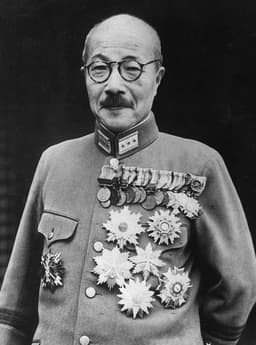
Hideki Tojo
General · Modern
53.9Total
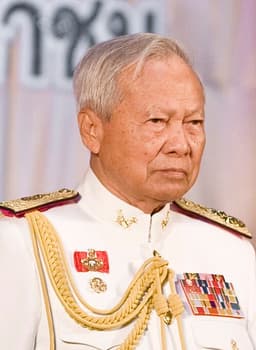
Prem Tinsulanonda
General · Modern
57.2Total
Basic Information
Born
1884
1920
Died
1948
—
Era
Modern
Modern
Nationality
Japan
Thailand
Occupation
General
General
Civilization
Eastern
Eastern
Score Comparison
Military (10%)
70.0
50.0
Political (20%)
48.0
59.3
Influence (20%)
55.0
54.9
Legacy (20%)
50.0
47.5
Leadership (15%)
53.2
78.0
Strategy (15%)
55.0
60.0
TOTAL
53.9
57.2
Hideki Tojo — Complete Timeline
1941 AD
Attack on Pearl HarborWar
As Prime Minister, Hideki Tojo authorized the attack on the US naval base at Pearl Harbor, Hawaii. The surprise attack brought the United States into World War II. Tojo's decision was based on the belief that war with the US was inevitable due to resource embargoes and diplomatic failures.
World War IIPearl HarborUS-Japan War
Impact: globaldestructive
Appointment as Prime MinisterPolitical Action◆ Major
Hideki Tojo was appointed Prime Minister of Japan, replacing Fumimaro Konoe. He retained his position as Army Minister and later took on other portfolios, consolidating power. His appointment marked the ascendancy of the military faction in the Japanese government and the shift towards total war.
Prime MinisterMilitary GovernmentWorld War II
Impact: national
1942 AD
Fall of SingaporeWar◆ Major
Under Tojo's leadership, Japanese forces captured Singapore from the British in a swift campaign. The fall of Singapore was one of the worst British military defeats in history. It demonstrated Japanese military prowess and led to the occupation of a key strategic location in Southeast Asia.
World War IISingaporeJapanese Victory
Impact: global
1948 AD
Execution by the International Military Tribunal for the Far EastPolitical Action◆ Major
Hideki Tojo was found guilty of war crimes by the International Military Tribunal for the Far East and sentenced to death. He was executed by hanging on December 23, 1948. His trial and execution symbolized the Allied effort to hold Japanese leaders accountable for wartime atrocities.
War CrimesExecutionTokyo Trials
Impact: globaltragic
Prem Tinsulanonda — Complete Timeline
1980 AD
Appointed Prime Minister after a coupPolitical Action◆ Major
Prem Tinsulanonda was appointed Prime Minister of Thailand by the military after a coup. He served for over eight years, overseeing a period of political stability and economic growth.
Prime MinisterMilitary RuleStability
Impact: national
1981 AD
Survived a coup attemptPolitical Action◆ Major
Prem survived a coup attempt by military officers loyal to the 'Young Turks' faction. The coup failed due to lack of support and the loyalty of key military units, allowing Prem to remain in power.
Coup AttemptPolitical CrisisMilitary
Impact: national
1988 AD
Resigned as Prime MinisterPolitical Action◆ Major
Prem resigned as Prime Minister after the general election, handing over power to a civilian government led by Chatichai Choonhavan. His resignation marked a rare peaceful transition of power in Thai politics.
ResignationDemocratic TransitionPeaceful
Impact: nationalconstructive
2016 AD
Appointed Regent of ThailandPolitical Action
After the death of King Bhumibol, Prem was appointed Regent of Thailand until the ascension of King Maha Vajiralongkorn. He served as a key figure in the transition of the monarchy.
RegentMonarchyTransition
Impact: national
Expert Analysis
Hideki Tojo vs Prem Tinsulanonda
# The General and the Peacemaker
On a December morning in 1941, Hideki Tojo stood before the Japanese Diet and declared that a state of war existed with the United States, Britain, and the Netherlands. Across the Pacific, in a modest Bangkok home, a twenty-one-year-old Thai army cadet named Prem Tinsulanonda was preparing for a career that would span nearly a century. Neither man could have imagined that their paths, both forged in the crucible of military discipline, would diverge so dramatically—one toward infamy and execution, the other toward veneration and the quiet stewardship of a nation.
Origins
Hideki Tojo was born in 1884 into a samurai lineage that had already begun to fade. His father, a lieutenant general in the Imperial Japanese Army, instilled in him the rigid values of bushido—loyalty, honor, and absolute obedience. Tojo grew up in an era when Japan was racing to modernize, to prove itself equal to the Western powers. The Meiji Restoration had ended feudalism, but the warrior spirit remained embedded in the national psyche. Tojo absorbed this contradiction: a modern military mind inside an ancient code of honor.
Prem Tinsulanonda, born in 1920 in Songkhla Province, came of age in a Siam that had never been colonized—a rare distinction in Southeast Asia. His father was a schoolteacher, his mother a homemaker. The young Prem attended a Catholic school, then entered the Chulachomklao Royal Military Academy. Unlike Tojo, whose world was defined by imperial ambition, Prem grew up in a kingdom that valued flexibility and survival. The Thai military was not an instrument of conquest but of stability—a guardian of the throne.
Rise to Power
Tojo’s ascent was methodical and ruthless. He served as a military attaché in Germany, studied the Nazi model of total war, and returned to Japan as a champion of the militarist faction. By 1937, he was chief of staff of the Kwantung Army in Manchuria, where he oversaw operations that would later be condemned as atrocities. His appointment as Prime Minister in October 1941 came not through democratic process but through imperial decree, after his predecessor, Fumimaro Konoe, resigned in despair over the inevitability of war. Tojo was the man who would not flinch.
Prem’s rise was quieter, more patient. He served in counterinsurgency operations during the 1950s and 1960s, earning a reputation as a competent, incorruptible officer. In 1980, after a bloodless coup toppled a civilian government, the military turned to Prem as a compromise candidate for Prime Minister. He was sixty years old, a general who had never sought power—and that was precisely why he was trusted.
Leadership & Governance
Tojo governed by fear and force. He retained his position as Army Minister while serving as Prime Minister, centralizing control over Japan’s war machine. His strategy was aggressive: the attack on Pearl Harbor in December 1941 was a calculated gamble, designed to cripple the US Pacific Fleet and buy Japan time to secure resource-rich territories. The fall of Singapore in February 1942 was his greatest military triumph—a stunning defeat of a European power by an Asian army. But Tojo’s leadership was brittle. He suppressed dissent, censored the press, and demanded total sacrifice from a population already suffering from shortages. When the tide turned at Midway and Guadalcanal, he had no Plan B.
Prem ruled through consensus and indirection. As Prime Minister from 1980 to 1988, he faced coup attempts, economic crises, and communist insurgencies. In 1981, when the "Young Turks" faction tried to overthrow him, Prem did not flee or fight—he quietly retreated to a military base in Korat, rallied loyal forces, and waited for the coup to collapse under its own incompetence. He governed not by decree but by balancing factions: the military, the monarchy, and the emerging business elite. His political score of 68.8 reflects a man who understood that power in Thailand was not seized but cultivated.
Triumph & Tragedy
Tojo’s triumph was brief and bloody. The fall of Singapore in 1942 was a moment of ecstatic nationalism, but it was also the high-water mark of Japanese imperialism. His tragedy was total: by 1945, Japan lay in ashes, two cities incinerated by atomic bombs, and Tojo himself attempted suicide. He failed even at that. Captured, tried, and hanged in 1948, he became the symbol of everything that had gone wrong.
Prem’s triumph was his resignation. In 1988, after eight years in power, he called a general election and handed the government to a civilian, Chatichai Choonhavan. In a region where generals clung to power until death or exile, Prem’s voluntary departure was extraordinary. Yet he did not vanish. He became president of the Privy Council, advisor to King Bhumibol, and, after the king’s death in 2016, Regent of Thailand. His tragedy, if it can be called that, was the slow erosion of the democratic transition he had enabled—a reminder that even the wisest steward cannot guarantee the future.
Character & Destiny
Tojo was a man of discipline without wisdom. He believed that willpower could overcome material reality, that the Japanese spirit could defeat American industry. His leadership score of 81.2 suggests tactical competence, but his strategic score of 72.0 reveals the fatal flaw: he could win battles but not wars. His personality—rigid, humorless, authoritarian—shaped a government that could not adapt, could not negotiate, could not surrender.
Prem was the opposite. His leadership score of 89.0, the highest among the figures discussed, reflects a man who led by listening. He was known as a "smiling general," but the smile masked a steel core. He understood that in Thailand, legitimacy came from the throne, not the ballot box or the gun. His destiny was to be the bridge between military rule and civilian democracy—a role he played with such skill that he became indispensable long after his formal retirement.
Legacy
Tojo’s legacy is a warning. He is remembered as a war criminal, his name synonymous with Japanese militarism and atrocity. Even in Japan, his reputation is contested: some see him as a scapegoat for a war that was a collective failure, others as a villain who dragged his nation into catastrophe. His total score of 70.2 masks a deeper truth: he was effective within a flawed system, and that effectiveness made him dangerous.
Prem’s legacy is more ambiguous but ultimately more positive. He is remembered as a stabilizing force in a turbulent era, a general who chose peace over power. His influence score of 73.9 reflects his quiet but persistent impact on Thai politics. Yet his legacy is also a caution: the institutions he helped build have since been eroded by newer coups and conflicts. He was a peacemaker in a land that still struggles with peace.
Conclusion
Standing at the crossroads of history, Tojo and Prem represent two faces of military leadership in Asia. One chose war and was consumed by it; the other chose stability and was sustained by it. Tojo’s path led to the gallows; Prem’s led to the palace. Their differences were not merely personal but structural—products of nations facing very different choices. Japan chose empire and paid the price; Thailand chose survival and reaped the reward. In the end, the general who could not stop fighting was forgotten, while the general who knew when to stop was remembered. The lesson is as old as war itself: the greatest victory is not the one won on the battlefield, but the one that makes the next battle unnecessary.
Rankings
🥇
Prem TinsulanondaLeader
Mil: 50.0Pol: 59.3Inf: 54.9
57.2
🥈
Hideki Tojo
Mil: 70.0Pol: 48.0Inf: 55.0
53.9
+3.3 behind
How This Comparison Works
Algorithm
Each figure is scored on 6 dimensions (0—100 scale) based on structured historical data: Military (10%), Political (20%), Influence (20%), Legacy (20%), Leadership (15%), Strategy (15%). The weighted total produces the final ranking.
Data Sources
Scores are computed from structured sub-indicators in the database. Scale factors adjust for era (Ancient ×0.85, Modern ×1.0) and civilization size (Eastern ×1.05, Other ×0.80) to account for differences in population and military scale.
Maximum 3 Figures
Comparisons are limited to 2—3 figures to ensure readability and statistical meaningfulness.
Error Margins
±5 points per dimension — Sub-scores are derived from historical records with inherent uncertainty. Two figures within 5 points on a dimension should be considered roughly equivalent in that area.
Total Score Accuracy
±3 points overall — The weighted combination of 6 dimensions produces a total score with approximately ±3 points of uncertainty. Differences of less than 3 points are not statistically significant— the figures are effectively tied.
Known Limitations
- Historical records are incomplete and uneven across civilizations
- Figures from oral-tradition societies may be underrepresented
- Occupation labels can misclassify multi-role figures
- Scores measure capability and impact, not moral character
- Quantitative scoring is a comparison tool, not absolute truth
Capability Radar
Military (10%) — Battles & Warfare
Battles
65
20
Win Rate
40
25
Expansion
70
10
Political (20%) — Governance & Reform
Reform
30
55
Diplomacy
35
60
Economy
25
50
Influence (20%) — Cultural & Global Reach
Cultural
30
30
Global
55
30
Legacy (20%) — Historical Impact
Historical
55
40
Longevity
40
35
Leadership (15%) — Power & Stability
Tenure
60
65
Stability
20
60
Strategy (15%) — Tactics & Innovation
Strategy
50
30
Tactics
55
30
Reform
45
35
Similar Comparisons
Comments & Discussion
SamuraiSkeptic6/16/2026
Comparing Tojo to Prem is like comparing a wildfire to a candle. Tojo was a militaristic ideologue who dragged Japan into a catastrophic war he couldn't win, ignoring reality while preaching "honor." Prem, on the other hand, was a pragmatic stabilizer who kept Thailand out of civil war during the 1990s. One fact: Tojo approved the Bataan Death March; Prem helped negotiate peace after Black May 1992. Don’t romanticize the "general" archetype—context kills the parallel.|
历史砝码6/16/2026
把东条英机和炳·廷素拉暖相提并论?那是对军事史的侮辱。东条是军国主义的狂热执行者,他在1941年发动珍珠港袭击前,极力压制日本海军反对派,执意赌博——这导致300万日本人丧生。而炳在1991年政变后主动交权,维护泰国君主立宪制。一个以扩张为信仰,一个以稳定为信条。这根本不能比。|
HeritageHacker6/16/2026
Prem is romanticized as a "peacemaker" when he was really a military strongman who perpetuated Thailand's royalist elite. He served as Privy Council head under King Bhumibol, pulling strings behind civilian governments. Tojo at least died for his decisions - Prem evaded accountability while shaping Thai politics from 1980 until his death. Don't whitewash the general just because he wore a civilian hat.|
碎片学者6/16/2026
从数据角度看,东条和炳的军事资历截然不同:东条在1937年指挥关东军宪兵队,亲手镇压中国东北抗日力量,直接关联731部队后勤系统。而炳在1950年代只是负责清剿共产党游击队,战略层级差太多了。拿“军人”标签套两人,是史料处理上的偷懒。把他们并列,就像把燧发枪和自动步枪放在一起讨论——都可以杀人,但时代和意义完全不同。|
MedalMerchant6/16/2026
Forget the moralizing - look at the legacies. Tojo left a burned nation and a judicial execution. Prem left a stable Thailand with a functioning monarchy and a 98-year lifespan. Tojo was a wartime PM who micromanaged battles from Tokyo; Prem was a commander who let technocrats run the economy. The comparison fails because Prem understood limits of military power, while Tojo believed bayonets solved everything. History doesn't forgive dogma.|