Loading...
Hideki Tojo vs Oscar Mejia Victores
Hideki Tojo leads by 2.0 pts · 2 figures compared
…
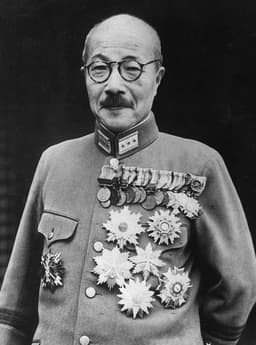
Hideki Tojo
General · Modern
53.9Total

Oscar Mejia Victores
General · Modern
51.9Total
Basic Information
Born
1884
1930
Died
1948
—
Era
Modern
Modern
Nationality
Japan
Guatemala
Occupation
General
General
Civilization
Eastern
Western
Score Comparison
Military (10%)
70.0
22.6
Political (20%)
48.0
68.0
Influence (20%)
55.0
50.2
Legacy (20%)
50.0
43.3
Leadership (15%)
53.2
80.0
Strategy (15%)
55.0
41.0
TOTAL
53.9
51.9
Hideki Tojo — Complete Timeline
1941 AD
Attack on Pearl HarborWar
As Prime Minister, Hideki Tojo authorized the attack on the US naval base at Pearl Harbor, Hawaii. The surprise attack brought the United States into World War II. Tojo's decision was based on the belief that war with the US was inevitable due to resource embargoes and diplomatic failures.
World War IIPearl HarborUS-Japan War
Impact: globaldestructive
Appointment as Prime MinisterPolitical Action◆ Major
Hideki Tojo was appointed Prime Minister of Japan, replacing Fumimaro Konoe. He retained his position as Army Minister and later took on other portfolios, consolidating power. His appointment marked the ascendancy of the military faction in the Japanese government and the shift towards total war.
Prime MinisterMilitary GovernmentWorld War II
Impact: national
1942 AD
Fall of SingaporeWar◆ Major
Under Tojo's leadership, Japanese forces captured Singapore from the British in a swift campaign. The fall of Singapore was one of the worst British military defeats in history. It demonstrated Japanese military prowess and led to the occupation of a key strategic location in Southeast Asia.
World War IISingaporeJapanese Victory
Impact: global
1948 AD
Execution by the International Military Tribunal for the Far EastPolitical Action◆ Major
Hideki Tojo was found guilty of war crimes by the International Military Tribunal for the Far East and sentenced to death. He was executed by hanging on December 23, 1948. His trial and execution symbolized the Allied effort to hold Japanese leaders accountable for wartime atrocities.
War CrimesExecutionTokyo Trials
Impact: globaltragic
Oscar Mejia Victores — Complete Timeline
1983 AD
1983 Guatemalan coup d'étatPolitical Action◆ Major
Mejia Victores, then Defense Minister, led a coup that ousted President Efrain Rios Montt. He assumed the presidency, becoming the last military ruler of Guatemala.
CoupMilitary RuleGuatemala
Impact: nationaldestructive
1984 AD
Human rights abuses during his ruleOther◆ Major
During his presidency, Mejia Victores' government continued counterinsurgency operations that resulted in forced disappearances and massacres of indigenous Maya communities, as documented by truth commissions.
Human RightsCivil WarAtrocities
Impact: nationaltragic
1985 AD
Transition to civilian rulePolitical Action
Under pressure, Mejia Victores oversaw the drafting of a new constitution and called for democratic elections. He transferred power to civilian President Vinicio Cerezo in 1986, ending decades of military rule.
DemocratizationConstitutionElection
Impact: nationalconstructive
Expert Analysis
Hideki Tojo vs Oscar Mejia Victores
### The General and the Transition: Hideki Tojo and Oscar Mejia Victores
In December 1941, a Japanese prime minister in military uniform gave the order to strike Pearl Harbor, plunging the world into a Pacific war that would end with his own execution. Forty-two years later, a Guatemalan defense minister seized power in a bloodless coup, only to voluntarily hand it back to civilians two years later. Both were generals. Both led their nations at moments of profound crisis. Yet one became a symbol of militaristic aggression, the other a reluctant architect of democratic transition. What explains the vast difference between their paths?
**Origins**
Hideki Tojo was born in 1884 into a samurai family, a caste that had lost its formal privileges but retained a deep sense of martial honor. He grew up in a Japan rapidly industrializing, yet still rigidly hierarchical, where military service was the highest calling. His father was a lieutenant general, and young Tojo absorbed the ethos of absolute loyalty, discipline, and imperial reverence. By contrast, Oscar Mejia Victores, born in 1930 in Guatemala, entered a world of stark inequality, military coups, and Cold War paranoia. The Guatemalan army was not a force for national defense but an instrument of elite control, trained by the United States to crush leftist insurgencies. Mejia rose through its ranks not as a strategist of empire but as a bureaucrat of counterinsurgency.
**Rise to Power**
Tojo’s ascent was methodical and ideological. He served as a military attaché in Germany, admired Nazi efficiency, and became chief of the Kwantung Army’s secret police in Manchuria, where he earned a reputation for ruthlessness. By 1941, as Japan’s civilian government faltered under economic sanctions and stalled negotiations with the United States, the military demanded action. Tojo, already Army Minister, was appointed Prime Minister in October 1941, replacing the more cautious Fumimaro Konoe. He held both portfolios, centralizing power in a way that left no room for dissent. His rise was not a coup but a quiet takeover by a man who believed war was inevitable.
Mejia Victores came to power more directly. In August 1983, as Defense Minister, he led a coup that ousted General Efrain Rios Montt, a brutal dictator whose evangelical fervor and scorched-earth tactics had alienated even his military backers. The coup was a palace affair, not a popular uprising. Mejia assumed the presidency with little public support but a clear mandate from the officer corps to stabilize a regime hemorrhaging legitimacy.
**Leadership & Governance**
Tojo governed as a wartime dictator. He micromanaged military campaigns, believing that willpower could overcome material disadvantages. The fall of Singapore in February 1942, a stunning victory that humiliated the British Empire, was his greatest triumph. But his strategic vision was fatally flawed. He authorized the attack on Pearl Harbor without a realistic plan for victory, assuming that a knockout blow would force America to negotiate. Instead, it awakened an industrial giant. On the home front, Tojo imposed censorship, rationing, and a cult of sacrifice that suppressed any hint of defeatism. His leadership was rigid, hierarchical, and ultimately catastrophic.
Mejia Victores governed differently. He continued the counterinsurgency campaign that had already caused tens of thousands of disappearances, and human rights abuses persisted under his watch. But he was not an ideologue. Facing international pressure and a bankrupt economy, he made a strategic calculation: democracy was the only way to preserve the army’s institutional power. In 1985, he oversaw the drafting of a new constitution and called for elections. In March 1986, he peacefully transferred power to a civilian president, Vinicio Cerezo. It was not a moral conversion but a pragmatic retreat.
**Triumph & Tragedy**
Tojo’s tragedy was total. His greatest victory, the fall of Singapore, was also the high-water mark of Japanese expansion. From 1942 onward, the war turned against him. The Battle of Midway, the island-hopping campaign, the firebombing of Tokyo—each defeat eroded his authority. By 1944, he was forced to resign as prime minister, though he remained a symbol of militarism. After Japan’s surrender, he attempted suicide but failed. In 1948, the International Military Tribunal for the Far East found him guilty of war crimes and sentenced him to death. He was hanged, his legacy forever tied to aggression and atrocity.
Mejia Victores faced a different reckoning. His transition to democracy was hailed by the United States as a Cold War success, but it left the Guatemalan army’s power largely intact. He himself faded into obscurity, avoiding prosecution for the abuses committed under his rule. His tragedy was not a dramatic downfall but a quiet complicity in a system that continued to terrorize its own people.
**Character & Destiny**
Tojo was a man of iron conviction. He believed in the divine mission of Japan, the sanctity of the emperor, and the necessity of war. His personality—disciplined, intolerant of dissent, convinced of his own rectitude—drove him to make decisions that led millions to death. He was not a monster in the cinematic sense but a bureaucrat of destruction, who saw the Pacific War as a test of national will. Mejia Victores, by contrast, was a pragmatist. He lacked Tojo’s ideological fervor. His decisions were shaped not by grand visions but by survival instincts. He saw the writing on the wall—the war in Central America was unwinnable, the economy collapsing—and chose retreat over ruin.
**Legacy**
Tojo is remembered as a war criminal, a symbol of Japanese militarism, and a cautionary tale about the dangers of unchecked military power. In Japan, his legacy is complex: a few right-wing nationalists honor him, but most view him as a disaster. Mejia Victores is largely forgotten. His name appears in footnotes of Guatemalan history, a transitional figure who enabled democracy but did not embody it. His scores on leadership and political acumen are higher than Tojo’s, but his influence is far narrower.
**Conclusion**
What separates these two generals is not merely circumstance but character. Tojo, shaped by a culture of imperial honor and a belief in inevitable conflict, chose war and paid the ultimate price. Mejia, a product of Cold War pragmatism and a smaller stage, chose survival and faded away. One burned bright and fell hard; the other dimmed quietly. Their stories remind us that history judges not only by outcomes but by intentions—and that the same uniform can hide vastly different men.
Rankings
🥇
Hideki TojoLeader
Mil: 70.0Pol: 48.0Inf: 55.0
53.9
🥈
Oscar Mejia Victores
Mil: 22.6Pol: 68.0Inf: 50.2
51.9
+2.0 behind
How This Comparison Works
Algorithm
Each figure is scored on 6 dimensions (0—100 scale) based on structured historical data: Military (10%), Political (20%), Influence (20%), Legacy (20%), Leadership (15%), Strategy (15%). The weighted total produces the final ranking.
Data Sources
Scores are computed from structured sub-indicators in the database. Scale factors adjust for era (Ancient ×0.85, Modern ×1.0) and civilization size (Eastern ×1.05, Other ×0.80) to account for differences in population and military scale.
Maximum 3 Figures
Comparisons are limited to 2—3 figures to ensure readability and statistical meaningfulness.
Error Margins
±5 points per dimension — Sub-scores are derived from historical records with inherent uncertainty. Two figures within 5 points on a dimension should be considered roughly equivalent in that area.
Total Score Accuracy
±3 points overall — The weighted combination of 6 dimensions produces a total score with approximately ±3 points of uncertainty. Differences of less than 3 points are not statistically significant— the figures are effectively tied.
Known Limitations
- Historical records are incomplete and uneven across civilizations
- Figures from oral-tradition societies may be underrepresented
- Occupation labels can misclassify multi-role figures
- Scores measure capability and impact, not moral character
- Quantitative scoring is a comparison tool, not absolute truth
Capability Radar
Military (10%) — Battles & Warfare
Battles
65
10
Win Rate
40
10
Expansion
70
5
Political (20%) — Governance & Reform
Reform
30
55
Diplomacy
35
50
Economy
25
30
Influence (20%) — Cultural & Global Reach
Cultural
30
15
Global
55
15
Legacy (20%) — Historical Impact
Historical
55
30
Longevity
40
20
Leadership (15%) — Power & Stability
Tenure
60
40
Stability
20
35
Strategy (15%) — Tactics & Innovation
Strategy
50
15
Tactics
55
15
Reform
45
20
Similar Comparisons
Comments & Discussion
SamuraiSlayer6/16/2026
Comparing Tojo to Mejia is like comparing a forest fire to campfire smoke. Tojo was a militarist true believer who turned Japan into a killing machine—he personally approved the Bataan Death March. Mejia was a reluctant caretaker who handed power back to civilians after only two years. One was hanged for war crimes; the other retired quietly. Tojo’s evil was systematic and global; Mejia’s sins were local and temporary. Call it what it is: empire vs. expediency.
数据侦探6/16/2026
说Mejia是民主转型的工程师纯属扯淡。他1983年政变上台前,危地马拉军政府已经杀了数万人。他两年后还政给文官政府,是因为美国施压和国内游击队压力,不是良心发现。而且他1985年离任后,1997年还因种族清洗被起诉。Tojo至少是明确的主战者,负全责。Mejia是个机会主义者,把烫手山芋丢给了文官,算不上“过渡建筑师”。数字不会撒谎:Tojo处决,Mejia逍遥法外。
PithosReader6/16/2026
Tojo and Mejia are both examples of how military men can hijack a state, but their regimes had opposite trajectories. Tojo expanded Japan’s war machine from Manchuria to Pearl Harbor—he was a true imperialist. Mejia took power in Guatemala to end a civil war, then stepped aside. That’s not “transition,” that’s damage control. Tojo unleashed total war; Mejia contained a crisis. Apples and hand grenades. One was a fanatic, the other was a fixer.
历史控6/16/2026
两人出身天差地别:东条出身武士家庭,从小被灌输“忠君爱国”;梅希亚出身危地马拉底层军官,靠镇压左翼游击队起家。东条是日本军部的代言人,梅希亚是美国对抗共产主义的棋子。前者引发亚洲数千万人死亡,后者统治两年多,危机后主动还政。但说梅希亚是“民主桥梁”过誉了—他只是没让危地马拉陷入更深的泥潭。没有可比性,纯属驴唇不对马嘴。
DecolonialCritic6/16/2026
Stop pretending Mejia was a reluctant democrat. Sure, he handed power to civilians, but only after the Guatemalan army had already massacred tens of thousands of Mayan peasants. Tojo’s Japan was a colonial empire; Mejia’s Guatemala was a U.S.-backed counterinsurgency state. Both ran violent machines—one global, one local. Mejia’s “transition” was a tactical retreat, not a moral conversion. Tojo at least owned his imperialism; Mejia’s legacy is just laundered by the CIA’s narrative.