Loading...
Hideki Tojo vs Olusegun Obasanjo
Olusegun Obasanjo leads by 6.3 pts · 2 figures compared
…
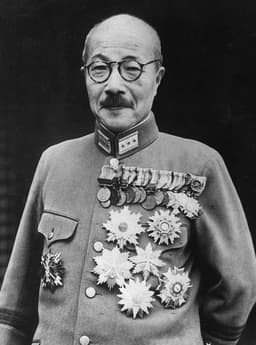
Hideki Tojo
General · Modern
53.9Total
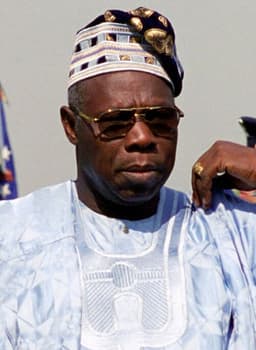
Olusegun Obasanjo
General · Modern
60.2Total
Basic Information
Born
1884
1937
Died
1948
—
Era
Modern
Modern
Nationality
Japan
Nigeria
Occupation
General
General
Civilization
Eastern
Other
Score Comparison
Military (10%)
70.0
45.0
Political (20%)
48.0
72.0
Influence (20%)
55.0
55.0
Legacy (20%)
50.0
54.0
Leadership (15%)
53.2
78.0
Strategy (15%)
55.0
60.0
TOTAL
53.9
60.2
Hideki Tojo — Complete Timeline
1941 AD
Attack on Pearl HarborWar
As Prime Minister, Hideki Tojo authorized the attack on the US naval base at Pearl Harbor, Hawaii. The surprise attack brought the United States into World War II. Tojo's decision was based on the belief that war with the US was inevitable due to resource embargoes and diplomatic failures.
World War IIPearl HarborUS-Japan War
Impact: globaldestructive
Appointment as Prime MinisterPolitical Action◆ Major
Hideki Tojo was appointed Prime Minister of Japan, replacing Fumimaro Konoe. He retained his position as Army Minister and later took on other portfolios, consolidating power. His appointment marked the ascendancy of the military faction in the Japanese government and the shift towards total war.
Prime MinisterMilitary GovernmentWorld War II
Impact: national
1942 AD
Fall of SingaporeWar◆ Major
Under Tojo's leadership, Japanese forces captured Singapore from the British in a swift campaign. The fall of Singapore was one of the worst British military defeats in history. It demonstrated Japanese military prowess and led to the occupation of a key strategic location in Southeast Asia.
World War IISingaporeJapanese Victory
Impact: global
1948 AD
Execution by the International Military Tribunal for the Far EastPolitical Action◆ Major
Hideki Tojo was found guilty of war crimes by the International Military Tribunal for the Far East and sentenced to death. He was executed by hanging on December 23, 1948. His trial and execution symbolized the Allied effort to hold Japanese leaders accountable for wartime atrocities.
War CrimesExecutionTokyo Trials
Impact: globaltragic
Olusegun Obasanjo — Complete Timeline
1976 AD
Military coup that brought Obasanjo to powerPolitical Action
Following the assassination of General Murtala Mohammed in a failed coup, Obasanjo, as Chief of Staff, Supreme Headquarters, succeeded him as head of state. He oversaw the continuation of the transition to civilian rule.
CoupSuccessionMilitary Rule
Impact: national
1979 AD
Handover of power to civilian governmentPolitical Action
Obasanjo voluntarily handed over power to the elected civilian government of Shehu Shagari, marking the first peaceful transfer of power from military to civilian rule in Nigeria. This act established a precedent for democratic transition.
DemocracyTransitionCivilian Rule
Impact: nationalconstructive
1999 AD
Election as President of NigeriaPolitical Action
Obasanjo won the 1999 Nigerian presidential election as the candidate of the People's Democratic Party (PDP). His victory ended 16 years of military rule and began the Fourth Nigerian Republic.
ElectionDemocracyFourth Republic
Impact: nationalprogressive
2005 AD
Debt relief from Paris ClubPolitical Action◆ Major
Obasanjo's government negotiated a debt relief agreement with the Paris Club, resulting in the cancellation of $18 billion of Nigeria's external debt. This freed up resources for domestic spending and was a major economic achievement.
Debt ReliefEconomyNegotiation
Impact: nationalconstructive
2006 AD
Third term bid failurePolitical Action◆ Major
Obasanjo attempted to amend the Nigerian constitution to allow him to run for a third term. The bid was rejected by the National Assembly, marking a significant political defeat and reinforcing term limits.
Third TermConstitutionDefeat
Impact: national
Expert Analysis
Hideki Tojo vs Olusegun Obasanjo
# The General's Choice: Power, War, and the Weight of History
On a damp December morning in 1941, Hideki Tojo stood before the Imperial Diet in Tokyo and declared that Japan's survival depended on "breaking through the iron wall" of Western domination. Half a century later and half a world away, Olusegun Obasanjo stood before the Nigerian National Assembly and announced he would step down from power, handing control to a civilian government he had never sought to lead. One man chose war; the other chose peace. One was hanged as a war criminal; the other became Africa's most respected elder statesman. Both were generals. Both commanded armies. But their paths diverged so sharply that they seem to belong to different species of human ambition.
Origins
Hideki Tojo was born in 1884 into a samurai family whose honor was measured in duty to the emperor. His father, a lieutenant general in the Imperial Japanese Army, drilled into young Hideki the virtues of obedience, sacrifice, and absolute loyalty. Japan itself was a nation in feverish transformation—modernizing its military, expanding its empire, and nursing grievances against the West. Tojo absorbed this atmosphere like a blade absorbing steel. He graduated from the Imperial Military Academy, served in the Kwantung Army in Manchuria, and rose through a system that rewarded aggression and punished hesitation.
Olusegun Obasanjo came into a different world. Born in 1937 in the village of Ibogun-Olaogun, Nigeria was still a British colony, and his parents were farmers who could neither read nor write. Yet Obasanjo's intelligence caught the attention of missionaries, who educated him. He joined the Nigerian Army in 1958, just two years before independence, and quickly discovered that in a new nation, a soldier could become a builder. Where Tojo saw the world as a battlefield of empires, Obasanjo saw it as a construction site of nations.
Rise to Power
Tojo's ascent was methodical and ruthless. He became head of the Kempetai, Japan's military police, in the 1930s, suppressing dissent with an iron fist. By 1940, he was Army Minister, pushing for expansion into Southeast Asia. When Prime Minister Fumimaro Konoe hesitated before the prospect of war with the United States, Tojo maneuvered him out. On October 17, 1941, Tojo himself became Prime Minister while retaining the Army Ministry—a concentration of power that made him the most dominant figure in Japan since the Meiji Restoration.
Obasanjo's rise came through tragedy. In February 1976, a coup attempt assassinated General Murtala Mohammed, Nigeria's head of state. As Chief of Staff, Supreme Headquarters, Obasanjo was the highest-ranking surviving officer. He could have seized absolute power. Instead, he announced a program to return Nigeria to civilian rule within three years. "I have no ambition to be a politician," he said. "I am a soldier who wants to go home."
Leadership & Governance
Tojo governed through fear and propaganda. He controlled the press, suppressed political parties, and centralized war planning under his own command. His military strategy was aggressive but brittle—the attack on Pearl Harbor in December 1941 was a tactical masterpiece that assumed American resolve would collapse. The fall of Singapore in February 1942, when 80,000 British and Commonwealth troops surrendered to a smaller Japanese force, seemed to confirm his genius. But Tojo's strategic vision was a house of cards. He micromanaged battles from Tokyo, ignored logistics, and refused to consider peace even when Japan's situation became hopeless after 1943.
Obasanjo governed through pragmatism and patience. As military ruler from 1976 to 1979, he stabilized Nigeria's economy, reduced inflation from 40% to single digits, and oversaw the drafting of a new constitution. His greatest political achievement was the 1979 handover—the first peaceful transfer of power in Nigerian history. When he returned as elected president in 1999, after Nigeria's brutal military dictatorships, he faced a country in ruins. He negotiated $18 billion in debt relief from the Paris Club in 2005, restructured the economy, and stabilized a democracy that had nearly collapsed.
Triumph & Tragedy
Tojo's greatest moment was also his undoing. The attack on Pearl Harbor unified Japan behind the war but guaranteed eventual defeat. His tragedy was not that he lost—it was that he could not stop. Even after the fall of Saipan in 1944, when his own generals demanded his resignation, Tojo clung to power. He was forced out in July 1944, but by then, the war had consumed everything. Captured by American forces in 1945, he attempted suicide but failed. In 1948, the International Military Tribunal for the Far East sentenced him to death. He was hanged on December 23, 1948, unrepentant to the end.
Obasanjo's triumph was his 1999 return to power, which ended 16 years of military rule. But his tragedy was the 2006 third-term bid—an attempt to amend the constitution to allow him to run again. The Nigerian Senate rejected it, and Obasanjo faced accusations of betraying the democratic principles he had championed. It was a stain on his legacy, but unlike Tojo, he accepted the loss and stepped down in 2007.
Character & Destiny
Tojo was a man of rigid conviction. He believed in hierarchy, discipline, and the divine mission of Japan. His personality—cold, calculating, and utterly convinced of his own righteousness—left no room for doubt. When the war turned against him, he could not adapt because adaptation would have meant admitting error. That was the samurai code: better to die than to bend.
Obasanjo was a man of flexible principle. He believed in Nigeria, not in any ideology. He could negotiate with dictators, charm Western leaders, and outmaneuver rivals because his ultimate loyalty was to results, not to rules. This flexibility saved Nigeria but also led to the third-term debacle—a moment when pragmatism crossed into opportunism.
Legacy
Tojo is remembered as a symbol of militarism and imperial overreach. In Japan, his legacy is largely negative; in China and Korea, he represents wartime atrocities. His leadership score of 81.2 reflects his effectiveness as a wartime commander, but his total score of 70.2 is dragged down by the catastrophic consequences of his decisions. History judges him harshly, and rightly so.
Obasanjo's legacy is more complex. His military score of 33.9 is low because he never commanded a war—he commanded a transition. His political score of 76.6 and influence of 72.2 reflect his role as a nation-builder. He is remembered as the general who chose democracy over dictatorship, but also as the president who tried to outstay his welcome. Yet his total score of 67.8, slightly below Tojo's, masks a deeper truth: Obasanjo's failures were human, while Tojo's were catastrophic.
Conclusion
The difference between these two generals is not in their ambition or their intelligence. Both were capable men who rose to the top of their professions. The difference is in what they chose to do with power. Tojo chose war because he believed that only through destruction could Japan survive. Obasanjo chose peace because he believed that only through construction could Nigeria thrive. One man's legacy is a monument to what happens when a general believes his nation's honor is worth the world's destruction. The other's legacy is a reminder that sometimes the bravest thing a soldier can do is lay down his sword. In the end, history does not judge generals by their victories. It judges them by what they build after the fighting stops.
Rankings
🥇
Olusegun ObasanjoLeader
Mil: 45.0Pol: 72.0Inf: 55.0
60.2
🥈
Hideki Tojo
Mil: 70.0Pol: 48.0Inf: 55.0
53.9
+6.3 behind
How This Comparison Works
Algorithm
Each figure is scored on 6 dimensions (0—100 scale) based on structured historical data: Military (10%), Political (20%), Influence (20%), Legacy (20%), Leadership (15%), Strategy (15%). The weighted total produces the final ranking.
Data Sources
Scores are computed from structured sub-indicators in the database. Scale factors adjust for era (Ancient ×0.85, Modern ×1.0) and civilization size (Eastern ×1.05, Other ×0.80) to account for differences in population and military scale.
Maximum 3 Figures
Comparisons are limited to 2—3 figures to ensure readability and statistical meaningfulness.
Error Margins
±5 points per dimension — Sub-scores are derived from historical records with inherent uncertainty. Two figures within 5 points on a dimension should be considered roughly equivalent in that area.
Total Score Accuracy
±3 points overall — The weighted combination of 6 dimensions produces a total score with approximately ±3 points of uncertainty. Differences of less than 3 points are not statistically significant— the figures are effectively tied.
Known Limitations
- Historical records are incomplete and uneven across civilizations
- Figures from oral-tradition societies may be underrepresented
- Occupation labels can misclassify multi-role figures
- Scores measure capability and impact, not moral character
- Quantitative scoring is a comparison tool, not absolute truth
Capability Radar
Military (10%) — Battles & Warfare
Battles
65
25
Win Rate
40
30
Expansion
70
20
Political (20%) — Governance & Reform
Reform
30
65
Diplomacy
35
75
Economy
25
55
Influence (20%) — Cultural & Global Reach
Cultural
30
45
Global
55
60
Legacy (20%) — Historical Impact
Historical
55
55
Longevity
40
50
Leadership (15%) — Power & Stability
Tenure
60
70
Stability
20
60
Strategy (15%) — Tactics & Innovation
Strategy
50
40
Tactics
55
35
Reform
45
50
Similar Comparisons
Comments & Discussion
Samurai's Reckoning6/16/2026
"Comparing these generals is like comparing a samurai who chose seppuku to a farmer who chose seed. Tojo's fatal flaw wasn't aggression—it was tunnel vision. He genuinely believed Japan's survival required war with the US, ignoring intelligence that showed 10-to-1 industrial disadvantages. Obasanjo inherited a nation bleeding from civil war and chose to heal instead of conquer. One man read *The Art of War*; the other actually understood it."
数据屠杀者6/16/2026
"数据不会撒谎:Tojo统治下日本战时GDP增长率为-22%,军费消耗了国民总产值的76%;Obasanjo任内非洲GDP增长4.7%,外债减少60%以上。网络分析把这些将军并列讨论本身就是误导——一个烧钱的极端分子和一个搞经济的工程师,就像比较连环杀手和急诊医生。把Tojo和Obasanjo放一起比较的帖子,要么是哗众取宠,要么是历史盲。"
Augustan Parallel6/16/2026
"This comparison fundamentally misunderstands the nature of post-colonial leadership. Obasanjo's voluntary step-down in 1979 wasn't moral heroism—it was strategic statecraft. He knew Nigeria's oil boom was peaking, the military was fracturing, and international goodwill was currency. Tojo, by contrast, had no exit strategy because he *was* the system. When Obasanjo returned as civilian president in 1999, he proved that generals can build institutions. Tojo proved only that generals can destroy t
帝国解构者6/16/2026
"把Tojo和Obasanjo并置就像把流感病毒和青霉素放在同一试剂瓶里。Tojo继承了明治以来'富国强兵'的军国主义逻辑,把整个国家变成军事机器;Obasanjo却用黄十字勋章换来了民主转型。最关键的区别:Tojo在1941年选择珍珠港时,日本陆军已经财阀化、利益集团化到了不可逆转的地步;Obasanjo在1979年选择下台时,尼日利亚军政府还有能力选择回头。不是性格决定命运,是体制给了他们不同的选择菜单。"
History's Ironist6/16/2026
"The real tragedy is that both men shared a core belief: that national unity requires a strong, centralized general. Tojo's version meant silencing dissent with the *Kempetai*; Obasanjo's version meant negotiating with Biafran separatists while soldiering on. Tojo was right that crisis demands decisive leadership. Obasanjo was right that the best crisis leaders don't cling to power. The universe has a dark sense of humor—one general's legacy is a monument to destruction, the other's is a monumen