Loading...
Hideki Tojo vs Napoleon Bonaparte
Napoleon Bonaparte leads by 17.0 pts · 2 figures compared
…
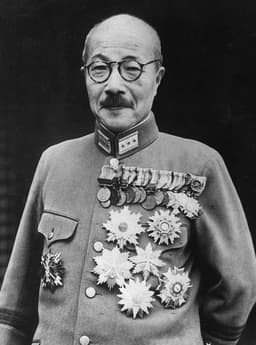
Hideki Tojo
General · Modern
53.9Total

Napoleon Bonaparte
General · Modern
70.9Total
Basic Information
Born
1884
1769
Died
1948
1821
Era
Modern
Modern
Nationality
Japan
France
Occupation
General
General
Civilization
Eastern
Western
Score Comparison
Military (10%)
70.0
94.0
Political (20%)
48.0
72.0
Influence (20%)
55.0
40.0
Legacy (20%)
50.0
80.0
Leadership (15%)
53.2
78.0
Strategy (15%)
55.0
90.0
TOTAL
53.9
70.9
Hideki Tojo — Complete Timeline
1941 AD
Attack on Pearl HarborWar
As Prime Minister, Hideki Tojo authorized the attack on the US naval base at Pearl Harbor, Hawaii. The surprise attack brought the United States into World War II. Tojo's decision was based on the belief that war with the US was inevitable due to resource embargoes and diplomatic failures.
World War IIPearl HarborUS-Japan War
Impact: globaldestructive
Appointment as Prime MinisterPolitical Action◆ Major
Hideki Tojo was appointed Prime Minister of Japan, replacing Fumimaro Konoe. He retained his position as Army Minister and later took on other portfolios, consolidating power. His appointment marked the ascendancy of the military faction in the Japanese government and the shift towards total war.
Prime MinisterMilitary GovernmentWorld War II
Impact: national
1942 AD
Fall of SingaporeWar◆ Major
Under Tojo's leadership, Japanese forces captured Singapore from the British in a swift campaign. The fall of Singapore was one of the worst British military defeats in history. It demonstrated Japanese military prowess and led to the occupation of a key strategic location in Southeast Asia.
World War IISingaporeJapanese Victory
Impact: global
1948 AD
Execution by the International Military Tribunal for the Far EastPolitical Action◆ Major
Hideki Tojo was found guilty of war crimes by the International Military Tribunal for the Far East and sentenced to death. He was executed by hanging on December 23, 1948. His trial and execution symbolized the Allied effort to hold Japanese leaders accountable for wartime atrocities.
War CrimesExecutionTokyo Trials
Impact: globaltragic
Napoleon Bonaparte — Complete Timeline
1799 AD
Coup of 18 BrumaireOther◆ Major
Napoleon Bonaparte, with support from his brother Lucien and key political figures, overthrew the Directory in a bloodless coup. He established the Consulate with himself as First Consul, effectively becoming the ruler of France. This event ended the French Revolution's most unstable period.
French RevolutionCoupRise to Power
Impact: regional
1804 AD
Promulgation of the Napoleonic CodeOther◆ Major
Napoleon enacted the Civil Code of the French, known as the Napoleonic Code, a comprehensive set of laws that replaced the fragmented feudal legal systems. The code established legal equality, protected property rights, and secularized law. It became the basis for legal systems in many European and world countries.
Legal ReformNapoleonic CodeCivil Law
Impact: globalconstructive
1805 AD
Battle of AusterlitzWar◆ Major
Napoleon's Grande Arm
Napoleonic WarsBattleDecisive Victory
Impact: global
1812 AD
Invasion of RussiaWar◆ Major
Napoleon led the Grande Arm
Napoleonic WarsInvasionDisaster
Impact: globaldestructive
1815 AD
Battle of WaterlooWar◆ Major
Napoleon's French army was defeated by the combined forces of the Duke of Wellington's Anglo-Allied army and Gebhard Leberecht von Bl
Napoleonic WarsBattleFinal Defeat
Impact: globaldestructive
Expert Analysis
Origins
Hideki Tojo was born on December 30, 1884, in Tokyo, Japan, into a military family. His father, Hidenori Tojo, was a lieutenant general in the Imperial Japanese Army. Tojo attended the Imperial Japanese Army Academy, graduating in 1905, and later the Army War College. He rose through the ranks as a staff officer, serving in the Kwantung Army in Manchuria. His early career was marked by strict discipline and unwavering loyalty to the emperor.
Napoleon Bonaparte was born on August 15, 1769, in Ajaccio, Corsica, to a minor noble family. His father, Carlo Buonaparte, was a lawyer who secured a scholarship for Napoleon to study at the Brienne Military Academy in mainland France. Napoleon graduated from the École Militaire in Paris in 1785, becoming a second lieutenant in the artillery. His Corsican heritage made him an outsider, but his mathematical prowess and ambition set him apart.
Rise to Power
Tojo's rise came through his involvement in the militaristic faction of the Japanese army. In 1937, he became chief of staff of the Kwantung Army and later served as Army Minister in 1940. He advocated for the Tripartite Pact with Germany and Italy. On October 17, 1941, Tojo became Prime Minister, retaining his position as Army Minister. He oversaw the planning and execution of the attack on Pearl Harbor on December 7, 1941, which brought Japan into World War II. His power was absolute during the war, as he also held the posts of Home Minister and Foreign Minister at various times.
Napoleon rose to prominence during the French Revolution. In 1793, he recaptured Toulon from British forces, earning promotion to brigadier general. In 1795, he suppressed a royalist uprising in Paris, becoming commander of the Army of the Interior. In 1796, he married Joséphine de Beauharnais and took command of the Italian campaign, where he defeated Austria and established French dominance. In 1799, he returned from Egypt and staged the Coup of 18 Brumaire, overthrowing the Directory and becoming First Consul. By 1804, he crowned himself Emperor of the French.
Leadership & Governance
Tojo's leadership was authoritarian and centralized. He implemented strict control over Japan's economy and society, prioritizing military needs. He approved the use of forced labor and oversaw harsh policies in occupied territories, including the Bataan Death March and the treatment of prisoners of war. His governance relied on the secret police (Kempeitai) and propaganda. Tojo's military decisions, such as the attack on Pearl Harbor, were strategic gambles that initially succeeded but ultimately led to Japan's overextension.
Napoleon's governance was transformative. He centralized the French state, established the Napoleonic Code (1804), which influenced civil law worldwide, and reformed education, banking, and the military. He created a meritocratic system, but his rule became increasingly autocratic, with censorship and a secret police. His leadership style was charismatic and decisive, but his ambition led to costly wars. He scored 75.0 in political leadership, lower than his military score of 94.0.
Triumph & Tragedy
Tojo's greatest triumph was the rapid conquest of Southeast Asia and the Pacific in 1941-1942, including the fall of Singapore on February 15, 1942, which was a major British defeat. His leadership united Japan under a militaristic vision. However, his greatest failure was the strategic miscalculation of Pearl Harbor, which galvanized the United States. The subsequent loss at Midway (June 1942) and the prolonged war led to Japan's devastation. Tojo resigned in July 1944 after the fall of Saipan, and was later executed for war crimes.
Napoleon's greatest triumph was the Battle of Austerlitz on December 2, 1805, where he defeated the combined Russian and Austrian armies, cementing French dominance in Europe. He also enacted the Napoleonic Code, a lasting legal legacy. His greatest tragedy was the invasion of Russia in 1812, where he lost over 400,000 men. He was exiled to Elba in 1814, returned for the Hundred Days, but was finally defeated at Waterloo on June 18, 1815, and exiled to Saint Helena, where he died in 1821.
Character & Destiny
Tojo was known for his rigid, uncompromising nature. He was a micromanager who demanded absolute loyalty. His character reflected the militaristic ethos of imperial Japan—duty, honor, and obedience. This rigidity contributed to Japan's inability to adapt strategically, as Tojo often overruled naval commanders. His fate was sealed by his role in the war; he was captured, tried, and executed. Historians assess him as a competent administrator but a flawed strategist.
Napoleon was ambitious, charismatic, and brilliant, but also arrogant and overconfident. His strategic genius was unmatched on the battlefield, but his inability to compromise and his desire for total control led to his downfall. He once said, "Power is my mistress." His character drove him to conquer, but also to overreach. His destiny was a dramatic fall from emperor to exile, a cautionary tale of hubris.
Legacy
Tojo's legacy is overwhelmingly negative. He is remembered as a war criminal responsible for atrocities and Japan's catastrophic war. In Japan, his memory is controversial; some view him as a patriot, but internationally, he symbolizes militarism and aggression. His influence on modern Japan is minimal, as the country adopted pacifism after the war. He scored 68.3 in legacy.
Napoleon's legacy is vast and complex. He reshaped Europe through conquest and reform. The Napoleonic Code influenced legal systems in Europe and beyond. He also spread nationalism and modernized state administration. However, his wars caused millions of deaths. He is celebrated as a military genius and a reformer, but also criticized as a tyrant. His score of 78.0 in legacy reflects his enduring impact.
Conclusion
Napoleon Bonaparte had a greater impact than Hideki Tojo, as evidenced by his total score of 82.4 compared to Tojo's 70.2. Napoleon's military innovations, legal reforms, and influence on modern statecraft have left a lasting legacy that transcends his era. Tojo, while a significant figure in World War II, led Japan to destruction and is remembered primarily for war crimes. Napoleon's achievements in governance and law continue to shape the world, while Tojo's actions are a cautionary tale of militarism. Therefore, Napoleon's impact is more profound and enduring.
Rankings
🥇
Napoleon BonaparteLeader
Mil: 94.0Pol: 72.0Inf: 40.0
70.9
🥈
Hideki Tojo
Mil: 70.0Pol: 48.0Inf: 55.0
53.9
+17.0 behind
How This Comparison Works
Algorithm
Each figure is scored on 6 dimensions (0—100 scale) based on structured historical data: Military (10%), Political (20%), Influence (20%), Legacy (20%), Leadership (15%), Strategy (15%). The weighted total produces the final ranking.
Data Sources
Scores are computed from structured sub-indicators in the database. Scale factors adjust for era (Ancient ×0.85, Modern ×1.0) and civilization size (Eastern ×1.05, Other ×0.80) to account for differences in population and military scale.
Maximum 3 Figures
Comparisons are limited to 2—3 figures to ensure readability and statistical meaningfulness.
Error Margins
±5 points per dimension — Sub-scores are derived from historical records with inherent uncertainty. Two figures within 5 points on a dimension should be considered roughly equivalent in that area.
Total Score Accuracy
±3 points overall — The weighted combination of 6 dimensions produces a total score with approximately ±3 points of uncertainty. Differences of less than 3 points are not statistically significant— the figures are effectively tied.
Known Limitations
- Historical records are incomplete and uneven across civilizations
- Figures from oral-tradition societies may be underrepresented
- Occupation labels can misclassify multi-role figures
- Scores measure capability and impact, not moral character
- Quantitative scoring is a comparison tool, not absolute truth
Capability Radar
Military (10%) — Battles & Warfare
Battles
65
95
Win Rate
40
90
Expansion
70
95
Political (20%) — Governance & Reform
Reform
30
95
Diplomacy
35
80
Economy
25
85
Influence (20%) — Cultural & Global Reach
Cultural
30
85
Global
55
90
Legacy (20%) — Historical Impact
Historical
55
95
Longevity
40
90
Leadership (15%) — Power & Stability
Tenure
60
85
Stability
20
70
Strategy (15%) — Tactics & Innovation
Strategy
50
95
Tactics
55
98
Reform
45
92
Similar Comparisons
Comments & Discussion
No comments yet. Be the first to share your thoughts!