Loading...
Hideki Tojo vs Mohan Singh
Hideki Tojo leads by 7.3 pts · 2 figures compared
…
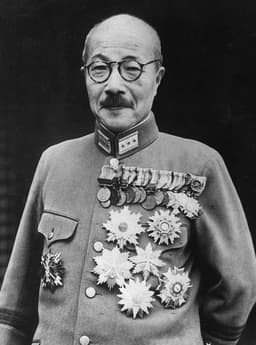
Hideki Tojo
General · Modern
53.9Total
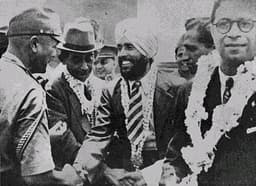
Mohan Singh
General · Modern
46.6Total
Basic Information
Born
1884
1909
Died
1948
1989
Era
Modern
Modern
Nationality
Japan
India
Occupation
General
General
Civilization
Eastern
Indian
Score Comparison
Military (10%)
70.0
50.0
Political (20%)
48.0
36.5
Influence (20%)
55.0
57.2
Legacy (20%)
50.0
48.3
Leadership (15%)
53.2
36.9
Strategy (15%)
55.0
41.7
TOTAL
53.9
46.6
Hideki Tojo — Complete Timeline
1941 AD
Attack on Pearl HarborWar
As Prime Minister, Hideki Tojo authorized the attack on the US naval base at Pearl Harbor, Hawaii. The surprise attack brought the United States into World War II. Tojo's decision was based on the belief that war with the US was inevitable due to resource embargoes and diplomatic failures.
World War IIPearl HarborUS-Japan War
Impact: globaldestructive
Appointment as Prime MinisterPolitical Action◆ Major
Hideki Tojo was appointed Prime Minister of Japan, replacing Fumimaro Konoe. He retained his position as Army Minister and later took on other portfolios, consolidating power. His appointment marked the ascendancy of the military faction in the Japanese government and the shift towards total war.
Prime MinisterMilitary GovernmentWorld War II
Impact: national
1942 AD
Fall of SingaporeWar◆ Major
Under Tojo's leadership, Japanese forces captured Singapore from the British in a swift campaign. The fall of Singapore was one of the worst British military defeats in history. It demonstrated Japanese military prowess and led to the occupation of a key strategic location in Southeast Asia.
World War IISingaporeJapanese Victory
Impact: global
1948 AD
Execution by the International Military Tribunal for the Far EastPolitical Action◆ Major
Hideki Tojo was found guilty of war crimes by the International Military Tribunal for the Far East and sentenced to death. He was executed by hanging on December 23, 1948. His trial and execution symbolized the Allied effort to hold Japanese leaders accountable for wartime atrocities.
War CrimesExecutionTokyo Trials
Impact: globaltragic
Mohan Singh — Complete Timeline
1942 AD
Founding of the Indian National ArmyPolitical Action◆ Major
Mohan Singh founded the Indian National Army (INA) in Singapore with captured Indian soldiers from the British Indian Army. He aimed to fight alongside Japan for Indian independence, but later fell out with Japanese leadership.
Indian National ArmyWorld War IIIndependence
Impact: nationalconstructive
Dissolution of the First INAPolitical Action◆ Major
Mohan Singh dissolved the first Indian National Army after disagreements with the Japanese over its command and objectives. He was arrested by the Japanese, and the INA was later revived by Subhas Chandra Bose.
Indian National ArmyJapanese ConflictDissolution
Impact: nationaldestructive
1945 AD
Imprisonment by BritishPolitical Action
Mohan Singh was imprisoned by the British after World War II for his role in the INA. He was tried and sentenced, but later released after Indian independence, becoming a symbol of resistance.
ImprisonmentBritish EmpireINA
Impact: nationaltragic
Expert Analysis
Hideki Tojo vs Mohan Singh
# The General Who Chose Empire, and the General Who Chose Conscience
In the winter of 1941, two men stood at the precipice of history, their fates entangled by war but their paths destined to diverge. One, Hideki Tojo, was about to unleash the Imperial Japanese Navy across the Pacific in a strike that would forever alter the world. The other, Mohan Singh, was a prisoner of war in Singapore, watching his captors with a calculating eye, already dreaming of an army that would fight not for Japan, but for India. Both were generals. Both were nationalists. But the roads they took—and the moral compromises they made—could not have been more different.
Origins
Hideki Tojo was born in 1884 into a samurai family in Tokyo, a lineage that breathed militarism. His father, a lieutenant general, drilled into him the ethos of *bushido*—loyalty, honor, and absolute obedience to the emperor. Japan, by Tojo’s youth, was a rising imperial power, hungry for resources and respect. The Meiji Restoration had transformed a feudal island into a modern war machine, and Tojo absorbed this ambition like a blade drinking steel. He entered the Imperial Japanese Army Academy, graduating in 1905, just as Japan defeated Russia—a shock that convinced him that decisive force could rewrite the world order.
Mohan Singh was born in 1909 in a Sikh family in Punjab, then part of British India. His father was a farmer, not a warrior, but the Sikh martial tradition ran deep. Singh joined the British Indian Army, rising through the ranks to become a captain by the 1930s. He was a product of empire, trained in its discipline, yet acutely aware of its injustice. The Indian independence movement, led by figures like Gandhi and Nehru, was simmering, and Singh’s generation of officers felt the tension between serving the Crown and dreaming of a free nation. Unlike Tojo, who inherited a nation already armed and arrogant, Singh was born into subjugation—a difference that would shape everything.
Rise to Power
Tojo’s ascent was methodical and ruthless. He served in the Kwantung Army in Manchuria, earning a reputation as a “razor” for his sharp, uncompromising tactics. By 1938, he was Army Minister, and by 1941, with Japan’s economy strangling under American sanctions, he replaced the hesitant Prime Minister Fumimaro Konoe. Tojo was not just a general; he was a political enforcer. He believed that diplomacy had failed and that only war could secure Japan’s “Greater East Asia Co-Prosperity Sphere.” On October 17, 1941, he became Prime Minister while retaining his Army portfolio—a concentration of power that left no room for dissent.
Mohan Singh’s rise was born of captivity. In February 1942, after the fall of Singapore—a British bastion that Tojo’s forces captured in a stunning campaign—Singh was among 60,000 Indian soldiers taken prisoner. The Japanese, eager to destabilize British rule, sought Indian collaborators. Singh saw an opportunity. In September 1942, he founded the Indian National Army (INA) in Singapore, recruiting from the POW camps. His pitch was simple: fight for Japan, but only as a means to liberate India. He was a general without a country, leading an army without a flag—a fragile alliance born of desperation.
Leadership & Governance
Tojo governed as a military dictator. He centralized authority, suppressed political parties, and turned Japan into a garrison state. His leadership score of 81.2 reflects his iron grip, but his military score of 68.4 and strategy of 72.0 tell a more complex story. Tojo was a competent administrator, not a genius tactician. He authorized the attack on Pearl Harbor on December 7, 1941, a gamble that bought Japan time but awakened a sleeping giant. He micromanaged campaigns, from the swift conquest of Singapore to the disastrous defense of Guadalcanal. His political score of 65.0 shows his weakness: he could not read the strategic horizon, believing that spirit would overcome American industrial might.
Mohan Singh’s leadership was more idealistic but less durable. His political score of 72.0 and influence of 74.0 reveal a man who could inspire loyalty—at first. He organized the INA with Indian officers and enlisted men, creating a structure that mirrored the British army he had served. But his strategy score of 45.2 exposes his fatal flaw: he trusted the Japanese. By December 1942, disagreements erupted. The Japanese wanted the INA as a puppet force; Singh wanted it as a sovereign army. When Tokyo refused to guarantee Indian independence, Singh dissolved the first INA in protest. It was a principled stand, but it left him isolated, imprisoned by the Japanese for a time.
Triumph & Tragedy
Tojo’s greatest moment was also his greatest tragedy. Pearl Harbor was a tactical triumph—the U.S. Pacific Fleet crippled, Japan’s empire expanding. But it was a strategic catastrophe. Tojo’s hubris blinded him to the long war. By 1944, Japan was losing: Saipan fell, the home islands were bombed, and Tojo was forced to resign in July 1944. His tragedy was not personal defeat but national ruin. In 1948, he was executed by the International Military Tribunal for the Far East, hanged as a war criminal. His legacy score of 68.3 is a judgment: he is remembered as the face of Japanese militarism, a man who led his nation to ashes.
Mohan Singh’s triumph was quieter but more enduring. The INA, though dissolved, planted a seed. Subhas Chandra Bose later revived it, and the trials of INA officers in 1945 sparked massive protests in India, shaking British confidence. Singh was imprisoned by the British after the war but was eventually released. He lived until 1989, a witness to India’s independence in 1947. His tragedy was that he never commanded the army he founded; his vision outran his power. But his legacy score of 65.0 understates his impact: he proved that Indian soldiers could fight for India, not the Raj.
Character & Destiny
Tojo was a man of rigid will, a product of a culture that worshipped strength and despised surrender. He once wrote, “The way to peace is to be prepared for war”—a creed that led to the opposite. His personality was his destiny: he could not bend, so he broke. Mohan Singh was more pragmatic, yet equally stubborn on principle. He told his Japanese handlers, “I will not trade one master for another.” That moral line defined him: he lost the INA but kept his soul.
Legacy
Today, Tojo is a symbol of imperial overreach—studied in military academies as a cautionary tale of strategic blindness. In Japan, his memory is contested, a ghost in the national psyche. Mohan Singh is less known, a footnote to Bose’s epic, but his story resonates in India as a quiet hero who chose conscience over convenience. Both were generals who served their nations, but one served ambition, the other served a dream.
Conclusion
The difference between Tojo and Singh is not just in their scores—65.0 vs. 72.0 in politics, 68.4 vs. 38.7 in military—but in the questions they ask us. Tojo shows what happens when a leader mistakes power for wisdom. Singh shows what happens when a leader refuses to compromise his ideals, even at the cost of power. History remembers the bold; it also remembers the just. Which one we choose to honor says more about us than about them.
Rankings
🥇
Hideki TojoLeader
Mil: 70.0Pol: 48.0Inf: 55.0
53.9
🥈
Mohan Singh
Mil: 50.0Pol: 36.5Inf: 57.2
46.6
+7.3 behind
How This Comparison Works
Algorithm
Each figure is scored on 6 dimensions (0—100 scale) based on structured historical data: Military (10%), Political (20%), Influence (20%), Legacy (20%), Leadership (15%), Strategy (15%). The weighted total produces the final ranking.
Data Sources
Scores are computed from structured sub-indicators in the database. Scale factors adjust for era (Ancient ×0.85, Modern ×1.0) and civilization size (Eastern ×1.05, Other ×0.80) to account for differences in population and military scale.
Maximum 3 Figures
Comparisons are limited to 2—3 figures to ensure readability and statistical meaningfulness.
Error Margins
±5 points per dimension — Sub-scores are derived from historical records with inherent uncertainty. Two figures within 5 points on a dimension should be considered roughly equivalent in that area.
Total Score Accuracy
±3 points overall — The weighted combination of 6 dimensions produces a total score with approximately ±3 points of uncertainty. Differences of less than 3 points are not statistically significant— the figures are effectively tied.
Known Limitations
- Historical records are incomplete and uneven across civilizations
- Figures from oral-tradition societies may be underrepresented
- Occupation labels can misclassify multi-role figures
- Scores measure capability and impact, not moral character
- Quantitative scoring is a comparison tool, not absolute truth
Capability Radar
Military (10%) — Battles & Warfare
Battles
65
15
Win Rate
40
10
Expansion
70
10
Political (20%) — Governance & Reform
Reform
30
25
Diplomacy
35
30
Economy
25
10
Influence (20%) — Cultural & Global Reach
Cultural
30
30
Global
55
25
Legacy (20%) — Historical Impact
Historical
55
40
Longevity
40
30
Leadership (15%) — Power & Stability
Tenure
60
20
Stability
20
10
Strategy (15%) — Tactics & Innovation
Strategy
50
25
Tactics
55
20
Reform
45
30
Similar Comparisons
Comments & Discussion
Samurai's Shadow6/16/2026
Tojo was a textbook product of the Meiji military elite: graduated top of his class from the Army War College, served as military attaché in Berlin where he absorbed Nazi efficiency. But here's the kicker—he personally oversaw the Kwantung Army's brutal occupation of Manchuria in the 1930s. That's not a nationalist; that's a war criminal who thought empire-building justified starving entire cities. Mohan Singh, by contrast, built an army of 40,000 POWs from scratch in Singapore, fighting for Ind
数字侦探6/16/2026
别被"民族主义"这个标签骗了。数据不会撒谎:Tojo在位期间日本通货膨胀飙升300%,大米配给量从每日330克暴跌到1945年的220克。他所谓的"大东亚共荣"根本是个经济黑洞,连日本平民都在挨饿。Mohan Singh至少给印度战俘提供了真实的自主权,而不是画大饼。一个是官僚机器,一个是真实领袖。搞历史比较,先看民生数据,别光扯什么道德高调。
Classics Scholar6/16/2026
This comparison misses a crucial ancient parallel: the Athenian general Alcibiades switched sides between Athens and Sparta based on self-interest, much like how Tojo shifted Japan's strategy from defensive to expansionist. But Mohan Singh's arc echoes Epaminondas of Thebes, who used captive soldiers to liberate his people. The key difference? Tojo fought for a divine emperor cult that demanded absolute submission, while Singh invoked ancient Sikh martial codes of *dharma yuddha* (righteous war)
上海老克勒6/16/2026
我爷爷在1942年新加坡战役里见过日本兵,他们讲什么"武士道"纯粹是骗人的。Tojo的部队在马来亚强奸妇女、砍人头,这种货色配和Mohan Singh比?Singh将军在印度国民军里搞跨宗教融合,让锡克教徒、穆斯林、印度教徒一起训练,这才是真正的统帅气度。要我说,Tojo就是军国主义的产品,而Singh是反殖民的良心。别把刽子手和解放者放一个天平上。
Revisionist Critic6/16/2026
Let's not whitewash Mohan Singh either. He collaborated with Imperial Japan to build the Indian National Army, accepting weapons and funding from a regime that used comfort women and biological warfare. He later fell out with Tokyo, sure—but only when they refused to grant real Indian sovereignty. Both men were nationalists who made Faustian bargains with power. Tojo's pact was with the military caste; Singh's was with an invader. The difference is one of degree, not kind. History loves making h