Loading...
Hideki Tojo vs Li Zongren
Li Zongren leads by 4.6 pts · 2 figures compared
…
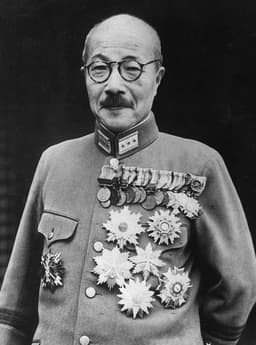
Hideki Tojo
General · Modern
53.9Total
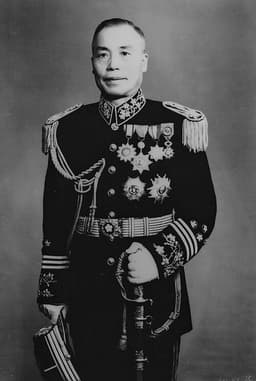
Li Zongren
General · Modern
58.5Total
Basic Information
Born
1884
1890
Died
1948
1969
Era
Modern
Modern
Nationality
Japan
China
Occupation
General
General
Civilization
Eastern
Eastern
Score Comparison
Military (10%)
70.0
65.0
Political (20%)
48.0
53.8
Influence (20%)
55.0
58.0
Legacy (20%)
50.0
52.0
Leadership (15%)
53.2
72.0
Strategy (15%)
55.0
56.8
TOTAL
53.9
58.5
Hideki Tojo — Complete Timeline
1941 AD
Attack on Pearl HarborWar
As Prime Minister, Hideki Tojo authorized the attack on the US naval base at Pearl Harbor, Hawaii. The surprise attack brought the United States into World War II. Tojo's decision was based on the belief that war with the US was inevitable due to resource embargoes and diplomatic failures.
World War IIPearl HarborUS-Japan War
Impact: globaldestructive
Appointment as Prime MinisterPolitical Action◆ Major
Hideki Tojo was appointed Prime Minister of Japan, replacing Fumimaro Konoe. He retained his position as Army Minister and later took on other portfolios, consolidating power. His appointment marked the ascendancy of the military faction in the Japanese government and the shift towards total war.
Prime MinisterMilitary GovernmentWorld War II
Impact: national
1942 AD
Fall of SingaporeWar◆ Major
Under Tojo's leadership, Japanese forces captured Singapore from the British in a swift campaign. The fall of Singapore was one of the worst British military defeats in history. It demonstrated Japanese military prowess and led to the occupation of a key strategic location in Southeast Asia.
World War IISingaporeJapanese Victory
Impact: global
1948 AD
Execution by the International Military Tribunal for the Far EastPolitical Action◆ Major
Hideki Tojo was found guilty of war crimes by the International Military Tribunal for the Far East and sentenced to death. He was executed by hanging on December 23, 1948. His trial and execution symbolized the Allied effort to hold Japanese leaders accountable for wartime atrocities.
War CrimesExecutionTokyo Trials
Impact: globaltragic
Li Zongren — Complete Timeline
1921 AD
Command of the Guangxi ArmyPolitical Action◆ Major
Li Zongren became a commander in the Guangxi Army and helped unify Guangxi province under the New Guangxi Clique. He established a powerful regional base that rivaled other warlords.
Guangxi CliqueMilitary CommandWarlord Era
Impact: regional
1926 AD
Alliance with the Nationalist GovernmentPolitical Action◆ Major
Li Zongren allied the Guangxi Clique with Chiang Kai-shek's Nationalist government during the Northern Expedition. His forces played a key role in defeating warlords and unifying China under KMT rule.
Northern ExpeditionAllianceKMT
Impact: nationalconstructive
1938 AD
Battle of TaierzhuangWar
Li Zongren commanded Chinese forces to a major victory over the Japanese at the Battle of Taierzhuang during the Second Sino-Japanese War. This was the first significant Chinese victory of the war and boosted national morale.
Second Sino-Japanese WarBattleVictory
Impact: nationalconstructive
1949 AD
Acting Presidency of the Republic of ChinaPolitical Action◆ Major
Li Zongren served as Acting President of the Republic of China after Chiang Kai-shek's resignation during the Chinese Civil War. He attempted to negotiate peace with the Communists but failed, leading to the KMT's retreat to Taiwan.
Chinese Civil WarPresidencyKMT
Impact: nationaltragic
Exile to the United StatesPolitical Action
After the Communist victory, Li Zongren fled to the United States, where he lived in exile. He criticized Chiang Kai-shek's leadership and advocated for a reformed KMT, but remained politically marginalized.
ExileChinese Civil WarPolitics
Impact: nationaltragic
Expert Analysis
Hideki Tojo vs Li Zongren
# The General and the Warlord: Two Paths Through War’s Inferno
In the winter of 1941, as Japanese bombers streaked toward Pearl Harbor, Hideki Tojo stood at the apex of imperial power, convinced that a single, devastating blow would secure Japan’s destiny. Seven years later, in a cold courtroom in Tokyo, he would hear his own death sentence read aloud. Half a world away, in the spring of 1938, Li Zongren watched Chinese soldiers dig trenches at Taierzhuang, a muddy town in Shandong province, and prepared to do what no Chinese commander had yet done: defeat the Japanese in open battle. One man built an empire of ashes; the other defended a nation that would ultimately abandon him. Their lives, separated by a sea and a war, reveal how character, circumstance, and the cruel logic of history can turn generals into heroes—or war criminals.
Origins
Hideki Tojo was born in 1884 into a samurai lineage that had already lost its feudal purpose. His father, a mid-ranking army officer, instilled in him the rigid virtues of bushido: obedience, sacrifice, and unquestioning loyalty to the emperor. Tojo grew up in a Japan that was industrializing furiously, humiliated by Western powers, and hungry for empire. He was a mediocre student but a relentless one—a man who compensated for lack of brilliance with fanatical discipline. By contrast, Li Zongren, born six years later in 1890, came from rural Guangxi, a poor and mountainous province in southern China. His father was a scholar-official in a crumbling Qing dynasty, and young Li grew up watching bandits and foreign gunboats carve up his homeland. He was not a samurai’s son but a survivor’s apprentice—pragmatic, shrewd, and deeply skeptical of ideology.
Tojo’s Japan was ascending; Li’s China was collapsing. That difference shaped everything that followed.
Rise to Power
Tojo climbed the ladder of the Imperial Japanese Army through bureaucratic ruthlessness. He served as a military attaché in Germany, studied the efficiency of Prussian militarism, and returned to Japan convinced that only total war could secure the nation’s place in the sun. By the 1930s, he was a leading figure in the “Control Faction,” which sought to subordinate the civilian government to military command. In 1941, when the moderate Prime Minister Fumimaro Konoe resigned, Tojo seized the opportunity. He became Prime Minister while retaining his post as Army Minister—a concentration of power that made him the de facto dictator of Japan.
Li Zongren’s rise was messier and more improvisational. He began as a minor officer in the Guangxi Army, but during the chaos of the 1920s, he allied with other local commanders to form the New Guangxi Clique. In 1926, he made a fateful decision: he threw his support behind Chiang Kai-shek’s Nationalist government during the Northern Expedition, the campaign to unify China. Li was no ideologue—he was a warlord who understood that survival meant choosing the right side at the right moment. His alliance with Chiang gave him legitimacy, but it also bound him to a leader he would eventually come to distrust.
Leadership & Governance
Tojo governed through fear and centralization. He believed that Japan’s destiny required a “Greater East Asia Co-Prosperity Sphere,” a euphemism for military conquest. As Prime Minister, he tightened censorship, expanded the secret police, and pushed through a national mobilization law that turned Japan into a garrison state. His military strategy was aggressive but brittle. The attack on Pearl Harbor in December 1941 was a tactical masterpiece—it crippled the U.S. Pacific Fleet—but a strategic catastrophe. Tojo had no plan for a long war. He assumed that a single blow would break American will, a miscalculation that reveals his profound ignorance of his enemy.
Li Zongren was a different kind of commander. At the Battle of Taierzhuang in 1938, he demonstrated what Chinese generals had long lacked: tactical flexibility and psychological insight. He lured Japanese forces into a trap, using the town’s narrow streets to neutralize their superior firepower. His soldiers fought with bayonets and grenades in house-to-house combat, and when the Japanese retreated, Li pursued them relentlessly. It was China’s first major victory of the Second Sino-Japanese War, and it made him a national hero. Yet Li’s political wisdom was more subtle. He understood that China’s survival depended not on winning battles but on not losing the war—on trading space for time, on preserving the army while the Japanese overextended themselves. It was the strategy of a man who had grown up watching empires crumble.
Triumph & Tragedy
Tojo’s greatest moment was also his greatest trap. Pearl Harbor united the American public against Japan with a fury that Tojo never anticipated. His subsequent campaigns—the fall of Singapore in 1942, the conquest of the Philippines—were brilliant but hollow. Each victory stretched Japan’s supply lines thinner, each conquest created more enemies. By 1944, when American forces landed on Saipan, Tojo’s government was crumbling. He resigned in disgrace, but he could not escape the consequences of his choices.
Li Zongren’s triumph at Taierzhuang was followed by decades of disappointment. In 1949, as the Chinese Civil War reached its climax, Chiang Kai-shek resigned the presidency, and Li became Acting President of the Republic of China. But the position was a poisoned gift. Chiang still controlled the army and the treasury from behind the scenes, and the Communists were advancing on all fronts. Li could not stop the collapse. When the Nationalists fled to Taiwan, Li chose exile in the United States rather than submission to Chiang. He lived in a modest house in New York, writing memoirs and criticizing his former ally, a ghost of a lost republic.
Character & Destiny
Tojo was a man of iron will and wooden imagination. He saw the world through a narrow lens of duty and hierarchy, and he could not conceive that other nations might value freedom as much as his soldiers valued obedience. His final words before his execution in 1948 were a prayer for Japan’s revival—but he never apologized for the millions of deaths he had caused. Li Zongren was more complex. He was a warlord who fought for a united China, a nationalist who distrusted his own leader, a general who won a battle but lost a country. He died in 1969, still in exile, still hoping that history would judge him kindly.
Legacy
Tojo is remembered as a war criminal, a symbol of militarism run amok. His name is synonymous with Pearl Harbor, with the Bataan Death March, with the brutal occupation of Southeast Asia. In Japan, he remains a controversial figure—some revile him, a few still honor him as a patriot. Li Zongren’s legacy is more ambiguous. In mainland China, he is praised as a hero of the Anti-Japanese War, but his role as a Nationalist general means he is not fully embraced. In Taiwan, he is remembered as a tragic figure who tried to save the Republic and failed. His scores—Military 65.3, Political 65.0, Strategy 83.4—reflect a man who was a better tactician than a politician, a better soldier than a statesman.
Conclusion
Standing at the crossroads of the same war, these two generals chose opposite paths. Tojo believed that aggression would bring glory; Li believed that endurance would bring survival. One built an empire that lasted four years; the other defended a nation that lost everything but its spirit. History does not always reward the righteous, but it does reveal the consequences of character. Tojo’s rigidity turned Japan into an ash heap; Li’s pragmatism could not save China from civil war, but it saved its honor at Taierzhuang. In the end, the difference between them is not just the difference between victory and defeat—it is the difference between a man who saw war as an end and a man who saw it as a means. One was consumed by the fire he lit. The other, though burned, lived to tell the tale.
Rankings
🥇
Li ZongrenLeader
Mil: 65.0Pol: 53.8Inf: 58.0
58.5
🥈
Hideki Tojo
Mil: 70.0Pol: 48.0Inf: 55.0
53.9
+4.6 behind
How This Comparison Works
Algorithm
Each figure is scored on 6 dimensions (0—100 scale) based on structured historical data: Military (10%), Political (20%), Influence (20%), Legacy (20%), Leadership (15%), Strategy (15%). The weighted total produces the final ranking.
Data Sources
Scores are computed from structured sub-indicators in the database. Scale factors adjust for era (Ancient ×0.85, Modern ×1.0) and civilization size (Eastern ×1.05, Other ×0.80) to account for differences in population and military scale.
Maximum 3 Figures
Comparisons are limited to 2—3 figures to ensure readability and statistical meaningfulness.
Error Margins
±5 points per dimension — Sub-scores are derived from historical records with inherent uncertainty. Two figures within 5 points on a dimension should be considered roughly equivalent in that area.
Total Score Accuracy
±3 points overall — The weighted combination of 6 dimensions produces a total score with approximately ±3 points of uncertainty. Differences of less than 3 points are not statistically significant— the figures are effectively tied.
Known Limitations
- Historical records are incomplete and uneven across civilizations
- Figures from oral-tradition societies may be underrepresented
- Occupation labels can misclassify multi-role figures
- Scores measure capability and impact, not moral character
- Quantitative scoring is a comparison tool, not absolute truth
Capability Radar
Military (10%) — Battles & Warfare
Battles
65
65
Win Rate
40
60
Expansion
70
60
Political (20%) — Governance & Reform
Reform
30
45
Diplomacy
35
60
Economy
25
40
Influence (20%) — Cultural & Global Reach
Cultural
30
40
Global
55
40
Legacy (20%) — Historical Impact
Historical
55
55
Longevity
40
45
Leadership (15%) — Power & Stability
Tenure
60
55
Stability
20
35
Strategy (15%) — Tactics & Innovation
Strategy
50
68
Tactics
55
70
Reform
45
55
Similar Comparisons
Comments & Discussion
焦土论者6/16/2026
说一千道一万,李宗仁打赢了台儿庄战役,毙伤日军一万多人,这是事实。日本陆军自日俄战争以来第一次战败撤退,政治意义远大于军事意义。反观东条英机,指挥诺门罕战役死伤两万,从无独立胜绩。所谓“名将”,能打赢一仗就够,否则就是纸上谈兵。
HistoryChewer6/16/2026
Li's Taierzhuang victory in 1938 was real—around 10,000 Japanese casualties, first major Chinese success. But let's not romanticize. He was a Guangxi warlord who fought Chiang as often as he fought Japan. Tojo was a bureaucratic weapon of mass destruction, sure, but Li wasn't some virtuous freedom fighter; he was a regional strongman who switched sides when convenient. Neither is a saint, just two guys who killed a lot of people for different flags.
数据猎人6/16/2026
东条英机任关东军参谋长时,诺门罕战役日军损失近五万,他隐瞒不报。后来当首相,搞出“一号作战”打通大陆交通线,结果是日军战死七万,中国战场进一步被拖入泥潭。李宗仁台儿庄歼灭日军一万余人,但桂系精锐在此役也损失超过一万。数据会说话:一个是用别人的命堆官位,一个是拿自己的命换时间。
RevisionistRogue6/16/2026
Everyone cheers Taierzhuang, but let's look at the aftermath: Li retreated with most of his force intact, leaving behind scorched earth that killed more Chinese civilians than Japanese soldiers. And Tojo's strategic insanity—like the 1944 Ichi-Go offensive—wasn't any dumber than Li's "dare to die" tactics. Both men treated soldiers and civilians as expendable. The difference? Li lost but got called a hero; Tojo lost and got hanged. That's not morality—that's the victors writing the script.
经典学人6/16/2026
东条英机有“武士道”的壳,却无武士道的魂。他从未亲临前线,却以“统制”之名把日本推入深渊。李宗仁出身广西乡野,带兵必与士卒同甘苦,台儿庄战役期间他三天三夜未合眼。两种领导力,一个是纸上谈兵的官僚独裁者,一个是身先士卒的战场指挥官。历史证明了哪条路更值得尊敬。