Loading...
Hideki Tojo vs Jung Bahadur Rana
Jung Bahadur Rana leads by 7.5 pts · 2 figures compared
…
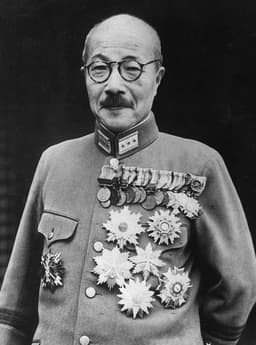
Hideki Tojo
General · Modern
53.9Total
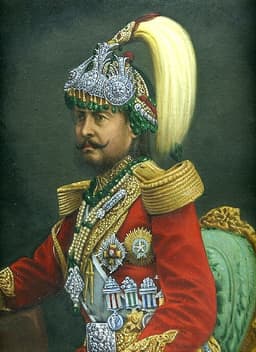
Jung Bahadur Rana
General · Modern
61.4Total
Basic Information
Born
1884
1817
Died
1948
1877
Era
Modern
Modern
Nationality
Japan
Nepal
Occupation
General
General
Civilization
Eastern
Indian
Score Comparison
Military (10%)
70.0
55.0
Political (20%)
48.0
72.0
Influence (20%)
55.0
56.7
Legacy (20%)
50.0
55.0
Leadership (15%)
53.2
78.0
Strategy (15%)
55.0
55.0
TOTAL
53.9
61.4
Hideki Tojo — Complete Timeline
1941 AD
Attack on Pearl HarborWar
As Prime Minister, Hideki Tojo authorized the attack on the US naval base at Pearl Harbor, Hawaii. The surprise attack brought the United States into World War II. Tojo's decision was based on the belief that war with the US was inevitable due to resource embargoes and diplomatic failures.
World War IIPearl HarborUS-Japan War
Impact: globaldestructive
Appointment as Prime MinisterPolitical Action◆ Major
Hideki Tojo was appointed Prime Minister of Japan, replacing Fumimaro Konoe. He retained his position as Army Minister and later took on other portfolios, consolidating power. His appointment marked the ascendancy of the military faction in the Japanese government and the shift towards total war.
Prime MinisterMilitary GovernmentWorld War II
Impact: national
1942 AD
Fall of SingaporeWar◆ Major
Under Tojo's leadership, Japanese forces captured Singapore from the British in a swift campaign. The fall of Singapore was one of the worst British military defeats in history. It demonstrated Japanese military prowess and led to the occupation of a key strategic location in Southeast Asia.
World War IISingaporeJapanese Victory
Impact: global
1948 AD
Execution by the International Military Tribunal for the Far EastPolitical Action◆ Major
Hideki Tojo was found guilty of war crimes by the International Military Tribunal for the Far East and sentenced to death. He was executed by hanging on December 23, 1948. His trial and execution symbolized the Allied effort to hold Japanese leaders accountable for wartime atrocities.
War CrimesExecutionTokyo Trials
Impact: globaltragic
Jung Bahadur Rana — Complete Timeline
1846 AD
Kot MassacrePolitical Action
Jung Bahadur Runa orchestrated the Kot Massacre in Kathmandu, where dozens of nobles and courtiers were killed. This event eliminated his political rivals and allowed him to seize effective control of the Nepalese government, establishing the hereditary Rana prime ministership.
CoupMassacreRana Dynasty
Impact: nationaldestructive
Establishment of Rana DynastyPolitical Action◆ Major
Following the Kot Massacre, Jung Bahadur Rana appointed himself prime minister and commander-in-chief. He made the position hereditary, founding the Rana dynasty that ruled Nepal for over a century, reducing the Shah monarchs to figureheads.
DynastyGovernmentNepal
Impact: national
1850 AD
Visit to EuropeCultural
Jung Bahadur Rana traveled to Britain and France, becoming the first South Asian ruler to visit Europe. He observed Western military and industrial technology, which influenced his modernization efforts in Nepal, including army reforms.
DiplomacyModernizationTravel
Impact: nationalconstructive
1856 AD
Nepal-Tibet War and Treaty of ThapathaliWar◆ Major
Jung Bahadur Rana led a Nepalese military campaign into Tibet. The conflict ended with the Treaty of Thapathali, which secured Nepalese territorial claims and established a tributary relationship with Tibet, enhancing Nepal's regional influence.
WarTreatyTibet
Impact: regional
Expert Analysis
Hideki Tojo vs Jung Bahadur Rana
# The Iron Generals: Hideki Tojo and Jung Bahadur Rana
On a crisp December morning in 1941, Hideki Tojo stood before Japan’s parliament and declared war on the United States, unleashing a conflict that would consume the Pacific. Just over a century earlier, on a blood-soaked night in Kathmandu, Jung Bahadur Rana watched as dozens of Nepal’s most powerful nobles fell to swords and rifles, clearing a path for his own dynasty. Both men were generals who seized political power. Both reshaped their nations. Yet one built a hereditary regime that lasted 104 years, while the other led his country into catastrophic defeat and died on a hangman’s noose. What drove such different outcomes?
Origins
Hideki Tojo was born in 1884 into a military family in Tokyo, the son of a lieutenant general. Japan was then racing to modernize, hungry for empire, and Tojo absorbed its militaristic ethos like a second skin. He graduated from the Imperial Japanese Army Academy, where discipline and hierarchy were absolute, and later served as a military attaché in Germany, observing Nazi efficiency firsthand. His world was one of order, obedience, and the belief that Japan’s destiny lay in expansion.
Jung Bahadur Rana, born in 1817, came from a different crucible. He was a member of the Kunwar family, a minor noble house in the chaotic court of Kathmandu. Nepal was then a patchwork of feuding clans, with a weak king and a queen mother who wielded real power through intrigue. Jung Bahadur grew up watching courtiers scheme and assassinate—a brutal education in the art of survival. Where Tojo saw the state as a machine to be commanded, Jung Bahadur saw it as a stage to be conquered.
Rise to Power
Tojo’s ascent was methodical, almost bureaucratic. He climbed the ranks of the Kwantung Army in Manchuria, earning a reputation as a stern, efficient officer. By 1941, Japan was mired in war with China and locked in a diplomatic stalemate with the United States. Prime Minister Fumimaro Konoe, exhausted and indecisive, resigned. Tojo, then Army Minister, stepped into the vacuum. He was not a revolutionary; he was the system’s logical endpoint—a man who believed that only military resolve could save Japan.
Jung Bahadur’s rise was a coup d’état in the truest sense. In 1846, the queen mother summoned the court nobles to the Kot Palace, hoping to purge her rivals. Jung Bahadur arrived with armed men, and within hours, dozens of the kingdom’s elite lay dead. The Kot Massacre was not a spontaneous bloodbath but a calculated strike. In its aftermath, Jung Bahadur appointed himself prime minister and commander-in-chief, making the posts hereditary. He did not abolish the monarchy; he simply rendered it ornamental.
Leadership & Governance
Tojo governed as a military dictator, ruling through the Imperial Rule Assistance Association and suppressing dissent with the secret police. He micromanaged campaigns, from the fall of Singapore in 1942—a stunning victory that humiliated the British—to the disastrous defense of island garrisons. His strategy was offense without end, a gamble that Japan’s spirit could overcome America’s industry. Politically, he was rigid. He saw compromise as weakness. When the tide turned, he clung to power, refusing to acknowledge defeat until the atomic bombs fell.
Jung Bahadur was more pragmatic. After the Kot Massacre, he consolidated power not through terror alone but through careful diplomacy. In 1850, he became the first South Asian ruler to visit Europe, touring Britain and France. He studied Western military organization, railway systems, and court etiquette. He returned to Nepal and modernized the army, but he also kept the king as a figurehead, balancing tradition with reform. When he led a campaign into Tibet in 1856, he fought a limited war, negotiated the Treaty of Thapathali, and secured favorable terms without overextending his forces. He understood that power required restraint.
Triumph & Tragedy
Tojo’s greatest triumph was the fall of Singapore in 1942, a campaign that humbled the British Empire and gave Japan control of Southeast Asia. Yet it was a hollow victory. The same aggression that won Singapore provoked a war Japan could never win. His tragedy was not just defeat but the destruction of his nation—firebombed cities, starving civilians, and a legacy of atrocity. In 1948, the International Military Tribunal for the Far East sentenced him to death. He was hanged, a war criminal in the eyes of the world.
Jung Bahadur’s triumph was the Kot Massacre itself. In one night, he eliminated every rival and secured a dynasty that would rule Nepal for over a century. His tragedy, if it can be called that, was the cost: a frozen political system where merit was subordinated to birth. Nepal modernized slowly, and its people remained subjects, not citizens. Yet Jung Bahadur died in 1877 in his palace, old and powerful, having never faced a battlefield defeat.
Character & Destiny
Tojo was a man of iron will but narrow vision. He believed in absolute loyalty to the emperor and absolute victory in war. His personality—disciplined, stubborn, intolerant of dissent—made him an effective administrator in peacetime but a disastrous leader in a conflict that demanded flexibility. He could not retreat, could not negotiate, could not admit error. That rigidity sealed his fate.
Jung Bahadur was a survivor first and a ruler second. He was ruthless but calculating, ambitious but patient. He knew when to strike and when to wait. He modernized the army but kept the monarchy alive. He visited Europe but never adopted its democracy. His character was a mirror of his court: cunning, adaptable, and cold. He built a system that outlasted him precisely because it was designed to endure, not to conquer.
Legacy
Tojo’s legacy is a warning. In Japan, he is remembered as a symbol of militarism and defeat. His name evokes shame, not pride. The institutions he commanded—the Imperial Army, the wartime government—were dismantled. His influence is studied as a cautionary tale.
Jung Bahadur’s legacy is more ambiguous. The Rana dynasty he founded ruled until 1951, when a popular revolution restored the monarchy. Today, Nepalis view him as both a nation-builder and a tyrant. He modernized the army and secured Nepal’s borders, but he also entrenched oligarchy. His visit to Europe opened Nepal to the world, yet his regime kept it closed.
Conclusion
The difference between these two generals lies in their understanding of power. Tojo saw power as a weapon to be wielded without limit. Jung Bahadur saw it as a fortress to be built and defended. One burned bright and vanished; the other cast a long shadow. In the end, history judges not by ambition but by endurance—and by the cost of the dreams we choose to pursue.
Rankings
🥇
Jung Bahadur RanaLeader
Mil: 55.0Pol: 72.0Inf: 56.7
61.4
🥈
Hideki Tojo
Mil: 70.0Pol: 48.0Inf: 55.0
53.9
+7.5 behind
How This Comparison Works
Algorithm
Each figure is scored on 6 dimensions (0—100 scale) based on structured historical data: Military (10%), Political (20%), Influence (20%), Legacy (20%), Leadership (15%), Strategy (15%). The weighted total produces the final ranking.
Data Sources
Scores are computed from structured sub-indicators in the database. Scale factors adjust for era (Ancient ×0.85, Modern ×1.0) and civilization size (Eastern ×1.05, Other ×0.80) to account for differences in population and military scale.
Maximum 3 Figures
Comparisons are limited to 2—3 figures to ensure readability and statistical meaningfulness.
Error Margins
±5 points per dimension — Sub-scores are derived from historical records with inherent uncertainty. Two figures within 5 points on a dimension should be considered roughly equivalent in that area.
Total Score Accuracy
±3 points overall — The weighted combination of 6 dimensions produces a total score with approximately ±3 points of uncertainty. Differences of less than 3 points are not statistically significant— the figures are effectively tied.
Known Limitations
- Historical records are incomplete and uneven across civilizations
- Figures from oral-tradition societies may be underrepresented
- Occupation labels can misclassify multi-role figures
- Scores measure capability and impact, not moral character
- Quantitative scoring is a comparison tool, not absolute truth
Capability Radar
Military (10%) — Battles & Warfare
Battles
65
45
Win Rate
40
50
Expansion
70
40
Political (20%) — Governance & Reform
Reform
30
75
Diplomacy
35
70
Economy
25
65
Influence (20%) — Cultural & Global Reach
Cultural
30
55
Global
55
40
Legacy (20%) — Historical Impact
Historical
55
65
Longevity
40
60
Leadership (15%) — Power & Stability
Tenure
60
80
Stability
20
60
Strategy (15%) — Tactics & Innovation
Strategy
50
60
Tactics
55
55
Reform
45
70
Similar Comparisons
Comments & Discussion
No comments yet. Be the first to share your thoughts!