Loading...
Hideki Tojo vs Julius Caesar
Julius Caesar leads by 28.9 pts · 2 figures compared
…
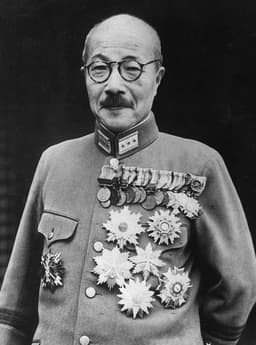
Hideki Tojo
General · Modern
53.9Total

Julius Caesar
General · Ancient
82.8Total
Basic Information
Born
1884
-100
Died
1948
-44
Era
Modern
Ancient
Nationality
Japan
Roman Republic
Occupation
General
General
Civilization
Eastern
Western
Score Comparison
Military (10%)
70.0
88.0
Political (20%)
48.0
78.0
Influence (20%)
55.0
85.0
Legacy (20%)
50.0
82.0
Leadership (15%)
53.2
80.0
Strategy (15%)
55.0
85.0
TOTAL
53.9
82.8
Hideki Tojo — Complete Timeline
1941 AD
Attack on Pearl HarborWar
As Prime Minister, Hideki Tojo authorized the attack on the US naval base at Pearl Harbor, Hawaii. The surprise attack brought the United States into World War II. Tojo's decision was based on the belief that war with the US was inevitable due to resource embargoes and diplomatic failures.
World War IIPearl HarborUS-Japan War
Impact: globaldestructive
Appointment as Prime MinisterPolitical Action◆ Major
Hideki Tojo was appointed Prime Minister of Japan, replacing Fumimaro Konoe. He retained his position as Army Minister and later took on other portfolios, consolidating power. His appointment marked the ascendancy of the military faction in the Japanese government and the shift towards total war.
Prime MinisterMilitary GovernmentWorld War II
Impact: national
1942 AD
Fall of SingaporeWar◆ Major
Under Tojo's leadership, Japanese forces captured Singapore from the British in a swift campaign. The fall of Singapore was one of the worst British military defeats in history. It demonstrated Japanese military prowess and led to the occupation of a key strategic location in Southeast Asia.
World War IISingaporeJapanese Victory
Impact: global
1948 AD
Execution by the International Military Tribunal for the Far EastPolitical Action◆ Major
Hideki Tojo was found guilty of war crimes by the International Military Tribunal for the Far East and sentenced to death. He was executed by hanging on December 23, 1948. His trial and execution symbolized the Allied effort to hold Japanese leaders accountable for wartime atrocities.
War CrimesExecutionTokyo Trials
Impact: globaltragic
Julius Caesar — Complete Timeline
58 BC
Gallic WarsWar◆ Major
Caesar, as proconsul of Gaul, launched a series of campaigns that conquered all of Gaul (modern France, Belgium, and parts of Switzerland). He fought numerous battles, including against the Helvetii, the Belgae, and the Gallic chieftain Vercingetorix. The wars brought immense wealth and a loyal army to Caesar.
Gallic WarsConquestRoman Expansion
Impact: regional
49 BC
Crossing the RubiconPolitical Action◆ Major
Caesar led Legio XIII across the Rubicon River into Italy, defying the Roman Senate's order to disband his army. This act triggered a civil war against Pompey and the Optimates, ultimately leading to Caesar's dictatorship and the end of the Roman Republic.
Roman Civil WarEnd of RepublicPower Struggle
Impact: global
48 BC
Battle of PharsalusWar◆ Major
Caesar's outnumbered army defeated the larger forces of Pompey the Great at Pharsalus in Greece. Caesar's tactical use of a reserve line to counter Pompey's cavalry charge proved decisive. Pompey fled to Egypt, where he was assassinated, leaving Caesar as the undisputed master of the Roman world.
Roman Civil WarBattleDecisive Victory
Impact: regional
44 BC
Appointment as Dictator for LifePolitical Action◆ Major
The Roman Senate appointed Caesar dictator perpetuo (dictator for life), granting him unprecedented personal power. This move concentrated military, legislative, and judicial authority in one person, effectively ending the Roman Republic's traditional system of checks and balances and alarming many senators.
DictatorshipEnd of RepublicPower Consolidation
Impact: regionaldestructive
Assassination on the Ides of MarchPolitical Action◆ Major
A group of Roman senators, led by Marcus Junius Brutus and Gaius Cassius Longinus, stabbed Caesar to death at a meeting of the Senate in the Theatre of Pompey. The assassination was intended to restore the Republic, but instead triggered another civil war that led to the rise of the Roman Empire.
AssassinationRoman PoliticsEnd of Republic
Impact: globaldestructive
Expert Analysis
hideki-tojo-vs-julius-caesar
# The General's Gambit: Caesar and Tojo on the Edge of History
On a January morning in 49 BCE, Julius Caesar stood at the banks of the Rubicon River, a small stream that marked the boundary between his province and Italy proper. To cross with his army was treason. He paused, then uttered the words that would echo through millennia: *"Alea iacta est"*—the die is cast. Nineteen centuries later, in October 1941, Hideki Tojo sat in his Tokyo office, contemplating a different kind of crossing. As the new Prime Minister of Japan, he faced a choice no less fateful: whether to strike the United States at Pearl Harbor or to pull back from the brink of war. Both men stood at thresholds where personal ambition and national destiny fused into a single, irreversible decision. Yet their paths, their characters, and their ends could not have been more different.
Origins
Julius Caesar was born into the patrician Julian clan in 100 BCE, a time when the Roman Republic was already cracking under the weight of its own expansion. His family was ancient but not wealthy, and young Caesar grew up in the shadow of political violence—the Social Wars, the civil strife between Marius and Sulla. He learned early that survival required cunning. When Sulla ordered him to divorce his wife, Caesar refused and fled, showing a defiance that would define his life. His education in rhetoric and philosophy under the Greek tutor Apollonius Molon gave him a mind both sharp and flexible, capable of swaying crowds and outmaneuvering rivals.
Hideki Tojo was born in 1884 in Tokyo, the son of a samurai-turned-army officer. Japan was then racing to modernize after the Meiji Restoration, and Tojo absorbed the values of his era: discipline, hierarchy, and unquestioning loyalty to the emperor. He was a middling student at the Imperial Japanese Army Academy, but his diligence and obedience earned him a reputation as a "razor" for his sharp, relentless efficiency. Unlike Caesar, who was raised in a world of political intrigue and oratory, Tojo grew up in a culture of militaristic conformity, where individualism was suspect and the group was everything.
Rise to Power
Caesar’s ascent was a masterclass in strategic patience. He served as a military tribune in Asia Minor, then as a quaestor in Spain, where he reportedly wept before a statue of Alexander the Great, lamenting that at the same age, Alexander had conquered the world while he had done nothing. He climbed the Roman political ladder—curule aedile, pontifex maximus, praetor—building alliances through lavish games and calculated debts. The turning point came in 60 BCE when he formed the First Triumvirate with Pompey and Crassus, a backroom deal that secured him the governorship of Gaul. From there, he launched his legendary campaigns, conquering a territory that stretched from the Alps to the Atlantic, and amassing an army that would be his power base.
Tojo’s rise was slower, more bureaucratic. He graduated from the Army War College in 1915 and spent years in staff positions, including a stint as a military attaché in Germany. His big break came in 1937 when he became chief of staff of the Kwantung Army in Manchuria, where he advocated for aggressive expansion into China. By 1940, he was Army Minister under Prime Minister Fumimaro Konoe, pushing for the Tripartite Pact with Germany and Italy. When Konoe faltered in the face of American oil embargoes, Tojo replaced him in October 1941, taking the premiership while keeping his army portfolio. His rise was not the result of personal charisma or visionary ambition, but of institutional momentum and the sheer weight of militarist ideology.
Leadership & Governance
Caesar governed through a blend of brilliance and calculation. As a general, his *Commentarii de Bello Gallico* reveal a commander who led from the front, sharing hardship with his soldiers and exploiting enemy weaknesses with ruthless precision. At Alesia in 52 BCE, he faced a Gallic army five times his size, yet he built a double ring of fortifications and starved the rebels into submission—a feat of logistics and nerve. Politically, he was equally adept: he reformed the calendar, granted citizenship to provincials, and initiated public works that alleviated unemployment. Yet his dictatorship, while effective, alienated the senatorial elite who saw him as a tyrant. His famous *"Veni, vidi, vici"*—I came, I saw, I conquered—captured his style: swift, decisive, and utterly self-assured.
Tojo’s leadership was narrower and more rigid. He was a competent administrator who streamlined Japan’s war economy and centralized command, but his military strategy was often flawed. The fall of Singapore in February 1942 was his greatest triumph—a swift campaign that humiliated the British and secured Japanese dominance in Southeast Asia. Yet he micromanaged operations, ignored naval advice, and failed to anticipate the industrial might of the United States. His political acumen was even more limited: he suppressed dissent through the *Kempeitai* secret police and alienated moderates in the cabinet. He ruled not by inspiration but by fear, embodying the Japanese concept of *kodo*—the imperial way—without the flexibility to adapt.
Triumph & Tragedy
Caesar’s greatest moment was his triumph over Pompey at Pharsalus in 48 BCE, where he defeated a larger army through tactical brilliance and the loyalty of his veterans. His tragedy was the Ides of March, 44 BCE, when sixty senators, led by Brutus and Cassius, stabbed him to death in the Theatre of Pompey. He had ignored warnings, refused a bodyguard, and walked into the Senate unarmed—a fatal overconfidence born of a lifetime of success. His last words, *"Et tu, Brute?"*—and you, Brutus?—became the epitaph of a man undone by his own arrogance.
Tojo’s triumph was the capture of Singapore, a victory that electrified Japan and seemed to confirm the invincibility of its military. But his tragedy was the war itself. By 1944, Japan was losing on every front; Tojo resigned in July after the fall of Saipan, and in 1945, after the atomic bombings, Japan surrendered. Tojo attempted suicide but failed, and was tried by the International Military Tribunal for the Far East. In 1948, he was hanged for war crimes, his legacy stained by the atrocities committed under his watch—the Bataan Death March, the rape of Nanking, the brutal occupation of Southeast Asia.
Character & Destiny
Caesar’s character was a paradox: a man of immense charm and generosity, yet utterly ruthless when crossed. He pardoned his enemies, promoted talent regardless of class, and wrote with clarity and wit. But his ambition was boundless, and his belief in his own destiny bordered on the divine. He styled himself as a reformer, but his actions destroyed the Republic he claimed to save. His destiny was to be both the father of the Roman Empire and a cautionary tale about the price of absolute power.
Tojo was the opposite—a man of limited vision, bound by the rigid codes of his culture. He was not cruel by nature, but he was willing to commit cruelty for the sake of the state. He believed in hierarchy, obedience, and the divine mission of Japan, and he never questioned whether that mission was just. His destiny was to be a symbol of militarist folly, a man who led his nation into ruin because he could not imagine a different path.
Legacy
Caesar’s legacy is monumental. His name became synonymous with autocracy—*Kaiser* and *Tsar* derive from it—and his reforms shaped Western governance for centuries. His writings are still studied in military academies, and his life has been dramatized in countless plays, books, and films. He is remembered as a genius and a tyrant, a man who changed the world and was destroyed by it.
Tojo’s legacy is far darker. In Japan, he is a controversial figure—some see him as a patriot who did his duty, others as a war criminal who disgraced the nation. Internationally, he is remembered only as the architect of Pearl Harbor and the face of Japanese militarism. His name evokes not admiration but horror, a reminder of how far a nation can fall when it surrenders to the logic of war.
Conclusion
Standing at the Rubicon, Caesar knew that crossing meant civil war, but he also knew that retreat meant obscurity. He chose glory, and paid for it with his life. Tojo, at the peak of his power, chose war because he saw no alternative—and paid for it with his honor. Both were generals who became rulers, but their fates were shaped not just by their times, but by their characters. Caesar was a gambler who won and lost everything; Tojo was a bureaucrat who never understood that the game was rigged from the start. In the end, the difference between them is not just the difference between success and failure, but between a man who shaped history and a man who was crushed by it.
Rankings
🥇
Julius CaesarLeader
Mil: 88.0Pol: 78.0Inf: 85.0
82.8
🥈
Hideki Tojo
Mil: 70.0Pol: 48.0Inf: 55.0
53.9
+28.9 behind
How This Comparison Works
Algorithm
Each figure is scored on 6 dimensions (0—100 scale) based on structured historical data: Military (10%), Political (20%), Influence (20%), Legacy (20%), Leadership (15%), Strategy (15%). The weighted total produces the final ranking.
Data Sources
Scores are computed from structured sub-indicators in the database. Scale factors adjust for era (Ancient ×0.85, Modern ×1.0) and civilization size (Eastern ×1.05, Other ×0.80) to account for differences in population and military scale.
Maximum 3 Figures
Comparisons are limited to 2—3 figures to ensure readability and statistical meaningfulness.
Error Margins
±5 points per dimension — Sub-scores are derived from historical records with inherent uncertainty. Two figures within 5 points on a dimension should be considered roughly equivalent in that area.
Total Score Accuracy
±3 points overall — The weighted combination of 6 dimensions produces a total score with approximately ±3 points of uncertainty. Differences of less than 3 points are not statistically significant— the figures are effectively tied.
Known Limitations
- Historical records are incomplete and uneven across civilizations
- Figures from oral-tradition societies may be underrepresented
- Occupation labels can misclassify multi-role figures
- Scores measure capability and impact, not moral character
- Quantitative scoring is a comparison tool, not absolute truth
Capability Radar
Military (10%) — Battles & Warfare
Battles
65
95
Win Rate
40
92
Expansion
70
97
Political (20%) — Governance & Reform
Reform
30
90
Diplomacy
35
85
Economy
25
82
Influence (20%) — Cultural & Global Reach
Cultural
30
88
Global
55
94
Legacy (20%) — Historical Impact
Historical
55
95
Longevity
40
96
Leadership (15%) — Power & Stability
Tenure
60
75
Stability
20
60
Strategy (15%) — Tactics & Innovation
Strategy
50
94
Tactics
55
96
Reform
45
88
Similar Comparisons
Comments & Discussion
No comments yet. Be the first to share your thoughts!