Loading...
Hideki Tojo vs Huang Xing
Huang Xing leads by 3.6 pts · 2 figures compared
…
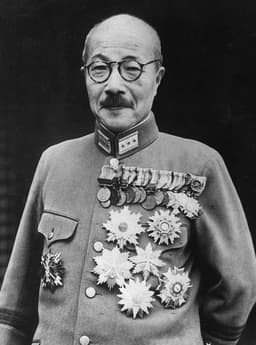
Hideki Tojo
General · Modern
53.9Total
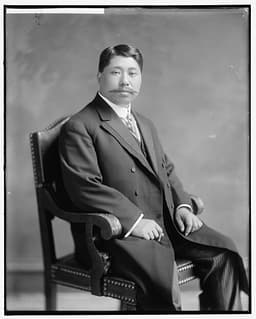
Huang Xing
General · Modern
57.5Total
Basic Information
Born
1884
1874
Died
1948
1916
Era
Modern
Modern
Nationality
Japan
China
Occupation
General
General
Civilization
Eastern
Eastern
Score Comparison
Military (10%)
70.0
46.7
Political (20%)
48.0
53.8
Influence (20%)
55.0
62.0
Legacy (20%)
50.0
56.0
Leadership (15%)
53.2
62.0
Strategy (15%)
55.0
60.0
TOTAL
53.9
57.5
Hideki Tojo — Complete Timeline
1941 AD
Attack on Pearl HarborWar
As Prime Minister, Hideki Tojo authorized the attack on the US naval base at Pearl Harbor, Hawaii. The surprise attack brought the United States into World War II. Tojo's decision was based on the belief that war with the US was inevitable due to resource embargoes and diplomatic failures.
World War IIPearl HarborUS-Japan War
Impact: globaldestructive
Appointment as Prime MinisterPolitical Action◆ Major
Hideki Tojo was appointed Prime Minister of Japan, replacing Fumimaro Konoe. He retained his position as Army Minister and later took on other portfolios, consolidating power. His appointment marked the ascendancy of the military faction in the Japanese government and the shift towards total war.
Prime MinisterMilitary GovernmentWorld War II
Impact: national
1942 AD
Fall of SingaporeWar◆ Major
Under Tojo's leadership, Japanese forces captured Singapore from the British in a swift campaign. The fall of Singapore was one of the worst British military defeats in history. It demonstrated Japanese military prowess and led to the occupation of a key strategic location in Southeast Asia.
World War IISingaporeJapanese Victory
Impact: global
1948 AD
Execution by the International Military Tribunal for the Far EastPolitical Action◆ Major
Hideki Tojo was found guilty of war crimes by the International Military Tribunal for the Far East and sentenced to death. He was executed by hanging on December 23, 1948. His trial and execution symbolized the Allied effort to hold Japanese leaders accountable for wartime atrocities.
War CrimesExecutionTokyo Trials
Impact: globaltragic
Huang Xing — Complete Timeline
1905 AD
Co-founded the TongmenghuiPolitical Action◆ Major
Huang Xing co-founded the Tongmenghui (Revolutionary Alliance) in Tokyo with Sun Yat-sen. He became its military leader, organizing armed uprisings against the Qing dynasty.
TongmenghuiRevolutionMilitary
Impact: nationalconstructive
1911 AD
Led the Wuchang UprisingWar
Huang Xing led the Wuchang Uprising, which sparked the Xinhai Revolution. He commanded revolutionary forces against Qing troops, securing initial victories that led to the dynasty's collapse.
Xinhai RevolutionUprisingMilitary
Impact: nationalconstructive
1912 AD
Served as Minister of War in the RepublicPolitical Action◆ Major
Huang Xing served as Minister of War in the provisional government of the Republic of China. He worked to organize a national army and defend the republic against counter-revolutionary forces.
GovernmentMilitaryRepublic
Impact: nationalconstructive
1913 AD
Led the Second Revolution Against Yuan ShikaiWar◆ Major
Huang Xing led the Second Revolution, an armed uprising against President Yuan Shikai's authoritarian rule. The rebellion failed due to lack of coordination and military inferiority, forcing Huang into exile.
Second RevolutionYuan ShikaiExile
Impact: nationaltragic
1916 AD
Died in Exile in ShanghaiPolitical Action
Huang Xing died in Shanghai after returning from exile in Japan and the United States. His death marked the loss of a key military leader of the Chinese revolution, though his legacy endured.
DeathExileRevolution
Impact: nationaltragic
Expert Analysis
Huang Xing vs Hideki Tojo
# The General and the Revolutionary
In the winter of 1948, Hideki Tojo knelt in a Tokyo prison, awaiting the hangman’s noose. Half a world away, Huang Xing had died thirty-two years earlier, his body laid to rest in Shanghai with the quiet dignity of a man who had fought for a republic that never fully arrived. Both were generals. Both came from Eastern civilizations shattered by modernity. But one ended as a war criminal, the other as a forgotten founder. What makes two men, born only a decade apart, walk such divergent paths?
Origins
Hideki Tojo was born in 1884 into a samurai lineage that had already lost its feudal purpose. His father, a lieutenant general in the Imperial Japanese Army, drilled into him the virtues of obedience, sacrifice, and imperial loyalty. Tojo grew up in a Japan racing to industrialize, its elite obsessed with catching the West through military might. He was not brilliant—his grades were average—but he was relentless. The army became his church, and the emperor his god.
Huang Xing, born ten years earlier in 1874, came from a different China. The Qing Empire was rotting from within, humiliated by foreign concessions and internal rebellions. His family was scholarly, not military; he passed the imperial civil service exams as a young man. But the Boxer Rebellion and the crushing of reform movements radicalized him. Where Tojo found order in the army, Huang Xing found purpose in revolution. He fled to Japan in 1902, studying military tactics not to serve a throne, but to destroy one.
Rise to Power
Tojo’s ascent was methodical. He served as a military attaché in Germany, studied the Prussian war machine, and climbed the ranks through bureaucratic competence. By 1937, he was chief of staff of the Kwantung Army in Manchuria, a hotbed of militarist ambition. His loyalty to the emperor and his hawkish stance on expansion made him indispensable. When Prime Minister Konoe resigned in 1941, unable to navigate the war-or-peace dilemma, Tojo stepped in. He did not seize power; it was handed to him by a system that had already chosen war.
Huang Xing’s rise was the opposite—chaotic, improvised, and fueled by desperation. In 1905, he co-founded the Tongmenghui with Sun Yat-sen in Tokyo, becoming the revolutionary alliance’s military chief. Unlike Sun, who was an exile and an idealist, Huang Xing was a man of action. He organized uprisings that failed again and again: in 1907, 1908, 1910. Each failure taught him something. When the Wuchang Uprising finally succeeded in 1911, it was not because of a master plan, but because a bomb accidentally exploded in a Russian concession, forcing the revolutionaries’ hand. Huang Xing rushed to Wuchang to lead the rag-tag army against Qing forces. He won not through superior strategy, but through sheer will.
Leadership & Governance
Tojo’s leadership was that of a manager of destruction. As prime minister, he micromanaged the war effort, demanding reports on everything from troop movements to rice rations. He was not a charismatic speaker; his speeches were dry, bureaucratic. But he understood power: he kept the Army Ministry, purged dissenters, and created the Imperial Rule Assistance Association to crush political opposition. His military record was mixed—the fall of Singapore in 1942 was a stunning victory, but his insistence on attacking Pearl Harbor in 1941 was a strategic gamble that assumed American weakness. He was a tactician, not a strategist. When the tide turned, he had no backup plan.
Huang Xing’s governance was the opposite. As Minister of War in the provisional republic in 1912, he tried to build a national army from scratch—a task impossible in a China still ruled by warlords and foreign concessions. He was a democrat by instinct, believing that the republic needed civilian control. But Yuan Shikai, the former Qing general turned president, had other plans. Huang Xing led the Second Revolution in 1913 to stop Yuan’s authoritarian drift. It failed. He fled into exile, his dream of a unified republic shattered. His governance was not about holding power; it was about trying to create the conditions for power to be legitimate.
Triumph & Tragedy
Tojo’s greatest moment was also his greatest trap. The attack on Pearl Harbor on December 7, 1941, was a tactical masterpiece that awoke a sleeping giant. He never understood that war is not a game of opening moves. His tragedy was the slow, grinding defeat of Japan from 1943 onward—the firebombing of Tokyo, the loss of Saipan, the atomic bombs. He was forced to resign in 1944, a broken man. His execution in 1948 was not just punishment; it was a verdict on an entire system of militarism.
Huang Xing’s triumph was the Wuchang Uprising. He led from the front, wounded in battle, and his courage inspired the revolutionaries to hold the city against Qing counterattacks. But his tragedy was that the republic he helped birth was stillborn. Yuan Shikai crushed the Second Revolution, and Huang Xing spent his final years in exile, watching China descend into warlord chaos. He died in 1916 at forty-two, of a stomach hemorrhage, worn out by failure. His last words were said to be: “The republic must live.”
Character & Destiny
Tojo was a man of rigid certainty. He believed in hierarchy, discipline, and the divine right of Japan to dominate Asia. This certainty made him effective in a system that demanded obedience, but it also blinded him. He could not imagine defeat because he could not question the emperor’s destiny. His personality was the perfect instrument for a nation that had lost its moral compass.
Huang Xing was a man of doubt and action. He was not a theorist like Sun Yat-sen; he was a doer who learned from failure. But his doubt made him hesitant in politics. He trusted Yuan Shikai too long, and he failed to build a power base. His destiny was to be the sword that others wielded, never the hand that held it.
Legacy
Tojo’s legacy is a warning. In Japan, he is a symbol of the madness of militarism, a name invoked to condemn war. His execution was a ritual of closure, but the questions he raised—about nationalism, about obedience, about the cost of empire—remain unanswered.
Huang Xing’s legacy is more ambiguous. He is remembered as a co-founder of the republic, but Sun Yat-sen overshadows him. In mainland China, he is a footnote; in Taiwan, a hero. His failure to build a stable republic haunted China for decades. But his life posed a different question: What does it mean to fight for freedom when the world is not ready for it?
Conclusion
Two generals, two Easts. Tojo inherited a Japan that was already on a path to war; Huang Xing inherited a China that was already collapsing. One chose to ride the tiger of militarism; the other tried to tame the dragon of revolution. Tojo’s tragedy was that he succeeded too well; Huang Xing’s was that he failed too soon. Their stories remind us that history is not a moral fable. It is a series of choices made by men who could not see the future, but who shaped it anyway.
Rankings
🥇
Huang XingLeader
Mil: 46.7Pol: 53.8Inf: 62.0
57.5
🥈
Hideki Tojo
Mil: 70.0Pol: 48.0Inf: 55.0
53.9
+3.6 behind
How This Comparison Works
Algorithm
Each figure is scored on 6 dimensions (0—100 scale) based on structured historical data: Military (10%), Political (20%), Influence (20%), Legacy (20%), Leadership (15%), Strategy (15%). The weighted total produces the final ranking.
Data Sources
Scores are computed from structured sub-indicators in the database. Scale factors adjust for era (Ancient ×0.85, Modern ×1.0) and civilization size (Eastern ×1.05, Other ×0.80) to account for differences in population and military scale.
Maximum 3 Figures
Comparisons are limited to 2—3 figures to ensure readability and statistical meaningfulness.
Error Margins
±5 points per dimension — Sub-scores are derived from historical records with inherent uncertainty. Two figures within 5 points on a dimension should be considered roughly equivalent in that area.
Total Score Accuracy
±3 points overall — The weighted combination of 6 dimensions produces a total score with approximately ±3 points of uncertainty. Differences of less than 3 points are not statistically significant— the figures are effectively tied.
Known Limitations
- Historical records are incomplete and uneven across civilizations
- Figures from oral-tradition societies may be underrepresented
- Occupation labels can misclassify multi-role figures
- Scores measure capability and impact, not moral character
- Quantitative scoring is a comparison tool, not absolute truth
Capability Radar
Military (10%) — Battles & Warfare
Battles
65
35
Win Rate
40
30
Expansion
70
20
Political (20%) — Governance & Reform
Reform
30
60
Diplomacy
35
55
Economy
25
30
Influence (20%) — Cultural & Global Reach
Cultural
30
40
Global
55
40
Legacy (20%) — Historical Impact
Historical
55
55
Longevity
40
45
Leadership (15%) — Power & Stability
Tenure
60
40
Stability
20
25
Strategy (15%) — Tactics & Innovation
Strategy
50
45
Tactics
55
40
Reform
45
50
Similar Comparisons
Comments & Discussion
古典学究6/16/2026
托尔金的父亲是帝国军中将,但日本武士道传统早已被现代化解构——他不过是穿了军装的官僚。黄兴考过科举,却成为革命党,这才是东亚知识分子的典型裂变:要么内化秩序,要么暴力破局。一个细节值得玩味:黄兴在日本学习军事时,正值日俄战争日本获胜,他亲眼目睹了"小国战胜帝国"的震撼。这彻底摧毁了他对西方文明优越论的迷信,转而相信亚洲可以自力更生。托尔金看到的是同一场战争,结论却是"必须比西方更残忍"。同源异流,只在一念之间。|
Memory Hole Digger6/16/2026
The summary conveniently omits that Tojo was executed for crimes against humanity while Huang Xing's anti-Manchu purges get romanticized as "revolution." Historical amnesia at its finest. Huang Xing's Tongmenghui explicitly called for racial extermination of Manchus in their 1906 manifesto—that's ethnic cleansing rhetoric. Tojo's Unit 731 had better documentation, sure, but morally they both prioritized national purification over human life. The difference is one side wrote the history books. Le
铁血考古员6/16/2026
完全同意黄兴被低估了——但原因不是东条英机有多坏,而是民国史被刻意边缘化。黄兴在1911年武汉保卫战中以三千临时民兵对抗北洋军两万精锐,靠的是地形改造和民间动员体系,这是现代游击战的雏形。他比毛泽东早二十年实践"全民战争"。讽刺的是,他被后来者蔡锷、蒋介石、毛泽东依次超越并遗忘。托尔金至少留下了"珍珠港"这页历史标签,黄兴却连教科书都懒得认真写。文明的残酷在于:战犯的污名比革命者的墓碑更持久。|
Underground Railroad Sage6/16/2026
我唯一想补充的是:两人对"现代化"的定义完全不同。黄兴去日本学的是君主立宪和议会武装造反等工具理性,骨子里仍是"中学为体"的改良派。托尔金学的却是普鲁士军国主义原教旨——他1937年
Chronicler91036/16/2026
The analysis frames them as opposites, but look closer: both were hyper-militarized responses to modernization trauma. Tojo's "average grades" actually prove my point—he was a bureaucrat-warrior, not a tactical genius. Huang Xing's civil service background makes him equally establishment. The divergence isn't moral character; it's institutional capture. Tojo got swallowed by Imperial Japan's fascist machinery; Huang Xing died before his revolution could corrupt him. Statistics show 80% of revolu