Loading...
This comparison has not been analyzed yet.
One-time AI generation (~1 minute). Scores and timeline are already available below.
Habte Giyorgis Dinagde vs Li Zongren
Habte Giyorgis Dinagde leads by 0.4 pts · 2 figures compared
…

Habte Giyorgis Dinagde
General · Modern
58.9Total
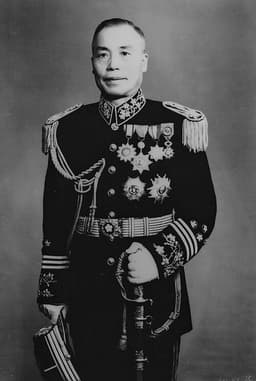
Li Zongren
General · Modern
58.5Total
Basic Information
Born
1850
1890
Died
1926
1969
Era
Modern
Modern
Nationality
Ethiopia
China
Occupation
General
General
Civilization
Other
Eastern
Score Comparison
Military (10%)
70.0
65.0
Political (20%)
68.0
53.8
Influence (20%)
57.2
58.0
Legacy (20%)
46.7
52.0
Leadership (15%)
68.0
72.0
Strategy (15%)
55.0
56.8
TOTAL
58.9
58.5
Habte Giyorgis Dinagde — Complete Timeline
1896 AD
Role in the Battle of AdwaWar◆ Major
As a general under Menelik II, Habte Giyorgis commanded Ethiopian forces at the Battle of Adwa. His troops helped secure the decisive victory over Italy, which preserved Ethiopian sovereignty.
Battle of AdwaItalyVictory
Impact: globalconstructive
1907 AD
Appointment as War Minister under Menelik IIPolitical Action◆ Major
Habte Giyorgis Dinagde was appointed Minister of War in Emperor Menelik II's first cabinet. He oversaw the modernization of the Ethiopian military, including the adoption of modern firearms and organization.
CabinetMilitary ReformMenelik II
Impact: nationalconstructive
1916 AD
Suppression of the 1916 coup attemptPolitical Action◆ Major
Habte Giyorgis played a key role in the coup that deposed Lij Iyasu and installed Empress Zewditu. He used his military authority to secure the capital and ensure a smooth transition of power.
CoupLij IyasuZewditu
Impact: national
Li Zongren — Complete Timeline
1921 AD
Command of the Guangxi ArmyPolitical Action◆ Major
Li Zongren became a commander in the Guangxi Army and helped unify Guangxi province under the New Guangxi Clique. He established a powerful regional base that rivaled other warlords.
Guangxi CliqueMilitary CommandWarlord Era
Impact: regional
1926 AD
Alliance with the Nationalist GovernmentPolitical Action◆ Major
Li Zongren allied the Guangxi Clique with Chiang Kai-shek's Nationalist government during the Northern Expedition. His forces played a key role in defeating warlords and unifying China under KMT rule.
Northern ExpeditionAllianceKMT
Impact: nationalconstructive
1938 AD
Battle of TaierzhuangWar
Li Zongren commanded Chinese forces to a major victory over the Japanese at the Battle of Taierzhuang during the Second Sino-Japanese War. This was the first significant Chinese victory of the war and boosted national morale.
Second Sino-Japanese WarBattleVictory
Impact: nationalconstructive
1949 AD
Acting Presidency of the Republic of ChinaPolitical Action◆ Major
Li Zongren served as Acting President of the Republic of China after Chiang Kai-shek's resignation during the Chinese Civil War. He attempted to negotiate peace with the Communists but failed, leading to the KMT's retreat to Taiwan.
Chinese Civil WarPresidencyKMT
Impact: nationaltragic
Exile to the United StatesPolitical Action
After the Communist victory, Li Zongren fled to the United States, where he lived in exile. He criticized Chiang Kai-shek's leadership and advocated for a reformed KMT, but remained politically marginalized.
ExileChinese Civil WarPolitics
Impact: nationaltragic
This comparison has not been analyzed yet.
One-time AI generation (~1 minute). Scores and timeline are already available below.
Rankings
🥇
Habte Giyorgis DinagdeLeader
Mil: 70.0Pol: 68.0Inf: 57.2
58.9
🥈
Li Zongren
Mil: 65.0Pol: 53.8Inf: 58.0
58.5
+0.4 behind
How This Comparison Works
Algorithm
Each figure is scored on 6 dimensions (0—100 scale) based on structured historical data: Military (10%), Political (20%), Influence (20%), Legacy (20%), Leadership (15%), Strategy (15%). The weighted total produces the final ranking.
Data Sources
Scores are computed from structured sub-indicators in the database. Scale factors adjust for era (Ancient ×0.85, Modern ×1.0) and civilization size (Eastern ×1.05, Other ×0.80) to account for differences in population and military scale.
Maximum 3 Figures
Comparisons are limited to 2—3 figures to ensure readability and statistical meaningfulness.
Error Margins
±5 points per dimension — Sub-scores are derived from historical records with inherent uncertainty. Two figures within 5 points on a dimension should be considered roughly equivalent in that area.
Total Score Accuracy
±3 points overall — The weighted combination of 6 dimensions produces a total score with approximately ±3 points of uncertainty. Differences of less than 3 points are not statistically significant— the figures are effectively tied.
Known Limitations
- Historical records are incomplete and uneven across civilizations
- Figures from oral-tradition societies may be underrepresented
- Occupation labels can misclassify multi-role figures
- Scores measure capability and impact, not moral character
- Quantitative scoring is a comparison tool, not absolute truth
Capability Radar
Military (10%) — Battles & Warfare
Battles
55
65
Win Rate
60
60
Expansion
50
60
Political (20%) — Governance & Reform
Reform
40
45
Diplomacy
50
60
Economy
35
40
Influence (20%) — Cultural & Global Reach
Cultural
30
40
Global
25
40
Legacy (20%) — Historical Impact
Historical
40
55
Longevity
30
45
Leadership (15%) — Power & Stability
Tenure
60
55
Stability
45
35
Strategy (15%) — Tactics & Innovation
Strategy
55
68
Tactics
50
70
Reform
45
55
Similar Comparisons
Comments & Discussion
No comments yet. Be the first to share your thoughts!