Loading...
Afonso de Albuquerque vs Li Zongren
Afonso de Albuquerque leads by 21.1 pts · 2 figures compared
…
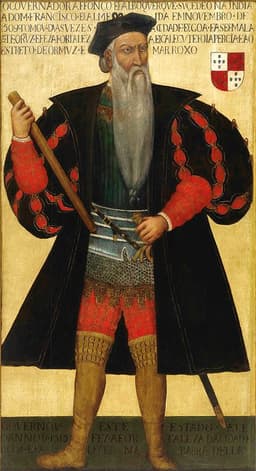
Afonso de Albuquerque
General · Medieval
79.6Total
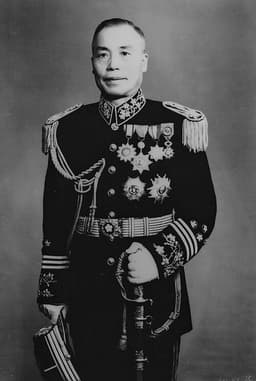
Li Zongren
General · Modern
58.5Total
Basic Information
Born
1453
1890
Died
1515
1969
Era
Medieval
Modern
Nationality
Portugal
China
Occupation
General
General
Civilization
Western
Eastern
Score Comparison
Military (10%)
77.5
65.0
Political (20%)
88.0
53.8
Influence (20%)
80.0
58.0
Legacy (20%)
75.0
52.0
Leadership (15%)
78.0
72.0
Strategy (15%)
82.0
56.8
TOTAL
79.6
58.5
Afonso de Albuquerque — Complete Timeline
1503 AD
First voyage to IndiaWar◆ Major
Afonso de Albuquerque led a fleet to India, establishing the first Portuguese fort at Cochin. This voyage laid the foundation for Portuguese control of the Indian Ocean trade.
ExplorationColonialismIndia
Impact: global
1510 AD
Conquest of GoaWar◆ Major
Albuquerque captured Goa from the Sultan of Bijapur. He made Goa the capital of Portuguese India, a position it held for over 400 years.
ConquestColonialismIndia
Impact: regional
1511 AD
Conquest of MalaccaWar◆ Major
Albuquerque led a Portuguese fleet to capture the strategic port of Malacca. This gave Portugal control of the spice trade route between the Indian Ocean and the Pacific.
ConquestSpice TradeSoutheast Asia
Impact: global
1513 AD
Siege of AdenWar
Albuquerque attempted to capture Aden in Yemen but failed. This failure prevented Portugal from controlling the entrance to the Red Sea and limited their influence in the region.
SiegeFailureRed Sea
Impact: regional
1515 AD
Death at seaOther◆ Major
Afonso de Albuquerque died at sea off the coast of Goa, possibly from illness or poison. His death left the Portuguese Empire in the Indian Ocean without its most capable leader.
DeathLeadershipEmpire
Impact: regionaltragic
Li Zongren — Complete Timeline
1921 AD
Command of the Guangxi ArmyPolitical Action◆ Major
Li Zongren became a commander in the Guangxi Army and helped unify Guangxi province under the New Guangxi Clique. He established a powerful regional base that rivaled other warlords.
Guangxi CliqueMilitary CommandWarlord Era
Impact: regional
1926 AD
Alliance with the Nationalist GovernmentPolitical Action◆ Major
Li Zongren allied the Guangxi Clique with Chiang Kai-shek's Nationalist government during the Northern Expedition. His forces played a key role in defeating warlords and unifying China under KMT rule.
Northern ExpeditionAllianceKMT
Impact: nationalconstructive
1938 AD
Battle of TaierzhuangWar
Li Zongren commanded Chinese forces to a major victory over the Japanese at the Battle of Taierzhuang during the Second Sino-Japanese War. This was the first significant Chinese victory of the war and boosted national morale.
Second Sino-Japanese WarBattleVictory
Impact: nationalconstructive
1949 AD
Acting Presidency of the Republic of ChinaPolitical Action◆ Major
Li Zongren served as Acting President of the Republic of China after Chiang Kai-shek's resignation during the Chinese Civil War. He attempted to negotiate peace with the Communists but failed, leading to the KMT's retreat to Taiwan.
Chinese Civil WarPresidencyKMT
Impact: nationaltragic
Exile to the United StatesPolitical Action
After the Communist victory, Li Zongren fled to the United States, where he lived in exile. He criticized Chiang Kai-shek's leadership and advocated for a reformed KMT, but remained politically marginalized.
ExileChinese Civil WarPolitics
Impact: nationaltragic
Expert Analysis
Afonso de Albuquerque vs Li Zongren
# The Conqueror and the Warlord: Two Paths to Power in Two Different Worlds
On a stormy December night in 1515, a Portuguese fleet lay anchored off the coast of Goa. Inside his cabin, Afonso de Albuquerque, the man who had built an empire from the deck of a ship, lay dying. He was feverish, delirious, and convinced—perhaps rightly—that his own king had ordered his poisoning. Meanwhile, nearly four centuries later and half a world away, a young Chinese officer named Li Zongren was just beginning to grasp the brutal realities of warlord politics in a crumbling empire. One man had conquered oceans; the other would spend his life trying to hold together a nation that was tearing itself apart. Their stories, separated by time and culture, pose a question that haunts history: What makes a leader succeed—and what makes him fail?
Origins
Albuquerque was born into the Portuguese nobility in 1453, the year Constantinople fell to the Ottomans. Europe was awakening to a world beyond its shores, and Portugal was leading the charge. His father was a loyal servant of the crown; his uncles had fought in the wars of North Africa. From childhood, Albuquerque absorbed the ethos of a crusading kingdom—faith, glory, and gold were not separate ambitions but one unified calling. The sea was his classroom, and the Indian Ocean would become his canvas.
Li Zongren came into the world in 1890, in the twilight of China’s Qing Dynasty. He was born in Guangxi, a southern province known for its rugged terrain and fierce independence. The old order was dying, and no one knew what would replace it. Li grew up in a world of bandits, local militias, and constant violence. His father was a minor scholar-official, but the family had fallen on hard times. Unlike Albuquerque, who inherited a clear sense of mission, Li inherited chaos. He would have to invent his own path.
Rise to Power
Albuquerque’s rise was methodical and state-sponsored. He first sailed to India in 1503, commanding a fleet that established the first Portuguese fort at Cochin. The Portuguese crown was building an empire, and Albuquerque was its most capable instrument. He was not a charismatic leader in the modern sense—he was stern, often harsh, and utterly relentless. But he understood something that his rivals did not: that control of the sea routes was worth more than any single battle. By 1509, he had been appointed Governor of Portuguese India, with a mandate to break the Muslim monopoly on the spice trade.
Li Zongren’s rise was more chaotic, more personal, and far more dangerous. In 1921, he became a commander in the Guangxi Army, a force that was less a national army than a private militia. He helped unify Guangxi under the New Guangxi Clique, a coalition of local warlords who promised order and reform. Li was a pragmatist in a world of ideologues. He allied with Chiang Kai-shek’s Nationalist government in 1926, joining the Northern Expedition that aimed to unify China. But alliances in warlord China were never permanent. Li would spend the next two decades navigating a labyrinth of betrayal, shifting loyalties, and open war.
Leadership & Governance
Albuquerque governed like a man building a fortress. In 1510, he captured Goa from the Sultan of Bijapur and made it the capital of Portuguese India—a position it would hold for over four centuries. He understood that empire required more than conquest; it required administration. He encouraged Portuguese men to marry local women, established a municipal government, and built a navy that could project power across the Indian Ocean. His strategy was simple but brutal: seize the choke points of global trade, and hold them at any cost. In 1511, he captured Malacca, the gateway to the Spice Islands. It was a masterstroke of naval warfare and geopolitical vision.
Li Zongren led differently. He was a general who commanded through personal loyalty, not bureaucratic machinery. His greatest military achievement came in 1938, at the Battle of Taierzhuang, where he led Chinese forces to a major victory over the Japanese. It was the first significant Chinese victory of the Second Sino-Japanese War, and it made Li a national hero. But victory on the battlefield could not solve the deeper problems of Chinese politics. Li was a warlord in an era that demanded nation-builders. He could win battles, but he could not create institutions.
Triumph & Tragedy
Albuquerque’s greatest triumph was the conquest of Malacca. It gave Portugal control of the spice trade and established a network of forts that stretched from East Africa to the South China Sea. But his greatest failure was the Siege of Aden in 1513. He attempted to capture the port city in Yemen, which would have given Portugal control of the entrance to the Red Sea. He failed, and that failure meant the Ottoman Empire could still threaten Portuguese interests. It was a rare strategic miscalculation, and it haunted him.
Li Zongren’s triumph was Taierzhuang. It was a moment of pure military brilliance, a battle that proved Chinese forces could defeat the Japanese in open combat. But his tragedy came in 1949, when he served as Acting President of the Republic of China after Chiang Kai-shek’s resignation during the Chinese Civil War. Li was left holding a sinking ship. The Communists were advancing, the Nationalist government was collapsing, and no amount of personal loyalty could stop the tide. He fled to the United States, where he lived in exile, criticizing Chiang from afar.
Character & Destiny
Albuquerque was a man of iron will and limited imagination. He saw the world in black and white: Christian versus Muslim, Portuguese versus everyone else. That clarity made him effective but also inflexible. He died at sea in 1515, possibly poisoned, possibly from illness. His last letter to the king begged for justice for his family. He never received a reply.
Li Zongren was more complex—a pragmatist in an age of extremes. He could fight alongside Communists against the Japanese, then turn against them. He could serve as Chiang’s ally, then criticize him from exile. This flexibility kept him alive but also made him a figure of ambiguity. He returned to China in 1965, under Communist rule, and died in Beijing in 1969. He had outlived his era.
Legacy
Albuquerque left behind an empire. The Portuguese Estado da Índia would endure for centuries, shaping the history of Asia and Europe. His legacy is carved in stone and saltwater—in the forts of Goa, the churches of Malacca, and the trade routes that connected the world.
Li Zongren left behind a memory. He is remembered in China as a patriot who fought the Japanese, but also as a warlord who could not save his country. His legacy is more ambiguous, more human. He was a man caught between worlds—the old China of warlords and the new China of nation-states—and he belonged fully to neither.
Conclusion
Albuquerque built an empire because he lived in an age when empires were possible. He had the backing of a unified state, a clear ideology, and a world that could still be conquered from the deck of a ship. Li Zongren tried to hold together a nation that was breaking apart, with no such certainty and no such support. One man’s tragedy was that he died too soon; the other’s was that he lived long enough to see his world disappear. In the end, both were prisoners of their time—and that is the deepest lesson history has to offer.
Rankings
🥇
Afonso de AlbuquerqueLeader
Mil: 77.5Pol: 88.0Inf: 80.0
79.6
🥈
Li Zongren
Mil: 65.0Pol: 53.8Inf: 58.0
58.5
+21.1 behind
How This Comparison Works
Algorithm
Each figure is scored on 6 dimensions (0—100 scale) based on structured historical data: Military (10%), Political (20%), Influence (20%), Legacy (20%), Leadership (15%), Strategy (15%). The weighted total produces the final ranking.
Data Sources
Scores are computed from structured sub-indicators in the database. Scale factors adjust for era (Ancient ×0.85, Modern ×1.0) and civilization size (Eastern ×1.05, Other ×0.80) to account for differences in population and military scale.
Maximum 3 Figures
Comparisons are limited to 2—3 figures to ensure readability and statistical meaningfulness.
Error Margins
±5 points per dimension — Sub-scores are derived from historical records with inherent uncertainty. Two figures within 5 points on a dimension should be considered roughly equivalent in that area.
Total Score Accuracy
±3 points overall — The weighted combination of 6 dimensions produces a total score with approximately ±3 points of uncertainty. Differences of less than 3 points are not statistically significant— the figures are effectively tied.
Known Limitations
- Historical records are incomplete and uneven across civilizations
- Figures from oral-tradition societies may be underrepresented
- Occupation labels can misclassify multi-role figures
- Scores measure capability and impact, not moral character
- Quantitative scoring is a comparison tool, not absolute truth
Capability Radar
Military (10%) — Battles & Warfare
Battles
85
65
Win Rate
80
60
Expansion
95
60
Political (20%) — Governance & Reform
Reform
80
45
Diplomacy
85
60
Economy
80
40
Influence (20%) — Cultural & Global Reach
Cultural
70
40
Global
85
40
Legacy (20%) — Historical Impact
Historical
85
55
Longevity
80
45
Leadership (15%) — Power & Stability
Tenure
70
55
Stability
65
35
Strategy (15%) — Tactics & Innovation
Strategy
95
68
Tactics
90
70
Reform
75
55
Similar Comparisons
Comments & Discussion
SeaLord Casus Belli6/16/2026
Albuquerque wasn't just conquering ports, he was building a *blue-water empire* from scratch with 1,500 men and a shoestring budget. Li Zongren inherited a fractured army and fought his own countrymen in endless civil wars. One seized Malacca, Ormuz, and Goa at gunpoint; the other couldn't even hold Pingjin without massive defections. Give me the Portuguese hurricane any day—he changed the world, not just his province.
铁血考据菌6/16/2026
Li Zongren的台儿庄大捷确实漂亮,但别忘了那是1938年,日军还没全面机械化展开。对比Albuquerque1511年占领马六甲时,只用18艘船和800人就完成了跨海奇袭。李宗仁的成就更多是战术层面的游击智慧,而阿尔布开克是真正重构了印度洋贸易体系。差距不在勇气,在格局。
Prince of Perpetual Motion6/16/2026
Let's be honest: Li Zongren's greatest strategic move was resisting Chiang Kai-shek, not fighting Japan. He spent more energy on warlord backroom deals than on actual national defense. Meanwhile Albuquerque orchestrated the fall of Goa with a fake surrender ruse, bribed local rulers, and married off his men to Hindu widows for loyalty. One man plays Risk, the other plays chess with actual empires as pieces.
南明遗民6/16/2026
你们这些欧洲中心论者永远不懂,李宗仁面对的敌人不是葡萄牙的雇佣兵,而是欧洲列强和日本的双重碾压。Albuquerque能绑票苏丹、烧杀劫掠,李宗仁却要在列强租界和军阀割据的夹缝中求存。1916年滇桂战争时他才26岁,已经要在三面受敌中找活路。把阿尔布开克放在1920年代的中国,他连一个小县城都打不下来。
Heresiarch of Empire6/16/2026
Albuquerque was a brilliant pirate with a navy, let's not romanticize this. He burned Calicut to the ground, massacred prisoners, and effectively created the Portuguese monopoly on spice trade through terror. Li Zongren, for all his flaws, actually understood that victory requires political legitimacy—his Guangxi reconstruction plans, local tax reforms, and anti-corruption campaigns were *real* statecraft. One man conquered by fear; the other ruled by consent. I know which legacy I'd rather inhe