Loading...
Fuad Chehab vs Prem Tinsulanonda
Prem Tinsulanonda leads by 7.3 pts · 2 figures compared
…
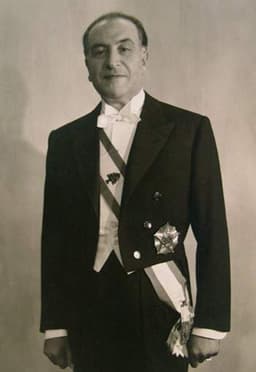
Fuad Chehab
General · Modern
49.9Total
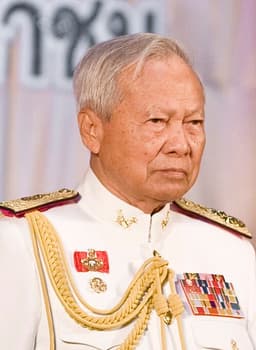
Prem Tinsulanonda
General · Modern
57.2Total
Basic Information
Born
1902
1920
Died
1973
—
Era
Modern
Modern
Nationality
Lebanon
Thailand
Occupation
General
General
Civilization
Middle Eastern
Eastern
Score Comparison
Military (10%)
10.2
50.0
Political (20%)
70.0
59.3
Influence (20%)
54.1
54.9
Legacy (20%)
44.2
47.5
Leadership (15%)
72.0
78.0
Strategy (15%)
30.3
60.0
TOTAL
49.9
57.2
Fuad Chehab — Complete Timeline
1958 AD
Launched Chehabist reforms and modernizationReform◆ Major
President Chehab implemented a series of reforms known as Chehabism, including administrative modernization, economic planning, and strengthening state institutions. He established the Central Bank of Lebanon and the Civil Service Board.
ReformModernizationState Building
Impact: nationalconstructive
Elected President of LebanonPolitical Action◆ Major
Fuad Chehab was elected President of Lebanon on September 23, 1958, succeeding Camille Chamoun. His election ended the 1958 crisis and was supported by both Christian and Muslim factions seeking stability.
PresidencyElectionStabilization
Impact: nationalconstructive
Created the Deuxième Bureau intelligence agencyPolitical Action
Chehab expanded the role of the Deuxi
IntelligenceSecurityAuthoritarianism
Impact: national
1960 AD
Presided over the 1960s economic boomOther
Under Chehab's presidency, Lebanon experienced a period of economic growth and stability, with Beirut becoming a major financial and tourism hub. His policies attracted foreign investment and expanded the middle class.
Economic GrowthBeirutProsperity
Impact: nationalconstructive
1964 AD
Refused to amend constitution for a second termPolitical Action
Chehab declined to seek a second term as president, respecting the constitutional limit. He retired from politics in 1964, setting a precedent for peaceful transitions of power in Lebanon.
ConstitutionTerm LimitRetirement
Impact: nationalconstructive
Prem Tinsulanonda — Complete Timeline
1980 AD
Appointed Prime Minister after a coupPolitical Action◆ Major
Prem Tinsulanonda was appointed Prime Minister of Thailand by the military after a coup. He served for over eight years, overseeing a period of political stability and economic growth.
Prime MinisterMilitary RuleStability
Impact: national
1981 AD
Survived a coup attemptPolitical Action◆ Major
Prem survived a coup attempt by military officers loyal to the 'Young Turks' faction. The coup failed due to lack of support and the loyalty of key military units, allowing Prem to remain in power.
Coup AttemptPolitical CrisisMilitary
Impact: national
1988 AD
Resigned as Prime MinisterPolitical Action◆ Major
Prem resigned as Prime Minister after the general election, handing over power to a civilian government led by Chatichai Choonhavan. His resignation marked a rare peaceful transition of power in Thai politics.
ResignationDemocratic TransitionPeaceful
Impact: nationalconstructive
2016 AD
Appointed Regent of ThailandPolitical Action
After the death of King Bhumibol, Prem was appointed Regent of Thailand until the ascension of King Maha Vajiralongkorn. He served as a key figure in the transition of the monarchy.
RegentMonarchyTransition
Impact: national
Expert Analysis
Fuad Chehab vs Prem Tinsulanonda
### The General as Statesman: Prem Tinsulanonda and Fuad Chehab
On a sweltering Bangkok afternoon in April 1981, General Prem Tinsulanonda sat in his office, waiting for news that would determine the fate of Thailand. Across the city, tanks rolled toward government buildings, commanded by the "Young Turks"—the very officers who had once supported him. In another world, a quarter-century earlier, a different general stood on the balcony of the Presidential Palace in Beirut, watching the smoke rise from the streets below. Lebanon was tearing itself apart in the 1958 crisis, and Fuad Chehab, the man who would soon be asked to stitch it back together, knew that the uniform he wore could not save his country. Two generals, two nations, two paths to power—and two very different answers to the same question: Can a soldier govern a democracy without destroying it?
### Origins
Prem Tinsulanonda was born in 1920 in Songkhla, a quiet coastal province in southern Thailand. His father was a civil servant, his mother a teacher—a modest, disciplined household that valued education and loyalty to the crown. By the time Prem graduated from the Chulachomklao Royal Military Academy, the world was at war, and Thailand was navigating the treacherous currents of Japanese occupation and post-colonial realignment. He learned early that survival meant patience and subtlety, not brute force.
Fuad Chehab, born in 1902 in Beirut, came from a different world entirely. His family was Maronite Christian aristocracy—his great-grandfather had been a governor, his uncle a patriarch. Lebanon was then part of the Ottoman Empire, a mosaic of sects and loyalties held together by imperial weight. Chehab trained at the French military academy at Saint-Cyr, absorbing the rationalism of the French Republic and the discipline of the colonial officer. When he returned home, Lebanon was a new nation, a fragile experiment in consociational democracy where every street corner whispered of sectarian tension.
### Rise to Power
Prem’s ascent was slow, careful, and deeply institutional. After serving in the Korean War and rising through the army’s bureaucracy, he became a trusted figure in the military establishment. When a coup in 1980 removed Prime Minister Kriangsak Chamanan, the generals looked for a man who could stabilize the country without alienating the civilian elite. They chose Prem—a general with no political party, no personal army, and a reputation for clean-handedness. He was appointed Prime Minister in March 1980, a soldier-politician who had never sought power but accepted it as duty.
Chehab’s rise was more dramatic, born of crisis. In 1958, Lebanon was engulfed in a civil war between Maronite Christians who wanted to align with the West and Muslims who demanded closer ties with Nasser’s Egypt. President Camille Chamoun called in U.S. Marines; the opposition called for his head. The compromise candidate was General Fuad Chehab, the army commander who had refused to order his troops to fire on civilians. He was elected president on September 23, 1958, not as a victor but as a mediator—a man trusted by both sides because he had shed no blood.
### Leadership & Governance
Prem governed not by decree but by consensus. He presided over a coalition of military factions, political parties, and the powerful monarchy of King Bhumibol Adulyadej. His style was quiet, almost monastic—he gave few speeches, avoided the spotlight, and let his ministers take credit. When the Young Turks tried to overthrow him in 1981, he did not counterattack with tanks; he fled to the northeastern city of Korat, rallied loyalist forces under the king’s implicit blessing, and waited for the coup to collapse under its own incompetence. It did. Prem understood that in Thailand, legitimacy flowed from the crown, not the gun.
Chehab, by contrast, was a reformer with a blueprint. He called his program "Chehabism"—a mix of state-led modernization, administrative rationalization, and political neutrality. He created the Deuxième Bureau, a military intelligence agency that spied on everyone—politicians, journalists, even clergymen—to prevent any faction from destabilizing the state. He pushed through economic planning, built roads and schools, and tried to reduce the staggering inequality between Beirut’s glittering coast and the impoverished countryside. But his reforms came at a cost: the Deuxième Bureau became a tool of surveillance, alienating the very groups he sought to unite.
### Triumph & Tragedy
Prem’s greatest triumph was not a battle but a transition. In 1988, after eight years in power, he called a general election, allowed the winner—Chatichai Choonhavan—to form a civilian government, and resigned without a single shot fired. It was the first peaceful transfer of power in Thailand in decades. His tragedy was quieter: by staying too close to the military and the monarchy, he never built a political party or a popular base. He became a kingmaker in the shadows, not a leader in the light.
Chehab’s triumph was the 1960s economic boom. Beirut became the "Paris of the Middle East," a hub of banking, tourism, and intellectual life. His tragedy was that he could not heal the sectarian wounds. By refusing to amend the constitution to seek a second term, he left office in 1964, and the fragile equilibrium he built collapsed into the abyss of the 1975-1990 civil war. The Deuxième Bureau became a symbol of repression; Chehabism became a memory.
### Character & Destiny
Prem was a man of restraint. He once said, "Power is like a shadow—if you chase it, it runs away. If you stand still, it follows you." His personality was defined by patience, loyalty to the king, and a deep aversion to personal ambition. This made him effective in a system where overt ambition was fatal. But it also meant he never challenged the structural flaws of Thai politics—the military’s veto power, the monarchy’s untouchable authority.
Chehab was a man of principle and anxiety. He believed in the state as a neutral arbiter, but he could not escape his own background as a Maronite general in a divided country. He once told an aide, "I am not a politician. I am a doctor trying to heal a patient who does not want to be cured." His destiny was to be the last honest man in a system built on lies.
### Legacy
Prem Tinsulanonda lived to be over 100, dying in 2019, a figure of immense influence even in old age. He served as regent after King Bhumibol’s death in 2016, a final act of loyalty. His legacy is mixed: hailed as a stabilizer, but also as the architect of a behind-the-scenes military monarchy that would later produce the coups of 2006 and 2014. He is remembered as the general who gave up power—but also as the man who taught the generals how to keep it.
Fuad Chehab died in 1973, before his country collapsed. In Lebanon, he is still revered as the "father of the state," a symbol of what could have been. His reforms are taught in schools; his portrait hangs in government offices. But the Deuxième Bureau is gone, and the state he tried to build is a ghost. He is remembered as the man who tried to save Lebanon from itself—and failed.
### Conclusion
Two generals, two countries, two visions of what a soldier can be in a democracy. Prem chose stability over reform, and Thailand survived. Chehab chose reform over stability, and Lebanon exploded. Neither was wrong; neither was right. They were both prisoners of their time, their culture, their history. In the end, the difference between them is not a matter of scores or strategies. It is the difference between a man who learned to live with the system and a man who tried to change it—and discovered that some systems are stronger than any general.
Rankings
🥇
Prem TinsulanondaLeader
Mil: 50.0Pol: 59.3Inf: 54.9
57.2
🥈
Fuad Chehab
Mil: 10.2Pol: 70.0Inf: 54.1
49.9
+7.3 behind
How This Comparison Works
Algorithm
Each figure is scored on 6 dimensions (0—100 scale) based on structured historical data: Military (10%), Political (20%), Influence (20%), Legacy (20%), Leadership (15%), Strategy (15%). The weighted total produces the final ranking.
Data Sources
Scores are computed from structured sub-indicators in the database. Scale factors adjust for era (Ancient ×0.85, Modern ×1.0) and civilization size (Eastern ×1.05, Other ×0.80) to account for differences in population and military scale.
Maximum 3 Figures
Comparisons are limited to 2—3 figures to ensure readability and statistical meaningfulness.
Error Margins
±5 points per dimension — Sub-scores are derived from historical records with inherent uncertainty. Two figures within 5 points on a dimension should be considered roughly equivalent in that area.
Total Score Accuracy
±3 points overall — The weighted combination of 6 dimensions produces a total score with approximately ±3 points of uncertainty. Differences of less than 3 points are not statistically significant— the figures are effectively tied.
Known Limitations
- Historical records are incomplete and uneven across civilizations
- Figures from oral-tradition societies may be underrepresented
- Occupation labels can misclassify multi-role figures
- Scores measure capability and impact, not moral character
- Quantitative scoring is a comparison tool, not absolute truth
Capability Radar
Military (10%) — Battles & Warfare
Battles
5
20
Win Rate
5
25
Expansion
5
10
Political (20%) — Governance & Reform
Reform
65
55
Diplomacy
60
60
Economy
50
50
Influence (20%) — Cultural & Global Reach
Cultural
30
30
Global
25
30
Legacy (20%) — Historical Impact
Historical
35
40
Longevity
30
35
Leadership (15%) — Power & Stability
Tenure
55
65
Stability
45
60
Strategy (15%) — Tactics & Innovation
Strategy
10
30
Tactics
10
30
Reform
20
35
Similar Comparisons
Comments & Discussion
BattleTactician886/16/2026
Prem proved that a general can stabilize a democracy by refusing to seize it—his slow-burn leadership during the 1981 coup failure was brilliant. He didn't need tanks; he had the king's backing and street-level patience. Chehab, though, botched Lebanon by trying to be Switzerland. In 1958, he alienated both Christians and Muslims with his neutral 'no victor, no vanquished' nonsense. You can't govern a sectarian powder keg by pretending it's a debating society. Prem knew when to wield soft power;
历史冷知识刺客6/16/2026
傅阿德·谢哈布根本不懂什么叫“秩序高于一切”。1958年黎巴嫩危机时,他居然拒绝用军队镇压反对派,说什么“不能让国家血流成河”——天真!相比之下,炳·廷素拉暖在1981年面对“青年军官团”政变时,果断联合王室和军方高层打心理战,最终兵不血刃。谢哈布所谓的“和解”让黎巴嫩陷入长期内战的温水煮青蛙模式,而炳的冷处理让泰国保持了十多年稳定。当将军的,有时候必须狠得下心。
ClassicsProf6/16/2026
Both men inherited impossible circumstances, but the comparison misses how each was shaped by their nation's political DNA. Prem operated within Thailand's sakdina system—a hierarchical loyalty framework that predates democracy—where a respected elder (like Prem) could mediate between monarch, military, and parliament. Chehab, however, stepped into Lebanon's consociational nightmare, where Maronite supremacy was already cracking. Chehab's 1960 presidential term tried to reform the civil service,
数据控的叛变6/16/2026
别被“将军治国”的光环骗了。炳的所谓“民主稳定”全靠军费开支维持——1970-1980年代泰国国防预算占GDP比例从2.5%飙到4.8%,但农村贫困率只降了3%。谢哈布更糟:他发起的“五年计划”让黎巴嫩GDP年均增长6%,但前1%的富裕阶层拿走了80%的收益。数据不会撒谎:两个人都用铁腕维持表面秩序,代价是底层被收割。将军的善意?不过是精英的遮羞布罢了。
RevisionistStance6/16/2026
Everyone loves Prem as the quiet savior, but let's not whitewash his legacy. He crushed the 1981 coup only to install his own cronies in the military hierarchy—the 'Democratic Soldier' myth is just that, a myth. Thai democracy under him was a façade where elections happened but real power stayed