Loading...
Fuad Chehab vs Yitzhak Rabin
Yitzhak Rabin leads by 16.5 pts · 2 figures compared
…
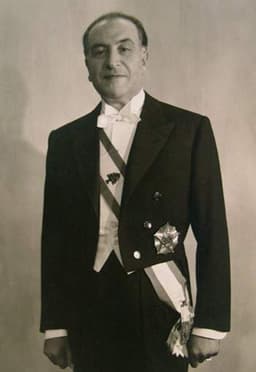
Fuad Chehab
General · Modern
49.9Total
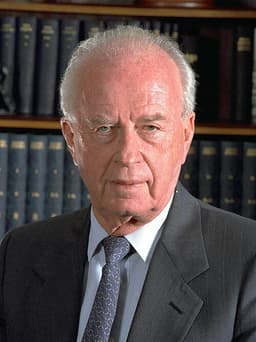
Yitzhak Rabin
General · Modern
66.4Total
Basic Information
Born
1902
1922
Died
1973
—
Era
Modern
Modern
Nationality
Lebanon
Israel
Occupation
General
General
Civilization
Middle Eastern
Middle Eastern
Score Comparison
Military (10%)
10.2
61.7
Political (20%)
70.0
82.0
Influence (20%)
54.1
68.0
Legacy (20%)
44.2
55.0
Leadership (15%)
72.0
78.0
Strategy (15%)
30.3
55.0
TOTAL
49.9
66.4
Fuad Chehab — Complete Timeline
1958 AD
Launched Chehabist reforms and modernizationReform◆ Major
President Chehab implemented a series of reforms known as Chehabism, including administrative modernization, economic planning, and strengthening state institutions. He established the Central Bank of Lebanon and the Civil Service Board.
ReformModernizationState Building
Impact: nationalconstructive
Elected President of LebanonPolitical Action◆ Major
Fuad Chehab was elected President of Lebanon on September 23, 1958, succeeding Camille Chamoun. His election ended the 1958 crisis and was supported by both Christian and Muslim factions seeking stability.
PresidencyElectionStabilization
Impact: nationalconstructive
Created the Deuxième Bureau intelligence agencyPolitical Action
Chehab expanded the role of the Deuxi
IntelligenceSecurityAuthoritarianism
Impact: national
1960 AD
Presided over the 1960s economic boomOther
Under Chehab's presidency, Lebanon experienced a period of economic growth and stability, with Beirut becoming a major financial and tourism hub. His policies attracted foreign investment and expanded the middle class.
Economic GrowthBeirutProsperity
Impact: nationalconstructive
1964 AD
Refused to amend constitution for a second termPolitical Action
Chehab declined to seek a second term as president, respecting the constitutional limit. He retired from politics in 1964, setting a precedent for peaceful transitions of power in Lebanon.
ConstitutionTerm LimitRetirement
Impact: nationalconstructive
Yitzhak Rabin — Complete Timeline
1967 AD
Chief of Staff during the Six-Day WarWar
As Chief of Staff of the Israel Defense Forces, Rabin commanded the Israeli military during the Six-Day War against Egypt, Jordan, and Syria. Israel captured the Sinai Peninsula, Gaza Strip, West Bank, East Jerusalem, and Golan Heights, reshaping the region.
Six-Day WarTerritorial ExpansionMilitary Victory
Impact: global
1993 AD
Signing of the Oslo AccordsPolitical Action
As prime minister, Rabin signed the Oslo Accords with PLO Chairman Yasser Arafat on the White House lawn. The agreement established the Palestinian Authority and set a framework for Palestinian self-governance in the West Bank and Gaza Strip.
Peace ProcessPalestiniansOslo
Impact: globalconstructive
1995 AD
Assassination at Peace RallyPolitical Action
Rabin was assassinated by Israeli extremist Yigal Amir after a peace rally in Tel Aviv. The assassination shocked Israel and the world, derailing the Oslo peace process and leading to a period of political instability.
AssassinationPeace ProcessPolitical Violence
Impact: globaltragic
Expert Analysis
Yitzhak Rabin vs Fuad Chehab
### The General and the Peacemaker
On a balmy November evening in 1995, Yitzhak Rabin folded a sheet of paper, slipped it into his breast pocket, and walked onto a floodlit stage in Tel Aviv. The crowd sang “Shir LaShalom” — “Song for Peace” — as he joined them, his voice a gravelly baritone. Moments later, three gunshots tore through the night, and Rabin crumpled to the asphalt, his blood soaking the song sheet. Half a world away and nearly four decades earlier, Fuad Chehab, a tall, austere general in a crisp uniform, took the oath of office in Beirut. He had no song, no crowd — only the wreckage of a civil war that had just ended. Where Rabin died for peace, Chehab built a peace that would die after him. Both were generals who became statesmen, but their paths diverged like the fates of their fragile nations.
### Origins
Rabin was born in Jerusalem in 1922 to a family of socialist Zionist pioneers. His mother, Rosa, was a fiery activist; his father, Nehemiah, a volunteer in the Jewish Legion. The boy grew up on a kibbutz, learning to shoot before he learned to negotiate. His world was one of siege and survival — a tiny Jewish state fighting for existence. Chehab, born in 1902, came from Lebanon’s feudal aristocracy: his family were Maronite Christian landowners with a tradition of military service under the Ottoman Empire. He was raised in a mountain village, schooled in French, and shaped by the delicate sectarian balance of a country where Christians, Muslims, and Druze coexisted in a tense, negotiated peace. Rabin’s Israel was a nation forged in war; Chehab’s Lebanon was a mosaic held together by compromise.
### Rise to Power
Rabin rose through the ranks of the Haganah, the Jewish underground army, and by 1967, as Chief of Staff of the Israel Defense Forces, he orchestrated one of the most stunning military campaigns of the 20th century: the Six-Day War. In June 1967, Israeli jets struck Egyptian airfields at dawn, and within days Rabin’s troops had captured the Sinai, the Golan Heights, and the Old City of Jerusalem. He became a national hero, but the victory carried a poison seed — occupation. Chehab’s rise was quieter. In 1958, Lebanon collapsed into a brief but bloody civil war between pro-Western Christians and Arab nationalist Muslims. As army commander, Chehab refused to let the military take sides, earning a reputation as a neutral arbiter. When President Camille Chamoun was forced out, the parliament elected Chehab as a compromise candidate. He took office on September 23, 1958, not as a conqueror, but as a surgeon stitching a wound.
### Leadership & Governance
Rabin’s leadership was that of a pragmatic soldier turned politician. As prime minister in the 1990s, he spoke in clipped, unadorned Hebrew. His military mind saw peace as a strategic necessity. On the White House lawn in 1993, he shook hands with Yasser Arafat, the man he had once called a terrorist, and signed the Oslo Accords. “Enough of blood and tears,” he said. But he governed by instinct, not ideology, and his security-obsessed style alienated both settlers and peaceniks. Chehab, by contrast, governed by system. He launched a program of reforms known as Chehabism: administrative modernization, economic planning, and the strengthening of state institutions. He built the Deuxième Bureau, a military intelligence agency that monitored politicians, journalists, and activists — a velvet glove over an iron fist. Lebanon boomed in the 1960s; Beirut became the Paris of the Middle East. But the price was surveillance and the freezing of sectarian grievances.
### Triumph & Tragedy
Rabin’s greatest triumph was also his tragedy. The Oslo Accords promised a two-state solution, but they were fatally vague. On November 4, 1995, at a peace rally in Tel Aviv, Rabin sang, then fell. The assassin, Yigal Amir, was a Jewish extremist who believed Rabin was betraying Israel. The prime minister’s last act was to carry a song sheet in his pocket — it was found later, stained with his blood, the lyrics about peace. Chehab’s triumph was the 1960s economic boom, but his tragedy was the Deuxième Bureau. By stifling dissent, he postponed the reckoning. When he retired in 1964 — refusing to amend the constitution for a second term — he left behind a state that looked strong but was hollow. Fifteen years later, Lebanon collapsed into a fifteen-year civil war.
### Character & Destiny
Rabin was a man of few words and deep doubts. He wept when he ordered the bombing of Beirut in 1982; he smoked constantly during peace talks. His character was forged in the crucible of a young nation that demanded both survival and morality. He chose peace, and it cost him his life. Chehab was a stoic, almost monkish figure. He never married, lived simply, and distrusted charisma. His motto was “No victor, no vanquished.” He thought he could freeze Lebanon’s contradictions through institutions and intelligence. But you cannot freeze a volcano. His character — cautious, rational, paternalistic — built a peace that lasted only as long as he did.
### Legacy
Rabin’s legacy is a broken peace process and a national trauma. Israelis still gather at his grave in Mount Herzl, and the song he sang is sung at memorials. He is remembered as a martyr for a cause that remains unfinished. Chehab is remembered, if at all, as a footnote — a president who tried to modernize Lebanon without solving its sectarian problem. His name lives on in “Chehabism,” a term used to describe authoritarian reform. But the Deuxième Bureau is gone, and Lebanon is again in crisis.
### Conclusion
Both generals believed that military men could build peace. Rabin tried to end a war; Chehab tried to prevent one. Rabin’s peace was a gamble that cost him everything; Chehab’s was a compromise that postponed everything. In the end, they remind us that peace is not a destination but a tightrope — and that the fall, when it comes, is always sudden. One fell to a bullet, the other to oblivion. Both are gone, but the questions they raised — about security, justice, and the price of coexistence — remain, waiting for leaders who may never come.
Rankings
🥇
Yitzhak RabinLeader
Mil: 61.7Pol: 82.0Inf: 68.0
66.4
🥈
Fuad Chehab
Mil: 10.2Pol: 70.0Inf: 54.1
49.9
+16.5 behind
How This Comparison Works
Algorithm
Each figure is scored on 6 dimensions (0—100 scale) based on structured historical data: Military (10%), Political (20%), Influence (20%), Legacy (20%), Leadership (15%), Strategy (15%). The weighted total produces the final ranking.
Data Sources
Scores are computed from structured sub-indicators in the database. Scale factors adjust for era (Ancient ×0.85, Modern ×1.0) and civilization size (Eastern ×1.05, Other ×0.80) to account for differences in population and military scale.
Maximum 3 Figures
Comparisons are limited to 2—3 figures to ensure readability and statistical meaningfulness.
Error Margins
±5 points per dimension — Sub-scores are derived from historical records with inherent uncertainty. Two figures within 5 points on a dimension should be considered roughly equivalent in that area.
Total Score Accuracy
±3 points overall — The weighted combination of 6 dimensions produces a total score with approximately ±3 points of uncertainty. Differences of less than 3 points are not statistically significant— the figures are effectively tied.
Known Limitations
- Historical records are incomplete and uneven across civilizations
- Figures from oral-tradition societies may be underrepresented
- Occupation labels can misclassify multi-role figures
- Scores measure capability and impact, not moral character
- Quantitative scoring is a comparison tool, not absolute truth
Capability Radar
Military (10%) — Battles & Warfare
Battles
5
65
Win Rate
5
70
Expansion
5
50
Political (20%) — Governance & Reform
Reform
65
65
Diplomacy
60
85
Economy
50
60
Influence (20%) — Cultural & Global Reach
Cultural
30
55
Global
25
70
Legacy (20%) — Historical Impact
Historical
35
75
Longevity
30
60
Leadership (15%) — Power & Stability
Tenure
55
70
Stability
45
40
Strategy (15%) — Tactics & Innovation
Strategy
10
75
Tactics
10
60
Reform
20
55
Similar Comparisons
Comments & Discussion
SANDSETTLER6/16/2026
Rabin’s fatal mistake was trusting the Oslo process without a security guarantee—he let a signed letter become his monument. Chehab, as a Maronite general, knew you can’t pacify a sectarian powder keg with mere reforms; he had the army bulldoze political rivals. One died for a paper handshake; the other silenced the guns long enough to die in bed. I’d rather Chehab’s ruthless stability than Rabin’s noble corpse.
数据拆弹手6/16/2026
数据上,拉宾遇刺后巴以暴力指数飙升300%,而谢哈布执政期间黎巴嫩GDP年均增长4.2%。但别拿表格骗人——拉宾的死亡是个可控的意外,谢哈布的计算却是铁拳压制教派冲突。我宁愿要一个被枪杀的诚恳计划,也不要一个靠监禁记者换来的平稳账本。数字从来不哭。
左派炮手6/16/2026
拉宾,一个从集体农庄扛枪出来的犹太人,最后举着和平歌单倒下——这比任何维基百科都更接近历史真理。而谢哈布?一个封建头子,戴着法式领带巩固宗派统治,1958年危机全靠美国陆战队才坐稳江山。进步不是躲在旧椅子里教条式平衡,而是像拉宾那样走出壕沟。
Historian8236/16/2026
Rabbin’s real legacy isn’t the peace accord but his 1967 war command—he understood force as the prerequisite for diplomacy. Chehab, by contrast, built a Lebanese army that couldn’t even outgun the Phalangists in 1958. The general from Tel Aviv used the sword to clear a path for the olive branch; the mountain marquis only polished his sabre for parades.
Historian8846/16/2026
Both were Roman types—one was Cincinnatus who died at the plough, the other an Augustus who built a peace of marble and tombs. Rabin left a bloodied song sheet and a nation split forever; Chehab left a motorway and a presidency that became a Christian fief. I call it a draw: tragedy beats paternalism. Neither solved their tribe’s curse.