Loading...
Fuad Chehab vs Oscar Mejia Victores
Oscar Mejia Victores leads by 2.0 pts · 2 figures compared
…
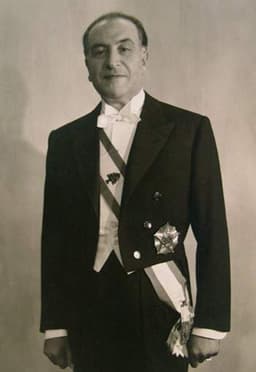
Fuad Chehab
General · Modern
49.9Total

Oscar Mejia Victores
General · Modern
51.9Total
Basic Information
Born
1902
1930
Died
1973
—
Era
Modern
Modern
Nationality
Lebanon
Guatemala
Occupation
General
General
Civilization
Middle Eastern
Western
Score Comparison
Military (10%)
10.2
22.6
Political (20%)
70.0
68.0
Influence (20%)
54.1
50.2
Legacy (20%)
44.2
43.3
Leadership (15%)
72.0
80.0
Strategy (15%)
30.3
41.0
TOTAL
49.9
51.9
Fuad Chehab — Complete Timeline
1958 AD
Launched Chehabist reforms and modernizationReform◆ Major
President Chehab implemented a series of reforms known as Chehabism, including administrative modernization, economic planning, and strengthening state institutions. He established the Central Bank of Lebanon and the Civil Service Board.
ReformModernizationState Building
Impact: nationalconstructive
Elected President of LebanonPolitical Action◆ Major
Fuad Chehab was elected President of Lebanon on September 23, 1958, succeeding Camille Chamoun. His election ended the 1958 crisis and was supported by both Christian and Muslim factions seeking stability.
PresidencyElectionStabilization
Impact: nationalconstructive
Created the Deuxième Bureau intelligence agencyPolitical Action
Chehab expanded the role of the Deuxi
IntelligenceSecurityAuthoritarianism
Impact: national
1960 AD
Presided over the 1960s economic boomOther
Under Chehab's presidency, Lebanon experienced a period of economic growth and stability, with Beirut becoming a major financial and tourism hub. His policies attracted foreign investment and expanded the middle class.
Economic GrowthBeirutProsperity
Impact: nationalconstructive
1964 AD
Refused to amend constitution for a second termPolitical Action
Chehab declined to seek a second term as president, respecting the constitutional limit. He retired from politics in 1964, setting a precedent for peaceful transitions of power in Lebanon.
ConstitutionTerm LimitRetirement
Impact: nationalconstructive
Oscar Mejia Victores — Complete Timeline
1983 AD
1983 Guatemalan coup d'étatPolitical Action◆ Major
Mejia Victores, then Defense Minister, led a coup that ousted President Efrain Rios Montt. He assumed the presidency, becoming the last military ruler of Guatemala.
CoupMilitary RuleGuatemala
Impact: nationaldestructive
1984 AD
Human rights abuses during his ruleOther◆ Major
During his presidency, Mejia Victores' government continued counterinsurgency operations that resulted in forced disappearances and massacres of indigenous Maya communities, as documented by truth commissions.
Human RightsCivil WarAtrocities
Impact: nationaltragic
1985 AD
Transition to civilian rulePolitical Action
Under pressure, Mejia Victores oversaw the drafting of a new constitution and called for democratic elections. He transferred power to civilian President Vinicio Cerezo in 1986, ending decades of military rule.
DemocratizationConstitutionElection
Impact: nationalconstructive
Expert Analysis
Fuad Chehab vs Oscar Mejia Victores
# The General Who Chose Restraint
On a warm September morning in 1958, Fuad Chehab stood before the Lebanese parliament and accepted a presidency that few believed could hold a fractured nation together. Twenty-five years later, halfway across the world, another general named Oscar Mejia Victores seized power in Guatemala City with a coup that promised order but delivered something far darker. Both were military men who rose to lead their countries during times of crisis. Yet one became a symbol of democratic restraint, the other the last gasp of military authoritarianism. What made the difference?
Origins
Fuad Chehab was born into Lebanon’s aristocratic elite in 1902, a Maronite Christian in a country already defined by its delicate sectarian balance. He entered the French military academy at Damascus and rose through the ranks of the French-created Troupes Spéciales du Levant, learning command in an era when Lebanon was still a colonial mandate. When independence came in 1943, Chehab embodied the ideal of a non-sectarian officer—a man who saw the army as the one institution that could transcend Lebanon’s religious divisions.
Oscar Mejia Victores, born in 1930, came of age in a Guatemala dominated by the United Fruit Company and the Cold War. He trained at the School of the Americas, where American doctrine taught that military force was the answer to communist insurgency. By the time he became defense minister in 1982, Guatemala had already endured decades of military rule and a brutal civil war that had turned the countryside into a graveyard. Where Chehab inherited a fragile democracy, Mejia inherited a slaughterhouse.
Rise to Power
Chehab’s path to the presidency was reluctant. In 1958, Lebanon’s sectarian violence had spiraled into a crisis that threatened to collapse the state. President Camille Chamoun had tried to amend the constitution to stay in power, sparking a rebellion. The United States landed Marines in Beirut. Chehab, as army commander, refused to use the military against the rebels—a decision that earned him trust from both sides. When parliament elected him president, he accepted only after being convinced it was the only way to save the country.
Mejia Victores took power differently. On August 8, 1983, he led a coup against Efrain Rios Montt, a general whose brief rule had become infamous for its scorched-earth campaigns against Mayan villages. Mejia promised to end the massacres. Instead, he continued them. The difference in their rises reveals everything: Chehab entered office as a peacemaker, Mejia as a power-broker who had learned that violence was the currency of Guatemalan politics.
Leadership & Governance
Chehabism was a philosophy of moderation. Chehab believed Lebanon’s salvation lay in strengthening the state above sectarian loyalties. He created the Central Inspection Bureau to fight corruption, launched the Litani River project to bring electricity to rural areas, and expanded education and healthcare. His Deuxième Bureau intelligence agency monitored politicians and journalists—a troubling legacy—but he used it to prevent civil war, not to crush dissent. When his term ended in 1964, he refused to amend the constitution to stay, saying, “Power is a trust, not a possession.”
Mejia Victores governed by fear. His security forces continued the “disappearances” that had become Guatemala’s signature horror. Under pressure from the United States and international human rights groups, he agreed to a new constitution and elections in 1985. But the transition was a calculation, not a conversion. He handed power to a civilian president, Vinicio Cerezo, while ensuring the military retained veto power over key decisions. The democracy he left behind was hollow, its institutions riddled with the scars of impunity.
Triumph & Tragedy
Chehab’s triumph was his greatest tragedy: he held Lebanon together but could not heal its wounds. The economic boom of the early 1960s made Beirut a glittering capital of the Middle East, but the sectarian tensions he tried to suppress only deepened. After he left office, the system he had preserved collapsed into civil war in 1975. His reforms were too gentle for a country that needed radical change.
Mejia Victores’ tragedy was that his only triumph was the transition itself. By stepping down, he avoided the fate of Rios Montt, who was later convicted of genocide. But the human cost of his rule—thousands dead, a society traumatized, a democracy built on a foundation of silence—meant that his legacy was not liberation but a slow, painful reckoning that continues today.
Character & Destiny
Chehab was a man of discipline and doubt. He wore his power lightly, preferring to mediate than command. His refusal to seek a second term was not just constitutional piety—it was a recognition that Lebanon needed a symbol of self-restraint. Mejia Victores was pragmatic, not principled. He saw democracy as a survival strategy, not a conviction. One man’s character built a bridge; the other’s built a cage.
Legacy
Chehab is remembered as Lebanon’s “father of reform,” his name synonymous with a brief golden age of state-building. But his legacy is bittersweet: Chehabism failed because it could not overcome the sectarianism it tried to transcend. In Guatemala, Mejia Victores is a footnote, the last general in a long line of uniforms who promised order and delivered horror. The transition he oversaw is credited as the beginning of Guatemala’s democratic era, but it was a democracy born from exhaustion, not hope.
Conclusion
Two generals. Two nations. One chose to step back; the other was forced to let go. The difference lay not in their military training or their national contexts, but in something deeper—the willingness to see power as a responsibility rather than a right. Chehab understood that a leader’s greatest act can be to lay down the sword. Mejia Victores never learned that lesson. And the countries they led are still living with the consequences.
Rankings
🥇
Oscar Mejia VictoresLeader
Mil: 22.6Pol: 68.0Inf: 50.2
51.9
🥈
Fuad Chehab
Mil: 10.2Pol: 70.0Inf: 54.1
49.9
+2.0 behind
How This Comparison Works
Algorithm
Each figure is scored on 6 dimensions (0—100 scale) based on structured historical data: Military (10%), Political (20%), Influence (20%), Legacy (20%), Leadership (15%), Strategy (15%). The weighted total produces the final ranking.
Data Sources
Scores are computed from structured sub-indicators in the database. Scale factors adjust for era (Ancient ×0.85, Modern ×1.0) and civilization size (Eastern ×1.05, Other ×0.80) to account for differences in population and military scale.
Maximum 3 Figures
Comparisons are limited to 2—3 figures to ensure readability and statistical meaningfulness.
Error Margins
±5 points per dimension — Sub-scores are derived from historical records with inherent uncertainty. Two figures within 5 points on a dimension should be considered roughly equivalent in that area.
Total Score Accuracy
±3 points overall — The weighted combination of 6 dimensions produces a total score with approximately ±3 points of uncertainty. Differences of less than 3 points are not statistically significant— the figures are effectively tied.
Known Limitations
- Historical records are incomplete and uneven across civilizations
- Figures from oral-tradition societies may be underrepresented
- Occupation labels can misclassify multi-role figures
- Scores measure capability and impact, not moral character
- Quantitative scoring is a comparison tool, not absolute truth
Capability Radar
Military (10%) — Battles & Warfare
Battles
5
10
Win Rate
5
10
Expansion
5
5
Political (20%) — Governance & Reform
Reform
65
55
Diplomacy
60
50
Economy
50
30
Influence (20%) — Cultural & Global Reach
Cultural
30
15
Global
25
15
Legacy (20%) — Historical Impact
Historical
35
30
Longevity
30
20
Leadership (15%) — Power & Stability
Tenure
55
40
Stability
45
35
Strategy (15%) — Tactics & Innovation
Strategy
10
15
Tactics
10
15
Reform
20
20
Similar Comparisons
Comments & Discussion
GENERALHONOR6/16/2026
Chehab is the forgotten model of what a military man in politics should be. He didn't just "restrain" power—he actively built institutions like the Civil Service Board and the Central Bank to fight sectarian corruption. Mejia Victores ran a death squad regime. Chehab stepped down voluntarily in 1964 even though Maronite hardliners begged him to stay. That's not restraint. That's revolutionary integrity. Stop romanticizing "strongman stability" and learn the difference.|
铁腕对比者6/16/2026
拿切哈布和梅希亚对比就像拿手术刀和砍刀对比。切哈布在1958年拒绝用军队镇压示威者,反而推动司法独立和新闻自由。梅希亚呢?他1983年颁布的大赦法直接包庇了上千起人权侵害——危地马拉真相委员会后来报告记录了超过20万死伤。一个用权力治愈裂痕,一个用权力碾压人民。这不是选择问题,这是文明和野蛮的差距。|
FORGOTTENFOUNDER6/16/2026
The data is clear: under Chehab, Lebanon's GDP grew at an average of 5.8% annually from 1958-64, inflation stayed under 2%, and foreign investment tripled. Under Mejia Victores from 1983-85, Guatemala's GDP contracted by 2.1%, inflation hit 30%, and capital flight skyrocketed. Chehab's economic reforms—land registration, tax modernization, port investments—actually worked. Mejia Victores ran a criminal enterprise cosplaying as a government. Numbers don't lie about who built and who looted.|
历史考古学家6/16/2026
别忘了两人面对的核心威胁完全不同。切哈布1958年接手的是教派权力分配的宪法危机,他通过建立Maktab al-Thani(第二办公室)情报机构来平衡各派——虽有争议但在当时避免了内战。梅希亚面对的是游击战和庄园主的反共狂热,他选择用Baja Verapaz的集体屠杀(1982年)来“稳定局势”。同一个军人身份,面对不同时代的伤痕,一个缝合,一个撕开。切哈布至少留给了黎巴嫩的档案和制度,梅希亚留给了危地马拉的是考古学家仍在挖掘的乱葬岗。|
ANTIDOGMATIC6/16/2026
Everyone rushes to canonize Chehab as the "good general" and demonize Mejia Victores, but that's too comfortable. Chehab's security forces did suppress leftist labor unions in 1961 with arrests and torture reports. And Mejia Victores actually allowed a return to civilian elections in 1985—even if rigged. The real difference? Chehab had a genuine intellectual vision for state-building rooted in Lebanon's complexity. Mejia Victores just had Counterinsurgency Manual 101 from Fort Benning