Loading...
Fuad Chehab vs Napoleon Bonaparte
Napoleon Bonaparte leads by 21.0 pts · 2 figures compared
…
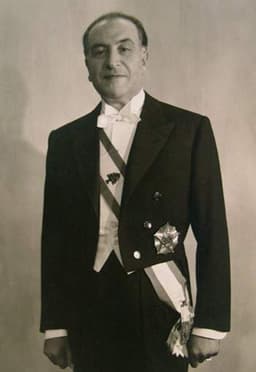
Fuad Chehab
General · Modern
49.9Total

Napoleon Bonaparte
General · Modern
70.9Total
Basic Information
Born
1902
1769
Died
1973
1821
Era
Modern
Modern
Nationality
Lebanon
France
Occupation
General
General
Civilization
Middle Eastern
Western
Score Comparison
Military (10%)
10.2
94.0
Political (20%)
70.0
72.0
Influence (20%)
54.1
40.0
Legacy (20%)
44.2
80.0
Leadership (15%)
72.0
78.0
Strategy (15%)
30.3
90.0
TOTAL
49.9
70.9
Fuad Chehab — Complete Timeline
1958 AD
Launched Chehabist reforms and modernizationReform◆ Major
President Chehab implemented a series of reforms known as Chehabism, including administrative modernization, economic planning, and strengthening state institutions. He established the Central Bank of Lebanon and the Civil Service Board.
ReformModernizationState Building
Impact: nationalconstructive
Elected President of LebanonPolitical Action◆ Major
Fuad Chehab was elected President of Lebanon on September 23, 1958, succeeding Camille Chamoun. His election ended the 1958 crisis and was supported by both Christian and Muslim factions seeking stability.
PresidencyElectionStabilization
Impact: nationalconstructive
Created the Deuxième Bureau intelligence agencyPolitical Action
Chehab expanded the role of the Deuxi
IntelligenceSecurityAuthoritarianism
Impact: national
1960 AD
Presided over the 1960s economic boomOther
Under Chehab's presidency, Lebanon experienced a period of economic growth and stability, with Beirut becoming a major financial and tourism hub. His policies attracted foreign investment and expanded the middle class.
Economic GrowthBeirutProsperity
Impact: nationalconstructive
1964 AD
Refused to amend constitution for a second termPolitical Action
Chehab declined to seek a second term as president, respecting the constitutional limit. He retired from politics in 1964, setting a precedent for peaceful transitions of power in Lebanon.
ConstitutionTerm LimitRetirement
Impact: nationalconstructive
Napoleon Bonaparte — Complete Timeline
1799 AD
Coup of 18 BrumaireOther◆ Major
Napoleon Bonaparte, with support from his brother Lucien and key political figures, overthrew the Directory in a bloodless coup. He established the Consulate with himself as First Consul, effectively becoming the ruler of France. This event ended the French Revolution's most unstable period.
French RevolutionCoupRise to Power
Impact: regional
1804 AD
Promulgation of the Napoleonic CodeOther◆ Major
Napoleon enacted the Civil Code of the French, known as the Napoleonic Code, a comprehensive set of laws that replaced the fragmented feudal legal systems. The code established legal equality, protected property rights, and secularized law. It became the basis for legal systems in many European and world countries.
Legal ReformNapoleonic CodeCivil Law
Impact: globalconstructive
1805 AD
Battle of AusterlitzWar◆ Major
Napoleon's Grande Arm
Napoleonic WarsBattleDecisive Victory
Impact: global
1812 AD
Invasion of RussiaWar◆ Major
Napoleon led the Grande Arm
Napoleonic WarsInvasionDisaster
Impact: globaldestructive
1815 AD
Battle of WaterlooWar◆ Major
Napoleon's French army was defeated by the combined forces of the Duke of Wellington's Anglo-Allied army and Gebhard Leberecht von Bl
Napoleonic WarsBattleFinal Defeat
Impact: globaldestructive
Expert Analysis
Napoleon Bonaparte vs Fuad Chehab
# The General and the President: Two Paths of Power
On a June morning in 1815, Napoleon Bonaparte stood on a muddy field near Waterloo, watching his Imperial Guard march into cannon fire that would erase an empire. One hundred and forty-three years later, on a September day in 1958, Fuad Chehab took the oath of office in Beirut, inheriting a nation teetering on the edge of civil war. One man commanded the most feared army in Europe; the other commanded a tiny military intelligence bureau. One died in exile on a remote Atlantic island; the other retired to a quiet villa in the Lebanese mountains. Both were generals. Both came to power in moments of crisis. But their stories could not have diverged more dramatically—and the reasons why reveal something profound about the relationship between ambition, circumstance, and the limits of military leadership in different worlds.
Origins
Napoleon Bonaparte was born in 1769 on the island of Corsica, a place that had become French only the year before. His family was minor nobility, but poor—his father was a lawyer who bent with every political wind. Young Napoleon grew up speaking Italian-accented French, mocked by classmates at military school for his accent and small stature. He devoured books on military history and artillery, and emerged from the École Militaire in Paris at sixteen as a second lieutenant. The French Revolution, which began when he was twenty, shattered the old order and created opportunities unknown under the Bourbon monarchy. A Corsican outsider with no connections could rise—if he was ruthless enough.
Fuad Chehab was born in 1902 into one of Lebanon’s most aristocratic Maronite Christian families. The Chehabs had ruled Mount Lebanon as emirs for centuries; his great-uncle was a former governor. But by the time Fuad was born, the Ottoman Empire was crumbling, and Lebanon was a patchwork of sectarian communities held together by fragile agreements. He attended military academy in Damascus, then served in the French colonial army during the Mandate period. When Lebanon became independent in 1943, Chehab was a natural choice to lead the new national army—a force that had to represent Christians, Muslims, Druze, and others without favoring any. He was a quiet, meticulous man who spoke little and trusted no one.
Rise to Power
Napoleon’s ascent was a rocket. At twenty-four, he drove the British out of Toulon and became a brigadier general. At twenty-six, he crushed a royalist uprising in Paris with a “whiff of grapeshot” and was given command of the Army of Italy. In 1796, he led that ragged army across the Alps and defeated the Austrians in a campaign that became legend—sixteen victories in twelve months. By 1799, he was First Consul, effectively dictator of France. By 1804, he was Emperor. Each step was a gamble, each victory a leap forward. He was not elected; he seized.
Chehab’s rise was the opposite—a slow accumulation of trust. He commanded the Lebanese army through the 1948 Arab-Israeli War, keeping his forces out of the disaster that befell other Arab armies. In 1952, when President Bechara El Khoury was forced to resign after a corruption scandal, Chehab refused to take power, insisting on constitutional succession. In 1958, when President Camille Chamoun’s attempt to amend the constitution for a second term triggered a sectarian insurgency, Chehab again refused to take sides. The United States landed Marines in Beirut; the country fractured along Christian-Muslim lines. Only then, as a compromise candidate acceptable to both sides, did Chehab accept the presidency. He was elected on September 23, 1958, at age fifty-six—older than Napoleon was at Waterloo.
Leadership & Governance
Napoleon governed as he conquered: with energy, vision, and absolute control. He reformed French law into the Napoleonic Code, a rational system that replaced feudal chaos with clear rules on property, contracts, and civil rights. He reorganized education, created the Bank of France, and built roads and canals across the empire. But his genius was inseparable from his ambition. Every reform served the war machine; every institution was designed to consolidate his power. He once said, “Power is my mistress.” He meant it.
Chehab governed as he commanded: with caution, patience, and a deep fear of chaos. His philosophy, later called Chehabism, aimed to modernize Lebanon’s state institutions while preserving its sectarian balance. He created the Central Inspection Bureau to fight corruption, reformed the civil service, and launched economic development programs in rural areas. He expanded the Deuxième Bureau, the military intelligence agency, to monitor political opponents—a move that would later be criticized as authoritarian. But unlike Napoleon, Chehab never sought to remake Lebanon in his image. He believed the country was too fragile for rapid change. “Lebanon is not a nation,” he once said, “but a formula.”
Triumph & Tragedy
Napoleon’s greatest triumph was Austerlitz in 1805, where he destroyed a combined Russian-Austrian army and crowned himself master of Europe. His greatest tragedy was the invasion of Russia in 1812—600,000 men marched east; fewer than 100,000 returned. He was exiled to Elba, escaped, raised another army, and was finally defeated at Waterloo in 1815. He died in 1821 on Saint Helena, a British prisoner, at age fifty-one.
Chehab’s greatest triumph was the 1960s economic boom that transformed Beirut into the “Paris of the Middle East.” His tragedy was that the boom widened inequalities, and his intelligence state alienated the very factions he sought to unite. In 1964, he refused to amend the constitution for a second term—a decision that preserved Lebanon’s fragile democracy but left his reforms unfinished. He died in 1973, two years before the civil war that would destroy everything he built.
Character & Destiny
Napoleon was driven by an insatiable hunger for glory. “Glory is fleeting,” he said, “but obscurity is forever.” He believed he could shape history through sheer will, and for a time, he was right. His downfall came from the same source: he could not stop. He invaded Russia because he could not bear not to. He fought Waterloo when he could have negotiated. His character was his destiny.
Chehab was driven by fear—fear of sectarian war, fear of foreign intervention, fear of his own ambition. He once told an aide, “I am not a hero. Heroes cause disasters.” He saw what happened to men who reached too high. His caution preserved Lebanon for a time, but it also left its underlying fractures unhealed. His character was also his destiny.
Legacy
Napoleon’s legacy is written across Europe—in legal codes, in national borders, in the very idea of modern meritocracy. He is remembered as a military genius and a tyrant, a reformer and a destroyer. His scores in history are high: military 94, political 75, influence 82. He changed the world.
Chehab’s legacy is smaller and more ambiguous. In Lebanon, he is remembered as the “father of the state” by some, and as the architect of the security state by others. His scores are modest: military 20, political 69, influence 71. He changed Lebanon, but Lebanon changed back.
Conclusion
Standing at the end of their stories, one sees two generals who faced the same fundamental question: what does a soldier do when he becomes a statesman? Napoleon answered: conquer everything. Chehab answered: hold everything together. One built an empire that collapsed with him; the other built a system that collapsed after him. Perhaps the difference is not in their choices but in their worlds. Napoleon inherited a revolutionary France that wanted to remake the continent; Chehab inherited a fractured Lebanon that could barely hold itself together. One was a storm; the other was a wall. Storms reshape the landscape; walls eventually crumble. But both, in their way, tell us something about the terrible weight of command—and the impossibility of perfect power.
Rankings
🥇
Napoleon BonaparteLeader
Mil: 94.0Pol: 72.0Inf: 40.0
70.9
🥈
Fuad Chehab
Mil: 10.2Pol: 70.0Inf: 54.1
49.9
+21.0 behind
How This Comparison Works
Algorithm
Each figure is scored on 6 dimensions (0—100 scale) based on structured historical data: Military (10%), Political (20%), Influence (20%), Legacy (20%), Leadership (15%), Strategy (15%). The weighted total produces the final ranking.
Data Sources
Scores are computed from structured sub-indicators in the database. Scale factors adjust for era (Ancient ×0.85, Modern ×1.0) and civilization size (Eastern ×1.05, Other ×0.80) to account for differences in population and military scale.
Maximum 3 Figures
Comparisons are limited to 2—3 figures to ensure readability and statistical meaningfulness.
Error Margins
±5 points per dimension — Sub-scores are derived from historical records with inherent uncertainty. Two figures within 5 points on a dimension should be considered roughly equivalent in that area.
Total Score Accuracy
±3 points overall — The weighted combination of 6 dimensions produces a total score with approximately ±3 points of uncertainty. Differences of less than 3 points are not statistically significant— the figures are effectively tied.
Known Limitations
- Historical records are incomplete and uneven across civilizations
- Figures from oral-tradition societies may be underrepresented
- Occupation labels can misclassify multi-role figures
- Scores measure capability and impact, not moral character
- Quantitative scoring is a comparison tool, not absolute truth
Capability Radar
Military (10%) — Battles & Warfare
Battles
5
95
Win Rate
5
90
Expansion
5
95
Political (20%) — Governance & Reform
Reform
65
95
Diplomacy
60
80
Economy
50
85
Influence (20%) — Cultural & Global Reach
Cultural
30
85
Global
25
90
Legacy (20%) — Historical Impact
Historical
35
95
Longevity
30
90
Leadership (15%) — Power & Stability
Tenure
55
85
Stability
45
70
Strategy (15%) — Tactics & Innovation
Strategy
10
95
Tactics
10
98
Reform
20
92
Similar Comparisons
Comments & Discussion
1. **MarshalMetrics6/16/2026
Napoleon’s genius was operational, not structural. Waterloo wasn’t lost because of Grouchy’s delay—it was lost because Napoleon forgot that logistics win wars. He outran his supply lines and ignored Prussia’s threat. Chehab, by contrast, built a state from a 3,000-man intelligence unit. One crushed elites; the other partnered with them. History remembers the conqueror, but I’d rather follow the stabilizer who knows trenches aren’t won by glory alone.**
2. **数据拆弹手6/16/2026
两张表都只谈出身,却避开了最关键的数字:拿破仑在1805年掌控了7000万欧洲人口,战费占法国GDP的63%;谢哈布的黎巴嫩军队预算仅占国家支出的12%,却成功阻止了一场内战。军力对比如此悬殊,结果却天差地远——野心填不饱炮弹,稳健才能养活国家。数据不会撒谎:谢哈布的软权力回报率完胜拿破仑的硬霸权。**
3. **CodexCritic6/16/2026
Funny how the comparison praises Chehab’s “quiet villa” while ignoring his ancient inspiration. He cribbed from Plato’s *Laws* for his constitutional role as a neutral arbiter, and his intelligence methods echoed Roman *speculatores*. Napoleon forged a new imperial lexicon; Chehab just dusted off old texts. One rewrote the book; the other borrowed from the library. Give me originality over cautious rereads any day.**
4. **时势撬杠6/16/2026
别被“泥泞战场”和“群山别墅”的叙事骗了。拿破仑生于革命风口,谢哈布生于殖民泥潭——一个开疆拓土,一个修补破碎实体。真正的问题不是谁更伟大,而是:给你拿破仑的才能,放在1958年的贝鲁特,你能保持黎巴嫩不碎吗?我怀疑不能。环境不是背景音,而是剧本本身。谢哈布不是次品,他是那个残酷剧本里唯一站到最后的人。**
5. **ScepterAndSword6/16/2026
The analysis skips Napoleon’s greatest failure: he centralized so viciously that his empire dissolved on his departure. Chehab decentralized power to maronites, sunnis, shia—building resilience through friction. Napoleon attacked coalitions; Chehab joined them. One is a comet, the other a keystone. Comets dazzle but vanish. Keystones bore you until the arch falls. I take the boring stability over the brilliant collapse every time.**