Loading...
Afonso de Albuquerque vs Fuad Chehab
Afonso de Albuquerque leads by 29.7 pts · 2 figures compared
…
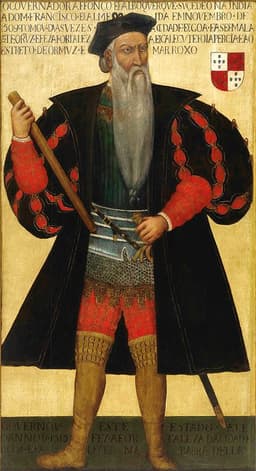
Afonso de Albuquerque
General · Medieval
79.6Total
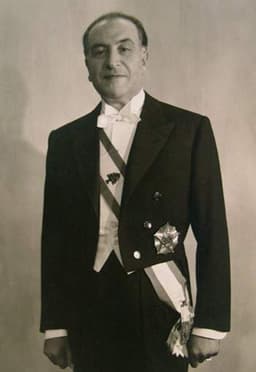
Fuad Chehab
General · Modern
49.9Total
Basic Information
Born
1453
1902
Died
1515
1973
Era
Medieval
Modern
Nationality
Portugal
Lebanon
Occupation
General
General
Civilization
Western
Middle Eastern
Score Comparison
Military (10%)
77.5
10.2
Political (20%)
88.0
70.0
Influence (20%)
80.0
54.1
Legacy (20%)
75.0
44.2
Leadership (15%)
78.0
72.0
Strategy (15%)
82.0
30.3
TOTAL
79.6
49.9
Afonso de Albuquerque — Complete Timeline
1503 AD
First voyage to IndiaWar◆ Major
Afonso de Albuquerque led a fleet to India, establishing the first Portuguese fort at Cochin. This voyage laid the foundation for Portuguese control of the Indian Ocean trade.
ExplorationColonialismIndia
Impact: global
1510 AD
Conquest of GoaWar◆ Major
Albuquerque captured Goa from the Sultan of Bijapur. He made Goa the capital of Portuguese India, a position it held for over 400 years.
ConquestColonialismIndia
Impact: regional
1511 AD
Conquest of MalaccaWar◆ Major
Albuquerque led a Portuguese fleet to capture the strategic port of Malacca. This gave Portugal control of the spice trade route between the Indian Ocean and the Pacific.
ConquestSpice TradeSoutheast Asia
Impact: global
1513 AD
Siege of AdenWar
Albuquerque attempted to capture Aden in Yemen but failed. This failure prevented Portugal from controlling the entrance to the Red Sea and limited their influence in the region.
SiegeFailureRed Sea
Impact: regional
1515 AD
Death at seaOther◆ Major
Afonso de Albuquerque died at sea off the coast of Goa, possibly from illness or poison. His death left the Portuguese Empire in the Indian Ocean without its most capable leader.
DeathLeadershipEmpire
Impact: regionaltragic
Fuad Chehab — Complete Timeline
1958 AD
Launched Chehabist reforms and modernizationReform◆ Major
President Chehab implemented a series of reforms known as Chehabism, including administrative modernization, economic planning, and strengthening state institutions. He established the Central Bank of Lebanon and the Civil Service Board.
ReformModernizationState Building
Impact: nationalconstructive
Elected President of LebanonPolitical Action◆ Major
Fuad Chehab was elected President of Lebanon on September 23, 1958, succeeding Camille Chamoun. His election ended the 1958 crisis and was supported by both Christian and Muslim factions seeking stability.
PresidencyElectionStabilization
Impact: nationalconstructive
Created the Deuxième Bureau intelligence agencyPolitical Action
Chehab expanded the role of the Deuxi
IntelligenceSecurityAuthoritarianism
Impact: national
1960 AD
Presided over the 1960s economic boomOther
Under Chehab's presidency, Lebanon experienced a period of economic growth and stability, with Beirut becoming a major financial and tourism hub. His policies attracted foreign investment and expanded the middle class.
Economic GrowthBeirutProsperity
Impact: nationalconstructive
1964 AD
Refused to amend constitution for a second termPolitical Action
Chehab declined to seek a second term as president, respecting the constitutional limit. He retired from politics in 1964, setting a precedent for peaceful transitions of power in Lebanon.
ConstitutionTerm LimitRetirement
Impact: nationalconstructive
Expert Analysis
Afonso de Albuquerque vs Fuad Chehab
# The Admiral and the President: Two Generals Who Shaped Empires at Sea and in the Sand
On a September morning in 1958, Fuad Chehab stood before the Lebanese parliament in Beirut, a general in a crisp uniform about to become a president. Half a world away and four centuries earlier, another general, Afonso de Albuquerque, lay dying on the deck of a ship off the coast of Goa, his body wracked by fever, his mind still fixed on the Indian Ocean he had conquered. One man built an empire that would last for centuries; the other built a fragile peace that would crumble within decades. Both were generals. Both sought order. But the oceans they crossed and the lands they ruled could not have been more different—and neither could their fates.
Origins
Albuquerque was born in 1453, the year Constantinople fell to the Ottomans, a date that marked the end of one world and the beginning of another. He came from Portugal’s military nobility, a class bred for crusade and conquest. His father was a lord, his uncle a diplomat, and young Afonso learned early that Portugal’s future lay not in Europe but beyond the horizon. The Age of Exploration was dawning, and the boy who would become “the Great” was shaped by a kingdom obsessed with spices, souls, and sea routes.
Fuad Chehab, born in 1902, came from a different kind of aristocracy. His family was one of Lebanon’s Maronite Christian dynasties, but the Ottoman Empire was crumbling around him. Chehab grew up in a Lebanon that did not yet exist as a nation—it was a patchwork of sects and clans, ruled from Istanbul. He entered the French military academy, learned the tools of modern warfare, and watched as the world wars redrew maps. Where Albuquerque’s world was expanding, Chehab’s was contracting: the age of empires was ending, and the age of fragile nation-states was beginning.
Rise to Power
Albuquerque’s path to power was forged in salt spray and cannon fire. In 1503, he led his first fleet to India, establishing a fort at Cochin that became the toehold of an empire. Unlike the Spanish conquistadors who stumbled into gold and glory, Albuquerque was a systematic builder. He studied the monsoon winds, learned the politics of Indian port cities, and understood that control of trade routes meant control of Asia. By 1510, he captured Goa from the Sultan of Bijapur, turning a small coastal town into the capital of Portuguese India. The following year, he took Malacca, the gateway to the Spice Islands, and suddenly Portugal held the keys to the world’s most valuable trade.
Chehab rose not through conquest but through crisis. In 1958, Lebanon was tearing itself apart. President Camille Chamoun’s pro-Western policies had inflamed Muslim and Arab nationalist factions, and civil war loomed. The army, under Chehab’s command, refused to take sides—a decision that made him the only acceptable candidate to all factions. When he was elected president on September 23, 1958, it was not as a conqueror but as a compromise. He entered office not with a fleet but with a reputation for integrity, and a promise to hold Lebanon together.
Leadership & Governance
Albuquerque governed like a man building a machine. He reformed Portuguese administration in India, established a system of fortresses from Hormuz to Malacca, and married his soldiers to local women to create a loyal mixed-race population. He was ruthless when necessary—he ordered the massacre of Muslim prisoners in Goa—but also pragmatic, allowing Hindu temples to remain open and local customs to continue. His strategy was simple: control the sea, tax the trade, and never let any rival power challenge Portuguese dominance. As he wrote to King Manuel I, “If you take the spice trade out of the hands of the Moors, you will make Portugal the richest kingdom in Christendom.”
Chehab governed like a man trying to balance a dozen fragile plates. His philosophy, later called “Chehabism,” aimed to modernize Lebanon while preserving its delicate sectarian balance. He created the Deuxième Bureau, a military intelligence agency that monitored political opponents—a tool that would later be abused by successors. He launched economic reforms, built infrastructure, and oversaw a boom that made Beirut the “Paris of the Middle East.” But he also refused to confront the deep inequalities between sects, believing that stability required silence. Where Albuquerque built walls, Chehab built bridges—and both would prove vulnerable.
Triumph & Tragedy
Albuquerque’s greatest triumph was the conquest of Malacca in 1511. He led a fleet of 18 ships against a city defended by thousands, using a mix of naval bombardment, amphibious assault, and psychological warfare. When the city fell, Portugal controlled the spice route that had made Venice rich. His greatest failure came in 1513, when he tried to capture Aden in Yemen. Without control of the Red Sea’s entrance, the Portuguese could never fully strangle Muslim trade to Europe. He failed, and the failure haunted him. When he died in 1515—possibly poisoned, possibly of illness—he was returning to Goa in disgrace, having been recalled by a jealous king.
Chehab’s triumph was the 1958-1964 period itself: a time when Lebanon, surrounded by revolutions and coups, remained stable and prosperous. He refused to amend the constitution for a second term, retiring in 1964 with his reputation intact. But his tragedy was that his system did not outlive him. The Deuxième Bureau grew corrupt, the economic boom concentrated wealth among the elite, and the sectarian tensions he had managed exploded into civil war in 1975—just two years after his death. He had built a dam, but the water kept rising.
Character & Destiny
Albuquerque was a man of iron will and grand vision. He believed that Portugal was chosen by God to spread Christianity and control the oceans, and he acted with the certainty of a crusader. He was harsh, sometimes cruel, but also capable of strategic patience. His personality drove him to conquer, but it also made enemies at court who undermined him. His destiny was to be the architect of an empire that would outlast him by centuries, even if he died feeling like a failure.
Chehab was a man of restraint and calculation. He believed that Lebanon’s survival depended on not rocking the boat, on managing rather than solving problems. He was a listener, a mediator, a man who avoided confrontation. His personality made him the right leader for a crisis, but it also meant he left the deep wounds of Lebanese society untreated. His destiny was to be remembered as a good man who could not change the course of history.
Legacy
Albuquerque’s legacy is written in stone and sea. Goa remained Portuguese until 1961. The fortresses he built still stand. The Portuguese language and Catholicism he brought to Asia remain vibrant. He is remembered as a founder, a visionary, a man who made Portugal a global power. His scores reflect this: a military rating of 82.2, leadership of 84.3, and a total score of 77.1 that places him among history’s great empire-builders.
Chehab’s legacy is more ambiguous. He is revered in Lebanon as a symbol of a lost golden age, a president who put country above sect. His reforms laid the groundwork for Lebanon’s modern state. But the system he preserved also contained the seeds of destruction. His scores tell a different story: military 19.9, political 68.8, total 61.2. He was not a conqueror but a caretaker, and caretakers rarely survive the test of time.
Conclusion
One built an empire on the Indian Ocean, the other tried to build a nation on the Mediterranean. Albuquerque died believing he had failed; Chehab died believing he had succeeded. History reversed their judgments. The Portuguese admiral’s empire crumbled, but his name lives on as a legend of conquest. The Lebanese general’s nation crumbled, but his name lives on as a memory of what could have been. Both were generals who understood that power is not about winning battles—it is about building something that lasts. And both learned, in the end, that even the strongest walls and the most careful balances cannot hold forever.
Rankings
🥇
Afonso de AlbuquerqueLeader
Mil: 77.5Pol: 88.0Inf: 80.0
79.6
🥈
Fuad Chehab
Mil: 10.2Pol: 70.0Inf: 54.1
49.9
+29.7 behind
How This Comparison Works
Algorithm
Each figure is scored on 6 dimensions (0—100 scale) based on structured historical data: Military (10%), Political (20%), Influence (20%), Legacy (20%), Leadership (15%), Strategy (15%). The weighted total produces the final ranking.
Data Sources
Scores are computed from structured sub-indicators in the database. Scale factors adjust for era (Ancient ×0.85, Modern ×1.0) and civilization size (Eastern ×1.05, Other ×0.80) to account for differences in population and military scale.
Maximum 3 Figures
Comparisons are limited to 2—3 figures to ensure readability and statistical meaningfulness.
Error Margins
±5 points per dimension — Sub-scores are derived from historical records with inherent uncertainty. Two figures within 5 points on a dimension should be considered roughly equivalent in that area.
Total Score Accuracy
±3 points overall — The weighted combination of 6 dimensions produces a total score with approximately ±3 points of uncertainty. Differences of less than 3 points are not statistically significant— the figures are effectively tied.
Known Limitations
- Historical records are incomplete and uneven across civilizations
- Figures from oral-tradition societies may be underrepresented
- Occupation labels can misclassify multi-role figures
- Scores measure capability and impact, not moral character
- Quantitative scoring is a comparison tool, not absolute truth
Capability Radar
Military (10%) — Battles & Warfare
Battles
85
5
Win Rate
80
5
Expansion
95
5
Political (20%) — Governance & Reform
Reform
80
65
Diplomacy
85
60
Economy
80
50
Influence (20%) — Cultural & Global Reach
Cultural
70
30
Global
85
25
Legacy (20%) — Historical Impact
Historical
85
35
Longevity
80
30
Leadership (15%) — Power & Stability
Tenure
70
55
Stability
65
45
Strategy (15%) — Tactics & Innovation
Strategy
95
10
Tactics
90
10
Reform
75
20
Similar Comparisons
Comments & Discussion
1. "GoaTamer"6/16/2026
Albuquerque wasn't just lucky—he revolutionized naval warfare by using local shipwrights and insiders to build a hybrid fleet. By 1510, he commanded 23 ships crewed by Portuguese, Indians, and Africans, a proto-multinational force that crushed the Mamluks at Diu. Chehab's 1958 French-trained "army of order" couldn't hold a candle to that logistical genius.
2. "灰尘统计学家"6/16/2026
数据说啥?阿尔布开克在印度洋部署了不到3,000士兵就控制了半个亚洲贸易,而谢哈布在1958年危机中动员了15,000军队却连贝鲁特都稳不住。别跟我扯什么时代不同,效率差就是铁证:前者用0.003%的葡萄牙人口建了帝国,后者占黎巴嫩人口的0.5%却只留下个烂摊子。
3. "SandAndSalt"6/16/2026
Military historians need to stop romanticizing Albuquerque. Yes, he took Goa. But his scorched-earth tactics alienated Hindu merchants, creating a resentment that fueled resistance for decades. Chehab's "no victor, no vanquished" approach after 1958's civil strife was smarter—he absorbed militias into the army and bought peace. Brutal efficiency isn't the only metric.
4. "修昔底德的叹息"6/16/2026
比较个鬼啊!一个是16世纪帝国扩张的屠夫,一个是20世纪宪政危机的调解者。阿尔布开克在信中自夸“我用葡萄牙剑丈量海洋”,谢哈布却写道“权力是腐蚀性的谎言”。前者靠屠杀和垄断致富,后者削军费、建大学。除了军装,他们共享的是个虚伪的“秩序”标签。
5. "TrumpetOfGoa"6/16/2026
Let's get real: Chehab was a footnote, Albuquerque reshaped two centuries of Asian geopolitics. The Portuguese admiral alone wrested control of the Malacca Straits in 1511, cutting the spice flow to Venice and redirecting 40% of Eurasian trade. Chehab's biggest legacy? A forgettable "Chehabism" doctrine that didn't outlive his term. Game, set, match to the Great.