Loading...
Fuad Chehab vs Mohan Singh
Fuad Chehab leads by 3.3 pts · 2 figures compared
…
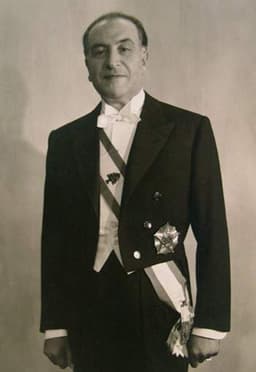
Fuad Chehab
General · Modern
49.9Total
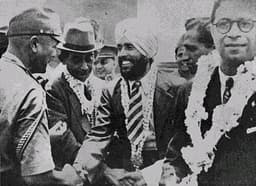
Mohan Singh
General · Modern
46.6Total
Basic Information
Born
1902
1909
Died
1973
1989
Era
Modern
Modern
Nationality
Lebanon
India
Occupation
General
General
Civilization
Middle Eastern
Indian
Score Comparison
Military (10%)
10.2
50.0
Political (20%)
70.0
36.5
Influence (20%)
54.1
57.2
Legacy (20%)
44.2
48.3
Leadership (15%)
72.0
36.9
Strategy (15%)
30.3
41.7
TOTAL
49.9
46.6
Fuad Chehab — Complete Timeline
1958 AD
Launched Chehabist reforms and modernizationReform◆ Major
President Chehab implemented a series of reforms known as Chehabism, including administrative modernization, economic planning, and strengthening state institutions. He established the Central Bank of Lebanon and the Civil Service Board.
ReformModernizationState Building
Impact: nationalconstructive
Elected President of LebanonPolitical Action◆ Major
Fuad Chehab was elected President of Lebanon on September 23, 1958, succeeding Camille Chamoun. His election ended the 1958 crisis and was supported by both Christian and Muslim factions seeking stability.
PresidencyElectionStabilization
Impact: nationalconstructive
Created the Deuxième Bureau intelligence agencyPolitical Action
Chehab expanded the role of the Deuxi
IntelligenceSecurityAuthoritarianism
Impact: national
1960 AD
Presided over the 1960s economic boomOther
Under Chehab's presidency, Lebanon experienced a period of economic growth and stability, with Beirut becoming a major financial and tourism hub. His policies attracted foreign investment and expanded the middle class.
Economic GrowthBeirutProsperity
Impact: nationalconstructive
1964 AD
Refused to amend constitution for a second termPolitical Action
Chehab declined to seek a second term as president, respecting the constitutional limit. He retired from politics in 1964, setting a precedent for peaceful transitions of power in Lebanon.
ConstitutionTerm LimitRetirement
Impact: nationalconstructive
Mohan Singh — Complete Timeline
1942 AD
Founding of the Indian National ArmyPolitical Action◆ Major
Mohan Singh founded the Indian National Army (INA) in Singapore with captured Indian soldiers from the British Indian Army. He aimed to fight alongside Japan for Indian independence, but later fell out with Japanese leadership.
Indian National ArmyWorld War IIIndependence
Impact: nationalconstructive
Dissolution of the First INAPolitical Action◆ Major
Mohan Singh dissolved the first Indian National Army after disagreements with the Japanese over its command and objectives. He was arrested by the Japanese, and the INA was later revived by Subhas Chandra Bose.
Indian National ArmyJapanese ConflictDissolution
Impact: nationaldestructive
1945 AD
Imprisonment by BritishPolitical Action
Mohan Singh was imprisoned by the British after World War II for his role in the INA. He was tried and sentenced, but later released after Indian independence, becoming a symbol of resistance.
ImprisonmentBritish EmpireINA
Impact: nationaltragic
Expert Analysis
Fuad Chehab vs Mohan Singh
### The General Who Refused Power, and the General Who Built an Army
On a warm September morning in 1958, Fuad Chehab took the oath of office in Beirut, inheriting a nation scarred by months of sectarian violence. Half a world away and sixteen years earlier, another general, Mohan Singh, stood in a Singapore prison camp, staring at the defeated soldiers of the British Indian Army and daring to imagine a rebellion. One man had power thrust upon him; the other had to wrest it from the ashes of empire. Both were generals who walked the tightrope between military duty and political ambition, yet their journeys could not have been more different. Chehab sought to heal a fractured country through cautious reform; Singh sought to break the chains of colonialism through armed struggle. What drove these two men, born just seven years apart in vastly different worlds, to such divergent fates?
### Origins
Fuad Chehab was born in 1902 into a prominent Maronite Christian family in Lebanon, then part of the Ottoman Empire. His lineage carried the weight of centuries: the Chehab dynasty had ruled Mount Lebanon for generations, and young Fuad absorbed a deep sense of aristocratic duty. He joined the French military academy, learning the arts of war under a colonial power that would later shape his nation. The Lebanon he knew was a mosaic of sects—Maronites, Sunni, Shia, Druze—each clinging to its own identity, a fragile balance that the French mandate had both created and exploited.
Mohan Singh, born in 1909 in the Punjab region of British India, came from a Sikh farming family. His father was a soldier in the British Indian Army, and young Mohan followed the same path, enlisting at seventeen. He rose through the ranks with discipline and ambition, serving in the Middle East and Malaya. But the world he grew up in was one of imperial subjugation: Indians were second-class citizens in their own land, their soldiers fighting for a king who did not represent them. The British Raj, for all its talk of civilization, was a machine of exploitation. Singh’s formative years were spent watching that machine at work, and the seed of rebellion was planted early.
### Rise to Power
Chehab’s ascent was gradual, almost reluctant. He served as commander of the Lebanese army during the 1958 crisis, when President Camille Chamoun’s attempt to amend the constitution for a second term sparked a civil war. The army, divided along sectarian lines, was on the verge of collapse. Chehab refused to order his troops to fire on fellow Lebanese, earning him a reputation as a peacemaker. When Chamoun finally stepped down, the political establishment turned to Chehab as the only man who could hold the country together. He was elected president on September 23, 1958, not as a conqueror, but as a mediator.
Mohan Singh’s rise was forged in the crucible of war. In February 1942, Singapore fell to the Japanese, and tens of thousands of Indian soldiers became prisoners of war. Singh, then a captain, was approached by Japanese officers who saw an opportunity: use Indian soldiers to fight against the British. But Singh had his own vision. He gathered fellow prisoners and, in a series of secret meetings, convinced them to form the Indian National Army (INA) in September 1942. It was a gamble—a general with no political base, commanding men who had just been humiliated in defeat, under the watchful eye of a ruthless Japanese ally. Singh’s power came not from elections, but from the sheer force of his conviction.
### Leadership & Governance
Chehab’s style was that of a cautious reformer. He called his program “Chehabism”—a blend of administrative modernization, economic planning, and national unity. He created the Deuxième Bureau, a military intelligence agency, to monitor political opponents and prevent sectarian violence. It was a double-edged sword: it brought stability, but also sowed the seeds of authoritarianism. He oversaw a period of economic boom in the early 1960s, transforming Beirut into a financial hub, but he never trusted the masses. His leadership was paternalistic, a general’s view of politics as a problem to be managed rather than a dialogue to be nurtured.
Mohan Singh was a different breed of leader. The INA was not just an army; it was a political statement. Singh drafted a manifesto calling for a free India, and he insisted that the Japanese treat his soldiers as allies, not puppets. But here lay his tragedy: he was a military man thrust into the treacherous waters of international diplomacy. The Japanese wanted control; Singh wanted independence. The clash was inevitable. In December 1942, after months of tension, Singh dissolved the first INA, declaring that he would not compromise his principles. It was a noble act, but it left his soldiers leaderless and his dream in ruins.
### Triumph & Tragedy
Chehab’s greatest triumph was his refusal to amend the constitution for a second term in 1964. In an era when strongmen across the Middle East clung to power, he walked away. It was a moment of rare political grace. But his tragedy was that his reforms were too shallow. He modernized the state without addressing the deep sectarian divisions that would explode a decade later in the Lebanese Civil War. His Deuxième Bureau became a tool of surveillance, not unity. Chehab left power, but the cracks he tried to paper over remained.
Mohan Singh’s triumph was the INA itself. He proved that Indian soldiers could defy the British, that a nationalist army could exist. His tragedy was that he was a pioneer who was quickly overshadowed. When Subhas Chandra Bose arrived in Singapore in 1943, he took command of the INA and transformed it into a larger, more disciplined force. Singh, who had been imprisoned by the British after the war, was released in 1945 and faded into obscurity. He had lit the flame, but another man carried the torch.
### Character & Destiny
Chehab was a man of restraint. He was known for his quiet demeanor, his refusal to give fiery speeches, his almost monastic detachment from the trappings of power. He once said, “I am not a man of ambition; I am a man of duty.” This made him a stabilizing force, but it also limited his vision. He could not imagine a Lebanon where sects transcended their identities, because he himself was a product of that system.
Mohan Singh was a man of fire. He was impulsive, principled to a fault, and unwilling to compromise even when compromise might have saved his cause. His clash with the Japanese was a matter of honor, but it also doomed his army. He once told a Japanese officer, “I would rather see India free through our own efforts than through the charity of others.” That pride was his strength and his weakness.
### Legacy
Chehab is remembered in Lebanon as a symbol of a lost era of stability. His name still evokes nostalgia among those who recall the 1960s as a golden age. But his legacy is ambiguous: the state he built was fragile, and his intelligence apparatus later became a tool of oppression. Today, his portrait hangs in government offices, but his reforms are a distant memory.
Mohan Singh is a footnote in the grand narrative of Indian independence. Bose gets the glory; Singh gets the footnote. But those who know the story understand that without Singh’s initial gamble, there would have been no INA. He is remembered as the founder, the man who dared to dream before others could. In India, his name is spoken with respect, but not with the reverence reserved for Bose.
### Conclusion
Two generals, two paths. Chehab chose order over revolution, and his country paid the price for his caution. Singh chose revolution over order, and his dream was stolen by larger forces. One refused power; the other could not hold it. In the end, both were prisoners of their times—Chehab of Lebanon’s impossible mosaic, Singh of the brutal calculus of empire. Their stories remind us that history is not made by the strongest or the wisest, but by those who, in their moment, choose what they believe is right. And sometimes, that choice is not enough.
Rankings
🥇
Fuad ChehabLeader
Mil: 10.2Pol: 70.0Inf: 54.1
49.9
🥈
Mohan Singh
Mil: 50.0Pol: 36.5Inf: 57.2
46.6
+3.3 behind
How This Comparison Works
Algorithm
Each figure is scored on 6 dimensions (0—100 scale) based on structured historical data: Military (10%), Political (20%), Influence (20%), Legacy (20%), Leadership (15%), Strategy (15%). The weighted total produces the final ranking.
Data Sources
Scores are computed from structured sub-indicators in the database. Scale factors adjust for era (Ancient ×0.85, Modern ×1.0) and civilization size (Eastern ×1.05, Other ×0.80) to account for differences in population and military scale.
Maximum 3 Figures
Comparisons are limited to 2—3 figures to ensure readability and statistical meaningfulness.
Error Margins
±5 points per dimension — Sub-scores are derived from historical records with inherent uncertainty. Two figures within 5 points on a dimension should be considered roughly equivalent in that area.
Total Score Accuracy
±3 points overall — The weighted combination of 6 dimensions produces a total score with approximately ±3 points of uncertainty. Differences of less than 3 points are not statistically significant— the figures are effectively tied.
Known Limitations
- Historical records are incomplete and uneven across civilizations
- Figures from oral-tradition societies may be underrepresented
- Occupation labels can misclassify multi-role figures
- Scores measure capability and impact, not moral character
- Quantitative scoring is a comparison tool, not absolute truth
Capability Radar
Military (10%) — Battles & Warfare
Battles
5
15
Win Rate
5
10
Expansion
5
10
Political (20%) — Governance & Reform
Reform
65
25
Diplomacy
60
30
Economy
50
10
Influence (20%) — Cultural & Global Reach
Cultural
30
30
Global
25
25
Legacy (20%) — Historical Impact
Historical
35
40
Longevity
30
30
Leadership (15%) — Power & Stability
Tenure
55
20
Stability
45
10
Strategy (15%) — Tactics & Innovation
Strategy
10
25
Tactics
10
20
Reform
20
30
Similar Comparisons
Comments & Discussion
GENERAL-SCRUPLE6/16/2026
Chehab was the ultimate fence-sitter in commander's boots. Calling him a "general" is generous—he was a politician in uniform who froze when Lebanon needed a sword, not a census taker. While Mohan Singh turned POW despair into the first Indian National Army, Chehab tinkered with administrative reforms like rearranging deck chairs on a sinking sectarian ship. His 1958 election wasn't a choice; it was a panic button.
数据侦探6/16/2026
说Chehab"拒绝权力"根本是美化过的历史滤镜。1958年黎巴嫩内战打到一半他才接盘,这叫拒绝权力?分明是各派别实在找不到更安全的人选。对比Mohan Singh在1942年从零拉起四万人的印度国民军——OK那是日军支持但至少他敢赌。Chehab做的不过是保守派官僚的标准操作:把问题推给时间。
SANDHURST-SKEPTIC6/16/2026
For all the praise of Chehab's "institution-building," the man preserved French colonial structures that kept Maronite Christians on top. That's not healing—it's rebranding. Meanwhile, Mohan Singh dared to unite Hindus and Muslims under one army against the British, a feat Nehru and Jinnah couldn't pull off. Singh failed, yes, but he aimed at something nobler than Chehab's "let's keep the rich Maronites happy" stability.
前朝残影6/16/2026
Mohan Singh输在太天真,以为在日军刺刀下真能建独立军队;Chehab赢在太现实,知道黎巴嫩就是一盘散沙。但问题来了:Singh的印度国民军至少后来成了Nethaji Subhas Bose的跳板,彻底动摇了英国统治的合法性。Chehab留下的呢?1967年他一下台,黎巴嫩直接滑向内战。哪个更有历史重量,不用我说吧?
CLASSICS-CORNER6/16/2026
An Aristotelean tragedy in two acts. Chehab embodies *phronesis*—practical wisdom that seeks communal balance—while Singh incarnates *thumos*—the spirited drive for liberation. Neither achieves *eudaimonia*. Chehab's cautious stewardship merely delayed Lebanon's collapse; Singh's audacious army dissolved without victory. Yet I'd rather study Singh's doomed campaign than Chehab's cautious census reforms. A noble failure teaches more than a prudent delay.