Loading...
Fuad Chehab vs Mohammad Fahim
Fuad Chehab leads by 0.2 pts · 2 figures compared
…
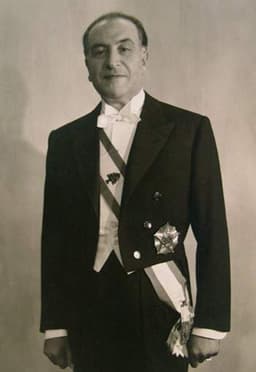
Fuad Chehab
General · Modern
49.9Total
Mohammad Fahim
General · Modern
49.7Total
Basic Information
Born
1902
1957
Died
1973
—
Era
Modern
Modern
Nationality
Lebanon
Afghanistan
Occupation
General
General
Civilization
Middle Eastern
Middle Eastern
Score Comparison
Military (10%)
10.2
40.0
Political (20%)
70.0
43.7
Influence (20%)
54.1
51.0
Legacy (20%)
44.2
43.3
Leadership (15%)
72.0
74.0
Strategy (15%)
30.3
45.0
TOTAL
49.9
49.7
Fuad Chehab — Complete Timeline
1958 AD
Launched Chehabist reforms and modernizationReform◆ Major
President Chehab implemented a series of reforms known as Chehabism, including administrative modernization, economic planning, and strengthening state institutions. He established the Central Bank of Lebanon and the Civil Service Board.
ReformModernizationState Building
Impact: nationalconstructive
Elected President of LebanonPolitical Action◆ Major
Fuad Chehab was elected President of Lebanon on September 23, 1958, succeeding Camille Chamoun. His election ended the 1958 crisis and was supported by both Christian and Muslim factions seeking stability.
PresidencyElectionStabilization
Impact: nationalconstructive
Created the Deuxième Bureau intelligence agencyPolitical Action
Chehab expanded the role of the Deuxi
IntelligenceSecurityAuthoritarianism
Impact: national
1960 AD
Presided over the 1960s economic boomOther
Under Chehab's presidency, Lebanon experienced a period of economic growth and stability, with Beirut becoming a major financial and tourism hub. His policies attracted foreign investment and expanded the middle class.
Economic GrowthBeirutProsperity
Impact: nationalconstructive
1964 AD
Refused to amend constitution for a second termPolitical Action
Chehab declined to seek a second term as president, respecting the constitutional limit. He retired from politics in 1964, setting a precedent for peaceful transitions of power in Lebanon.
ConstitutionTerm LimitRetirement
Impact: nationalconstructive
Mohammad Fahim — Complete Timeline
2001 AD
Led Northern Alliance Forces in Fall of KabulWar
Mohammad Fahim, as a senior Northern Alliance commander, led forces that captured Kabul from the Taliban in November 2001. This victory followed the US invasion and was a turning point in the war, leading to the collapse of Taliban rule.
AfghanistanWarTaliban
Impact: national
Appointed Vice President of AfghanistanPolitical Action◆ Major
Mohammad Fahim was appointed Vice President of Afghanistan under Hamid Karzai in 2001, serving until 2004. He was a key Northern Alliance commander and his appointment was part of the post-Taliban power-sharing arrangement.
AfghanistanVice PresidencyNorthern Alliance
Impact: nationalconstructive
Served as Minister of DefensePolitical Action◆ Major
Mohammad Fahim served as Afghanistan's Minister of Defense from 2001 to 2004. He oversaw the formation of the new Afghan National Army and security forces, integrating former mujahideen and Northern Alliance fighters.
AfghanistanDefenseMilitary
Impact: nationalconstructive
2009 AD
Appointed First Vice President in 2009Political Action◆ Major
Mohammad Fahim was appointed First Vice President of Afghanistan under President Hamid Karzai in 2009. He served until his death in 2014, playing a key role in security and political affairs.
AfghanistanVice PresidencyGovernment
Impact: nationalconstructive
Expert Analysis
Fuad Chehab vs Mohammad Fahim
# The General and the Statesman: Fuad Chehab and Mohammad Fahim
In the autumn of 1958, a slim, ascetic-looking general in a crisp uniform stepped onto the balcony of the presidential palace in Beirut, Lebanon. The crowd below, a sea of fezzes and headscarves, erupted in cheers. Across the Middle East, in the winter of 2001, another general—broad-shouldered, bearded, with a Kalashnikov slung over his shoulder—rode a tank into the streets of Kabul, Afghanistan, as the Taliban fled. Both men were generals who became political leaders. Both rose from the chaos of civil strife. Yet one is remembered as a reformer who built institutions, the other as a warlord who never quite shed his uniform. Why did their paths diverge so sharply?
Origins
Fuad Chehab was born in 1902 into a distinguished Maronite Christian family in Beirut, Lebanon. His lineage traced back to the Chehab dynasty that had ruled Mount Lebanon for centuries. He was raised in privilege, educated at the Jesuit Saint Joseph University, and steeped in the French military tradition after training at the École Spéciale Militaire de Saint-Cyr. Lebanon in the early twentieth century was a fragile mosaic of eighteen religious sects, and Chehab absorbed from childhood the delicate art of balancing communities.
Mohammad Fahim, born in 1957 in the Panjshir Valley of Afghanistan, came from a modest Tajik farming family. His world was one of mountains, tribal loyalties, and resistance. He had little formal education. By the time he was a teenager, Afghanistan was descending into Soviet invasion and civil war. Fahim joined the mujahideen, learning war not in a military academy but on the rocky slopes of his homeland.
The difference in their formative worlds was stark: Chehab inherited a state with institutions; Fahim inherited a battlefield.
Rise to Power
Chehab’s rise was methodical. He became commander of the Lebanese Army in 1945, a period when the army was a weak, sectarian force. He spent years professionalizing it, refusing to involve the military in politics. His turning point came in 1958, when President Camille Chamoun’s attempt to amend the constitution triggered a civil war. The United States intervened, and a compromise emerged: Chehab, the neutral general, was elected president on September 23, 1958. He did not seize power; power was thrust upon him.
Fahim’s rise was violent. He fought alongside the legendary Ahmad Shah Massoud in the Northern Alliance against the Soviet occupation and later the Taliban. When Massoud was assassinated on September 9, 2001, just two days before the 9/11 attacks, Fahim inherited the military command. When the U.S. invasion of Afghanistan began in October 2001, Fahim led the Northern Alliance forces in the fall of Kabul in November. He was appointed Vice President and Minister of Defense in the new government of Hamid Karzai. He arrived at the table of power still smelling of gunpowder.
Leadership & Governance
Chehab’s presidency was defined by a philosophy that came to be called “Chehabism.” He believed that Lebanon’s sectarian system could be stabilized only through a strong, neutral state that intervened to correct economic imbalances. He created the Central Bank, reformed the civil service, and launched massive infrastructure projects. Beirut boomed in the 1960s, becoming the banking capital of the Middle East. But Chehab also created the Deuxième Bureau, an intelligence agency that monitored politicians, journalists, and activists. It was a double-edged sword: it kept the peace, but it also stifled dissent.
Fahim’s governance was more personal. As Minister of Defense, he oversaw the formation of the new Afghan National Army, but his loyalty was always to his Northern Alliance commanders rather than to the state. He used his position to amass wealth and power, building a network of patronage. Critics accused him of running the Defense Ministry as a private fiefdom. Unlike Chehab, who tried to transcend his military background, Fahim remained a general in civilian clothes.
Triumph & Tragedy
Chehab’s greatest triumph was Lebanon’s stability and prosperity during his tenure. He refused to amend the constitution for a second term in 1964, a rare act of self-restraint in a region of strongmen. His tragedy was that his reforms did not outlast him. After he left office, the sectarian tensions he had managed returned, and Lebanon slid into civil war in 1975.
Fahim’s greatest moment was the fall of Kabul in November 2001, a victory that ended Taliban rule. But his tragedy was that he could not build on it. He was dropped from the vice presidency in 2004, only to return in 2009 as First Vice President. He died in 2014, leaving behind a reputation as a warlord who had helped liberate his country but also helped corrupt it.
Character & Destiny
Chehab was introverted, ascetic, and deeply principled. He slept in a simple bed in the presidential palace and refused to use his office for personal gain. His motto was “No victor, no vanquished.” He believed that leadership was about service, not power.
Fahim was pragmatic, ruthless, and tribal. He believed that power was about loyalty and force. He once said, “In Afghanistan, the gun is the father of the law.” He was not a philosopher-king; he was a survivor.
These characters shaped their destinies. Chehab’s restraint left Lebanon without a strongman to hold it together after him. Fahim’s ambition left Afghanistan with a state that remained weak and corrupt.
Legacy
Chehab is remembered in Lebanon as a rare honest leader, but his legacy is ambiguous. His intelligence apparatus became a tool of repression, and his reforms failed to prevent civil war. Yet he remains a symbol of what Lebanon could have been.
Fahim is remembered in Afghanistan as a key figure in the defeat of the Taliban, but also as a symbol of the warlordism that undermined the republic. His death in 2014 marked the end of an era of Northern Alliance dominance.
Conclusion
Standing at the crossroads of history, both men faced the same question: Can a general build a nation? Chehab tried to become a statesman and almost succeeded. Fahim remained a general and never quite tried. Their stories remind us that leadership is not just about seizing power but about transforming it. The difference between a reformer and a warlord is not the uniform they wear but the institutions they leave behind.
Rankings
🥇
Fuad ChehabLeader
Mil: 10.2Pol: 70.0Inf: 54.1
49.9
🥈
Mohammad Fahim
Mil: 40.0Pol: 43.7Inf: 51.0
49.7
+0.2 behind
How This Comparison Works
Algorithm
Each figure is scored on 6 dimensions (0—100 scale) based on structured historical data: Military (10%), Political (20%), Influence (20%), Legacy (20%), Leadership (15%), Strategy (15%). The weighted total produces the final ranking.
Data Sources
Scores are computed from structured sub-indicators in the database. Scale factors adjust for era (Ancient ×0.85, Modern ×1.0) and civilization size (Eastern ×1.05, Other ×0.80) to account for differences in population and military scale.
Maximum 3 Figures
Comparisons are limited to 2—3 figures to ensure readability and statistical meaningfulness.
Error Margins
±5 points per dimension — Sub-scores are derived from historical records with inherent uncertainty. Two figures within 5 points on a dimension should be considered roughly equivalent in that area.
Total Score Accuracy
±3 points overall — The weighted combination of 6 dimensions produces a total score with approximately ±3 points of uncertainty. Differences of less than 3 points are not statistically significant— the figures are effectively tied.
Known Limitations
- Historical records are incomplete and uneven across civilizations
- Figures from oral-tradition societies may be underrepresented
- Occupation labels can misclassify multi-role figures
- Scores measure capability and impact, not moral character
- Quantitative scoring is a comparison tool, not absolute truth
Capability Radar
Military (10%) — Battles & Warfare
Battles
5
35
Win Rate
5
40
Expansion
5
25
Political (20%) — Governance & Reform
Reform
65
20
Diplomacy
60
40
Economy
50
15
Influence (20%) — Cultural & Global Reach
Cultural
30
15
Global
25
20
Legacy (20%) — Historical Impact
Historical
35
30
Longevity
30
20
Leadership (15%) — Power & Stability
Tenure
55
45
Stability
45
20
Strategy (15%) — Tactics & Innovation
Strategy
10
35
Tactics
10
30
Reform
20
20
Similar Comparisons
Comments & Discussion
No comments yet. Be the first to share your thoughts!