Loading...
Fuad Chehab vs Li Zongren
Li Zongren leads by 8.6 pts · 2 figures compared
…
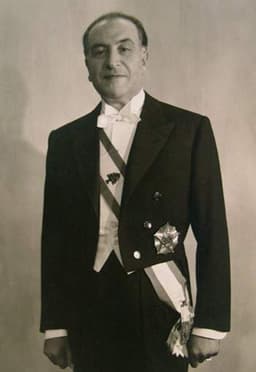
Fuad Chehab
General · Modern
49.9Total
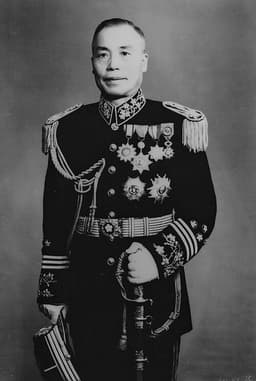
Li Zongren
General · Modern
58.5Total
Basic Information
Born
1902
1890
Died
1973
1969
Era
Modern
Modern
Nationality
Lebanon
China
Occupation
General
General
Civilization
Middle Eastern
Eastern
Score Comparison
Military (10%)
10.2
65.0
Political (20%)
70.0
53.8
Influence (20%)
54.1
58.0
Legacy (20%)
44.2
52.0
Leadership (15%)
72.0
72.0
Strategy (15%)
30.3
56.8
TOTAL
49.9
58.5
Fuad Chehab — Complete Timeline
1958 AD
Launched Chehabist reforms and modernizationReform◆ Major
President Chehab implemented a series of reforms known as Chehabism, including administrative modernization, economic planning, and strengthening state institutions. He established the Central Bank of Lebanon and the Civil Service Board.
ReformModernizationState Building
Impact: nationalconstructive
Elected President of LebanonPolitical Action◆ Major
Fuad Chehab was elected President of Lebanon on September 23, 1958, succeeding Camille Chamoun. His election ended the 1958 crisis and was supported by both Christian and Muslim factions seeking stability.
PresidencyElectionStabilization
Impact: nationalconstructive
Created the Deuxième Bureau intelligence agencyPolitical Action
Chehab expanded the role of the Deuxi
IntelligenceSecurityAuthoritarianism
Impact: national
1960 AD
Presided over the 1960s economic boomOther
Under Chehab's presidency, Lebanon experienced a period of economic growth and stability, with Beirut becoming a major financial and tourism hub. His policies attracted foreign investment and expanded the middle class.
Economic GrowthBeirutProsperity
Impact: nationalconstructive
1964 AD
Refused to amend constitution for a second termPolitical Action
Chehab declined to seek a second term as president, respecting the constitutional limit. He retired from politics in 1964, setting a precedent for peaceful transitions of power in Lebanon.
ConstitutionTerm LimitRetirement
Impact: nationalconstructive
Li Zongren — Complete Timeline
1921 AD
Command of the Guangxi ArmyPolitical Action◆ Major
Li Zongren became a commander in the Guangxi Army and helped unify Guangxi province under the New Guangxi Clique. He established a powerful regional base that rivaled other warlords.
Guangxi CliqueMilitary CommandWarlord Era
Impact: regional
1926 AD
Alliance with the Nationalist GovernmentPolitical Action◆ Major
Li Zongren allied the Guangxi Clique with Chiang Kai-shek's Nationalist government during the Northern Expedition. His forces played a key role in defeating warlords and unifying China under KMT rule.
Northern ExpeditionAllianceKMT
Impact: nationalconstructive
1938 AD
Battle of TaierzhuangWar
Li Zongren commanded Chinese forces to a major victory over the Japanese at the Battle of Taierzhuang during the Second Sino-Japanese War. This was the first significant Chinese victory of the war and boosted national morale.
Second Sino-Japanese WarBattleVictory
Impact: nationalconstructive
1949 AD
Acting Presidency of the Republic of ChinaPolitical Action◆ Major
Li Zongren served as Acting President of the Republic of China after Chiang Kai-shek's resignation during the Chinese Civil War. He attempted to negotiate peace with the Communists but failed, leading to the KMT's retreat to Taiwan.
Chinese Civil WarPresidencyKMT
Impact: nationaltragic
Exile to the United StatesPolitical Action
After the Communist victory, Li Zongren fled to the United States, where he lived in exile. He criticized Chiang Kai-shek's leadership and advocated for a reformed KMT, but remained politically marginalized.
ExileChinese Civil WarPolitics
Impact: nationaltragic
Expert Analysis
Fuad Chehab vs Li Zongren
### The General and the Reformer: Two Paths from the Barracks to Power
On a spring morning in 1938, a Chinese general named Li Zongren watched his forces smash the elite Japanese 10th Division at Taierzhuang, a victory that would electrify a nation reeling from invasion. Twenty years later, on a Mediterranean coast, another general, Fuad Chehab of Lebanon, stepped into a presidential palace not through conquest, but through crisis, inheriting a country shattered by sectarian violence. Both men were soldiers who became statesmen, yet their journeys could not have been more different. One fought to hold a crumbling nation together with sheer will and guerrilla cunning; the other tried to knit a fractured society together with bureaucracy and reform. Why did one end his life in exile, the other in quiet retirement? The answer lies not just in their choices, but in the worlds they were born to command.
### Origins: The Warlord and the Officer
Li Zongren was born in 1890 in Guangxi, a poor, mountainous province in southern China. His childhood was steeped in the chaos of the dying Qing Dynasty—bandits, famine, and the humiliations of foreign imperialism. He was a product of the "warlord era," a time when power flowed from the barrel of a gun. His father, a scholar, taught him Confucian classics, but the young Li learned his real lessons in the local militia, where survival depended on personal loyalty and tactical cunning. By 1921, at age 31, he had clawed his way to command of the Guangxi Army, unifying the province under the New Guangxi Clique. His was a world where trust was a luxury and betrayal a constant threat.
Fuad Chehab, born in 1902 in Beirut, came from a very different Lebanon—then part of the Ottoman Empire, but a cosmopolitan crossroads of Christian and Muslim communities. His family was aristocratic, of the Maronite Christian elite, but they had lost political power. Chehab chose the military not as a path to power, but as a profession of order. He was trained by the French, studying at the École Spéciale Militaire de Saint-Cyr, the same academy that produced Napoleon’s officers. Where Li’s education was forged in guerrilla warfare, Chehab’s was molded in discipline, hierarchy, and the European ideal of a non-political army. This contrast in upbringing—one a rough-hewn survivor of chaos, the other a polished product of colonial order—would define their leadership.
### Rise to Power: Alliances and Accidents
Li Zongren’s rise was a masterclass in tactical alliance. In 1926, he made a pivotal decision: he allied the Guangxi Clique with Chiang Kai-shek’s Nationalist government during the Northern Expedition. This was not idealism—it was pragmatism. Chiang offered a unified front against the northern warlords, and Li saw a chance to expand his influence. But the alliance was a marriage of convenience, not conviction. Li’s forces fought brilliantly, but he remained a regional kingpin, never fully trusted by Chiang. His path to the presidency in 1949 was not a victory, but a collapse: as Chiang’s Nationalist regime crumbled before Mao’s Communists, Chiang resigned in desperation, and Li became Acting President. It was a throne of ashes.
Fuad Chehab’s ascent was equally dramatic, but driven by crisis of a different kind. In 1958, Lebanon was on the brink of civil war, as President Camille Chamoun’s pro-Western policies inflamed Muslim and Arab nationalist factions. The army, under Chehab’s command, refused to take sides. When Chamoun was forced to resign, Chehab was the only figure acceptable to all sides—a neutral soldier who had kept his hands clean. He was elected President on September 23, 1958, not as a conqueror, but as a compromise. His power came from trust, not territory.
### Leadership & Governance: The Sword and the Scale
Li Zongren’s finest hour was the Battle of Taierzhuang in 1938. His strategy—luring the Japanese into a trap and then counterattacking with overwhelming force—was a textbook example of Chinese military genius. His leadership score of 79.9 and strategy score of 83.4 reflect this: he was a brilliant tactician who could inspire men to fight against impossible odds. But as a political leader, he was out of his depth. His acting presidency in 1949 lasted only months. He tried to negotiate peace with the Communists, but his army was already disintegrating. He fled to the United States, where he lived in exile, bitterly criticizing Chiang. His political score of 65.0 tells the story: he could win battles, but not a country.
Chehab governed differently. He believed that Lebanon’s sectarian divisions could be healed not by force, but by institutions. His "Chehabism" was a philosophy of reform: he modernized the bureaucracy, created a national planning council, and expanded the role of the state to curb the power of feudal clan leaders. He also created the Deuxième Bureau, a military intelligence agency, to monitor extremists. This was controversial—it became a tool of surveillance—but Chehab saw it as necessary to prevent the chaos of 1958 from recurring. Under his presidency, Lebanon experienced an economic boom, with Beirut becoming a financial hub. His political score of 68.8, while modest, reflects a steady hand in a volatile region.
### Triumph & Tragedy
Li’s triumph was Taierzhuang, a victory that gave China hope during the darkest days of the war. But his tragedy was the Chinese Civil War. He could not unite the warlords, he could not stop the Communists, and he could not even hold his own faction together. His exile in the United States was lonely and bitter—a man who had once commanded armies now living in a New York apartment, writing memoirs and waiting for a call that never came.
Chehab’s triumph was his presidency itself: he kept Lebanon stable for six years, a feat in a region where stability was a luxury. His tragedy was that his reforms did not outlast him. He refused to amend the constitution for a second term in 1964, a gesture of principle that left his successors without his moral authority. The Deuxième Bureau became a symbol of state repression. When Chehab died in 1973, Lebanon was already sliding toward the civil war that would begin two years later.
### Character & Destiny
Li was a man of immense personal courage but limited political vision. He saw power as something to be won, not built. His exile was the fate of a warlord in a world that no longer had room for warlords. Chehab was a man of restraint and principle, but his faith in institutions was naive in a country where loyalty was to sect, not state. His retirement was his own choice, but it left a vacuum.
### Legacy
Today, Li Zongren is remembered in China as a patriotic general who fought the Japanese, but his political legacy is overshadowed by Chiang and Mao. In Taiwan, he is a footnote. Fuad Chehab is a more complex figure: revered as a symbol of moderation, but criticized for the Deuxième Bureau. His name lives on in "Chehabism," a term for reformist authoritarianism.
### Conclusion
Two generals, two fates. Li Zongren fought to hold a nation together with a sword; Fuad Chehab tried to stitch it together with a scale. One ended in exile, the other in retirement. Their stories remind us that leadership is not just about strength, but about the world you inherit. Li’s China was a battlefield; Chehab’s Lebanon was a mosaic. Both men did what they could with what they had—and history, as always, was the final judge.
Rankings
🥇
Li ZongrenLeader
Mil: 65.0Pol: 53.8Inf: 58.0
58.5
🥈
Fuad Chehab
Mil: 10.2Pol: 70.0Inf: 54.1
49.9
+8.6 behind
How This Comparison Works
Algorithm
Each figure is scored on 6 dimensions (0—100 scale) based on structured historical data: Military (10%), Political (20%), Influence (20%), Legacy (20%), Leadership (15%), Strategy (15%). The weighted total produces the final ranking.
Data Sources
Scores are computed from structured sub-indicators in the database. Scale factors adjust for era (Ancient ×0.85, Modern ×1.0) and civilization size (Eastern ×1.05, Other ×0.80) to account for differences in population and military scale.
Maximum 3 Figures
Comparisons are limited to 2—3 figures to ensure readability and statistical meaningfulness.
Error Margins
±5 points per dimension — Sub-scores are derived from historical records with inherent uncertainty. Two figures within 5 points on a dimension should be considered roughly equivalent in that area.
Total Score Accuracy
±3 points overall — The weighted combination of 6 dimensions produces a total score with approximately ±3 points of uncertainty. Differences of less than 3 points are not statistically significant— the figures are effectively tied.
Known Limitations
- Historical records are incomplete and uneven across civilizations
- Figures from oral-tradition societies may be underrepresented
- Occupation labels can misclassify multi-role figures
- Scores measure capability and impact, not moral character
- Quantitative scoring is a comparison tool, not absolute truth
Capability Radar
Military (10%) — Battles & Warfare
Battles
5
65
Win Rate
5
60
Expansion
5
60
Political (20%) — Governance & Reform
Reform
65
45
Diplomacy
60
60
Economy
50
40
Influence (20%) — Cultural & Global Reach
Cultural
30
40
Global
25
40
Legacy (20%) — Historical Impact
Historical
35
55
Longevity
30
45
Leadership (15%) — Power & Stability
Tenure
55
55
Stability
45
35
Strategy (15%) — Tactics & Innovation
Strategy
10
68
Tactics
10
70
Reform
20
55
Similar Comparisons
Comments & Discussion
GuerrillaSage6/16/2026
Li Zongren was a military savant, pure and simple. Taierzhuang wasn't just a win; it was the only major Chinese victory in the entire war's early phase. He used local geography and peasant intelligence like a master. Chehab? A paper-pusher in uniform. His "reforms" in Lebanon were administrative band-aids on a sectarian wound that would explode in 1975. One man shaped history through grit; the other just managed its decay.
数据侠客6/16/2026
把数据摊开看看:李宗仁的广系军阀巅峰时能调动20万军队,控制了半个中国;Chehab手下呢?黎巴嫩陆军总共才1.5万人,还分属各个教派。两人根本不在同一个量级。说李宗仁"败走海外"?台儿庄那场仗就够封神了,更何况后来在武汉会战、随枣会战里他都顶住了日军主力。Chehab的改革在Sami Makarem的核算里,连经济结构都没动——这叫"改革"?别逗了。
TogaScepter6/16/2026
Comparing them is intellectually dishonest. Chehab was a Roman institutionalist in a Byzantine chaos; Li Zongren was a Confucian tactician in a Darwinian hell. Chehab's real innovation was enforced secularism in the officer corps—the only institution in Lebanon that transcended sect. He literally wrote the book on it. Li's tragedy was not exile, but that his provincial "Guangxi clique" mindset made him incapable of national vision. One built a church of state; the other never left his village's
长安旧梦6/16/2026
作为半个广西人,我永远站李宗仁。他拆了桂林城墙建公路、办广西大学、推广义务教育的时,Chehab还在法国圣西尔军校念书呢。李宗仁的"三自三寓"政策差点把广西建成模范省。Chehab那种平衡派系的做法说白了就是维持现状,李宗仁是真想重构社会。别拿一个守着摊子的和开创局面的比。最后Chehab身边是法拉赫,李宗仁身边是周恩来——还不够说明问题?
RevisionistEcho6/16/2026
Let's puncture the Chehab myth. His "reforms" were a neoliberal fantasy that exempted Lebanon's feudal landlords from taxation, funded by foreign aid and central bank printing. Meanwhile, Li Zongren's Guangxi was China's only province with a balanced budget in the 1930s, running on opium taxes and forced savings. Chehab built a civil service that collapsed in 18 months of war; Li built a guerrilla army that survived him by decades. Institutional longevity doesn't come from NATO manuals. It comes