Loading...
Fuad Chehab vs Julius Caesar
Julius Caesar leads by 32.9 pts · 2 figures compared
…
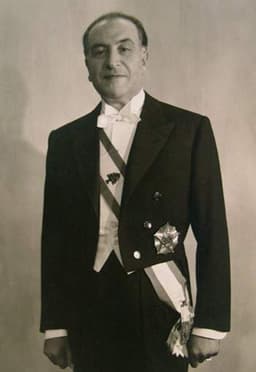
Fuad Chehab
General · Modern
49.9Total

Julius Caesar
General · Ancient
82.8Total
Basic Information
Born
1902
-100
Died
1973
-44
Era
Modern
Ancient
Nationality
Lebanon
Roman Republic
Occupation
General
General
Civilization
Middle Eastern
Western
Score Comparison
Military (10%)
10.2
88.0
Political (20%)
70.0
78.0
Influence (20%)
54.1
85.0
Legacy (20%)
44.2
82.0
Leadership (15%)
72.0
80.0
Strategy (15%)
30.3
85.0
TOTAL
49.9
82.8
Fuad Chehab — Complete Timeline
1958 AD
Launched Chehabist reforms and modernizationReform◆ Major
President Chehab implemented a series of reforms known as Chehabism, including administrative modernization, economic planning, and strengthening state institutions. He established the Central Bank of Lebanon and the Civil Service Board.
ReformModernizationState Building
Impact: nationalconstructive
Elected President of LebanonPolitical Action◆ Major
Fuad Chehab was elected President of Lebanon on September 23, 1958, succeeding Camille Chamoun. His election ended the 1958 crisis and was supported by both Christian and Muslim factions seeking stability.
PresidencyElectionStabilization
Impact: nationalconstructive
Created the Deuxième Bureau intelligence agencyPolitical Action
Chehab expanded the role of the Deuxi
IntelligenceSecurityAuthoritarianism
Impact: national
1960 AD
Presided over the 1960s economic boomOther
Under Chehab's presidency, Lebanon experienced a period of economic growth and stability, with Beirut becoming a major financial and tourism hub. His policies attracted foreign investment and expanded the middle class.
Economic GrowthBeirutProsperity
Impact: nationalconstructive
1964 AD
Refused to amend constitution for a second termPolitical Action
Chehab declined to seek a second term as president, respecting the constitutional limit. He retired from politics in 1964, setting a precedent for peaceful transitions of power in Lebanon.
ConstitutionTerm LimitRetirement
Impact: nationalconstructive
Julius Caesar — Complete Timeline
58 BC
Gallic WarsWar◆ Major
Caesar, as proconsul of Gaul, launched a series of campaigns that conquered all of Gaul (modern France, Belgium, and parts of Switzerland). He fought numerous battles, including against the Helvetii, the Belgae, and the Gallic chieftain Vercingetorix. The wars brought immense wealth and a loyal army to Caesar.
Gallic WarsConquestRoman Expansion
Impact: regional
49 BC
Crossing the RubiconPolitical Action◆ Major
Caesar led Legio XIII across the Rubicon River into Italy, defying the Roman Senate's order to disband his army. This act triggered a civil war against Pompey and the Optimates, ultimately leading to Caesar's dictatorship and the end of the Roman Republic.
Roman Civil WarEnd of RepublicPower Struggle
Impact: global
48 BC
Battle of PharsalusWar◆ Major
Caesar's outnumbered army defeated the larger forces of Pompey the Great at Pharsalus in Greece. Caesar's tactical use of a reserve line to counter Pompey's cavalry charge proved decisive. Pompey fled to Egypt, where he was assassinated, leaving Caesar as the undisputed master of the Roman world.
Roman Civil WarBattleDecisive Victory
Impact: regional
44 BC
Appointment as Dictator for LifePolitical Action◆ Major
The Roman Senate appointed Caesar dictator perpetuo (dictator for life), granting him unprecedented personal power. This move concentrated military, legislative, and judicial authority in one person, effectively ending the Roman Republic's traditional system of checks and balances and alarming many senators.
DictatorshipEnd of RepublicPower Consolidation
Impact: regionaldestructive
Assassination on the Ides of MarchPolitical Action◆ Major
A group of Roman senators, led by Marcus Junius Brutus and Gaius Cassius Longinus, stabbed Caesar to death at a meeting of the Senate in the Theatre of Pompey. The assassination was intended to restore the Republic, but instead triggered another civil war that led to the rise of the Roman Empire.
AssassinationRoman PoliticsEnd of Republic
Impact: globaldestructive
Expert Analysis
Julius Caesar vs Fuad Chehab
# The General Who Refused Power, and the One Who Died for It
On the morning of March 15, 44 BCE, Julius Caesar walked into the Senate chamber in Rome, expecting to hear petitions. Instead, sixty senators surrounded him with daggers. He fell at the base of a statue of Pompey, his former rival, stabbed twenty-three times. The man who had crossed the Rubicon and conquered Gaul could not cross the threshold of his own ambition.
Eighteen centuries later and a thousand miles east, another general faced a different kind of choice. In 1964, Fuad Chehab, President of Lebanon, was asked to amend the constitution so he could serve a second term. He refused. He walked away from power when it was offered to him on a silver platter. Why did one man die clutching for more, while another retired quietly to his garden?
Origins
Caesar was born into the chaos of the late Roman Republic, a world where noble families competed for glory through military conquest and political manipulation. His aunt had married Gaius Marius, the great populist general, and his father died when Caesar was sixteen. From childhood, he understood that in Rome, power was a prize taken by force or cunning—never given.
Fuad Chehab was born in 1902 in Beirut, then part of the Ottoman Empire, into a family of Maronite Christian aristocrats. His grandfather had been a governor under the Ottomans; his father died when Chehab was young as well. But Lebanon was not Rome. It was a fragile mosaic of eighteen religious sects, held together by nothing more than mutual exhaustion. Chehab learned early that in the Levant, survival meant balance, not conquest.
Rise to Power
Caesar’s path was a ladder of audacity. He was captured by pirates as a young man, laughed at their ransom demand, and later crucified them. He climbed the political ranks—quaestor, aedile, pontifex maximus—but his real breakthrough came in 58 BCE, when he took command of the Roman provinces in Gaul. Over eight years, he conquered a territory larger than Italy itself, wrote about it in elegant Latin, and built an army that loved him more than it loved the Republic.
Chehab’s rise was quieter. He joined the French-sponsored Troupes Spéciales du Levant, served as a staff officer, and by 1945 had become commander of the Lebanese Army. He was not a conqueror. He was a stabilizer. When Lebanon’s first crisis erupted in 1958—a civil war between pro-Western Christians and Arab nationalist Muslims—Chehab refused to use the army to crush either side. He kept his soldiers in their barracks, waiting. The crisis burned itself out, and the exhausted politicians turned to the one man who had not taken sides.
Leadership & Governance
Caesar governed as he conquered: decisively, ruthlessly, and with a vision that terrified his peers. He reformed the calendar, extended citizenship to provincials, and redistributed land to veterans. But he also centralized power in his own hands, packed the Senate with his supporters, and accepted the title “dictator for life.” His military genius was undeniable—the siege of Alesia, the lightning campaign at Pharsalus—but his political wisdom was undermined by his refusal to share credit. He forgot that in a republic, no man is indispensable.
Chehab governed by the opposite logic. His “Chehabism” was a philosophy of controlled reform: modernize the administration, build infrastructure, create a secret intelligence service (the Deuxième Bureau) to monitor extremists, but never move so fast that the delicate sectarian balance shattered. He presided over Lebanon’s golden economic boom in the early 1960s, when Beirut became the banking capital of the Middle East. But he also built a surveillance state that stifled dissent. His reforms were real, but they were cautious. He knew that in Lebanon, boldness could mean civil war.
Triumph & Tragedy
Caesar’s triumph was Gaul. His *Commentaries* remain a masterpiece of self-promotion and military analysis. His tragedy was his own success: by destroying the Republic, he made his own murder inevitable. The Ides of March was not a betrayal; it was the logical conclusion of a system he had broken.
Chehab’s triumph was the 1958 transition itself—a peaceful end to a sectarian war, a rare achievement in the Middle East. His tragedy was that his reforms did not outlast him. After he left office in 1964, his successors abandoned Chehabism, the Deuxième Bureau became a tool of repression, and by 1975 Lebanon collapsed into a fifteen-year civil war. Chehab had built a dam, but he could not make it hold.
Character & Destiny
Caesar was driven by a belief that he was exceptional. He gambled constantly—crossing the Rubicon, pardoning his enemies, ignoring warnings of assassination—because he genuinely believed his luck would never run out. His personality was his destiny: brilliant, arrogant, and ultimately fatal.
Chehab was driven by a fear of failure. He had seen what happened when Lebanon’s sects turned on each other. He governed like a man walking through a minefield, always checking his step. His caution saved Lebanon in 1958, but it also meant he never dared to reshape the system fundamentally. He refused a second term because he believed that power concentrated in one man would destroy the country. He was probably right.
Legacy
Caesar’s legacy is the Roman Empire. His adopted heir, Octavian, became Augustus, and the Republic never returned. Every European monarch and dictator who claimed the title “Caesar” was walking in his shadow. He is remembered as a genius, a tyrant, and the man who proved that one person can change history—for better and for worse.
Chehab’s legacy is more ambiguous. In Lebanon, he is remembered as the “father of the army” and the president who could have been a dictator but chose not to be. His portrait hangs in government offices, but his reforms are a memory. The Chehabist experiment proved that moderation works only as long as the moderates remain in power. Once they leave, the extremists return.
Conclusion
Caesar and Chehab both stood at the edge of absolute power. Caesar stepped forward and was destroyed. Chehab stepped back and was forgotten. Which was the wiser choice? The answer depends on what you value: glory or peace, impact or stability. Caesar changed the world and died young. Chehab preserved his country for a few years and watched it crumble anyway. Perhaps the real lesson is not about the men themselves, but about the systems they inherited. Rome could be remade by a single will. Lebanon could only be balanced. And some balances are too fragile to survive even the gentlest hand.
Rankings
🥇
Julius CaesarLeader
Mil: 88.0Pol: 78.0Inf: 85.0
82.8
🥈
Fuad Chehab
Mil: 10.2Pol: 70.0Inf: 54.1
49.9
+32.9 behind
How This Comparison Works
Algorithm
Each figure is scored on 6 dimensions (0—100 scale) based on structured historical data: Military (10%), Political (20%), Influence (20%), Legacy (20%), Leadership (15%), Strategy (15%). The weighted total produces the final ranking.
Data Sources
Scores are computed from structured sub-indicators in the database. Scale factors adjust for era (Ancient ×0.85, Modern ×1.0) and civilization size (Eastern ×1.05, Other ×0.80) to account for differences in population and military scale.
Maximum 3 Figures
Comparisons are limited to 2—3 figures to ensure readability and statistical meaningfulness.
Error Margins
±5 points per dimension — Sub-scores are derived from historical records with inherent uncertainty. Two figures within 5 points on a dimension should be considered roughly equivalent in that area.
Total Score Accuracy
±3 points overall — The weighted combination of 6 dimensions produces a total score with approximately ±3 points of uncertainty. Differences of less than 3 points are not statistically significant— the figures are effectively tied.
Known Limitations
- Historical records are incomplete and uneven across civilizations
- Figures from oral-tradition societies may be underrepresented
- Occupation labels can misclassify multi-role figures
- Scores measure capability and impact, not moral character
- Quantitative scoring is a comparison tool, not absolute truth
Capability Radar
Military (10%) — Battles & Warfare
Battles
5
95
Win Rate
5
92
Expansion
5
97
Political (20%) — Governance & Reform
Reform
65
90
Diplomacy
60
85
Economy
50
82
Influence (20%) — Cultural & Global Reach
Cultural
30
88
Global
25
94
Legacy (20%) — Historical Impact
Historical
35
95
Longevity
30
96
Leadership (15%) — Power & Stability
Tenure
55
75
Stability
45
60
Strategy (15%) — Tactics & Innovation
Strategy
10
94
Tactics
10
96
Reform
20
88
Similar Comparisons
Comments & Discussion
RubiconRefuser6/16/2026
Caesar's mistake wasn't ambition—it was that he never built an exit strategy. Chehab understood something Caesar didn't: that in a deeply divided society like Lebanon, staying in power makes you a target, not a legend. Caesar had Gaul's wealth and Rome's legions, yet died clutching a toga. Chehab had a garden. Who really won?
塞壬迷途者6/16/2026
拿恺撒和谢哈布对比就是在混淆“权力欲”和“使命感”。恺撒是为个人荣耀撕碎共和体制——他跨过卢比孔河时罗马就已经死了。谢哈布拒绝修宪连任,是因为他知道黎巴嫩经不起第二个总统的独揽大权。一个是英雄主义的毒药,一个是制度理性的见证。历史该为后者立碑。
StatsDecay6/16/2026
All this hand-wringing about Chehab's "virtue" ignores the practical reality: Lebanon was already a confessional powder keg by 1964. He didn't refuse power from moral purity—he saw the math. A second term meant sectarian blowback with no military solution. Caesar's twenty-three stab wounds prove that refusing to share power is a death sentence. Chehab just read the room better.
旧罗马的残影6/16/2026
公元前44年元老院的匕首不是偶然,是罗马贵族对“僭主”的终极抵抗。恺撒想把自己从将军变成神——这套把戏在共和国晚期还能骗人。但谢哈布在1960年代面对的是黎巴嫩,十八个教派互相制衡,任何个人独裁都会被撕碎。他拒绝连任不是谦逊,是清醒:有些权,握住了也坐不稳。
ZhongheScholar6/16/2026
最讽刺的是:恺撒死于权力太少,谢哈布死于权力太多。一个是永远嫌不够,一个是知道够了就放手。罗马史里有个未解之谜——恺撒如果活下来会不会变成暴君。但黎巴嫩史有个铁证——谢哈布辞职后国家确实没崩。制度自信不是看谁站得多高,是看谁肯在高峰时转身走下山。