Loading...
Ferdinand VII of Spain vs Zhao Kuangyin
Zhao Kuangyin leads by 26.4 pts · 2 figures compared
…
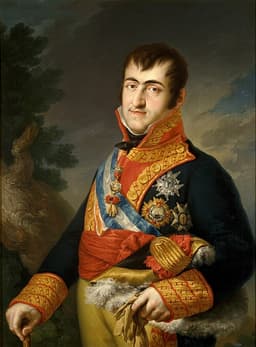
Ferdinand VII of Spain
Emperor · Modern
45.1Total
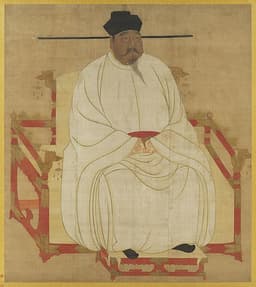
Zhao Kuangyin
Emperor · Medieval
71.5Total
Basic Information
Born
1784
927
Died
1833
976
Era
Modern
Medieval
Nationality
Spain
China
Occupation
Emperor
Emperor
Civilization
Western
Eastern
Score Comparison
Military (10%)
14.9
78.0
Political (20%)
32.2
84.0
Influence (20%)
51.0
68.0
Legacy (20%)
41.7
65.0
Leadership (15%)
74.0
74.0
Strategy (15%)
45.0
68.0
TOTAL
45.1
71.5
Ferdinand VII of Spain — Complete Timeline
1808 AD
Accession to the thronePolitical Action◆ Major
Ferdinand VII became King of Spain after the abdication of his father Charles IV. His reign was interrupted by Napoleon's intervention and the Peninsular War, but he was restored in 1814.
SuccessionMonarchy
Impact: national
1814 AD
Abolition of the Constitution of 1812Political Action
Upon returning to Spain, Ferdinand VII abolished the liberal Constitution of 1812 and restored absolute monarchy. He persecuted liberals and reinstated the Inquisition, reversing the reforms of the Cortes of C
ConstitutionAbsolutismReaction
Impact: nationaldestructive
1820 AD
Trienio LiberalPolitical Action◆ Major
A military revolt led by Rafael del Riego forced Ferdinand VII to reinstate the Constitution of 1812, beginning the Trienio Liberal. Ferdinand was effectively a constitutional monarch for three years.
Liberal RevolutionConstitutionRevolt
Impact: national
1823 AD
French intervention and restoration of absolutismWar◆ Major
A French army, the Hundred Thousand Sons of Saint Louis, invaded Spain to restore Ferdinand VII's absolute power. The liberal government fell, and Ferdinand resumed repressive rule.
InterventionAbsolutismCongress of Vienna
Impact: regionaldestructive
1830 AD
Pragmatic Sanction of 1830Political Action◆ Major
Ferdinand VII issued the Pragmatic Sanction, abolishing Salic Law and allowing his daughter Isabella to inherit the throne. This led to the Carlist Wars after his death.
SuccessionLawCarlist Wars
Impact: national
Zhao Kuangyin — Complete Timeline
960 AD
Founded Song dynastyPolitical Action
Zhao Kuangyin, a general of Later Zhou, was proclaimed emperor by his troops at Chenqiao. He established the Song dynasty, ending the Five Dynasties period and beginning a new era of Chinese history.
Song dynastyFoundingChenqiao
Impact: globalconstructive
961 AD
Removed military power from generalsPolitical Action◆ Major
Zhao Kuangyin invited senior generals to a banquet and persuaded them to retire peacefully. This 'removal of military power over wine' prevented military coups and centralized control.
Song dynastyMilitary reformCentralization
Impact: nationalconstructive
963 AD
Unified southern ChinaWar◆ Major
Zhao Kuangyin launched campaigns to conquer the southern kingdoms, including Jingnan, Later Shu, and Southern Tang. By his death, most of China was reunified under Song rule.
Song unificationConquestSouthern kingdoms
Impact: national
Expert Analysis
Zhao Kuangyin vs Ferdinand VII of Spain
### The King Who Lost His Kingdom and the Emperor Who Built One
In the autumn of 1814, Ferdinand VII of Spain returned to Madrid in triumph. The French occupiers were gone, the crowds cheered, and the king promptly tore up the liberal constitution that had been written in his absence. A few months later, he began hunting down the very men who had fought to restore him. Across the world, nine centuries earlier, another emperor—Zhao Kuangyin of Song China—did something almost unthinkable: he invited his most powerful generals to a banquet, drank wine with them, and persuaded them to give up their armies. One ruler restored tyranny; the other built a dynasty. What made the difference?
### Origins
Ferdinand VII was born into a decaying empire. His father, Charles IV, was weak; his mother, Maria Luisa, was domineering; and the court was a nest of intrigue. Ferdinand grew up hating his parents and fearing the French Revolution. He learned early that power was a prize to be seized, not a trust to be earned. When Napoleon lured the Spanish royal family to Bayonne in 1808, Ferdinand watched his father abdicate under French pressure—and then accepted the throne himself, only to be imprisoned by Napoleon for six years. His education was in betrayal.
Zhao Kuangyin was born into chaos. The Five Dynasties and Ten Kingdoms period had torn China apart for half a century. He was the son of a military officer, raised in camps and battlefields. He knew that generals could make emperors—and unmake them just as quickly. But he also saw the suffering of common people caught between warring states. His world taught him that stability was the highest good, and that power, if not controlled, would destroy everything.
### Rise to Power
Ferdinand’s rise was passive. He became king in 1808 because his father was forced to abdicate, not because he had earned the throne. When Napoleon imprisoned him, he became a symbol of Spanish resistance—a king in chains. But he contributed nothing to the war that liberated Spain. The Spanish people fought Napoleon with guerrilla warfare and desperation; Ferdinand simply waited.
Zhao Kuangyin’s rise was active. In 960, while leading an army against the Khitans, his troops stopped at Chenqiao and proclaimed him emperor. The story says they draped a yellow robe over him—whether he wanted it or not. He accepted, but he did not simply seize power. He negotiated with the child emperor of Later Zhou, promised the boy safety, and then marched into the capital without bloodshed. His rise was a coup, but a disciplined one.
### Leadership & Governance
Ferdinand VII ruled by fear. After abolishing the Constitution of 1812 in 1814, he restored the Inquisition, censored the press, and exiled or executed liberals. He trusted no one. When a military revolt in 1820 forced him to reinstate the constitution, he signed it while plotting its destruction. Three years later, he invited a French army—the Hundred Thousand Sons of Saint Louis—to invade his own country and crush the liberals. He called this restoration; his subjects called it betrayal. He issued the Pragmatic Sanction in 1830 to secure the throne for his daughter Isabella, but only after failing to produce a male heir. His governance was reactive, personal, and ultimately destructive.
Zhao Kuangyin governed by persuasion. In 961, at the famous banquet, he told his generals: "If someone else were to put a yellow robe on you, what could you do?" They understood. He gave them wealth, titles, and peaceful retirement. Then he reformed the bureaucracy, centralized military command, and conquered the southern kingdoms one by one—Jingnan in 963, Later Shu, Southern Tang. He did not destroy his rivals; he absorbed them. He reduced taxes, promoted agriculture, and opened the civil service to talent. His governance was systematic, strategic, and constructive.
### Triumph & Tragedy
Ferdinand’s greatest moment was also his most tragic. In 1814, he returned to Spain as the "Desired One"—the king the people had prayed for. But within months, he became the "Hated One." His tragedy was not that he failed, but that he succeeded in destroying the very nation that had fought for him. He left Spain bankrupt, divided, and on the brink of civil war.
Zhao Kuangyin’s triumph was the peaceful removal of military power from his generals—a feat almost unprecedented in Chinese history. His tragedy was that he never completed the unification of China. The Sixteen Prefectures remained in Khitan hands, and the Song dynasty would struggle with northern invaders for centuries. He died in 976, perhaps poisoned by his own brother, leaving behind a dynasty that would be remembered as cultured but militarily weak.
### Character & Destiny
Ferdinand VII was a man of deep insecurity and petty cruelty. He could not forgive, could not trust, and could not learn. His personality turned Spain into a prison. Zhao Kuangyin was a man of pragmatism and restraint. He understood that power was not about crushing enemies but about aligning interests. His personality turned chaos into order.
### Legacy
Ferdinand VII is remembered in Spain as a tyrant who crushed liberalism and set the stage for the Carlist Wars. His legacy is a cautionary tale about the cost of absolutism. Zhao Kuangyin is remembered as the founder of the Song dynasty, a golden age of Chinese culture, technology, and commerce. His legacy is a model of peaceful transition and strategic reform.
### Conclusion
Two emperors, two paths. Ferdinand VII clung to power until it rotted in his hands. Zhao Kuangyin released power and built a dynasty that lasted three centuries. The difference was not fate, but character. One man saw power as something to be hoarded; the other saw it as something to be shaped. In the end, the king who would not share his throne lost everything, while the general who gave away his army gained an empire.
Rankings
🥇
Zhao KuangyinLeader
Mil: 78.0Pol: 84.0Inf: 68.0
71.5
🥈
Ferdinand VII of Spain
Mil: 14.9Pol: 32.2Inf: 51.0
45.1
+26.4 behind
How This Comparison Works
Algorithm
Each figure is scored on 6 dimensions (0—100 scale) based on structured historical data: Military (10%), Political (20%), Influence (20%), Legacy (20%), Leadership (15%), Strategy (15%). The weighted total produces the final ranking.
Data Sources
Scores are computed from structured sub-indicators in the database. Scale factors adjust for era (Ancient ×0.85, Modern ×1.0) and civilization size (Eastern ×1.05, Other ×0.80) to account for differences in population and military scale.
Maximum 3 Figures
Comparisons are limited to 2—3 figures to ensure readability and statistical meaningfulness.
Error Margins
±5 points per dimension — Sub-scores are derived from historical records with inherent uncertainty. Two figures within 5 points on a dimension should be considered roughly equivalent in that area.
Total Score Accuracy
±3 points overall — The weighted combination of 6 dimensions produces a total score with approximately ±3 points of uncertainty. Differences of less than 3 points are not statistically significant— the figures are effectively tied.
Known Limitations
- Historical records are incomplete and uneven across civilizations
- Figures from oral-tradition societies may be underrepresented
- Occupation labels can misclassify multi-role figures
- Scores measure capability and impact, not moral character
- Quantitative scoring is a comparison tool, not absolute truth
Capability Radar
Military (10%) — Battles & Warfare
Battles
10
75
Win Rate
5
85
Expansion
5
75
Political (20%) — Governance & Reform
Reform
5
90
Diplomacy
20
85
Economy
10
80
Influence (20%) — Cultural & Global Reach
Cultural
15
70
Global
20
60
Legacy (20%) — Historical Impact
Historical
30
80
Longevity
20
75
Leadership (15%) — Power & Stability
Tenure
60
65
Stability
10
85
Strategy (15%) — Tactics & Innovation
Strategy
5
80
Tactics
5
70
Reform
5
90
Similar Comparisons
Comments & Discussion
DaggerAndGoblet6/16/2026
Ferdinand VII thought he could rule like a medieval king in an age of reform. Zhao Kuangyin understood that power isn't about crushing enemies—it's about making them irrelevant. The "cup of poisoned wine" story gets repeated, but the real genius was in the pension system and land grants that transformed warlords into bureaucrats. Ferdinand just put people in dungeons. One built a civil service state; the other built a police state.
IronFanatic6/16/2026
说赵匡胤是“杯酒释兵权”的仁慈皇帝?别天真了。他那是把军阀变成了土地贵族,只是换了个更隐蔽的掠夺方式。宋朝重文轻武,直接导致后来三百年的边患。费迪南七世至少还有点骨气,敢跟拿破仑对着干;赵匡胤呢,连自己亲弟弟的刀都躲不过去——烛影斧声,千古谜案。两个都是权力动物,别美化谁。
CrownedByNapoleon6/16/2026
Ferdinand VII didn't "lose" his kingdom—he was handed back a wreck by the Congress of Vienna after six years in French prison. The man learned kingship from watching his father grovel before Napoleon at Bayonne. Of course he tore up the 1812 Constitution; it was written by rebels while he was locked up. Zhao Kuangyin had the luxury of starting from scratch. Ferdinand had to clean up a mess that included his own family's betrayal. Different circumstances, not different character.
ClassicsConnoisseur6/16/2026
比较这两位君主,实则是在比较两种不同的治国逻辑。赵匡胤的“杯酒释兵权”体现的是中国传统的“中庸”智慧——以柔克刚,用利益交换换取长治久安。而费迪南七世的行为,则是西方绝对君主制的典型反应——“我即国家”。但有趣的是,宋太祖的成功建立在五代十国的军人干政教训上,而西班牙国王的失败,恰恰在于他无视了启蒙运动带来的新政治逻辑。两种传统,两种结局。
HardDataSkeptic6/16/2026
Everyone romanticizes Zhao Kuangyin's "peaceful" solution, but let's look at the numbers: Song China had a standing army of over 1 million men by the 11th century, and still got rolled by the Jurchens. Meanwhile, Ferdinand VII restored the Inquisition and crushed the liberals, yet Spain survived as a nation. Zhao's "gentle" approach actually institutionalized military inefficiency. Ferdinand's brutality at least kept his regime stable for a decade. Sometimes the velvet glove is worse than the ir