Loading...
Emperor Pedro I of Brazil vs Zhao Kuangyin
Zhao Kuangyin leads by 16.0 pts · 2 figures compared
…
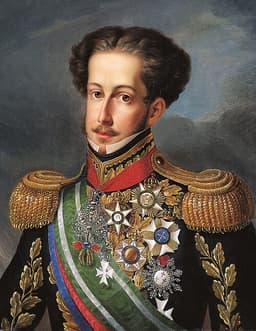
Emperor Pedro I of Brazil
Emperor · Modern
55.5Total
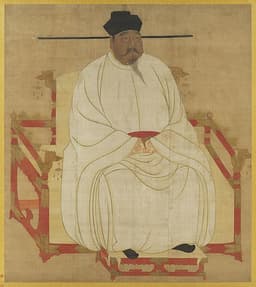
Zhao Kuangyin
Emperor · Medieval
71.5Total
Basic Information
Born
1798
927
Died
1834
976
Era
Modern
Medieval
Nationality
Brazil
China
Occupation
Emperor
Emperor
Civilization
Western
Eastern
Score Comparison
Military (10%)
55.0
78.0
Political (20%)
62.7
84.0
Influence (20%)
59.0
68.0
Legacy (20%)
50.0
65.0
Leadership (15%)
65.0
74.0
Strategy (15%)
35.7
68.0
TOTAL
55.5
71.5
Emperor Pedro I of Brazil — Complete Timeline
1822 AD
Declaration of Brazilian IndependencePolitical Action
Dom Pedro declared Brazil's independence from Portugal on September 7, 1822, at the Ipiranga River. He was acclaimed Emperor Pedro I of Brazil, establishing a constitutional monarchy separate from Portugal.
IndependenceFounding
Impact: globalprogressive
Coronation as Emperor of BrazilPolitical Action◆ Major
Pedro I was crowned Emperor of Brazil on December 1, 1822, in Rio de Janeiro. The coronation formalized his rule over the newly independent nation, with a constitution promulgated in 1824.
CoronationMonarchy
Impact: national
1825 AD
Cisplatine WarWar◆ Major
Brazil went to war with the United Provinces of the R
WarTerritorial Loss
Impact: regionaldestructive
1831 AD
Abdication of the Brazilian ThronePolitical Action
Facing political crisis and military unrest, Pedro I abdicated the Brazilian throne on April 7, 1831, in favor of his five-year-old son Pedro II. He then returned to Portugal to claim the Portuguese throne.
AbdicationPolitical Crisis
Impact: nationaltragic
Zhao Kuangyin — Complete Timeline
960 AD
Founded Song dynastyPolitical Action
Zhao Kuangyin, a general of Later Zhou, was proclaimed emperor by his troops at Chenqiao. He established the Song dynasty, ending the Five Dynasties period and beginning a new era of Chinese history.
Song dynastyFoundingChenqiao
Impact: globalconstructive
961 AD
Removed military power from generalsPolitical Action◆ Major
Zhao Kuangyin invited senior generals to a banquet and persuaded them to retire peacefully. This 'removal of military power over wine' prevented military coups and centralized control.
Song dynastyMilitary reformCentralization
Impact: nationalconstructive
963 AD
Unified southern ChinaWar◆ Major
Zhao Kuangyin launched campaigns to conquer the southern kingdoms, including Jingnan, Later Shu, and Southern Tang. By his death, most of China was reunified under Song rule.
Song unificationConquestSouthern kingdoms
Impact: national
Expert Analysis
Zhao Kuangyin vs Emperor Pedro I of Brazil
# The Emperor and the Liberator: Two Paths to Power
On a spring night in 961, Zhao Kuangyin invited his most trusted generals to a banquet in Kaifeng. Wine flowed freely, laughter echoed through the hall, and then the Emperor of the newly founded Song dynasty grew quiet. He spoke of sleepless nights, of the fragility of power, of how any man sitting at that table might one day be proclaimed emperor by his own troops—just as Zhao himself had been, one year earlier. By morning, the generals had resigned their commands. They returned to their estates, rich and alive. Half a world away and nine centuries later, another emperor faced a different kind of crisis. Dom Pedro I of Brazil, exhausted by political strife and military revolt, stood before the throne he had created and simply walked away. On April 7, 1831, he abdicated in favor of his five-year-old son, then sailed back to Portugal, leaving behind a nation still unsure of its own shape. Two founders, two departures from power—one peaceful, one desperate. What drove such different outcomes?
Origins
Zhao Kuangyin was born in 927 into a military family serving the crumbling Tang dynasty's successor states. China had fractured into the Five Dynasties and Ten Kingdoms—an era of constant warfare where generals routinely overthrew emperors. Zhao grew up watching power change hands at swordpoint. His father was a commander; his own path lay through the army. By contrast, Pedro de Alcântara was born in 1798 as a prince of the Portuguese royal family, raised in the opulent court of Rio de Janeiro, where the Braganza dynasty had fled during Napoleon's wars. His education was European, his manners aristocratic. Where Zhao learned strategy on battlefields, Pedro learned statecraft in ballrooms and council chambers. Their worlds could not have been more different—one forged in chaos, the other in privilege.
Rise to Power
Zhao's ascent came through the very instability he would later tame. In 960, as a general of the Later Zhou dynasty, he was stationed at Chenqiao when his troops draped a yellow imperial robe over his shoulders and proclaimed him emperor. It was a familiar scene in medieval China, but Zhao handled it with remarkable restraint. He ordered his soldiers not to loot the capital, not to harm the imperial family, and he took the throne with minimal bloodshed. Pedro's rise was more deliberate—and more public. On September 7, 1822, standing beside the Ipiranga River in São Paulo, he declared Brazil independent from Portugal with the cry "Independence or Death!" He was crowned emperor on December 1 of that year, a young monarch who had chosen to stay in the New World rather than return to Lisbon. Both men seized their moment, but Zhao's power came from the army, while Pedro's came from a political act of defiance.
Leadership and Governance
Zhao Kuangyin's genius lay in his ability to dismantle the very system that had elevated him. After the banquet of 961, he systematically reduced military influence in government, replacing generals with civilian officials and creating a bureaucracy based on merit rather than force. He then turned south, launching campaigns between 963 and 976 that conquered the kingdoms of Jingnan, Later Shu, and Southern Tang, reunifying most of China under a single rule. His political wisdom was extraordinary: he knew that the Song dynasty would survive not through conquest alone, but through stability. Pedro's leadership was more tempestuous. He presided over the drafting of Brazil's first constitution in 1824, which balanced imperial authority with legislative power, but he lacked Zhao's patience. The Cisplatine War from 1825 to 1828 drained Brazilian resources and ended in stalemate. Pedro's military score of 32.8 reflects his weakness as a commander—he was no warrior-emperor. His political score of 60.2 suggests a ruler who understood institutions but could not master the art of compromise.
Triumph and Tragedy
Zhao's greatest triumph was the unification of China, a feat that ended decades of division. His total score of 75.5 reflects a leader who achieved lasting peace through strategic restraint. Yet his tragedy was subtle: by weakening the military, he left the Song vulnerable to northern invaders, a problem that would haunt his successors. Pedro's triumph was more dramatic—he gave birth to a nation. Brazil today traces its independence to his declaration in 1822. But his tragedy was personal and political. Facing rebellion in the provinces, conflict with the legislature, and the death of his wife, he chose abdication. His legacy score of 70.0 is high, but it is a legacy of beginnings, not endings.
Character and Destiny
Zhao Kuangyin was a man who understood the psychology of power. He did not need to kill his rivals; he needed only to convince them that peace was preferable to war. His leadership score of 82.3 is the highest among his metrics, and it fits: he led not by fear but by persuasion. Pedro, with a leadership score of 75.2, was more impulsive. He loved glory, but he could not endure the grind of daily governance. His strategy score of 59.3 suggests a man who acted on instinct rather than calculation. Where Zhao built a system designed to outlast him, Pedro built a throne he could not bear to sit on.
Legacy
Today, Zhao Kuangyin is remembered as the founder of the Song dynasty, a golden age of Chinese culture, commerce, and technology. His "removal of military power at a banquet" remains a legendary example of bloodless statecraft. Pedro I is remembered as the Liberator of Brazil, the father of an independent nation, but also as a flawed ruler who abandoned his creation. Both men shaped history, but their paths diverged because their eras demanded different virtues. Zhao lived in a world of warlords and needed to pacify; Pedro lived in a world of empires and needed to declare.
Conclusion
In the end, the difference between Zhao Kuangyin and Pedro I is the difference between building a house and lighting a fire. Zhao constructed a dynasty that would last three centuries. Pedro ignited a nation that would outlast him, but he could not stay to tend the flames. One emperor retired his generals with wine; the other retired himself with sorrow. History judges both kindly, but for different reasons: Zhao for the peace he created, Pedro for the freedom he proclaimed. Their stories remind us that power is not a single path but a thousand forks, and that the choices leaders make in their moments of greatest strength—or greatest weakness—define not only their own fates, but the fates of millions.
Rankings
🥇
Zhao KuangyinLeader
Mil: 78.0Pol: 84.0Inf: 68.0
71.5
🥈
Emperor Pedro I of Brazil
Mil: 55.0Pol: 62.7Inf: 59.0
55.5
+16.0 behind
How This Comparison Works
Algorithm
Each figure is scored on 6 dimensions (0—100 scale) based on structured historical data: Military (10%), Political (20%), Influence (20%), Legacy (20%), Leadership (15%), Strategy (15%). The weighted total produces the final ranking.
Data Sources
Scores are computed from structured sub-indicators in the database. Scale factors adjust for era (Ancient ×0.85, Modern ×1.0) and civilization size (Eastern ×1.05, Other ×0.80) to account for differences in population and military scale.
Maximum 3 Figures
Comparisons are limited to 2—3 figures to ensure readability and statistical meaningfulness.
Error Margins
±5 points per dimension — Sub-scores are derived from historical records with inherent uncertainty. Two figures within 5 points on a dimension should be considered roughly equivalent in that area.
Total Score Accuracy
±3 points overall — The weighted combination of 6 dimensions produces a total score with approximately ±3 points of uncertainty. Differences of less than 3 points are not statistically significant— the figures are effectively tied.
Known Limitations
- Historical records are incomplete and uneven across civilizations
- Figures from oral-tradition societies may be underrepresented
- Occupation labels can misclassify multi-role figures
- Scores measure capability and impact, not moral character
- Quantitative scoring is a comparison tool, not absolute truth
Capability Radar
Military (10%) — Battles & Warfare
Battles
25
75
Win Rate
30
85
Expansion
35
75
Political (20%) — Governance & Reform
Reform
50
90
Diplomacy
45
85
Economy
30
80
Influence (20%) — Cultural & Global Reach
Cultural
45
70
Global
40
60
Legacy (20%) — Historical Impact
Historical
55
80
Longevity
50
75
Leadership (15%) — Power & Stability
Tenure
40
65
Stability
20
85
Strategy (15%) — Tactics & Innovation
Strategy
25
80
Tactics
20
70
Reform
15
90
Similar Comparisons
Comments & Discussion
黄袍加身考古员6/16/2026
赵匡胤那杯酒释兵权,看着是温情脉脉,实则是五代十国血腥教训逼出来的天才操作。别跟我扯什么佩德罗一世“自由呐喊”,他退位就是纯纯的政治撤退。赵匡胤最绝的是,他既不想当柴荣那样的傀儡,又不愿做朱温那种屠夫——用一顿饭解决两百年的兵祸循环,这成本控制力,佩德罗写一辈子宣言都学不会。