Loading...
Ferdinand VII of Spain vs Pedro I of Brazil
Pedro I of Brazil leads by 9.5 pts · 2 figures compared
…
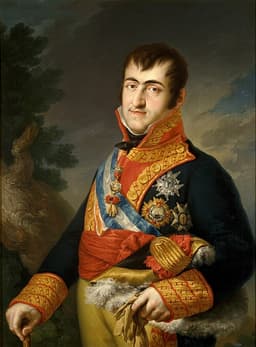
Ferdinand VII of Spain
Emperor · Modern
45.1Total
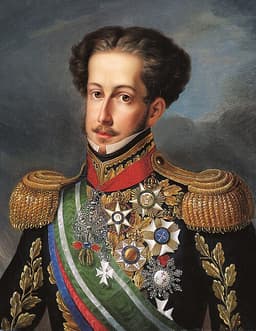
Pedro I of Brazil
Emperor · Modern
54.6Total
Basic Information
Born
1784
1798
Died
1833
1834
Era
Modern
Modern
Nationality
Spain
Brazil
Occupation
Emperor
Emperor
Civilization
Western
Western
Score Comparison
Military (10%)
14.9
55.0
Political (20%)
32.2
62.7
Influence (20%)
51.0
59.0
Legacy (20%)
41.7
50.0
Leadership (15%)
74.0
53.2
Strategy (15%)
45.0
45.0
TOTAL
45.1
54.6
Ferdinand VII of Spain — Complete Timeline
1808 AD
Accession to the thronePolitical Action◆ Major
Ferdinand VII became King of Spain after the abdication of his father Charles IV. His reign was interrupted by Napoleon's intervention and the Peninsular War, but he was restored in 1814.
SuccessionMonarchy
Impact: national
1814 AD
Abolition of the Constitution of 1812Political Action
Upon returning to Spain, Ferdinand VII abolished the liberal Constitution of 1812 and restored absolute monarchy. He persecuted liberals and reinstated the Inquisition, reversing the reforms of the Cortes of C
ConstitutionAbsolutismReaction
Impact: nationaldestructive
1820 AD
Trienio LiberalPolitical Action◆ Major
A military revolt led by Rafael del Riego forced Ferdinand VII to reinstate the Constitution of 1812, beginning the Trienio Liberal. Ferdinand was effectively a constitutional monarch for three years.
Liberal RevolutionConstitutionRevolt
Impact: national
1823 AD
French intervention and restoration of absolutismWar◆ Major
A French army, the Hundred Thousand Sons of Saint Louis, invaded Spain to restore Ferdinand VII's absolute power. The liberal government fell, and Ferdinand resumed repressive rule.
InterventionAbsolutismCongress of Vienna
Impact: regionaldestructive
1830 AD
Pragmatic Sanction of 1830Political Action◆ Major
Ferdinand VII issued the Pragmatic Sanction, abolishing Salic Law and allowing his daughter Isabella to inherit the throne. This led to the Carlist Wars after his death.
SuccessionLawCarlist Wars
Impact: national
Pedro I of Brazil — Complete Timeline
1822 AD
Declaration of Independence of BrazilPolitical Action
Pedro I declared Brazil's independence from Portugal on September 7, 1822, at the Ipiranga River in S
Impact: globalprogressive
Coronation as Emperor of BrazilPolitical Action◆ Major
Pedro I was crowned Emperor of Brazil on December 1, 1822, in Rio de Janeiro. The coronation formalized the new imperial government, with Pedro I as constitutional monarch, though he retained significant executive powers.
Impact: nationalconstructive
1823 AD
War of Independence of BrazilWar◆ Major
Pedro I led Brazilian forces against Portuguese loyalists in the War of Independence. Key battles occurred in Bahia, Maranh
Impact: national
Dissolution of the Constituent AssemblyPolitical Action◆ Major
Pedro I dissolved the Constituent Assembly after conflicts over the constitution's limits on imperial power. He then imposed the 1824 Constitution, which granted the emperor extensive powers, including the Moderating Power, centralizing authority.
Impact: nationaldestructive
1831 AD
Abdication of the Brazilian ThronePolitical Action
Pedro I abdicated the Brazilian throne in favor of his five-year-old son Pedro II on April 7, 1831. He returned to Portugal to claim the Portuguese throne, leaving Brazil under a regency until his son came of age.
Impact: national
Expert Analysis
Pedro I of Brazil vs Ferdinand VII of Spain
### The Emperor and the King: Two Monarchs, One Revolutionary Age
In the autumn of 1823, two monarchs faced the same fundamental question: Could a king in the age of revolutions survive by embracing change, or was absolute power the only path to survival? Pedro I of Brazil, a thirty-five-year-old prince who had just led his nation to independence, was busy drafting a constitution that would limit his own authority. Ferdinand VII of Spain, a bitter forty-year-old king recently restored to his throne, was burning the Spanish Constitution of 1812 and hunting down liberals with the help of French bayonets. Within a decade, one would abdicate in disgrace, the other would die on his throne, leaving a succession war. Their stories are a study in how personality and circumstance, more than ideology, shaped the fates of monarchs in the turbulent early nineteenth century.
### Origins
Pedro was born in 1798 in Lisbon, the second son of the Portuguese royal family. His childhood was one of flight: when Napoleon invaded Portugal in 1807, the entire court fled to Brazil, making Rio de Janeiro the capital of a transatlantic empire. Young Pedro grew up not in a palace of inherited grandeur, but in a tropical colony that was suddenly the center of a global monarchy. He learned to ride horses in the hills of São Paulo and to speak Portuguese with a Brazilian accent. His education was erratic—he was impulsive, passionate, and more interested in swordplay than statecraft.
Ferdinand VII was born in 1784 in Madrid, the eldest son of Charles IV. He grew up in the suffocating atmosphere of the Bourbon court, where his father was dominated by Queen Maria Luisa and her favorite, Manuel Godoy. Ferdinand learned early that politics was a game of conspiracy and betrayal. In 1808, he led a coup against his own father, only to be tricked by Napoleon into abdicating. He spent the next six years in captivity in France, brooding in the Château of Valençay. Where Pedro’s exile was an adventure that opened his world, Ferdinand’s was a prison that narrowed his soul.
### Rise to Power
Both men entered history through the rupture of Napoleon’s wars, but their paths diverged immediately. Ferdinand’s accession in 1808 was a farce: he became king for two months before Napoleon forced him to hand the crown to Joseph Bonaparte. He returned to Spain in 1814 as a martyr of the French occupation, but also as a man who had learned nothing from the experience. He immediately abolished the liberal Constitution of 1812, which had been written by the Spanish parliament in his absence, and reimposed absolute rule. His power rested on the army and the Church, not on any national mandate.
Pedro’s rise was more dramatic. In 1821, when his father King John VI returned to Portugal, Pedro stayed behind as regent of Brazil. The Portuguese parliament tried to reduce Brazil to colonial status again, demanding Pedro’s return. On January 9, 1822, he famously declared, “I will stay,” defying the Cortes. On September 7, 1822, at the Ipiranga River near São Paulo, he raised his sword and shouted, “Independence or Death!” He was crowned Emperor of Brazil on December 1, 1822, at the age of twenty-four. His power came from a revolutionary act: he had broken with Portugal and chosen Brazil.
### Leadership & Governance
Here the two men could not have been more different. Pedro was a warrior-king. He personally led Brazilian forces in the War of Independence, fighting Portuguese loyalists in Bahia and elsewhere through 1823. His military score of 65 reflects real battlefield experience. Politically, he was more complex. He dissolved the Constituent Assembly in 1823 when it tried to limit his powers, then imposed his own constitution in 1824. But that constitution, while authoritarian in structure, established a constitutional monarchy with an elected parliament and civil rights. Pedro accepted limits—even if he sometimes chafed against them.
Ferdinand VII was a different creature. He had no military ability—his score of 32.2 is brutally honest—and no strategic vision. He spent his reign fighting against the tide of history. In 1820, a military revolt forced him to restore the Constitution of 1812, beginning the Trienio Liberal. He spent those three years secretly plotting with the Holy Alliance for foreign intervention. In 1823, a French army, the Hundred Thousand Sons of Saint Louis, invaded Spain and restored his absolute power. Ferdinand then spent the rest of his reign persecuting liberals, purging the army, and trying to erase the memory of constitutional government. He was not a ruler; he was a reactionary who ruled by proxy.
### Triumph & Tragedy
Pedro’s greatest moment was the Declaration of Independence itself—a single act that created a nation. His worst failure came later. His unpopularity in Brazil grew as he mismanaged the economy, fought a disastrous war with Argentina over Uruguay, and became entangled in a scandalous affair with his mistress. In 1831, facing rebellion, he abdicated the throne for his five-year-old son Pedro II and sailed back to Portugal. He left behind a legacy of independence but also a pattern of instability.
Ferdinand’s tragedy was more complete. His greatest triumph was simply surviving: he outlasted Napoleon, the liberals, and his own family’s intrigues. But his triumph was hollow. By abolishing Salic Law in 1830 with the Pragmatic Sanction, he allowed his daughter Isabella to inherit the throne—but this set off the Carlist Wars after his death in 1833, a civil war that tore Spain apart for decades. He had spent his reign destroying every institution that could have made Spain stable.
### Character & Destiny
Pedro was impulsive, generous, and passionate—a man who acted on emotion and then regretted it. His abdication speech captured his nature: “I prefer to descend from the throne with honor than to remain on it disgraced.” He could not bear the compromises of daily governance. Ferdinand was secretive, vengeful, and paranoid. He trusted no one, learned nothing, and forgave nothing. A courtier once said of him, “The king never forgot an injury and never remembered a kindness.” Where Pedro’s flaws were those of a romantic hero, Ferdinand’s were those of a petty tyrant.
### Legacy
Pedro I is remembered as the founder of Brazilian independence, but his reign is often seen as a necessary prelude to his son’s more stable rule. His legacy score of 70 reflects this: he is honored but not revered. In Brazil, he is the Liberator; in Portugal, he is the man who abdicated twice (once as emperor, once as king of Portugal, which he briefly claimed for his daughter).
Ferdinand VII is remembered as one of Spain’s worst kings. His legacy score of 57.1 is surprisingly generous. He is the king who destroyed Spanish liberalism, who invited a foreign army to restore his throne, and who left a succession crisis that bled Spain for generations. Historians call him “the Desired One” with bitter irony.
### Conclusion
Standing at the Ipiranga River in 1822, Pedro I chose to create a nation. Standing in the Spanish court in 1823, Ferdinand VII chose to destroy one. Both were absolute monarchs in an age of revolution, but they made opposite wagers on history. Pedro gambled that a limited monarchy could survive; Ferdinand bet that absolute power could be restored. In the end, Pedro’s Brazil became a stable empire that lasted until 1889, while Ferdinand’s Spain descended into civil war. The difference was not in their circumstances—both faced similar threats from liberalism—but in their character. One king had the imagination to see that the old world was dying. The other had only the will to cling to its corpse.
Rankings
🥇
Pedro I of BrazilLeader
Mil: 55.0Pol: 62.7Inf: 59.0
54.6
🥈
Ferdinand VII of Spain
Mil: 14.9Pol: 32.2Inf: 51.0
45.1
+9.5 behind
How This Comparison Works
Algorithm
Each figure is scored on 6 dimensions (0—100 scale) based on structured historical data: Military (10%), Political (20%), Influence (20%), Legacy (20%), Leadership (15%), Strategy (15%). The weighted total produces the final ranking.
Data Sources
Scores are computed from structured sub-indicators in the database. Scale factors adjust for era (Ancient ×0.85, Modern ×1.0) and civilization size (Eastern ×1.05, Other ×0.80) to account for differences in population and military scale.
Maximum 3 Figures
Comparisons are limited to 2—3 figures to ensure readability and statistical meaningfulness.
Error Margins
±5 points per dimension — Sub-scores are derived from historical records with inherent uncertainty. Two figures within 5 points on a dimension should be considered roughly equivalent in that area.
Total Score Accuracy
±3 points overall — The weighted combination of 6 dimensions produces a total score with approximately ±3 points of uncertainty. Differences of less than 3 points are not statistically significant— the figures are effectively tied.
Known Limitations
- Historical records are incomplete and uneven across civilizations
- Figures from oral-tradition societies may be underrepresented
- Occupation labels can misclassify multi-role figures
- Scores measure capability and impact, not moral character
- Quantitative scoring is a comparison tool, not absolute truth
Capability Radar
Military (10%) — Battles & Warfare
Battles
10
35
Win Rate
5
40
Expansion
5
30
Political (20%) — Governance & Reform
Reform
5
45
Diplomacy
20
50
Economy
10
30
Influence (20%) — Cultural & Global Reach
Cultural
15
40
Global
20
45
Legacy (20%) — Historical Impact
Historical
30
55
Longevity
20
50
Leadership (15%) — Power & Stability
Tenure
60
55
Stability
10
25
Strategy (15%) — Tactics & Innovation
Strategy
5
35
Tactics
5
30
Reform
5
20
Similar Comparisons
Comments & Discussion
HISTORY'S SHOWDOWN6/16/2026
This comparison is a masterclass in how personality defines legacy. Pedro I was a Romantic hero—impulsive but genuinely progressive, granting Brazil a constitution while Ferdinand was busy restoring the Inquisition. Sure, Pedro's reign ended in abdication, but he gave Brazil a parliamentary start. Ferdinand died with Spain's empire crumbling and a dynastic war brewing. I'd rather be the emperor who chose reform over reaction, even if it cost him the crown.