Loading...
Bayinnaung vs Ferdinand VII of Spain
Bayinnaung leads by 23.5 pts · 2 figures compared
…
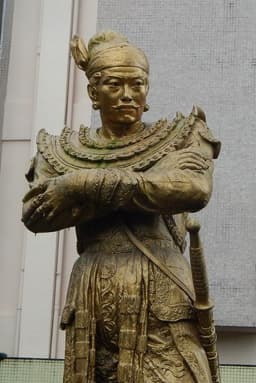
Bayinnaung
Emperor · Modern
68.6Total
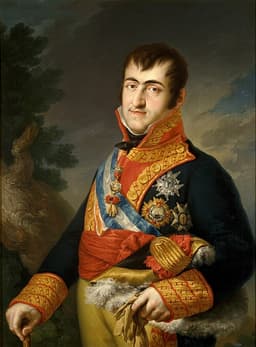
Ferdinand VII of Spain
Emperor · Modern
45.1Total
Basic Information
Born
1516
1784
Died
1581
1833
Era
Modern
Modern
Nationality
Myanmar
Spain
Occupation
Emperor
Emperor
Civilization
Eastern
Western
Score Comparison
Military (10%)
77.1
14.9
Political (20%)
82.0
32.2
Influence (20%)
65.0
51.0
Legacy (20%)
55.0
41.7
Leadership (15%)
74.0
74.0
Strategy (15%)
75.0
45.0
TOTAL
68.6
45.1
Bayinnaung — Complete Timeline
1550 AD
Establishment of the Toungoo EmpirePolitical Action
King Bayinnaung ascended the throne and began a series of military campaigns that created the largest empire in Southeast Asian history. At its peak, the Toungoo empire covered modern Myanmar, Thailand, Laos, and parts of China and India.
Toungoo EmpireSoutheast AsiaImperial Expansion
Impact: regionalconstructive
1557 AD
Conquest of the Shan StatesWar◆ Major
King Bayinnaung conquered the Shan States, bringing them under Toungoo control. This expansion added significant territory and resources to the Burmese empire.
Shan StatesToungoo ExpansionBurmese Empire
Impact: regional
1569 AD
Capture of AyutthayaWar
King Bayinnaung's forces captured the Siamese capital of Ayutthaya after a long siege. He installed a vassal king and made Siam a tributary state of the Toungoo empire.
Burmese-Siamese WarAyutthayaToungoo Empire
Impact: regional
1570 AD
Administrative ReformsReform◆ Major
King Bayinnaung implemented administrative reforms to govern his vast empire, including the appointment of governors and the standardization of laws and taxes. These reforms helped maintain control over conquered territories.
GovernanceAdministrationToungoo Empire
Impact: regionalconstructive
1574 AD
Conquest of Lan XangWar◆ Major
King Bayinnaung conquered the Lao kingdom of Lan Xang (modern Laos), bringing it under Toungoo control. This further expanded the Burmese empire to its greatest territorial extent.
Lan XangToungoo ExpansionLaos
Impact: regional
Ferdinand VII of Spain — Complete Timeline
1808 AD
Accession to the thronePolitical Action◆ Major
Ferdinand VII became King of Spain after the abdication of his father Charles IV. His reign was interrupted by Napoleon's intervention and the Peninsular War, but he was restored in 1814.
SuccessionMonarchy
Impact: national
1814 AD
Abolition of the Constitution of 1812Political Action
Upon returning to Spain, Ferdinand VII abolished the liberal Constitution of 1812 and restored absolute monarchy. He persecuted liberals and reinstated the Inquisition, reversing the reforms of the Cortes of C
ConstitutionAbsolutismReaction
Impact: nationaldestructive
1820 AD
Trienio LiberalPolitical Action◆ Major
A military revolt led by Rafael del Riego forced Ferdinand VII to reinstate the Constitution of 1812, beginning the Trienio Liberal. Ferdinand was effectively a constitutional monarch for three years.
Liberal RevolutionConstitutionRevolt
Impact: national
1823 AD
French intervention and restoration of absolutismWar◆ Major
A French army, the Hundred Thousand Sons of Saint Louis, invaded Spain to restore Ferdinand VII's absolute power. The liberal government fell, and Ferdinand resumed repressive rule.
InterventionAbsolutismCongress of Vienna
Impact: regionaldestructive
1830 AD
Pragmatic Sanction of 1830Political Action◆ Major
Ferdinand VII issued the Pragmatic Sanction, abolishing Salic Law and allowing his daughter Isabella to inherit the throne. This led to the Carlist Wars after his death.
SuccessionLawCarlist Wars
Impact: national
Expert Analysis
Bayinnaung vs Ferdinand VII of Spain
# The Emperor and the Absolutist
In the summer of 1569, King Bayinnaung of the Toungoo dynasty watched his war elephants crash against the walls of Ayutthaya, the Siamese capital. Smoke rose from burning temples, and the Chao Phraya River ran red. Half a world away, in the winter of 1823, another king, Ferdinand VII of Spain, watched French troops march into Madrid, not as invaders but as saviors—restoring him to a throne he had lost to liberals. One monarch was building an empire; the other was clinging to one that was collapsing. What separated these two rulers, both crowned in turbulent times, was not merely geography or century, but the very nature of power itself—how to seize it, how to wield it, and what to do when the world refused to obey.
Origins
Bayinnaung was born in 1516 into a world of fractured kingdoms. The Toungoo dynasty had only recently emerged from the chaos of warring Burmese states, and his early life was shaped by the harsh realities of Southeast Asian warfare: shifting alliances, monsoon-fed campaigns, and the constant need to prove loyalty through blood. He rose not as a prince but as a trusted general under King Tabinshwehti, learning that power was something you took, not inherited.
Ferdinand VII, born in 1784, inherited everything—and nothing. The son of Charles IV and Maria Luisa of Parma, he grew up in a Spanish court rotting from within, where his own parents conspired against him, and he conspired against them. The French Revolution had already shaken Europe’s thrones, and the Enlightenment’s ideas of liberty and constitution were spreading like wildfire. Ferdinand learned early that power was something to be protected, not built.
Rise to Power
When Tabinshwehti was assassinated in 1550, Bayinnaung did not hesitate. He seized the throne and immediately launched campaigns to reunify Burma and then expand outward. His path was forged by war: the conquest of the Shan States in 1557 added vast territories and resources, while the capture of Ayutthaya in 1569 made him the master of Siam. Each victory was a stepping stone, and each defeat—rare as they were—a lesson. He did not wait for opportunity; he created it.
Ferdinand’s rise was a tragicomedy of abdications and betrayals. In 1808, he became king after forcing his father Charles IV to abdicate—only to be immediately deposed by Napoleon, who installed his own brother Joseph on the Spanish throne. Ferdinand spent six years as a prisoner in France, a king in name only. When he returned in 1814, he found that Spain had changed: a liberal constitution, the Constitution of 1812, had been written in his absence, and a parliament, the Cortes, now claimed authority. Ferdinand refused to accept it.
Leadership & Governance
Bayinnaung governed like a master architect. His empire, the largest in Southeast Asian history, stretched from Manipur to Cambodia, and he knew that conquest alone could not hold it together. In 1570, he implemented administrative reforms, appointing loyal governors and establishing a system of tribute and vassalage that allowed local rulers to retain power as long as they paid homage. He was ruthless when necessary—after capturing Ayutthaya, he installed a vassal king—but he also understood that an empire built on fear alone would crumble. He patronized Buddhism, built pagodas, and promoted trade. His military genius lay not just in winning battles, but in knowing when to show mercy.
Ferdinand governed like a man trying to hold back the tide. Upon returning to Spain in 1814, he immediately abolished the Constitution of 1812, dissolved the Cortes, and restored absolute monarchy. He purged liberals, reinstated the Inquisition, and ruled through a cabal of reactionary advisors. When a military revolt in 1820 forced him to reinstate the constitution—the Trienio Liberal—he accepted only as a ruse, secretly plotting with France to restore his absolutism. In 1823, French troops invaded, and Ferdinand returned to power with a vengeance, executing and exiling his enemies. He had no vision beyond his own authority.
Triumph & Tragedy
Bayinnaung’s greatest triumph was the conquest of Lan Xang in 1574, bringing the Lao kingdom under Toungoo control. His empire now covered most of mainland Southeast Asia. But the tragedy was already seeded: the empire was too vast, too diverse, and too dependent on his personal leadership. After his death in 1581, it fragmented within decades, undone by revolts and overextension.
Ferdinand’s greatest triumph was the Pragmatic Sanction of 1830, which abolished Salic Law and allowed his daughter Isabella to inherit the throne. But this was a poisoned victory. It sparked a succession crisis that would tear Spain apart for generations, leading to the Carlist Wars. His greatest tragedy was his blindness: he could not see that absolutism was dying, and that by crushing liberalism, he only ensured its violent return.
Character & Destiny
Bayinnaung was a builder. He thought in terms of years and decades, not days. His personality—ambitious, patient, and strategic—drove him to create something lasting. He understood that power required legitimacy, not just force. Ferdinand VII was a survivor. He thought in terms of threats and enemies, not opportunities. His personality—suspicious, vengeful, and rigid—drove him to destroy anything that challenged him, even if it meant destroying his own kingdom. One expanded; the other contracted.
Legacy
Bayinnaung is remembered in Myanmar as a national hero, the unifier who created the greatest empire the region had ever seen. His name is synonymous with strength and vision. Yet his empire did not survive him, and his legacy is one of ambition as much as achievement.
Ferdinand VII is remembered in Spain as "the Desired" by his supporters and "the Felon" by his enemies. He is a cautionary tale: a king who chose reaction over reform, who preferred to rule over ruins than share power. His legacy is the Spanish Civil War that would come a century later—a conflict born from the wounds he refused to heal.
Conclusion
In the end, Bayinnaung and Ferdinand VII represent two faces of monarchy: the emperor who builds and the absolutist who clings. One expanded his world; the other shrank his. One understood that power must be earned and shared; the other believed it must be hoarded and defended. Their stories remind us that leadership is not just about seizing the throne, but about what you do once you sit on it—and whether you leave behind an empire, or a wreckage.
Rankings
🥇
BayinnaungLeader
Mil: 77.1Pol: 82.0Inf: 65.0
68.6
🥈
Ferdinand VII of Spain
Mil: 14.9Pol: 32.2Inf: 51.0
45.1
+23.5 behind
How This Comparison Works
Algorithm
Each figure is scored on 6 dimensions (0—100 scale) based on structured historical data: Military (10%), Political (20%), Influence (20%), Legacy (20%), Leadership (15%), Strategy (15%). The weighted total produces the final ranking.
Data Sources
Scores are computed from structured sub-indicators in the database. Scale factors adjust for era (Ancient ×0.85, Modern ×1.0) and civilization size (Eastern ×1.05, Other ×0.80) to account for differences in population and military scale.
Maximum 3 Figures
Comparisons are limited to 2—3 figures to ensure readability and statistical meaningfulness.
Error Margins
±5 points per dimension — Sub-scores are derived from historical records with inherent uncertainty. Two figures within 5 points on a dimension should be considered roughly equivalent in that area.
Total Score Accuracy
±3 points overall — The weighted combination of 6 dimensions produces a total score with approximately ±3 points of uncertainty. Differences of less than 3 points are not statistically significant— the figures are effectively tied.
Known Limitations
- Historical records are incomplete and uneven across civilizations
- Figures from oral-tradition societies may be underrepresented
- Occupation labels can misclassify multi-role figures
- Scores measure capability and impact, not moral character
- Quantitative scoring is a comparison tool, not absolute truth
Capability Radar
Military (10%) — Battles & Warfare
Battles
85
10
Win Rate
90
5
Expansion
92
5
Political (20%) — Governance & Reform
Reform
70
5
Diplomacy
78
20
Economy
72
10
Influence (20%) — Cultural & Global Reach
Cultural
70
15
Global
55
20
Legacy (20%) — Historical Impact
Historical
75
30
Longevity
60
20
Leadership (15%) — Power & Stability
Tenure
85
60
Stability
65
10
Strategy (15%) — Tactics & Innovation
Strategy
88
5
Tactics
80
5
Reform
75
5
Similar Comparisons
Comments & Discussion
WALL-BREAKER BAYIN6/16/2026
Bayinnaung wasn't just a conqueror—he was a logistical genius. Marching war elephants through monsoon jungles to sack Ayutthaya in 1569? That required organization, not just brute force. Ferdinand VII, by contrast, couldn't even hold Madrid without French troops bailing him out in 1823. One built an empire from scratch; the other begged for restoration. Real power is earned, not inherited.
斐迪南世的哀歌6/16/2026
别被表象骗了,斐迪南七世看似软弱,但他玩政治阴谋时,巴因农还在战象背上砍人呢!1814年他废除1812年宪法,靠的是利用西班牙民众对拿破仑的仇恨,这招可比硬攻阿瑜陀耶高明。他让自由派自相残杀,自己躲幕后操控。统治者不需要亲自打仗,只要懂得谁该跪。
DATA-ADEUS SKEPTIC6/16/2026
Statistics don't lie: Bayinnaung's Toungoo Empire lasted barely 30 years after his death in 1581. Ferdinand VII's restored absolutism? It crumbled within a decade, culminating in the 1833 Carlist Wars. Both failed to build lasting institutions. Bayinnaung relied on personal loyalty; Ferdinand on reactionary terror. Neither understood that power needs systems, not just personalities. History grades both as D+.
田野骑士6/16/2026
巴因农是真正的帝国缔造者,统一缅甸后还打了四十场战役,从老挝到暹罗无一不降。而斐迪南七世?1820年他的海军叛乱,他连镇压都要靠法国刺刀。一个用战象和汗水征服土地,一个躲在王座上签字画押。哪个更配称王?战象不会说谎。
CLASSICS CONTRARIAN6/16/2026
Comparative history is a fallacy here. Bayinnaung operated in a pre-modern world where personal loyalty and direct conquest defined rule. Ferdinand VII faced proto-liberal revolutions and a fractured Spanish elite. Apples and durians. But if we must judge, I'll take the man who actually built an empire worth the name. Bayinnaung expanded Burma to its largest extent; Ferdinand brought Spain to the brink of bankruptcy. Case closed.