Loading...
Gojong of Korea vs Zhao Kuangyin
Zhao Kuangyin leads by 16.0 pts · 2 figures compared
…
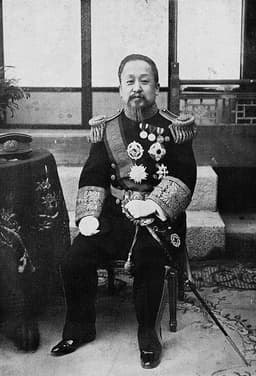
Gojong of Korea
Emperor · Modern
55.5Total
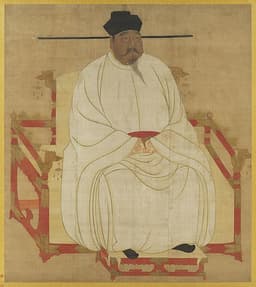
Zhao Kuangyin
Emperor · Medieval
71.5Total
Basic Information
Born
1852
927
Died
1919
976
Era
Modern
Medieval
Nationality
Korea
China
Occupation
Emperor
Emperor
Civilization
Eastern
Eastern
Score Comparison
Military (10%)
43.3
78.0
Political (20%)
68.0
84.0
Influence (20%)
60.0
68.0
Legacy (20%)
50.0
65.0
Leadership (15%)
53.2
74.0
Strategy (15%)
54.6
68.0
TOTAL
55.5
71.5
Gojong of Korea — Complete Timeline
1897 AD
Proclamation of the Korean EmpirePolitical Action
Gojong declared Korea an empire, assuming the title of Emperor. This was an attempt to assert Korea's sovereignty and equal status with China and Japan, and to modernize the state. The move was partly a response to the assassination of his wife, Empress Myeongseong.
Korean EmpireSovereigntyModernization
Impact: nationalconstructive
1905 AD
Signing of the Japan-Korea Treaty of 1905Political Action
Under Japanese pressure, Gojong's government signed the Eulsa Treaty, making Korea a Japanese protectorate. Gojong did not sign the treaty himself and later attempted to appeal to international powers, but the treaty stripped Korea of its diplomatic sovereignty.
TreatyJapanese ProtectorateLoss of Sovereignty
Impact: nationaltragic
1907 AD
Forced Abdication by JapanPolitical Action◆ Major
Japanese authorities forced Gojong to abdicate in favor of his son, Sunjong, after Gojong sent a secret envoy to the Hague Peace Conference to protest Japanese control. The abdication was part of Japan's consolidation of power over Korea.
AbdicationJapanese ImperialismHague Secret Envoy Affair
Impact: nationaltragic
1919 AD
Death and Funeral of GojongOther
Gojong died suddenly, with rumors of poisoning by Japanese agents. His funeral on March 1, 1919, became a catalyst for the March First Movement, a massive nationwide protest against Japanese rule. The movement was brutally suppressed but galvanized Korean independence efforts.
DeathMarch First MovementKorean Independence
Impact: nationaltragic
Zhao Kuangyin — Complete Timeline
960 AD
Founded Song dynastyPolitical Action
Zhao Kuangyin, a general of Later Zhou, was proclaimed emperor by his troops at Chenqiao. He established the Song dynasty, ending the Five Dynasties period and beginning a new era of Chinese history.
Song dynastyFoundingChenqiao
Impact: globalconstructive
961 AD
Removed military power from generalsPolitical Action◆ Major
Zhao Kuangyin invited senior generals to a banquet and persuaded them to retire peacefully. This 'removal of military power over wine' prevented military coups and centralized control.
Song dynastyMilitary reformCentralization
Impact: nationalconstructive
963 AD
Unified southern ChinaWar◆ Major
Zhao Kuangyin launched campaigns to conquer the southern kingdoms, including Jingnan, Later Shu, and Southern Tang. By his death, most of China was reunified under Song rule.
Song unificationConquestSouthern kingdoms
Impact: national
Expert Analysis
Zhao Kuangyin vs Gojong of Korea
### The Emperor Who Lost a Kingdom and the Emperor Who Built One
In the autumn of 1907, a 55-year-old Korean emperor sat in his palace, stripped of his throne, his country a protectorate of Japan. Less than a thousand miles away and a thousand years earlier, a Chinese general named Zhao Kuangyin had risen from a military camp to forge a dynasty that would last three centuries. Both men were emperors, both faced existential threats, but their fates diverged as sharply as the Pacific current that separates the Korean peninsula from the Chinese mainland. Why did one emperor lose his kingdom while the other built an enduring empire? The answer lies not in their era, but in their choices.
### Origins
Gojong of Korea was born in 1852 into a world already fracturing. The Joseon dynasty, which had ruled for five centuries, was a hermit kingdom slowly waking to the clatter of Western gunships. His father, the regent Heungseon Daewongun, raised him in a court rife with factionalism, where Confucian orthodoxy clashed with the brutal reality of foreign encroachment. Gojong’s youth was a crucible of isolation: he learned to read Chinese classics while Japanese and Russian warships prowled his coasts. He inherited not a stable throne, but a sinking ship.
Zhao Kuangyin, born in 927, emerged from the chaos of the Five Dynasties and Ten Kingdoms period, when China was a patchwork of warring states. His father was a military officer, and Zhao grew up in the barracks, learning swordsmanship and strategy. The world he knew was one of constant upheaval, where generals became emperors overnight and lost their heads by dawn. Where Gojong was a scholar-prince trained in ritual, Zhao was a soldier forged in blood.
### Rise to Power
Gojong ascended the throne at age twelve in 1864, a puppet for his father’s regency. He did not seize power; it was handed to him, wrapped in the silks of court protocol. His path was passive—a boy-king who watched his father purge rivals and close borders. When Gojong finally took the reins in his twenties, he faced a Korea already encircled: the French in 1866, the Americans in 1871, and always the Japanese, hungry for influence.
Zhao Kuangyin’s rise was a story of audacity. In 960, as a general of the Later Zhou dynasty, he was stationed at Chenqiao when his troops, weary of a child emperor, draped a yellow robe over his shoulders and proclaimed him emperor. He did not resist. Unlike Gojong, who inherited a throne, Zhao took one—and he did so with a soldier’s pragmatism. He did not burn the old capital; he moved into it, declaring the Song dynasty and promising stability.
### Leadership & Governance
Gojong’s reign was a desperate balancing act. He tried to modernize: he built the first electric tram in Seoul, sent students to Japan, and in 1897, he proclaimed the Korean Empire, crowning himself Emperor. It was a political masterstroke—a bid to stand equal to China and Japan. His political score of 85.0 reflects this vision. But his military score of 59.7 tells the other story: he had no army to back his ambition. When Japan forced the Eulsa Treaty of 1905, making Korea a protectorate, Gojong could only send secret envoys to the Hague Peace Conference in 1907. It failed. Japan forced his abdication that same year.
Zhao Kuangyin governed with a different logic. He understood that the general who crowns an emperor can also unseat him. In 961, at a famous banquet, he invited his top commanders, plied them with wine, and gently persuaded them to retire to comfortable estates. This “removal of military power at a feast” was genius—bloodless, strategic, and final. He then centralized the army under civilian control, ensuring no future general could repeat his own coup. His leadership score of 82.3 and strategy of 69.8 show a man who thought in decades, not days. By 963, he had conquered the southern kingdoms—Jingnan, Later Shu, and Southern Tang—unifying China through a mix of force and diplomacy.
### Triumph & Tragedy
Gojong’s greatest moment was the proclamation of the Korean Empire in 1897. For a fleeting instant, Korea stood as a sovereign equal. His tragedy was the 1905 treaty: he did not sign it, but his ministers did, and he could not stop it. His forced abdication in 1907 was a humiliation that broke him. He died in 1919, rumored poisoned by Japanese agents. His funeral on March 1, 1919, ignited the March First Movement, a nationwide protest for independence.
Zhao Kuangyin’s triumph was the unification of China. His tragedy was that he never completed it. He died in 976 at age 49, with the northern territories still held by the Liao dynasty. His brother Zhao Guangyi succeeded him and finished the conquest, but the Song would forever struggle against northern invaders—a weakness born from Zhao’s own decision to weaken the military.
### Character & Destiny
Gojong was a man of vision but not of action. He dreamed of a modern Korea but lacked the ruthlessness to build one. His character was that of a scholar-king: cautious, diplomatic, but ultimately passive. He trusted treaties and international law in an age of gunboats. His destiny was to be a tragic footnote.
Zhao Kuangyin was a pragmatist. He knew power was a weapon that could cut both ways. He drank with his generals, then sent them home. He conquered with mercy, sparing the royal families of fallen kingdoms. His character was that of a survivor—calculating, patient, and unsentimental. His destiny was to found a dynasty.
### Legacy
Gojong’s legacy is bittersweet. He is remembered as the last emperor of a free Korea, a martyr whose death sparked a resistance that would eventually lead to Korean independence. His empire lasted only thirteen years, but his name is carved into the soul of modern Korea.
Zhao Kuangyin’s legacy is the Song dynasty itself—a golden age of painting, poetry, and commerce. He is remembered as the emperor who unified China without a bloodbath, who valued civilization over conquest. His military reforms ensured stability, but they also sowed the seeds of future weakness.
### Conclusion
Standing at the edge of history, Gojong and Zhao Kuangyin offer a stark lesson. Both faced impossible odds: one a crumbling kingdom, the other a fractured empire. Gojong tried to save his nation by standing still, hoping the world would respect his sovereignty. Zhao Kuangyin seized his moment, then built a system to prevent anyone else from doing the same. The difference between losing a kingdom and founding a dynasty is not luck—it is the courage to act when the yellow robe is offered, and the wisdom to know when to set it down.
Rankings
🥇
Zhao KuangyinLeader
Mil: 78.0Pol: 84.0Inf: 68.0
71.5
🥈
Gojong of Korea
Mil: 43.3Pol: 68.0Inf: 60.0
55.5
+16.0 behind
How This Comparison Works
Algorithm
Each figure is scored on 6 dimensions (0—100 scale) based on structured historical data: Military (10%), Political (20%), Influence (20%), Legacy (20%), Leadership (15%), Strategy (15%). The weighted total produces the final ranking.
Data Sources
Scores are computed from structured sub-indicators in the database. Scale factors adjust for era (Ancient ×0.85, Modern ×1.0) and civilization size (Eastern ×1.05, Other ×0.80) to account for differences in population and military scale.
Maximum 3 Figures
Comparisons are limited to 2—3 figures to ensure readability and statistical meaningfulness.
Error Margins
±5 points per dimension — Sub-scores are derived from historical records with inherent uncertainty. Two figures within 5 points on a dimension should be considered roughly equivalent in that area.
Total Score Accuracy
±3 points overall — The weighted combination of 6 dimensions produces a total score with approximately ±3 points of uncertainty. Differences of less than 3 points are not statistically significant— the figures are effectively tied.
Known Limitations
- Historical records are incomplete and uneven across civilizations
- Figures from oral-tradition societies may be underrepresented
- Occupation labels can misclassify multi-role figures
- Scores measure capability and impact, not moral character
- Quantitative scoring is a comparison tool, not absolute truth
Capability Radar
Military (10%) — Battles & Warfare
Battles
5
75
Win Rate
5
85
Expansion
5
75
Political (20%) — Governance & Reform
Reform
40
90
Diplomacy
30
85
Economy
30
80
Influence (20%) — Cultural & Global Reach
Cultural
50
70
Global
40
60
Legacy (20%) — Historical Impact
Historical
60
80
Longevity
40
75
Leadership (15%) — Power & Stability
Tenure
60
65
Stability
20
85
Strategy (15%) — Tactics & Innovation
Strategy
5
80
Tactics
5
70
Reform
10
90
Similar Comparisons
Comments & Discussion
TANG DYNASTY DEBATER6/16/2026
Let's not pretend Gojong had any real shot. Zhao Kuangyin conquered a fractured China through sheer military genius, personally leading campaigns to reunify the realm. Gojong sat in his palace while Japan dismantled his army without a fight, signing away Korea's sovereignty in the 1905 Protectorate Treaty. One man built an empire; the other watched his crumble. There's no comparison here — it's about who was willing to get their hands dirty. Zhao knew war; Gojong knew surrender.|zh|别把高宗说得那么无辜。赵匡