Loading...
Bayinnaung vs Zhao Kuangyin
Zhao Kuangyin leads by 2.9 pts · 2 figures compared
…
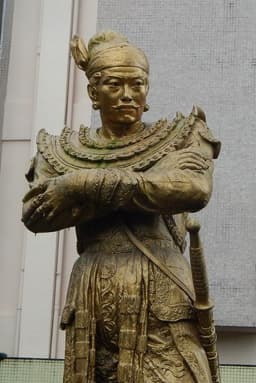
Bayinnaung
Emperor · Modern
68.6Total
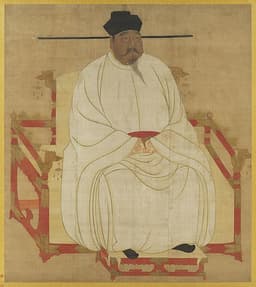
Zhao Kuangyin
Emperor · Medieval
71.5Total
Basic Information
Born
1516
927
Died
1581
976
Era
Modern
Medieval
Nationality
Myanmar
China
Occupation
Emperor
Emperor
Civilization
Eastern
Eastern
Score Comparison
Military (10%)
77.1
78.0
Political (20%)
82.0
84.0
Influence (20%)
65.0
68.0
Legacy (20%)
55.0
65.0
Leadership (15%)
74.0
74.0
Strategy (15%)
75.0
68.0
TOTAL
68.6
71.5
Bayinnaung — Complete Timeline
1550 AD
Establishment of the Toungoo EmpirePolitical Action
King Bayinnaung ascended the throne and began a series of military campaigns that created the largest empire in Southeast Asian history. At its peak, the Toungoo empire covered modern Myanmar, Thailand, Laos, and parts of China and India.
Toungoo EmpireSoutheast AsiaImperial Expansion
Impact: regionalconstructive
1557 AD
Conquest of the Shan StatesWar◆ Major
King Bayinnaung conquered the Shan States, bringing them under Toungoo control. This expansion added significant territory and resources to the Burmese empire.
Shan StatesToungoo ExpansionBurmese Empire
Impact: regional
1569 AD
Capture of AyutthayaWar
King Bayinnaung's forces captured the Siamese capital of Ayutthaya after a long siege. He installed a vassal king and made Siam a tributary state of the Toungoo empire.
Burmese-Siamese WarAyutthayaToungoo Empire
Impact: regional
1570 AD
Administrative ReformsReform◆ Major
King Bayinnaung implemented administrative reforms to govern his vast empire, including the appointment of governors and the standardization of laws and taxes. These reforms helped maintain control over conquered territories.
GovernanceAdministrationToungoo Empire
Impact: regionalconstructive
1574 AD
Conquest of Lan XangWar◆ Major
King Bayinnaung conquered the Lao kingdom of Lan Xang (modern Laos), bringing it under Toungoo control. This further expanded the Burmese empire to its greatest territorial extent.
Lan XangToungoo ExpansionLaos
Impact: regional
Zhao Kuangyin — Complete Timeline
960 AD
Founded Song dynastyPolitical Action
Zhao Kuangyin, a general of Later Zhou, was proclaimed emperor by his troops at Chenqiao. He established the Song dynasty, ending the Five Dynasties period and beginning a new era of Chinese history.
Song dynastyFoundingChenqiao
Impact: globalconstructive
961 AD
Removed military power from generalsPolitical Action◆ Major
Zhao Kuangyin invited senior generals to a banquet and persuaded them to retire peacefully. This 'removal of military power over wine' prevented military coups and centralized control.
Song dynastyMilitary reformCentralization
Impact: nationalconstructive
963 AD
Unified southern ChinaWar◆ Major
Zhao Kuangyin launched campaigns to conquer the southern kingdoms, including Jingnan, Later Shu, and Southern Tang. By his death, most of China was reunified under Song rule.
Song unificationConquestSouthern kingdoms
Impact: national
Expert Analysis
Bayinnaung vs Zhao Kuangyin
# The Conqueror and the Unifier: Two Paths to Empire
On a spring morning in 961, two emperors sat down to very different banquets. In Kaifeng, Zhao Kuangyin raised his wine cup to a gathering of nervous generals, about to persuade them to surrender their commands over a feast of brotherly affection. In Pegu, Bayinnaung raised his war trumpet to summon an army that would march across mountains and rivers for two decades. Both men built empires—one through the quiet clinking of cups, the other through the thunder of elephant charges. Yet their stories reveal how the same ambition, shaped by different worlds, can produce radically different outcomes.
Origins
Zhao Kuangyin was born in 927 into a military family serving the crumbling Later Tang dynasty, a time when China had fractured into the Five Dynasties and Ten Kingdoms. He grew up watching warlords rise and fall like autumn leaves—one general after another seizing power through force, only to lose it the same way. This instability seared into him a lesson that would define his reign: military power, left unchecked, devours everything it touches.
Bayinnaung entered the world in 1516 in the Toungoo Kingdom, a small state squeezed between the powerful Mon kingdoms and the Shan confederations. Unlike Zhao, he was not born into the ruling family—he was a commoner’s son who rose through friendship with the future king. His world was one of constant warfare, where survival meant expansion and the only law was the sword. Where Zhao saw chaos in military ambition, Bayinnaung saw opportunity.
Rise to Power
Their paths to the throne could not have been more different. Zhao Kuangyin became emperor almost by accident. In 960, while marching against a northern enemy, his troops—tired of weak leadership—draped a yellow robe over his shoulders and proclaimed him emperor. He accepted reluctantly, knowing that refusal meant death. His rise was a coup, but one he never wanted to repeat.
Bayinnaung’s ascent was deliberate and bloody. When his close friend King Tabinshwehti was assassinated in 1550, Bayinnaung seized the throne and immediately launched a campaign to reunify the fractured Toungoo realm. Within months, he had crushed rebellions and begun the conquests that would create the largest empire Southeast Asia had ever seen. For him, power was not a burden thrust upon him—it was a tool he forged with his own hands.
Leadership & Governance
Zhao Kuangyin governed through restraint. His most famous act came in 961, when he invited his senior generals to a banquet and, over wine, convinced them to resign their commands in exchange for riches and land. “If I did not desire this throne,” he told them, “you would have forced me to take it anyway. Let us part as friends, not enemies.” This “removal of military power at a feast” became legendary—a bloodless purge that ended a century of warlord rule. He then centralized administration, promoted civil service examinations, and built a bureaucracy that valued scholars over soldiers. His military campaigns, like the unification of southern China between 963 and 975, were methodical and limited—he conquered only what was necessary to restore order.
Bayinnaung ruled through sheer force. After conquering the Shan States in 1557, he appointed loyal governors but left local rulers in place as vassals, creating a patchwork empire held together by his personal authority. His 1569 capture of Ayutthaya was brutal—the Siamese capital fell after a long siege, and he installed a puppet king while deporting thousands to repopulate his own lands. His administrative reforms in 1570 tried to impose order on this chaos, appointing governors and standardizing tribute, but the empire remained a military machine that required constant conquest to sustain itself. Where Zhao built institutions, Bayinnaung built armies.
Triumph & Tragedy
Zhao’s greatest triumph was not a battle but a peace. By disarming his generals and creating a stable civil service, he ended the cycle of coups that had plagued China for fifty years. His tragedy was that he never completed the unification of China—the northern Sixteen Prefectures remained under Liao control, a wound that would haunt the Song dynasty for centuries. He died in 976, perhaps poisoned by his own brother, leaving an empire that was secure but incomplete.
Bayinnaung’s triumph was scale itself. By 1574, when he conquered Lan Xang (modern Laos), his empire stretched from Manipur to the Mekong Delta—the largest in Southeast Asian history. His tragedy was that this empire was a house of cards. It depended entirely on his personal military genius and charisma. Within decades of his death in 1581, it collapsed into warring states, leaving no lasting institutions. He conquered everything and built nothing that outlasted him.
Character & Destiny
Zhao Kuangyin was a man who understood limits. He once said, “I would rather lose territory than lose the trust of the people.” His decisions were shaped by a deep fear of repeating history’s mistakes. He chose stability over glory, and his caution gave China a dynasty that would last 300 years.
Bayinnaung was a man who knew only expansion. He reportedly said, “I will not rest until all the kings of the east bow to me.” His ambition was boundless, but so was his blindness to the costs. He created an empire that terrified its neighbors but could not govern itself. His personality—restless, brilliant, relentless—drove him to conquer, but also to destroy the very foundations of his own creation.
Legacy
Today, Zhao Kuangyin is remembered as a wise founder, the emperor who ended anarchy and gave China the Song dynasty—a golden age of culture, commerce, and technology. His portrait hangs in temples, and his “feast of the removal of military power” is taught as a masterpiece of political wisdom.
Bayinnaung is remembered as a conqueror, the “Napoleon of Southeast Asia.” In Myanmar, he is a national hero, celebrated for his military genius. But his empire vanished, leaving behind only ruins and legends. The difference is telling: Zhao built a civilization; Bayinnaung built a moment.
Conclusion
Perhaps the deepest contrast between these two emperors lies in what they feared. Zhao Kuangyin feared his own generals—and so he disarmed them. Bayinnaung feared nothing—and so he conquered everything. One built a dynasty that lasted centuries; the other built an empire that lasted a lifetime. In the end, the greatest empires are not those that stretch the farthest, but those that endure the longest. And endurance requires not just the courage to conquer, but the wisdom to stop.
Rankings
🥇
Zhao KuangyinLeader
Mil: 78.0Pol: 84.0Inf: 68.0
71.5
🥈
Bayinnaung
Mil: 77.1Pol: 82.0Inf: 65.0
68.6
+2.9 behind
How This Comparison Works
Algorithm
Each figure is scored on 6 dimensions (0—100 scale) based on structured historical data: Military (10%), Political (20%), Influence (20%), Legacy (20%), Leadership (15%), Strategy (15%). The weighted total produces the final ranking.
Data Sources
Scores are computed from structured sub-indicators in the database. Scale factors adjust for era (Ancient ×0.85, Modern ×1.0) and civilization size (Eastern ×1.05, Other ×0.80) to account for differences in population and military scale.
Maximum 3 Figures
Comparisons are limited to 2—3 figures to ensure readability and statistical meaningfulness.
Error Margins
±5 points per dimension — Sub-scores are derived from historical records with inherent uncertainty. Two figures within 5 points on a dimension should be considered roughly equivalent in that area.
Total Score Accuracy
±3 points overall — The weighted combination of 6 dimensions produces a total score with approximately ±3 points of uncertainty. Differences of less than 3 points are not statistically significant— the figures are effectively tied.
Known Limitations
- Historical records are incomplete and uneven across civilizations
- Figures from oral-tradition societies may be underrepresented
- Occupation labels can misclassify multi-role figures
- Scores measure capability and impact, not moral character
- Quantitative scoring is a comparison tool, not absolute truth
Capability Radar
Military (10%) — Battles & Warfare
Battles
85
75
Win Rate
90
85
Expansion
92
75
Political (20%) — Governance & Reform
Reform
70
90
Diplomacy
78
85
Economy
72
80
Influence (20%) — Cultural & Global Reach
Cultural
70
70
Global
55
60
Legacy (20%) — Historical Impact
Historical
75
80
Longevity
60
75
Leadership (15%) — Power & Stability
Tenure
85
65
Stability
65
85
Strategy (15%) — Tactics & Innovation
Strategy
88
80
Tactics
80
70
Reform
75
90
Similar Comparisons
Comments & Discussion
WarTrumpet6/16/2026
Bayinnaung conquered like a force of nature, but Zhao Kuangyin outsmarted everyone without firing a shot. The history books love Bayinnaung's elephant charges across Siam and Burma, but how many of those conquests lasted? Zhao ended the chaos of Five Dynasties by simply taking a cup of wine and saying "let's be friends." That's not weakness - that's strategic genius. Bayinnaung expanded; Zhao built something that held.
数字铁骑6/16/2026
别急着崇拜贝因瑙,他连续二十年打仗的结果是什么?缅甸没有真正统一,他死后帝国迅速分裂成碎片。而赵匡胤杯酒释兵权,一纸文书化解五代十国乱局,大宋活了三百多年。统计一下:贝因瑙打下多少土地?大概等于今天缅甸加部分泰国。赵匡胤统一了多少?整个中国本部加上文化影响力辐射千年。数据不撒谎,可持续性才是真正的力量。
EpicFailReviewer6/16/2026
Calling Bayinnaung "the Conqueror" is generous - he was more like a neighborhood bully on steroids. Sure, he marched elephants and conquered Ayutthaya, but let's be real: his "empire" was a fragile mess held together by personal oaths. Zhao Kuangyin's Song dynasty outlasted Bayinnaung's entire confederation by centuries. The real question isn't who conquered more, but who built something that actually stuck. I'll take the guy who could retire his generals peacefully over the one who needed const
历史的褶皱6/16/2026
你们都忽略了关键一点:赵匡胤的成功建立在中华文明的制度积累上,他只需恢复秩序。贝因瑙什么都没有,必须在荒野里从零建立权力。这不是个人能力的差别,而是文明起点的差距。赵匡胤站在唐朝的肩膀上,贝因瑙只是刚学会走路的孩子。把他们互换位置,结果会完全不同。真正的历史不是英雄传,是文明赛道的不同起点。
IronScribe6/16/2026
Here's what nobody mentions: Zhao Kuangyin's "peaceful unification" came with a massive hidden cost - the Song military never recovered from his suppression of generals. Northern Song got steamrolled by the Khitan and Jurchen precisely because Zhao emasculated his own army. Bayinnaung, for all his chaos, at least understood that real power requires real force. You can criticize his empire's fragility, but at least he didn't leave his successors militarily crippled. Sometimes the elephant's trump