Loading...
Ferdinand VII of Spain vs Fu Jian
Fu Jian leads by 19.3 pts · 2 figures compared
…
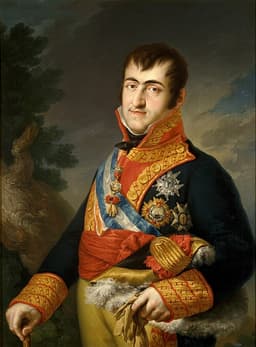
Ferdinand VII of Spain
Emperor · Modern
45.1Total
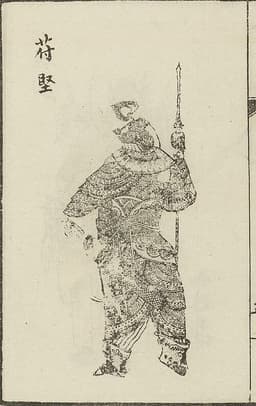
Fu Jian
Emperor · Ancient
64.4Total
Basic Information
Born
1784
338
Died
1833
385
Era
Modern
Ancient
Nationality
Spain
China
Occupation
Emperor
Emperor
Civilization
Western
Eastern
Score Comparison
Military (10%)
14.9
78.0
Political (20%)
32.2
72.0
Influence (20%)
51.0
59.0
Legacy (20%)
41.7
50.0
Leadership (15%)
74.0
85.0
Strategy (15%)
45.0
58.0
TOTAL
45.1
64.4
Ferdinand VII of Spain — Complete Timeline
1808 AD
Accession to the thronePolitical Action◆ Major
Ferdinand VII became King of Spain after the abdication of his father Charles IV. His reign was interrupted by Napoleon's intervention and the Peninsular War, but he was restored in 1814.
SuccessionMonarchy
Impact: national
1814 AD
Abolition of the Constitution of 1812Political Action
Upon returning to Spain, Ferdinand VII abolished the liberal Constitution of 1812 and restored absolute monarchy. He persecuted liberals and reinstated the Inquisition, reversing the reforms of the Cortes of C
ConstitutionAbsolutismReaction
Impact: nationaldestructive
1820 AD
Trienio LiberalPolitical Action◆ Major
A military revolt led by Rafael del Riego forced Ferdinand VII to reinstate the Constitution of 1812, beginning the Trienio Liberal. Ferdinand was effectively a constitutional monarch for three years.
Liberal RevolutionConstitutionRevolt
Impact: national
1823 AD
French intervention and restoration of absolutismWar◆ Major
A French army, the Hundred Thousand Sons of Saint Louis, invaded Spain to restore Ferdinand VII's absolute power. The liberal government fell, and Ferdinand resumed repressive rule.
InterventionAbsolutismCongress of Vienna
Impact: regionaldestructive
1830 AD
Pragmatic Sanction of 1830Political Action◆ Major
Ferdinand VII issued the Pragmatic Sanction, abolishing Salic Law and allowing his daughter Isabella to inherit the throne. This led to the Carlist Wars after his death.
SuccessionLawCarlist Wars
Impact: national
Fu Jian — Complete Timeline
370 AD
Conquest of Former YanWar◆ Major
Fu Jian's Former Qin forces conquered the Former Yan state, annexing its territory in northern China. This victory significantly expanded Former Qin's power and territory, bringing Fu Jian closer to unifying the north.
ConquestExpansion
Impact: regionalconstructive
376 AD
Conquest of Former LiangWar◆ Major
Fu Jian's forces conquered the Former Liang state in the northwest, incorporating its territory into Former Qin. This further consolidated his control over northern China.
ConquestExpansion
Impact: regionalconstructive
Conquest of DaiWar
Fu Jian's army conquered the Dai state, a Xianbei confederation in the north. This eliminated a rival and extended Former Qin's influence into the steppe region.
ConquestExpansion
Impact: regionalconstructive
379 AD
Capture of XiangyangWar
Fu Jian's forces captured the strategic city of Xiangyang from the Eastern Jin dynasty. This victory gave Former Qin a foothold south of the Huai River, setting the stage for the invasion that led to the Battle of Fei River.
ConquestCampaign
Impact: regionalconstructive
383 AD
Battle of Fei RiverWar
Fu Jian led a massive Former Qin army against the Eastern Jin dynasty at the Fei River. The Jin forces defeated the Qin army, causing a catastrophic rout. This defeat shattered Fu Jian's unification efforts and led to the collapse of Former Qin.
BattleUnificationDefeat
Impact: regionaltragic
Expert Analysis
Ferdinand VII of Spain vs Fu Jian
# The Conqueror and the Reactionary
On a misty autumn morning in 383 AD, Fu Jian stood atop a hill overlooking the Fei River, his army stretching across the horizon like an endless tide. He believed he was about to complete what no man had done in centuries—unify China under a single rule. Across the river, a vastly outnumbered Jin force waited, trembling. And yet, within hours, Fu Jian’s empire would shatter, and he would flee for his life, a broken man. Fifteen centuries later, in 1814, another monarch returned to his throne—Ferdinand VII of Spain, fresh from exile, riding into Madrid amid cheering crowds. He too faced a choice: to embrace the new world or cling to the old. He chose the latter, and his kingdom would never recover. Two rulers, two eras, two catastrophes—each a warning about the limits of power and the weight of a single decision.
Origins
Fu Jian was born in 338, a child of the chaotic Sixteen Kingdoms period, when northern China was a patchwork of warring states. His people, the Di tribe, were semi-nomadic, and young Jian grew up in a world where survival depended on the sword. His grandfather had founded the Former Qin dynasty, but it was a fragile realm. Jian’s education was practical—horsemanship, archery, the art of command—and he absorbed the Confucian ideals of benevolent rule from Chinese scholars at court. His era demanded ruthlessness tempered with vision.
Ferdinand VII, born in 1784, was a prince of the House of Bourbon, raised in the gilded cage of the Spanish court. His childhood was shadowed by the French Revolution, and he learned early that power was a matter of intrigue, not battle. His father Charles IV was weak, his mother and her favorite Manuel Godoy effectively ruled. Young Ferdinand was trained in the arts of courtly manipulation, not governance. The Enlightenment was reshaping Europe, but in Madrid, the old regime clung to its rituals. Ferdinand’s world was one of ceremony, suspicion, and the absolute belief that monarchy came from God.
Rise to Power
Fu Jian’s path was forged in blood. He became emperor at 19, after a coup that deposed his tyrannical cousin. Rather than purge his rivals, he surprised everyone by forgiving them—a gesture that won loyalty. In 370, he launched his first great campaign, crushing the Former Yan kingdom. The conquest was swift and brutal: Yan’s capital fell, its king captured. By 376, he had swallowed the Former Liang and the Dai confederation, uniting all of northern China under one banner. His strategy was simple but effective—overwhelming force, swift marches, and generous terms for those who surrendered. He was not merely a conqueror; he was a unifier.
Ferdinand VII’s rise was a drama of abdication and betrayal. In 1808, Napoleon’s armies invaded Spain, and a popular revolt forced his father to abdicate. Ferdinand became king, but within weeks Napoleon lured him to Bayonne and forced him to renounce the throne. For six years, Ferdinand was a prisoner in France, a symbol of Spanish resistance. He learned nothing from exile except resentment. When Napoleon fell, Ferdinand returned in 1814 to a country that had fought for him, written a liberal constitution in his name, and expected him to rule as a constitutional monarch. He refused.
Leadership & Governance
As a ruler, Fu Jian was a paradox. He was ruthless in war but merciful in peace. He integrated conquered elites into his court, promoted Chinese officials alongside his own tribesmen, and patronized Buddhism alongside Confucianism. His capital at Chang’an became a cosmopolitan center. He reduced taxes, repaired canals, and encouraged trade. His governance was pragmatic—he understood that an empire of many peoples required tolerance. But he was also dangerously idealistic. He believed his army was invincible, his destiny manifest. When his generals warned against invading the Eastern Jin in 383, he dismissed them. “My army has a million men,” he boasted. “They can throw their whips into the river and stop its flow.”
Ferdinand VII governed by spite. Upon returning, he immediately abolished the Constitution of 1812, dissolved the Cortes, and arrested liberal deputies. He restored the Inquisition, the feudal privileges of the nobility, and the absolute power of the throne. His rule was a war against his own people. When a military revolt forced him to accept the constitution again in 1820, he bided his time, secretly plotting with foreign powers. In 1823, a French army—the Hundred Thousand Sons of Saint Louis—marched in to restore him. He responded with mass executions. His only political act of lasting consequence was the Pragmatic Sanction of 1830, which allowed his daughter to inherit the throne—a decision that would spark a century of civil war.
Triumph & Tragedy
Fu Jian’s greatest triumph was the unification of northern China. By 382, he ruled an empire from the Gobi Desert to the Yangtze River. His tragedy was the Battle of Fei River in 383. Leading a force estimated at 870,000 men (though modern scholars halve that number), he faced a Jin army of 80,000. The Jin commander offered a truce: let the Qin army retreat so the Jin could cross the river and fight on open ground. Fu Jian agreed, expecting a rout. Instead, the retreat turned into a panic. His multi-ethnic army, never truly loyal, collapsed. The Jin crossed, slaughtered thousands, and Fu Jian fled, his empire dissolving into rebellion. Within two years, he was killed by his own general.
Ferdinand VII’s triumph was survival itself. He outlasted Napoleon, outmaneuvered the liberals, and died in his bed in 1833. His tragedy was that he left Spain shattered. The liberal constitution he crushed had been a genuine attempt at modernization; his restoration of absolutism condemned Spain to a century of instability. His reign saw the loss of most of Spain’s American empire, economic stagnation, and the poisoning of political life. He was a king who ruled by fear, and when he died, the country he left behind was a powder keg.
Character & Destiny
Fu Jian was a man of grand visions and fatal generosity. He trusted too easily—his conquered generals, his disloyal troops, his enemy’s word. His personality was open, even naive. He believed in unity through kindness, a rare virtue in the Sixteen Kingdoms. But that same openness became his ruin. He could not imagine betrayal, and so he was betrayed. His destiny was shaped by the collision of his idealism with the brutal realities of an age of war.
Ferdinand VII was Fu Jian’s opposite: suspicious, vengeful, and narrow. He saw enemies everywhere, and he was often right. But his response was to crush rather than co-opt. He had no vision beyond his own power. His character was a product of exile—humiliation that curdled into cruelty. He ruled not to build but to punish. His destiny was to preside over decline, a king whose name became synonymous with reaction.
Legacy
Fu Jian is remembered as a tragic figure—a near-unifier who failed at the final moment. Chinese historians debate his legacy: some see a wise ruler undone by hubris; others, a conqueror who overreached. His empire vanished, but his example of multicultural governance influenced later dynasties. The Fei River battle became a Chinese proverb for arrogance before a fall.
Ferdinand VII’s legacy is darker. In Spain, he is the “Desired One” turned “the Felonious King.” His abolition of the constitution made him a symbol of absolutism, his reign a cautionary tale. The Carlist wars that followed his death, over the succession he engineered, cost Spain generations of progress. He is remembered as the king who chose the past and lost the future.
Conclusion
Standing at the Fei River, Fu Jian saw victory. Returning to Madrid, Ferdinand saw obedience. Both were wrong. One failed because he believed too much in his own dream; the other because he believed in nothing but his own power. Their stories echo across centuries: the conqueror who could not conquer his own ambition, the king who could not rule his own people. In the end, the measure of a ruler is not the size of his army or the length of his reign, but whether he leaves his people stronger than he found them. By that measure, both failed—but Fu Jian’s failure was glorious, and Ferdinand’s was merely sad.
Rankings
🥇
Fu JianLeader
Mil: 78.0Pol: 72.0Inf: 59.0
64.4
🥈
Ferdinand VII of Spain
Mil: 14.9Pol: 32.2Inf: 51.0
45.1
+19.3 behind
How This Comparison Works
Algorithm
Each figure is scored on 6 dimensions (0—100 scale) based on structured historical data: Military (10%), Political (20%), Influence (20%), Legacy (20%), Leadership (15%), Strategy (15%). The weighted total produces the final ranking.
Data Sources
Scores are computed from structured sub-indicators in the database. Scale factors adjust for era (Ancient ×0.85, Modern ×1.0) and civilization size (Eastern ×1.05, Other ×0.80) to account for differences in population and military scale.
Maximum 3 Figures
Comparisons are limited to 2—3 figures to ensure readability and statistical meaningfulness.
Error Margins
±5 points per dimension — Sub-scores are derived from historical records with inherent uncertainty. Two figures within 5 points on a dimension should be considered roughly equivalent in that area.
Total Score Accuracy
±3 points overall — The weighted combination of 6 dimensions produces a total score with approximately ±3 points of uncertainty. Differences of less than 3 points are not statistically significant— the figures are effectively tied.
Known Limitations
- Historical records are incomplete and uneven across civilizations
- Figures from oral-tradition societies may be underrepresented
- Occupation labels can misclassify multi-role figures
- Scores measure capability and impact, not moral character
- Quantitative scoring is a comparison tool, not absolute truth
Capability Radar
Military (10%) — Battles & Warfare
Battles
10
75
Win Rate
5
70
Expansion
5
80
Political (20%) — Governance & Reform
Reform
5
70
Diplomacy
20
60
Economy
10
65
Influence (20%) — Cultural & Global Reach
Cultural
15
50
Global
20
45
Legacy (20%) — Historical Impact
Historical
30
60
Longevity
20
40
Leadership (15%) — Power & Stability
Tenure
60
65
Stability
10
55
Strategy (15%) — Tactics & Innovation
Strategy
5
70
Tactics
5
65
Reform
5
60
Similar Comparisons
Comments & Discussion
铁血史官6/16/2026
苻坚的淝水之战输在分兵,前秦军队号称百万却因各怀鬼胎而溃散;斐迪南七世输在刚愎自用,废除1812年宪法后欧洲列强都懒得救他。一个是军事菜鸟把杂牌军当精锐用,一个是政治蠢货把自由派当叛徒杀。苻坚至少敢打,斐迪南只敢逃——他逃到瓦朗斯时法国人给他根橄榄枝,他咬断了。两个失败的教科书,一个教你别轻敌,一个教你别复古。
StatsGuy6/16/2026
Let's look at the numbers: Fu Jian ruled at 45, died at 48—3 years post-catastrophe. Ferdinand VII ruled 1814-1833—19 years of decline. Jian's population: roughly 20 million Former Qin subjects; Ferdinand's Spain: 10.5 million. Both lost territory: Jian lost all of north China; Ferdinand lost all of Spanish America. But here's the kicker—Jian's empire collapsed 100% in his lifetime; Ferdinand's only lost 60%. Math says Ferdinand was less catastrophic, but both are solid F-minus rulers.
复古学者6/16/2026
比较这两位君主就像比较苹果和橘子——苻坚是个试图统一天下的军阀,斐迪南是个试图恢复旧秩序的国王。但他们都犯了同样的错误:高估了自己的控制力。苻坚在淝水前连慕容垂的背叛都看不出来,斐迪南在1823年还相信神圣同盟能救他的专制。一个读不懂人心的军事家,一个看不懂时代的政治家。历史给他们的教训是一样的:权力不是靠人数或头衔,而是靠判断力。
WhatIfHistorian6/16/2026
Imagine Fu Jian had listened to his advisors who warned against a hasty attack—he could have consolidated northern China and built a stable dynasty. Imagine Ferdinand had accepted the 1812 Constitution—Spain might have avoided the Carlist Wars and retained some American colonies. Instead, both chose pride over pragmatism. Jian's defeat wasn't inevitable; he just ignored logistics and morale. Ferdinand's failure wasn't predetermined; he just hated the idea of compromise. Two what-ifs that could h
Historian5556/16/2026
Fu Jian had 870,000 men at Fei River; Ferdinand had all of Spain's loyalty in 1814. Both wasted it—Jian through arrogance, Ferdinand through stupidity. Jian thought his "whipping the river dry" boast was clever; Ferdinand thought restoring the Inquisition was smart. One lost an empire in a day, the other in a decade. Numbers don't lie: Jian's 30:1 advantage meant nothing against morale, and Ferdinand's 100% support meant nothing against reform. Both are case studies in how to lose what you have.