Loading...
Bayinnaung vs Fu Jian
Bayinnaung leads by 4.2 pts · 2 figures compared
…
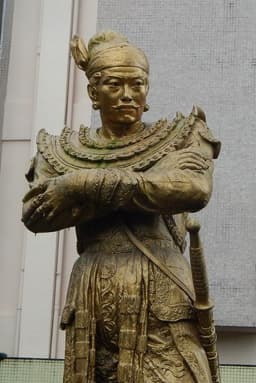
Bayinnaung
Emperor · Modern
68.6Total
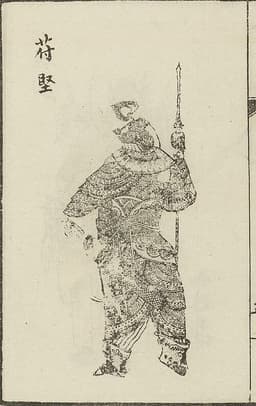
Fu Jian
Emperor · Ancient
64.4Total
Basic Information
Born
1516
338
Died
1581
385
Era
Modern
Ancient
Nationality
Myanmar
China
Occupation
Emperor
Emperor
Civilization
Eastern
Eastern
Score Comparison
Military (10%)
77.1
78.0
Political (20%)
82.0
72.0
Influence (20%)
65.0
59.0
Legacy (20%)
55.0
50.0
Leadership (15%)
74.0
85.0
Strategy (15%)
75.0
58.0
TOTAL
68.6
64.4
Bayinnaung — Complete Timeline
1550 AD
Establishment of the Toungoo EmpirePolitical Action
King Bayinnaung ascended the throne and began a series of military campaigns that created the largest empire in Southeast Asian history. At its peak, the Toungoo empire covered modern Myanmar, Thailand, Laos, and parts of China and India.
Toungoo EmpireSoutheast AsiaImperial Expansion
Impact: regionalconstructive
1557 AD
Conquest of the Shan StatesWar◆ Major
King Bayinnaung conquered the Shan States, bringing them under Toungoo control. This expansion added significant territory and resources to the Burmese empire.
Shan StatesToungoo ExpansionBurmese Empire
Impact: regional
1569 AD
Capture of AyutthayaWar
King Bayinnaung's forces captured the Siamese capital of Ayutthaya after a long siege. He installed a vassal king and made Siam a tributary state of the Toungoo empire.
Burmese-Siamese WarAyutthayaToungoo Empire
Impact: regional
1570 AD
Administrative ReformsReform◆ Major
King Bayinnaung implemented administrative reforms to govern his vast empire, including the appointment of governors and the standardization of laws and taxes. These reforms helped maintain control over conquered territories.
GovernanceAdministrationToungoo Empire
Impact: regionalconstructive
1574 AD
Conquest of Lan XangWar◆ Major
King Bayinnaung conquered the Lao kingdom of Lan Xang (modern Laos), bringing it under Toungoo control. This further expanded the Burmese empire to its greatest territorial extent.
Lan XangToungoo ExpansionLaos
Impact: regional
Fu Jian — Complete Timeline
370 AD
Conquest of Former YanWar◆ Major
Fu Jian's Former Qin forces conquered the Former Yan state, annexing its territory in northern China. This victory significantly expanded Former Qin's power and territory, bringing Fu Jian closer to unifying the north.
ConquestExpansion
Impact: regionalconstructive
376 AD
Conquest of Former LiangWar◆ Major
Fu Jian's forces conquered the Former Liang state in the northwest, incorporating its territory into Former Qin. This further consolidated his control over northern China.
ConquestExpansion
Impact: regionalconstructive
Conquest of DaiWar
Fu Jian's army conquered the Dai state, a Xianbei confederation in the north. This eliminated a rival and extended Former Qin's influence into the steppe region.
ConquestExpansion
Impact: regionalconstructive
379 AD
Capture of XiangyangWar
Fu Jian's forces captured the strategic city of Xiangyang from the Eastern Jin dynasty. This victory gave Former Qin a foothold south of the Huai River, setting the stage for the invasion that led to the Battle of Fei River.
ConquestCampaign
Impact: regionalconstructive
383 AD
Battle of Fei RiverWar
Fu Jian led a massive Former Qin army against the Eastern Jin dynasty at the Fei River. The Jin forces defeated the Qin army, causing a catastrophic rout. This defeat shattered Fu Jian's unification efforts and led to the collapse of Former Qin.
BattleUnificationDefeat
Impact: regionaltragic
Expert Analysis
Bayinnaung vs Fu Jian
# The Emperor and the Conqueror: Two Visions of Power in Ancient Asia
On a late autumn day in 383, the largest army ever assembled in ancient China stood massed along the banks of the Fei River in what is now Anhui Province. Emperor Fu Jian of Former Qin gazed across the water at a vastly smaller force of Eastern Jin defenders. He had conquered nearly all of northern China, commanded perhaps 870,000 men, and yet something felt wrong. His soldiers, a patchwork of recently defeated tribes, shifted uneasily. Across the river, the Jin general Xie Xuan had sent a taunting message: either retreat to let them cross, or prepare to be annihilated. Fu Jian, confident in his numbers, ordered the retreat. It became the most catastrophic miscalculation in Chinese military history.
Half a world away, in the steamy river valleys of Southeast Asia, another empire builder faced no such moment of ruin. Bayinnaung of the Toungoo dynasty, crowned king of Burma in 1550, spent three decades doing what Fu Jian had attempted: forging a vast, multi-ethnic empire through conquest. But where Fu Jian’s creation collapsed in a single battle, Bayinnaung’s endured for generations. The difference lies not in ambition, but in the subtle arts of governance, patience, and the brutal logic of power.
Origins
Fu Jian was born in 338 into the Di tribe, a non-Chinese people who had carved out a kingdom amid the chaos of the Sixteen Kingdoms period. His grandfather had founded Former Qin, and Fu Jian inherited a state that was already a rising power. Yet he was raised steeped in Chinese classical learning, a strange hybrid of tribal warrior and Confucian scholar. This dual identity would haunt him: he wanted to be a civilized emperor, but his power rested on the swords of nomadic horsemen.
Bayinnaung, born in 1516, emerged from a different crucible. The Toungoo dynasty was a minor kingdom in Upper Burma, struggling to survive against the powerful Shan states and the Mon kingdoms to the south. His early life was one of constant warfare and political maneuvering. Unlike Fu Jian, who inherited a throne, Bayinnaung seized his. He was the son-in-law of King Tabinshwehti, the founder of Toungoo’s expansion, and when Tabinshwehti was assassinated in 1550, Bayinnaung crushed the rebels and claimed the crown with ruthless efficiency.
Rise to Power
Fu Jian’s ascent was almost eerily smooth. He came to the throne at nineteen, guided by his brilliant prime minister Wang Meng, a man of extraordinary political acumen. Together, they orchestrated a series of campaigns that swallowed rival states whole. In 370, Former Qin conquered Former Yan, absorbing its vast territories. In 376, they took Former Liang and the Xianbei confederation of Dai. Each victory added soldiers, resources, and—crucially—unassimilated peoples to Fu Jian’s empire. Wang Meng repeatedly warned him to consolidate before expanding further, but Fu Jian, flush with success, ignored the advice.
Bayinnaung’s rise was bloodier and more deliberate. After stabilizing his throne, he turned outward with methodical precision. In 1557, he conquered the Shan States, but instead of simply annexing them, he appointed local rulers as vassals, binding them with oaths of loyalty and marriage alliances. In 1569, after a brutal siege, he captured Ayutthaya, the Siamese capital. Rather than destroy it, he installed a puppet king and demanded tribute, preserving the kingdom’s structure while draining its wealth. Every conquest was followed by administrative integration, not mere plunder.
Leadership & Governance
Here lies the deepest difference between the two men. Fu Jian was a generous, almost naive ruler. He pardoned defeated enemies, gave them high offices, and trusted them completely. His court was a polyglot collection of Xianbei, Qiang, Di, and Chinese nobles, all nursing old grievances. He abolished harsh laws, promoted education, and tried to build a unified Chinese empire based on Confucian ideals. But his mercy was a weakness. The very men he spared—like the Xianbei prince Murong Chui—would later betray him.
Bayinnaung was no less ambitious, but he understood the mechanics of power. He divided his empire into provinces governed by loyal relatives or trusted generals. He standardized weights, measures, and currency. He built roads and canals to bind his realm together. Most importantly, he respected local customs and religions, presenting himself as a Buddhist king who protected the faith. In Ayutthaya, he allowed the Siamese to keep their own laws. In the Shan States, he married local princesses. His empire was a web of personal loyalties, not a fragile union of resentful subjects.
Triumph & Tragedy
Fu Jian’s greatest moment was also his undoing. The Battle of Fei River in 383 was a masterpiece of strategic folly. His vast army, composed of conscripts from conquered states, had no loyalty to him. When he ordered the retreat to let the Jin forces cross, the retreat became a panic. The Jin army attacked, and the Qin forces disintegrated. Fu Jian fled, wounded and humiliated. Within a year, his empire shattered into warring fragments. He was captured and killed by a former ally in 385.
Bayinnaung’s triumph was more sustained. By 1574, he had conquered Lan Xang, modern Laos, extending his empire from the borders of India to the Mekong River. He was the first ruler to unite most of mainland Southeast Asia. But even he faced limits. His later campaigns into Siam were costly, and after his death in 1581, the empire slowly frayed. Yet it did not collapse overnight. The administrative structures he built kept the Toungoo dynasty alive for another century.
Character & Destiny
Fu Jian was a dreamer. He wanted to be remembered as a unifier, a sage-king who brought peace to a fractured land. But his generosity masked a fatal blindness to human nature. He believed that loyalty could be won with kindness, that former enemies would forget their grievances. He was wrong. His empire was a house of cards built on trust, and the Fei River was the wind that blew it down.
Bayinnaung was a realist. He trusted no one completely, kept his enemies close, and never forgot that power was maintained through fear as much as love. He was called “the Conqueror of Ten Directions,” but he knew that conquest was only half the work. The other half was building a system that could survive the conqueror.
Legacy
Fu Jian is remembered today as a cautionary tale. The Battle of Fei River became a byword for overconfidence and the dangers of hubris. Chinese historians, writing from the perspective of the Jin dynasty, painted him as a barbarian who overreached. Yet his vision of a unified China, transcending ethnic divisions, was ahead of its time. It would take another two centuries before the Sui and Tang dynasties achieved what he attempted.
Bayinnaung’s legacy is more ambiguous. In Myanmar, he is revered as a national hero, the greatest king in Burmese history. His empire is celebrated as a golden age. But in Thailand and Laos, he is remembered as a conqueror who burned cities and imposed foreign rule. His statue stands in Yangon, but the ghosts of Ayutthaya still haunt the memory.
Conclusion
Two emperors, two empires, two fates. Fu Jian dreamed of unity and died in failure. Bayinnaung built an empire and saw it endure. The difference was not in ambition, but in the cold calculus of power. Fu Jian believed that men could be won with kindness. Bayinnaung knew that they had to be bound with chains of interest, fear, and mutual benefit. Both were great in their own way, but only one understood that an empire is not built by conquest alone—it is built by the daily, unglamorous work of governance. The Fei River carries Fu Jian’s memory downstream, while Bayinnaung’s roads still trace the bones of his empire. History, as always, judges not by intention, but by outcome.
Rankings
🥇
BayinnaungLeader
Mil: 77.1Pol: 82.0Inf: 65.0
68.6
🥈
Fu Jian
Mil: 78.0Pol: 72.0Inf: 59.0
64.4
+4.2 behind
How This Comparison Works
Algorithm
Each figure is scored on 6 dimensions (0—100 scale) based on structured historical data: Military (10%), Political (20%), Influence (20%), Legacy (20%), Leadership (15%), Strategy (15%). The weighted total produces the final ranking.
Data Sources
Scores are computed from structured sub-indicators in the database. Scale factors adjust for era (Ancient ×0.85, Modern ×1.0) and civilization size (Eastern ×1.05, Other ×0.80) to account for differences in population and military scale.
Maximum 3 Figures
Comparisons are limited to 2—3 figures to ensure readability and statistical meaningfulness.
Error Margins
±5 points per dimension — Sub-scores are derived from historical records with inherent uncertainty. Two figures within 5 points on a dimension should be considered roughly equivalent in that area.
Total Score Accuracy
±3 points overall — The weighted combination of 6 dimensions produces a total score with approximately ±3 points of uncertainty. Differences of less than 3 points are not statistically significant— the figures are effectively tied.
Known Limitations
- Historical records are incomplete and uneven across civilizations
- Figures from oral-tradition societies may be underrepresented
- Occupation labels can misclassify multi-role figures
- Scores measure capability and impact, not moral character
- Quantitative scoring is a comparison tool, not absolute truth
Capability Radar
Military (10%) — Battles & Warfare
Battles
85
75
Win Rate
90
70
Expansion
92
80
Political (20%) — Governance & Reform
Reform
70
70
Diplomacy
78
60
Economy
72
65
Influence (20%) — Cultural & Global Reach
Cultural
70
50
Global
55
45
Legacy (20%) — Historical Impact
Historical
75
60
Longevity
60
40
Leadership (15%) — Power & Stability
Tenure
85
65
Stability
65
55
Strategy (15%) — Tactics & Innovation
Strategy
88
70
Tactics
80
65
Reform
75
60
Similar Comparisons
Comments & Discussion
MongolianThunder6/16/2026
Fu Jian's Fei River disaster proves numbers mean nothing without loyalty. 870,000 men sounds impressive until you realize half were POWs who'd rather stab him in the back than fight. Bayinnaung spent decades personally integrating conquered elites through marriage and Buddhist patronage. Fu Jian rushed his conquests like a kid stacking blocks too high. One push and the whole thing crashed. That's not empire building, that's just showing off with other people's armies.
数字暴君6/16/2026
数据不会撒谎:苻坚征调了近百万大军,结果几分钟内土崩瓦解;莽应龙带着几千缅军就横扫了暹罗万象。问题不在人数,在信任成本。苻坚的帝国是个高价收购的破烂公司,表面光鲜,内部全是心怀鬼胎的"新员工"。莽应龙的帝国像滚雪球,越滚越紧实。苻坚输在一场豪赌,莽应龙赢了三十年的耐心工程。数据铁证:前者是泡沫,后者是金砖。
SoutheastAsianSynthesis6/16/2026
Classics scholars obsess over Rome and China, but Bayinnaung's Toungoo Empire is the real underrated gig. He conquered Siam, Laos, and Manipur while building a decentralized administrative system that actually worked for multi-ethnic rule. Fu Jian tried to homogenize everyone into his "Chinese" mold and got humiliated by a river crossing. Bayinnaung let local chiefs keep power as tributaries, creating stability without constant rebellion. The lesson: brute force only works if you know when to le
纸上谈兵6/16/2026
历史课本总说苻坚是"雄才大略",但读过《晋书》就知道这哥们决策有多不靠谱。淝水之战前,他弟弟苻融、大臣石越全都反对,说北方刚平,人心未附,贸然南下必败。苻坚怎么回的?"吾料彼众犹以石投卵耳。"完全是战略傲慢!莽应龙在《琉璃宫史》里的形象恰恰相反,每个征战决策都有详细的情报和后勤准备。苻坚像个被成功冲昏头脑的CEO,莽应龙才是真正的大将军。
RevisionistRoar6/16/2026
西方史学家老吹苻坚是"失败的统一者",我呸!他最大的罪不是野心,而是太天真。苻坚对战败的慕容垂、姚苌这些人不计前嫌,委以重任,他以为宽容能换来忠诚,结果慕容垂反手就复国了。莽应龙呢?你看他对掸族首领的手段——打服之后把人质押在首都,但给足面子。不是仁政,是恩威并施。苻坚的白左式包容,在铁血时代就是找死。他