Loading...
Emperor Pedro I of Brazil vs Ferdinand VII of Spain
Emperor Pedro I of Brazil leads by 10.4 pts · 2 figures compared
…
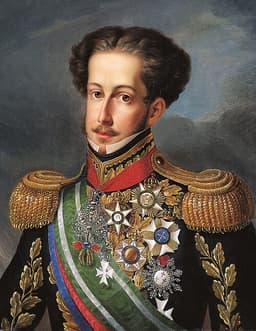
Emperor Pedro I of Brazil
Emperor · Modern
55.5Total
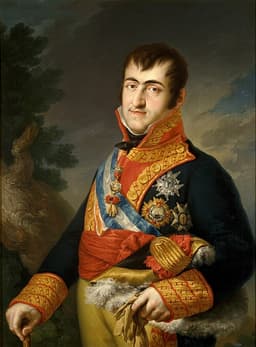
Ferdinand VII of Spain
Emperor · Modern
45.1Total
Basic Information
Born
1798
1784
Died
1834
1833
Era
Modern
Modern
Nationality
Brazil
Spain
Occupation
Emperor
Emperor
Civilization
Western
Western
Score Comparison
Military (10%)
55.0
14.9
Political (20%)
62.7
32.2
Influence (20%)
59.0
51.0
Legacy (20%)
50.0
41.7
Leadership (15%)
65.0
74.0
Strategy (15%)
35.7
45.0
TOTAL
55.5
45.1
Emperor Pedro I of Brazil — Complete Timeline
1822 AD
Declaration of Brazilian IndependencePolitical Action
Dom Pedro declared Brazil's independence from Portugal on September 7, 1822, at the Ipiranga River. He was acclaimed Emperor Pedro I of Brazil, establishing a constitutional monarchy separate from Portugal.
IndependenceFounding
Impact: globalprogressive
Coronation as Emperor of BrazilPolitical Action◆ Major
Pedro I was crowned Emperor of Brazil on December 1, 1822, in Rio de Janeiro. The coronation formalized his rule over the newly independent nation, with a constitution promulgated in 1824.
CoronationMonarchy
Impact: national
1825 AD
Cisplatine WarWar◆ Major
Brazil went to war with the United Provinces of the R
WarTerritorial Loss
Impact: regionaldestructive
1831 AD
Abdication of the Brazilian ThronePolitical Action
Facing political crisis and military unrest, Pedro I abdicated the Brazilian throne on April 7, 1831, in favor of his five-year-old son Pedro II. He then returned to Portugal to claim the Portuguese throne.
AbdicationPolitical Crisis
Impact: nationaltragic
Ferdinand VII of Spain — Complete Timeline
1808 AD
Accession to the thronePolitical Action◆ Major
Ferdinand VII became King of Spain after the abdication of his father Charles IV. His reign was interrupted by Napoleon's intervention and the Peninsular War, but he was restored in 1814.
SuccessionMonarchy
Impact: national
1814 AD
Abolition of the Constitution of 1812Political Action
Upon returning to Spain, Ferdinand VII abolished the liberal Constitution of 1812 and restored absolute monarchy. He persecuted liberals and reinstated the Inquisition, reversing the reforms of the Cortes of C
ConstitutionAbsolutismReaction
Impact: nationaldestructive
1820 AD
Trienio LiberalPolitical Action◆ Major
A military revolt led by Rafael del Riego forced Ferdinand VII to reinstate the Constitution of 1812, beginning the Trienio Liberal. Ferdinand was effectively a constitutional monarch for three years.
Liberal RevolutionConstitutionRevolt
Impact: national
1823 AD
French intervention and restoration of absolutismWar◆ Major
A French army, the Hundred Thousand Sons of Saint Louis, invaded Spain to restore Ferdinand VII's absolute power. The liberal government fell, and Ferdinand resumed repressive rule.
InterventionAbsolutismCongress of Vienna
Impact: regionaldestructive
1830 AD
Pragmatic Sanction of 1830Political Action◆ Major
Ferdinand VII issued the Pragmatic Sanction, abolishing Salic Law and allowing his daughter Isabella to inherit the throne. This led to the Carlist Wars after his death.
SuccessionLawCarlist Wars
Impact: national
Expert Analysis
Emperor Pedro I of Brazil vs Ferdinand VII of Spain
# The Two Faces of Absolutism: Ferdinand VII and Pedro I
On a sweltering September afternoon in 1822, a prince on horseback stood at the banks of the Ipiranga River in Brazil, tearing the Portuguese insignia from his uniform and shouting “Independência ou Morte!” It was a moment of theatrical bravado that would define an era. Just eight years earlier, another prince had crossed the Pyrenees into Spain, returning from French captivity to a nation that hailed him as “the Desired One.” Within weeks, that same king would tear up a constitution and plunge his country into a century of civil war. These two monarchs—Ferdinand VII of Spain and Pedro I of Brazil—shared blood, era, and the challenge of ruling empires in the age of revolution. Yet their paths diverged so sharply that one became a symbol of reactionary stagnation, the other a flawed but genuine founder of a nation. Why?
Origins
Both men were born into the House of Bourbon, Europe’s most anciently absolutist dynasty. Ferdinand VII arrived in 1784 as the son of Charles IV of Spain, a king more interested in hunting than governing, and his wife Maria Luisa, whose influence—and rumored affair with the prime minister Manuel Godoy—poisoned the court. Ferdinand grew up in a world of decaying imperial grandeur, where the French Revolution had already shattered the certainties of divine right. He was educated in secrecy and resentment, learning to hate his parents’ ministers and to fear the Enlightenment.
Pedro I, born in 1798, was Ferdinand’s nephew. His father was John VI of Portugal, who fled to Brazil in 1807 when Napoleon’s armies invaded. Young Pedro grew up not in Lisbon’s palaces but in Rio de Janeiro, a tropical capital where the court was a strange hybrid of European formality and colonial reality. He was impulsive, energetic, and poorly educated—but he was also present at the moment when Brazil became the seat of the Portuguese Empire, a unique experience that gave him a firsthand understanding of colonial grievances.
The difference in their formative years was stark. Ferdinand learned to scheme in the shadows; Pedro learned to act in the open. One was shaped by the suffocating politics of a dying court, the other by the raw possibilities of a rising nation.
Rise to Power
Ferdinand VII’s rise was a study in passive aggression. In 1808, he orchestrated the “Mutiny of Aranjuez,” a palace coup that forced his father to abdicate. But Napoleon had other plans: the French emperor summoned both father and son to Bayonne, forced Ferdinand to return the crown to Charles IV, who then handed it to Napoleon, who gave it to his brother Joseph. Ferdinand spent the next six years imprisoned in France, a martyr-king in absentia, while Spain fought the devastating Peninsular War. When he returned in 1814, he was greeted as a liberator—but he immediately betrayed the liberals who had fought in his name.
Pedro I’s rise was the opposite: direct, confrontational, and decisive. In 1821, when his father returned to Portugal and left him as regent in Brazil, Pedro faced a choice: obey the Portuguese Cortes, which demanded his return and the recolonization of Brazil, or defy them. He chose defiance, famously declaring “I remain” in January 1822. By September, he had declared independence. By December, he was crowned Emperor. His path to power took months, not years, and it was built on action, not intrigue.
Leadership & Governance
Here the contrast becomes almost painful. Ferdinand VII ruled Spain for nineteen years after his restoration, and his governance was a masterclass in how not to manage a modern state. He abolished the liberal Constitution of 1812, restored the Inquisition, and persecuted liberals, Freemasons, and reformers. His reign was punctuated by crisis: the Trienio Liberal of 1820–1823, when a military revolt forced him to accept the constitution, only to be crushed by a French invasion—the Hundred Thousand Sons of Saint Louis—that restored his absolutism. He governed through a revolving door of incompetent ministers, relying on repression and the Church. He left Spain economically exhausted, politically polarized, and on the brink of the Carlist Wars.
Pedro I was hardly a model liberal. He ruled as an emperor, not a president, and his reign was marked by authoritarian tendencies, financial mismanagement, and the costly Cisplatine War (1825–1828) against Argentina, which Brazil lost. He clashed with the General Assembly, dismissed cabinets, and struggled to balance Portuguese and Brazilian interests. Yet he did one thing Ferdinand never could: he accepted limits on his power. In 1824, he granted a constitution that, while conservative, established a parliamentary system, guaranteed civil rights, and created an independent judiciary. It was not democracy—but it was a framework within which Brazil could evolve.
The difference lay in their relationship to change. Ferdinand saw reform as a personal threat; Pedro saw it as a necessary tool for survival.
Triumph & Tragedy
Ferdinand VII’s greatest moment was also his most hollow: the restoration of absolutism in 1823, thanks to French bayonets. It was a triumph that required foreign intervention to suppress his own people. His greatest tragedy was the Pragmatic Sanction of 1830, which abolished Salic Law to allow his daughter Isabella to inherit the throne. This act, born of his desperate desire to keep the Bourbon line alive, triggered the Carlist Wars after his death, tearing Spain apart for decades.
Pedro I’s triumph was September 7, 1822—the cry of “Independence or Death” that created a nation. His tragedy was his abdication on April 7, 1831, when he surrendered the Brazilian throne to his five-year-old son Pedro II. The Brazilian elite had turned against him; the military was restless; his Portuguese origins made him suspect. He left for Europe, where he briefly fought for his daughter’s claim to the Portuguese throne, dying of tuberculosis in 1834 at just 35.
Character & Destiny
Ferdinand was a man of deep cunning and shallow courage. He lied to liberals, to conservatives, to his family, and to himself. His biographer called him “the most ungrateful of kings.” He was physically unattractive, paranoid, and indecisive—a man who could plot a coup but could not lead an army. His personality mirrored his reign: reactive, petty, and ultimately destructive.
Pedro was the opposite: impulsive, charismatic, and self-destructive. He was a womanizer, a spendthrift, and a hothead who once challenged a minister to a duel. He was also capable of genuine generosity and vision. His decision to abdicate, while humiliating, was arguably his wisest act: it spared Brazil a civil war and allowed his son to grow into one of the 19th century’s most respected monarchs.
Legacy
Ferdinand VII left Spain a legacy of division. His name is synonymous with the “Ominous Decade” of absolutist repression. He is remembered not as a builder but as a wrecker—a king who could have modernized Spain but chose instead to strangle it.
Pedro I left Brazil a nation. His statue stands in São Paulo, his cry echoes in the national anthem, and his son Pedro II would go on to rule for nearly half a century, making Brazil a stable, progressive empire. Yet Pedro I himself remains a controversial figure: a liberal who kept slaves, a democrat who ruled as an emperor, a Portuguese prince who became a Brazilian hero.
Conclusion
Standing at the Ipiranga River in 1822, Pedro I made a choice that Ferdinand VII could never have made: he chose the future over the past. Ferdinand, returning to Spain in 1814, chose the opposite. Both were products of their age, but one understood that monarchy could survive only by adapting, the other that it could survive only by resisting. History rendered its verdict: one king is remembered as a tyrant, the other as a founder. In the end, the difference between them was not blood or birth, but the simple willingness to let go of a world that was already gone.
Rankings
🥇
Emperor Pedro I of BrazilLeader
Mil: 55.0Pol: 62.7Inf: 59.0
55.5
🥈
Ferdinand VII of Spain
Mil: 14.9Pol: 32.2Inf: 51.0
45.1
+10.4 behind
How This Comparison Works
Algorithm
Each figure is scored on 6 dimensions (0—100 scale) based on structured historical data: Military (10%), Political (20%), Influence (20%), Legacy (20%), Leadership (15%), Strategy (15%). The weighted total produces the final ranking.
Data Sources
Scores are computed from structured sub-indicators in the database. Scale factors adjust for era (Ancient ×0.85, Modern ×1.0) and civilization size (Eastern ×1.05, Other ×0.80) to account for differences in population and military scale.
Maximum 3 Figures
Comparisons are limited to 2—3 figures to ensure readability and statistical meaningfulness.
Error Margins
±5 points per dimension — Sub-scores are derived from historical records with inherent uncertainty. Two figures within 5 points on a dimension should be considered roughly equivalent in that area.
Total Score Accuracy
±3 points overall — The weighted combination of 6 dimensions produces a total score with approximately ±3 points of uncertainty. Differences of less than 3 points are not statistically significant— the figures are effectively tied.
Known Limitations
- Historical records are incomplete and uneven across civilizations
- Figures from oral-tradition societies may be underrepresented
- Occupation labels can misclassify multi-role figures
- Scores measure capability and impact, not moral character
- Quantitative scoring is a comparison tool, not absolute truth
Capability Radar
Military (10%) — Battles & Warfare
Battles
25
10
Win Rate
30
5
Expansion
35
5
Political (20%) — Governance & Reform
Reform
50
5
Diplomacy
45
20
Economy
30
10
Influence (20%) — Cultural & Global Reach
Cultural
45
15
Global
40
20
Legacy (20%) — Historical Impact
Historical
55
30
Longevity
50
20
Leadership (15%) — Power & Stability
Tenure
40
60
Stability
20
10
Strategy (15%) — Tactics & Innovation
Strategy
25
5
Tactics
20
5
Reform
15
5
Similar Comparisons
Comments & Discussion
No comments yet. Be the first to share your thoughts!