Loading...
Feng Guozhang vs Prem Tinsulanonda
Prem Tinsulanonda leads by 8.1 pts · 2 figures compared
…
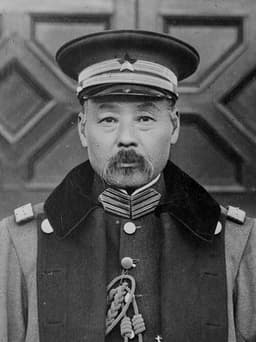
Feng Guozhang
General · Modern
49.1Total
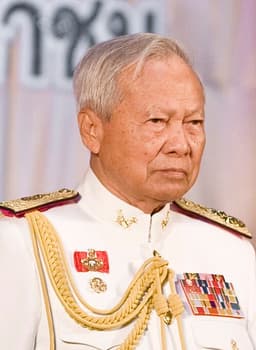
Prem Tinsulanonda
General · Modern
57.2Total
Basic Information
Born
1859
1920
Died
1919
—
Era
Modern
Modern
Nationality
China
Thailand
Occupation
General
General
Civilization
Eastern
Eastern
Score Comparison
Military (10%)
30.0
50.0
Political (20%)
61.3
59.3
Influence (20%)
54.9
54.9
Legacy (20%)
45.8
47.5
Leadership (15%)
40.0
78.0
Strategy (15%)
57.5
60.0
TOTAL
49.1
57.2
Feng Guozhang — Complete Timeline
1912 AD
Command of the Beiyang ArmyPolitical Action◆ Major
Feng Guozhang became a key commander of the Beiyang Army under Yuan Shikai. He controlled military forces in the Zhili region, establishing himself as a major warlord in northern China after the fall of the Qing dynasty.
Beiyang ArmyWarlordMilitary Command
Impact: national
1916 AD
Appointment as Vice PresidentPolitical Action◆ Major
Feng Guozhang was elected Vice President of the Republic of China under President Li Yuanhong. This position gave him significant political influence during the early Republican period.
Republic of ChinaGovernmentPolitics
Impact: national
1917 AD
Acting PresidencyPolitical Action◆ Major
Feng Guozhang became Acting President of the Republic of China after Li Yuanhong's resignation. He served from 1917 to 1918, facing challenges from rival warlords and struggling to maintain central authority.
Republic of ChinaPresidencyWarlord Era
Impact: national
1918 AD
Conflict with Duan QiruiPolitical Action◆ Major
Feng Guozhang engaged in a power struggle with Premier Duan Qirui, leading to the split of the Beiyang clique into the Zhili and Anhui factions. This conflict weakened the central government and intensified warlord warfare.
Beiyang CliquePower StruggleWarlord Era
Impact: nationaldestructive
Prem Tinsulanonda — Complete Timeline
1980 AD
Appointed Prime Minister after a coupPolitical Action◆ Major
Prem Tinsulanonda was appointed Prime Minister of Thailand by the military after a coup. He served for over eight years, overseeing a period of political stability and economic growth.
Prime MinisterMilitary RuleStability
Impact: national
1981 AD
Survived a coup attemptPolitical Action◆ Major
Prem survived a coup attempt by military officers loyal to the 'Young Turks' faction. The coup failed due to lack of support and the loyalty of key military units, allowing Prem to remain in power.
Coup AttemptPolitical CrisisMilitary
Impact: national
1988 AD
Resigned as Prime MinisterPolitical Action◆ Major
Prem resigned as Prime Minister after the general election, handing over power to a civilian government led by Chatichai Choonhavan. His resignation marked a rare peaceful transition of power in Thai politics.
ResignationDemocratic TransitionPeaceful
Impact: nationalconstructive
2016 AD
Appointed Regent of ThailandPolitical Action
After the death of King Bhumibol, Prem was appointed Regent of Thailand until the ascension of King Maha Vajiralongkorn. He served as a key figure in the transition of the monarchy.
RegentMonarchyTransition
Impact: national
Expert Analysis
Prem Tinsulanonda vs Feng Guozhang
# The Art of Transition: Prem Tinsulanonda and Feng Guozhang
In the summer of 1981, a Thai general sat in a Bangkok office, waiting for news that would determine whether he would remain prime minister or become a footnote in history. Across the room, maps of Thailand were spread out, marked with troop movements of the "Young Turks" who had launched a coup against his government. Prem Tinsulanonda, a quiet man with a soldier's bearing and a diplomat's patience, did not call for tanks or declare martial law. Instead, he waited—and the coup collapsed from within, starved of legitimacy. Half a century earlier and a thousand miles away, another general faced a different kind of unraveling. Feng Guozhang, acting president of the Republic of China, watched as his authority dissolved not through bullets but through the slow poison of political betrayal. Both men were generals who became statesmen in turbulent times. One died in office as a revered regent; the other died in obscurity, his name barely remembered. The difference lay not in their ambition but in the worlds they tried to hold together.
Origins
Prem Tinsulanonda was born in 1920 in Songkhla, a coastal province in southern Thailand, into a family of modest means. His father was a schoolteacher, his mother a homemaker. The young Prem grew up under the shadow of absolute monarchy, watching King Rama VII struggle with the forces of modernization that would eventually end royal absolutism in 1932. This upbringing instilled in him a deep reverence for the monarchy as a stabilizing force—a belief that would define his career. He entered military academy in the 1930s, graduating just as World War II reshaped Southeast Asia. Thailand, uniquely among its neighbors, avoided colonization, and its military emerged as a central pillar of national identity.
Feng Guozhang, born in 1859 in Hebei province, came of age in a China crumbling under dynastic decay and foreign incursion. His family was literate but poor, and Feng joined the military as a path to survival. He rose through the ranks of the Beiyang Army, a modernized force created by the Qing dynasty to suppress rebellions and defend against Western powers. By the time the Qing fell in 1912, Feng had become a trusted commander under Yuan Shikai, the man who would briefly declare himself emperor. Unlike Prem, who inherited a stable if fragile nation-state, Feng inherited a civilization in collapse—a republic in name only, where loyalty shifted like sand.
Rise to Power
Prem's ascent was gradual, almost reluctant. He served as a staff officer during the 1960s and 1970s, earning a reputation for competence and incorruptibility in a military often accused of both. When a coup in 1980 toppled the civilian government, the military junta needed a prime minister who could bridge the gap between generals and civilians. They chose Prem—a man with no political party, no personal army, and no obvious enemies. He was appointed prime minister in March 1980, a position he would hold for over eight years.
Feng's rise was more dramatic and violent. In 1912, after the Qing abdicated, Yuan Shikai appointed Feng to command the Beiyang Army's key divisions. By 1916, when Yuan's imperial ambitions failed and he died, Feng was elected Vice President of the Republic of China. The following year, President Li Yuanhong resigned amid a constitutional crisis, and Feng became Acting President. He inherited a nation already fractured: the Beiyang clique was splitting into rival factions, with Duan Qirui controlling the premiership and the north, while warlords in the south declared independence. Prem stepped into a room where the furniture was arranged; Feng stepped into a building already on fire.
Leadership & Governance
Prem governed as a consensus-builder. His style was quiet, almost invisible—he rarely gave speeches, avoided public confrontations, and let his ministers take credit. His political wisdom lay in knowing what not to do. He refused to purge the military of rival factions, instead absorbing them into a broad coalition. He survived the 1981 coup attempt not by force but by ensuring that the monarchy, the military high command, and the public all withheld support from the rebels. Economically, Thailand boomed under his watch, with annual growth averaging over 7 percent. He also navigated the tricky relationship between the military and the monarchy, positioning himself as a loyal servant of King Bhumibol Adulyadej, whose moral authority underpinned the state.
Feng governed as a warlord playing republican politics. His military score of 62.6 reflects competence, not brilliance; his political score of 81.7 shows his real skill lay in maneuvering. As acting president from 1917 to 1918, he tried to balance the competing claims of Duan Qirui's Anhui clique, the southern separatists, and foreign powers demanding repayment of loans. He attempted to negotiate with the south, but Duan undercut him at every turn. Feng's strategy score of 72.0 suggests he understood the chessboard but lacked the pieces to win. He called for elections, but no one trusted them. He ordered troops, but they owed loyalty to local commanders. In the end, he resigned in 1918, his presidency a memory of what might have been.
Triumph & Tragedy
Prem's greatest triumph was not a battle but a transition. In 1988, after eight years as prime minister, he called a general election and handed power to Chatichai Choonhavan, a civilian politician. This was almost unprecedented in Thai history, where military leaders typically clung to power until overthrown. Prem then retired—or appeared to. In 2016, after King Bhumibol's death, Prem was appointed Regent of Thailand, serving as the symbolic head of state until King Maha Vajiralongkorn ascended the throne. He died in office, a figure of stability in a nation that had seen more than a dozen coups since 1932.
Feng's tragedy was his failure to hold the center. His greatest moment—becoming acting president of a republic that spanned from Manchuria to Yunnan—was also his undoing. He could not reconcile the factions, could not stop the slide into warlordism, and could not protect the republican institutions he nominally led. After resigning in 1918, he retired to Tianjin, where he died in 1919, a broken man. His legacy score of 64.4 reflects a figure remembered, if at all, as a footnote—a general who tried to be a president in an era that wanted generals, not presidents.
Character & Destiny
Prem was cautious, patient, and emotionally restrained. He understood that in Thailand, power came not from guns but from legitimacy—and legitimacy flowed from the monarchy, the bureaucracy, and the people's desire for stability. He never sought the spotlight; he sought the consensus. His leadership score of 89.0 reflects a man who led by not leading, who ruled by not ruling. Feng was more ambitious, more direct, and ultimately more trapped by his era. He believed in the Republic of China as an idea, but he lived in a China of warlords, foreign concessions, and shattered dreams. His leadership score of 87.3 is almost as high as Prem's, but it was wasted on a nation that had no room for a moderate.
Legacy
Prem left behind a Thailand where the military and monarchy remained intertwined, where democracy was fragile but not dead. He is remembered as a "father figure," a man who kept the ship steady in stormy seas. His scores—Influence 73.9, Legacy 66.8—reflect a figure who mattered deeply in his time but whose impact was institutional rather than transformative. Feng left behind a China that would soon plunge into the Warlord Era, a decade of chaos that ended only with the rise of the Kuomintang and the Communist Party. His scores—Influence 73.9, Legacy 64.4—suggest a man of equal influence but lesser legacy, a general who could not prevent the collapse he saw coming.
Conclusion
In the end, the difference between Prem Tinsulanonda and Feng Guozhang is the difference between a nation that had found its center and one that had lost it. Prem inherited a Thailand that, despite coups and crises, believed in its own continuity. Feng inherited a China that had forgotten what continuity meant. Both men were generals who tried to be statesmen. One succeeded because he knew when to step back; the other failed because he could not step forward. Their stories remind us that leadership is not just about strength or strategy—it is about timing, about the era that shapes you, and about the nation that either carries you forward or lets you fall.
Rankings
🥇
Prem TinsulanondaLeader
Mil: 50.0Pol: 59.3Inf: 54.9
57.2
🥈
Feng Guozhang
Mil: 30.0Pol: 61.3Inf: 54.9
49.1
+8.1 behind
How This Comparison Works
Algorithm
Each figure is scored on 6 dimensions (0—100 scale) based on structured historical data: Military (10%), Political (20%), Influence (20%), Legacy (20%), Leadership (15%), Strategy (15%). The weighted total produces the final ranking.
Data Sources
Scores are computed from structured sub-indicators in the database. Scale factors adjust for era (Ancient ×0.85, Modern ×1.0) and civilization size (Eastern ×1.05, Other ×0.80) to account for differences in population and military scale.
Maximum 3 Figures
Comparisons are limited to 2—3 figures to ensure readability and statistical meaningfulness.
Error Margins
±5 points per dimension — Sub-scores are derived from historical records with inherent uncertainty. Two figures within 5 points on a dimension should be considered roughly equivalent in that area.
Total Score Accuracy
±3 points overall — The weighted combination of 6 dimensions produces a total score with approximately ±3 points of uncertainty. Differences of less than 3 points are not statistically significant— the figures are effectively tied.
Known Limitations
- Historical records are incomplete and uneven across civilizations
- Figures from oral-tradition societies may be underrepresented
- Occupation labels can misclassify multi-role figures
- Scores measure capability and impact, not moral character
- Quantitative scoring is a comparison tool, not absolute truth
Capability Radar
Military (10%) — Battles & Warfare
Battles
45
20
Win Rate
40
25
Expansion
35
10
Political (20%) — Governance & Reform
Reform
30
55
Diplomacy
45
60
Economy
25
50
Influence (20%) — Cultural & Global Reach
Cultural
30
30
Global
20
30
Legacy (20%) — Historical Impact
Historical
40
40
Longevity
25
35
Leadership (15%) — Power & Stability
Tenure
55
65
Stability
20
60
Strategy (15%) — Tactics & Innovation
Strategy
55
30
Tactics
50
30
Reform
40
35
Similar Comparisons
Comments & Discussion
PremInsight6/16/2026
The comparison of Prem and Feng reveals a fundamental truth about political legitimacy. Prem survived because he understood that modern military power requires constitutional cover—he let the Young Turks' coup die from lack of popular support while maintaining royal blessing. Feng, meanwhile, was a warlord playing at republican politics, his military clique backing him one day and abandoning him the next. Without institutional anchors, even a general's authority evaporates like morning dew.
兵权哲人6/16/2026
这两人对比的关键在于"枪杆子到底听谁的"。冯国璋表面上是民国代理总统,但他既没有袁世凯的威望,也控制不了北洋各系的军阀。段祺瑞的皖系根本不买他的账,他这个总统连自己的卫队都指挥不动。而炳·廷素拉暖的根基在于泰国军队的现代化体系——他不是靠个人魅力,而是靠制度化的权力网络。冯国璋的死穴就在于:民国时期,兵权是私人的,不是国家的。
ClassicsScholar6/16/2026
What fascinates me is how both men embodied the Confucian dilemma of the "scholar-general." Prem succeeded because he mastered the art of having power while appearing not to want it—a true practitioner of the Daoist principle of wu wei. Feng, though educated and urbane, couldn't resist the trappings of office. When he accepted the presidency in 1917, he became a sitting target for every faction. The lesson from ancient China applies: the throne is a tiger's back—hard to mount, harder to dismount
DataSkeptic6/16/2026
这个比较最大的问题是用结果倒推原因。我们根本没法控制变量——两人相隔五十年,国家制度完全不同。泰国1932年就建立了相对稳定的宪政框架,而民国初年的政治体系就是空中楼阁。再说,Prem执政时期有美国在东南亚的战略支持,冯国璋面对的是列强瓜分和内部军阀混战。简单说"一个人成功、一个人失败"是对历史的粗暴简化。
RevisionistCritic6/16/2026
Let's not romanticize Prem's "regent" status too much. He stabilized Thailand by keeping the military happy with budgets and the monarchy supreme—basically a junta-lite solution that avoided direct repression by co-opting elites. Feng's tragedy was that he actually tried to govern within the early republican framework, however flawed. He attempted to hold elections, negotiate with provincial governors, and maintain civilian control. His failure wasn't personal weakness but systemic—the warlord e