Loading...
Enomoto Takeaki vs Prem Tinsulanonda
Prem Tinsulanonda leads by 5.6 pts · 2 figures compared
…
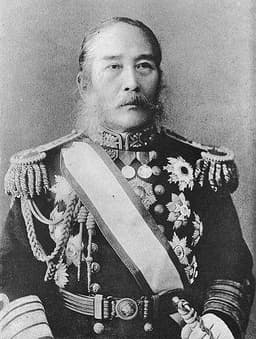
Enomoto Takeaki
General · Modern
51.6Total
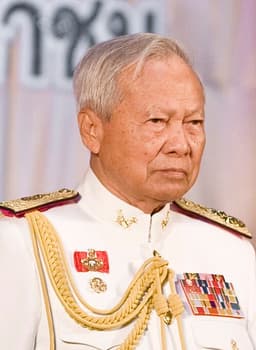
Prem Tinsulanonda
General · Modern
57.2Total
Basic Information
Born
1836
1920
Died
1908
—
Era
Modern
Modern
Nationality
Japan
Thailand
Occupation
General
General
Civilization
Eastern
Eastern
Score Comparison
Military (10%)
25.0
50.0
Political (20%)
54.7
59.3
Influence (20%)
54.1
54.9
Legacy (20%)
46.7
47.5
Leadership (15%)
68.0
78.0
Strategy (15%)
55.0
60.0
TOTAL
51.6
57.2
Enomoto Takeaki — Complete Timeline
1868 AD
Led the Shogunate Fleet to HokkaidoWar
Enomoto commanded the shogunate's remaining naval forces, including eight warships, and sailed to Hokkaido. This fleet formed the core of the Republic of Ezo's military and allowed the loyalists to establish a base.
Naval CommandBoshin WarShogunate Loyalist
Impact: regional
Founded the Republic of EzoPolitical Action
After the shogunate's defeat, Enomoto led loyalist forces to Hokkaido and established the Republic of Ezo, an independent state with a Western-style government. He was elected president and organized a defense against imperial forces.
Boshin WarSeparatist StateShogunate Loyalist
Impact: national
1869 AD
Surrendered at the Battle of HakodateWar◆ Major
Enomoto's forces were defeated by the imperial army at the Battle of Hakodate. He surrendered the Republic of Ezo and was taken prisoner, ending the last organized resistance to the Meiji Restoration.
Boshin WarDefeatEnd of Resistance
Impact: nationaltragic
1885 AD
Served as Minister of Foreign Affairs in the Meiji GovernmentPolitical Action◆ Major
After being pardoned, Enomoto served as Japan's Minister of Foreign Affairs. He negotiated treaties with Western powers and worked to revise the unequal treaties imposed on Japan, contributing to Japan's diplomatic modernization.
DiplomacyTreaty RevisionMeiji Government
Impact: nationalconstructive
Prem Tinsulanonda — Complete Timeline
1980 AD
Appointed Prime Minister after a coupPolitical Action◆ Major
Prem Tinsulanonda was appointed Prime Minister of Thailand by the military after a coup. He served for over eight years, overseeing a period of political stability and economic growth.
Prime MinisterMilitary RuleStability
Impact: national
1981 AD
Survived a coup attemptPolitical Action◆ Major
Prem survived a coup attempt by military officers loyal to the 'Young Turks' faction. The coup failed due to lack of support and the loyalty of key military units, allowing Prem to remain in power.
Coup AttemptPolitical CrisisMilitary
Impact: national
1988 AD
Resigned as Prime MinisterPolitical Action◆ Major
Prem resigned as Prime Minister after the general election, handing over power to a civilian government led by Chatichai Choonhavan. His resignation marked a rare peaceful transition of power in Thai politics.
ResignationDemocratic TransitionPeaceful
Impact: nationalconstructive
2016 AD
Appointed Regent of ThailandPolitical Action
After the death of King Bhumibol, Prem was appointed Regent of Thailand until the ascension of King Maha Vajiralongkorn. He served as a key figure in the transition of the monarchy.
RegentMonarchyTransition
Impact: national
Expert Analysis
Prem Tinsulanonda vs Enomoto Takeaki
### The General Who Bridged Two Worlds
On a sweltering Bangkok morning in 1981, Prime Minister Prem Tinsulanonda sat in his office, calmly reviewing documents as tanks rumbled toward the capital. A coup was underway. Across the Pacific, in the frozen winter of 1869, another general—Enomoto Takeaki—stood on the ramparts of Hakodate, watching imperial troops close in on his last stronghold. Both men were soldiers who became statesmen. Both faced moments when their worlds collapsed around them. Yet one surrendered and later served the victors; the other survived to become a kingmaker. What drove these divergent paths? The answer lies not in their times alone, but in the quiet calculus of character, circumstance, and the strange mercy of defeat.
### Origins
Prem Tinsulanonda was born in 1920 in Songkhla, a quiet southern province of Siam—the kingdom that had never been colonized. His father was a schoolteacher, his mother a homemaker. The young Prem grew up in a world where loyalty to the monarchy was as natural as breathing. He entered military academy at sixteen, just as Thailand’s absolute monarchy gave way to constitutional rule. Prem learned to navigate not battlefields but the space between barracks and throne rooms.
Enomoto Takeaki’s world was far more turbulent. Born in 1836 in Edo, he was a child of the samurai class when Japan’s feudal order was cracking. He studied Dutch naval science, mastering Western technology while his country faced the black ships of Commodore Perry. By his twenties, Enomoto had seen his shogun, the military ruler who had governed Japan for centuries, challenged by reformers who wanted to restore the emperor. He was not merely a samurai; he was a man caught between two eras, forced to choose a side.
### Rise to Power
Prem’s ascent was slow, deliberate, and bloodless. He rose through the ranks of the Thai army, never commanding troops in war, but becoming known for his integrity and his ties to the palace. In 1980, after a coup ousted the civilian government, the military turned to Prem as a compromise figure—a general who could calm the streets without crushing them. He was appointed prime minister at sixty, a man who had spent decades waiting for a moment he never sought.
Enomoto’s rise was faster and more desperate. In 1868, when the shogunate collapsed, he chose defiance. He gathered eight warships and three thousand loyalists, sailing north to the island of Hokkaido. There, in a freezing harbor, he founded the Republic of Ezo—the first independent state in modern Japanese history. It was a stunning act of ambition: a samurai declaring a republic, complete with a constitution and elections. But it was also a gamble born of desperation, a last stand against a tide he could not stop.
### Leadership & Governance
As prime minister from 1980 to 1988, Prem governed not by decree but by balance. He was a master of what Thais call *khlum*—a quiet, almost invisible control. He survived the 1981 coup attempt not by fighting, but by waiting. When rebel tanks surrounded Bangkok, Prem simply stayed in his office, and the king—King Bhumibol Adulyadej—stepped in, ordering the rebels to stand down. Prem understood that his power came not from the gun but from his proximity to the throne. He handed over power peacefully after elections in 1988, a rare act in a coup-prone country.
Enomoto’s rule in Ezo was a different story. He led a government of ex-samurai and farmers, trying to build a Western-style republic while fighting a war. His strategy was sound: fortify Hakodate, secure the straits, and negotiate with foreign powers. But his political wisdom was overshadowed by his military inexperience. The imperial army, better equipped and more disciplined, crushed his forces at the Battle of Hakodate in 1869. Enomoto surrendered, his republic lasting less than a year.
### Triumph & Tragedy
Prem’s greatest moment came not in victory but in departure. By resigning in 1988, he allowed Thailand’s first fully elected government in years to take power. His tragedy was quieter: he lived long enough to see military coups return, and his own role as a behind-the-scenes power broker drew criticism. Yet when he died in 2019 at ninety-eight, he was mourned as a statesman who kept Thailand stable during the Cold War.
Enomoto’s triumph was his survival. After surrendering, he was imprisoned briefly, then pardoned. He joined the very government he had fought against, becoming Japan’s Minister of Foreign Affairs in 1885. He negotiated treaties with Western powers, helping Japan become a modern nation. His tragedy was that he never fully escaped the shadow of defeat—a samurai who had surrendered, a rebel who served his conquerors.
### Character & Destiny
Prem was a man of patience and silence. He once said, “A leader must be like a lotus—rooted in mud, but blooming above the water.” His character was shaped by a culture that valued harmony over confrontation. He never sought glory, only stability. In contrast, Enomoto was a man of action and pride. His decision to found the Republic of Ezo was both noble and reckless—a samurai’s last stand. But his willingness to later serve the Meiji government showed a pragmatism that Prem never needed to learn. One man’s destiny was to hold the center; the other’s was to fall and rise again.
### Legacy
Today, Prem is remembered as the “silent general” who kept Thailand’s democracy on life support. His legacy is mixed: admired for stability, criticized for enabling military influence. Enomoto is a more complex figure—a traitor to some, a hero to others. In Japan, he is taught as a symbol of resilience, a man who fought for a lost cause and then helped build the nation that defeated him.
### Conclusion
Standing at the end of their lives, both men might have recognized a strange kinship. Prem, who never fired a shot in anger, and Enomoto, who led a doomed rebellion, both understood that power is not about winning or losing—it is about what you do after. One held the line; the other crossed it. Together, they remind us that history’s most enduring leaders are not those who never fall, but those who find a way to stand again, no matter what side they once fought for.
Rankings
🥇
Prem TinsulanondaLeader
Mil: 50.0Pol: 59.3Inf: 54.9
57.2
🥈
Enomoto Takeaki
Mil: 25.0Pol: 54.7Inf: 54.1
51.6
+5.6 behind
How This Comparison Works
Algorithm
Each figure is scored on 6 dimensions (0—100 scale) based on structured historical data: Military (10%), Political (20%), Influence (20%), Legacy (20%), Leadership (15%), Strategy (15%). The weighted total produces the final ranking.
Data Sources
Scores are computed from structured sub-indicators in the database. Scale factors adjust for era (Ancient ×0.85, Modern ×1.0) and civilization size (Eastern ×1.05, Other ×0.80) to account for differences in population and military scale.
Maximum 3 Figures
Comparisons are limited to 2—3 figures to ensure readability and statistical meaningfulness.
Error Margins
±5 points per dimension — Sub-scores are derived from historical records with inherent uncertainty. Two figures within 5 points on a dimension should be considered roughly equivalent in that area.
Total Score Accuracy
±3 points overall — The weighted combination of 6 dimensions produces a total score with approximately ±3 points of uncertainty. Differences of less than 3 points are not statistically significant— the figures are effectively tied.
Known Limitations
- Historical records are incomplete and uneven across civilizations
- Figures from oral-tradition societies may be underrepresented
- Occupation labels can misclassify multi-role figures
- Scores measure capability and impact, not moral character
- Quantitative scoring is a comparison tool, not absolute truth
Capability Radar
Military (10%) — Battles & Warfare
Battles
40
20
Win Rate
35
25
Expansion
30
10
Political (20%) — Governance & Reform
Reform
30
55
Diplomacy
40
60
Economy
25
50
Influence (20%) — Cultural & Global Reach
Cultural
25
30
Global
20
30
Legacy (20%) — Historical Impact
Historical
40
40
Longevity
30
35
Leadership (15%) — Power & Stability
Tenure
35
65
Stability
20
60
Strategy (15%) — Tactics & Innovation
Strategy
50
30
Tactics
55
30
Reform
45
35
Similar Comparisons
Comments & Discussion
No comments yet. Be the first to share your thoughts!