Loading...
Enomoto Takeaki vs Napoleon Bonaparte
Napoleon Bonaparte leads by 19.3 pts · 2 figures compared
…
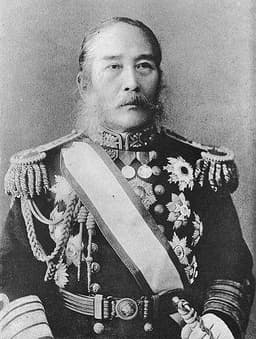
Enomoto Takeaki
General · Modern
51.6Total

Napoleon Bonaparte
General · Modern
70.9Total
Basic Information
Born
1836
1769
Died
1908
1821
Era
Modern
Modern
Nationality
Japan
France
Occupation
General
General
Civilization
Eastern
Western
Score Comparison
Military (10%)
25.0
94.0
Political (20%)
54.7
72.0
Influence (20%)
54.1
40.0
Legacy (20%)
46.7
80.0
Leadership (15%)
68.0
78.0
Strategy (15%)
55.0
90.0
TOTAL
51.6
70.9
Enomoto Takeaki — Complete Timeline
1868 AD
Led the Shogunate Fleet to HokkaidoWar
Enomoto commanded the shogunate's remaining naval forces, including eight warships, and sailed to Hokkaido. This fleet formed the core of the Republic of Ezo's military and allowed the loyalists to establish a base.
Naval CommandBoshin WarShogunate Loyalist
Impact: regional
Founded the Republic of EzoPolitical Action
After the shogunate's defeat, Enomoto led loyalist forces to Hokkaido and established the Republic of Ezo, an independent state with a Western-style government. He was elected president and organized a defense against imperial forces.
Boshin WarSeparatist StateShogunate Loyalist
Impact: national
1869 AD
Surrendered at the Battle of HakodateWar◆ Major
Enomoto's forces were defeated by the imperial army at the Battle of Hakodate. He surrendered the Republic of Ezo and was taken prisoner, ending the last organized resistance to the Meiji Restoration.
Boshin WarDefeatEnd of Resistance
Impact: nationaltragic
1885 AD
Served as Minister of Foreign Affairs in the Meiji GovernmentPolitical Action◆ Major
After being pardoned, Enomoto served as Japan's Minister of Foreign Affairs. He negotiated treaties with Western powers and worked to revise the unequal treaties imposed on Japan, contributing to Japan's diplomatic modernization.
DiplomacyTreaty RevisionMeiji Government
Impact: nationalconstructive
Napoleon Bonaparte — Complete Timeline
1799 AD
Coup of 18 BrumaireOther◆ Major
Napoleon Bonaparte, with support from his brother Lucien and key political figures, overthrew the Directory in a bloodless coup. He established the Consulate with himself as First Consul, effectively becoming the ruler of France. This event ended the French Revolution's most unstable period.
French RevolutionCoupRise to Power
Impact: regional
1804 AD
Promulgation of the Napoleonic CodeOther◆ Major
Napoleon enacted the Civil Code of the French, known as the Napoleonic Code, a comprehensive set of laws that replaced the fragmented feudal legal systems. The code established legal equality, protected property rights, and secularized law. It became the basis for legal systems in many European and world countries.
Legal ReformNapoleonic CodeCivil Law
Impact: globalconstructive
1805 AD
Battle of AusterlitzWar◆ Major
Napoleon's Grande Arm
Napoleonic WarsBattleDecisive Victory
Impact: global
1812 AD
Invasion of RussiaWar◆ Major
Napoleon led the Grande Arm
Napoleonic WarsInvasionDisaster
Impact: globaldestructive
1815 AD
Battle of WaterlooWar◆ Major
Napoleon's French army was defeated by the combined forces of the Duke of Wellington's Anglo-Allied army and Gebhard Leberecht von Bl
Napoleonic WarsBattleFinal Defeat
Impact: globaldestructive
Expert Analysis
enomoto-takeaki-vs-napoleon-bonaparte
# The Emperor and the Admiral
On a rain-soaked June evening in 1815, Napoleon Bonaparte stood on a muddy ridge near Waterloo, watching his dreams of empire dissolve into the Belgian twilight. Half a century later and half a world away, on the northern island of Hokkaido, another defeated commander—Enomoto Takeaki—bowed before his conquerors, handing over the sword of a republic that had lasted barely a year. Two men, two endings, two vastly different afterlives. Why did one become a titan of Western history while the other became a footnote in the East? The answer lies not merely in their talents, but in the worlds that shaped them.
Origins
Napoleon was born in 1769 on Corsica, an island that had just passed from Genoese to French control. His family were minor nobility, but they were poor—poor enough that young Napoleone Buonaparte (he later changed the spelling) spoke French with a thick Italian accent and was mocked by his classmates at military school. He was an outsider who burned to prove himself. France in the 1780s was a powder keg of revolution, a society tearing down old hierarchies and creating opportunities for ambitious men. Napoleon’s Corsican ferocity met the French Revolution’s chaos, and the match was explosive.
Enomoto Takeaki was born in 1836 into a samurai family of the Tokugawa shogunate—a rigid feudal order that had ruled Japan for 250 years. His world was one of prescribed duties, hereditary status, and the sword. But by his youth, that world was cracking. American warships under Commodore Perry had forced Japan open in 1853, and the shogunate’s authority was crumbling. Enomoto studied Dutch naval science, learned Western shipbuilding, and became a modern-minded officer in a dying regime. He was not an outsider like Napoleon—he was the loyal servant of a sinking ship.
Rise to Power
Napoleon’s ascent was meteoric. At 24, he drove the British out of Toulon and was promoted to brigadier general. By 26, he was commanding the Army of Italy, where he defeated larger Austrian forces with breathtaking speed. His 1798 Egyptian campaign was a disaster strategically, but he managed to present it as a triumph of civilization. In 1799, he returned to a France desperate for order and staged a coup, making himself First Consul. By 1804, he crowned himself Emperor. He had gone from Corsican nobody to master of Europe in fifteen years.
Enomoto’s rise was slower and more tragic. In 1868, the Boshin War erupted between the shogunate and the imperial restoration forces. Enomoto commanded the shogunate’s fleet, but his side was losing. Rather than surrender, he gathered eight warships and 2,000 loyalists and sailed north to Hokkaido, the wild frontier island. There, in December 1868, he founded the Republic of Ezo—the first republic in Japanese history. It was a desperate gamble, a samurai’s last stand dressed in Western political clothes.
Leadership & Governance
Napoleon ruled Europe with a blend of terror and reform. He placed his brothers on thrones, redrew borders, and demanded loyalty. But he also gave France the Napoleonic Code—a legal system based on merit, property rights, and secular law that influenced civil codes from Brazil to Egypt. He centralized education, built roads, and stabilized the currency. His military genius was undeniable: he won 60 battles and lost only 7, with a strategy rating of 93.0. Yet his political score of 75.0 reflects the fatal flaw—he could conquer, but he could not consolidate. He treated allies as vassals and enemies as future conquests, creating a coalition that eventually crushed him.
Enomoto governed the Ezo Republic differently. He was elected president by his men—a remarkable act for a samurai. He attempted to negotiate with the imperial government, offering to develop Hokkaido as a loyal frontier. His leadership score of 84.7 suggests he inspired genuine devotion. But his republic was tiny, isolated, and outmatched. When the imperial army arrived in 1869, Enomoto’s forces held out for months at the Battle of Hakodate, but winter and superior numbers forced surrender. He gave up his sword, expecting execution.
Triumph & Tragedy
Napoleon’s greatest triumph was Austerlitz in 1805, where he crushed the Russian and Austrian armies in a single day. His greatest tragedy was the 1812 invasion of Russia—600,000 men marched east; fewer than 100,000 returned. He never recovered. Exiled to Elba, he escaped and ruled France for 100 days, only to fall at Waterloo. His final exile on Saint Helena was a slow death of boredom and cancer, alone on a remote island.
Enomoto’s triumph was not military—his military score is a modest 28.1—but moral. He surrendered honorably, and the imperial government, surprisingly, pardoned him. By 1885, he had become Japan’s Minister of Foreign Affairs, negotiating treaties with Western powers on equal terms. He helped build the modern Japan that would defeat Russia in 1905. His tragedy was that he fought for a lost cause, but his redemption was that he lived to serve the nation that defeated him.
Character & Destiny
Napoleon was a man of boundless ambition and restless energy. He once said, “I love power as a musician loves his violin.” He could work 18 hours a day, dictate letters to four secretaries simultaneously, and sleep anywhere. But his ego was his undoing. He refused to share power, refused to compromise, and refused to stop until the world said no. His destiny was to be the man who reshaped Europe and then was crushed by it.
Enomoto was a man of duty and adaptability. He was a samurai who learned from the West, a rebel who became a minister. He understood that survival required change. When the shogunate fell, he did not commit seppuku—he surrendered and waited. When the Meiji government needed skilled diplomats, he served. His destiny was to be a bridge between old Japan and new, a man who lost the battle but won the peace.
Legacy
Napoleon’s legacy is monumental. The Napoleonic Code governs much of the world. His military tactics are still studied. His name is synonymous with ambition and empire. His total score of 82.4 reflects his immense impact, even if his political failures keep him from perfection. He is remembered as a genius who overreached.
Enomoto’s legacy is quieter but profound. He is honored in Japan as a figure of loyalty and pragmatism. The Republic of Ezo is a footnote, but his later service as Foreign Minister helped Japan enter the modern world. His total score of 68.8 understates his influence—he helped shape a nation that would become a global power.
Conclusion
Napoleon and Enomoto faced the same fundamental question: when your world collapses, what do you do? Napoleon answered: fight, conquer, burn brighter than anyone. Enomoto answered: adapt, serve, and survive. One became a legend; the other became a statesman. Neither was wrong. The difference was not in their abilities, but in the worlds they inhabited. Napoleon’s Europe rewarded glory; Enomoto’s Japan rewarded resilience. In the end, both men taught the same lesson: history does not judge the defeated by their defeats, but by what they do afterward.
Rankings
🥇
Napoleon BonaparteLeader
Mil: 94.0Pol: 72.0Inf: 40.0
70.9
🥈
Enomoto Takeaki
Mil: 25.0Pol: 54.7Inf: 54.1
51.6
+19.3 behind
How This Comparison Works
Algorithm
Each figure is scored on 6 dimensions (0—100 scale) based on structured historical data: Military (10%), Political (20%), Influence (20%), Legacy (20%), Leadership (15%), Strategy (15%). The weighted total produces the final ranking.
Data Sources
Scores are computed from structured sub-indicators in the database. Scale factors adjust for era (Ancient ×0.85, Modern ×1.0) and civilization size (Eastern ×1.05, Other ×0.80) to account for differences in population and military scale.
Maximum 3 Figures
Comparisons are limited to 2—3 figures to ensure readability and statistical meaningfulness.
Error Margins
±5 points per dimension — Sub-scores are derived from historical records with inherent uncertainty. Two figures within 5 points on a dimension should be considered roughly equivalent in that area.
Total Score Accuracy
±3 points overall — The weighted combination of 6 dimensions produces a total score with approximately ±3 points of uncertainty. Differences of less than 3 points are not statistically significant— the figures are effectively tied.
Known Limitations
- Historical records are incomplete and uneven across civilizations
- Figures from oral-tradition societies may be underrepresented
- Occupation labels can misclassify multi-role figures
- Scores measure capability and impact, not moral character
- Quantitative scoring is a comparison tool, not absolute truth
Capability Radar
Military (10%) — Battles & Warfare
Battles
40
95
Win Rate
35
90
Expansion
30
95
Political (20%) — Governance & Reform
Reform
30
95
Diplomacy
40
80
Economy
25
85
Influence (20%) — Cultural & Global Reach
Cultural
25
85
Global
20
90
Legacy (20%) — Historical Impact
Historical
40
95
Longevity
30
90
Leadership (15%) — Power & Stability
Tenure
35
85
Stability
20
70
Strategy (15%) — Tactics & Innovation
Strategy
50
95
Tactics
55
98
Reform
45
92
Similar Comparisons
Comments & Discussion
BONAPARTE'S GHOST6/17/2026
Let's be honest: comparing Napoleon to Enomoto is like comparing a supernova to a candle. Napoleon rewrote the map of Europe, codified laws still used today, and spawned a cult of personality that defines modern leadership. Enomoto? He held a remote Japanese island for a year before bowing out gracefully. He's a footnote because he made no systemic impact. Napoleon's failures were epic; Enomoto's successes were microscopic.|zh|把拿破仑和榎本武扬放在一起比,就像拿泰山比土丘。拿破仑打烂了半个欧洲的旧秩序,留下《法典》和现代军队架构,死后还有狂热崇拜。榎本武扬呢?在