Loading...
Afonso de Albuquerque vs Enomoto Takeaki
Afonso de Albuquerque leads by 28.0 pts · 2 figures compared
…
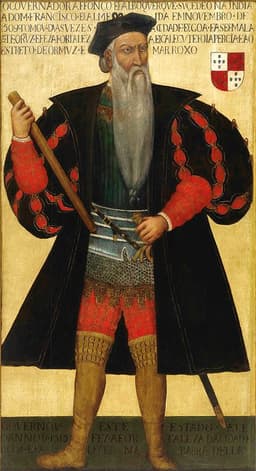
Afonso de Albuquerque
General · Medieval
79.6Total
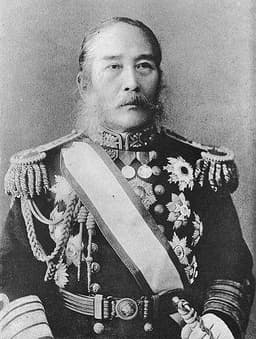
Enomoto Takeaki
General · Modern
51.6Total
Basic Information
Born
1453
1836
Died
1515
1908
Era
Medieval
Modern
Nationality
Portugal
Japan
Occupation
General
General
Civilization
Western
Eastern
Score Comparison
Military (10%)
77.5
25.0
Political (20%)
88.0
54.7
Influence (20%)
80.0
54.1
Legacy (20%)
75.0
46.7
Leadership (15%)
78.0
68.0
Strategy (15%)
82.0
55.0
TOTAL
79.6
51.6
Afonso de Albuquerque — Complete Timeline
1503 AD
First voyage to IndiaWar◆ Major
Afonso de Albuquerque led a fleet to India, establishing the first Portuguese fort at Cochin. This voyage laid the foundation for Portuguese control of the Indian Ocean trade.
ExplorationColonialismIndia
Impact: global
1510 AD
Conquest of GoaWar◆ Major
Albuquerque captured Goa from the Sultan of Bijapur. He made Goa the capital of Portuguese India, a position it held for over 400 years.
ConquestColonialismIndia
Impact: regional
1511 AD
Conquest of MalaccaWar◆ Major
Albuquerque led a Portuguese fleet to capture the strategic port of Malacca. This gave Portugal control of the spice trade route between the Indian Ocean and the Pacific.
ConquestSpice TradeSoutheast Asia
Impact: global
1513 AD
Siege of AdenWar
Albuquerque attempted to capture Aden in Yemen but failed. This failure prevented Portugal from controlling the entrance to the Red Sea and limited their influence in the region.
SiegeFailureRed Sea
Impact: regional
1515 AD
Death at seaOther◆ Major
Afonso de Albuquerque died at sea off the coast of Goa, possibly from illness or poison. His death left the Portuguese Empire in the Indian Ocean without its most capable leader.
DeathLeadershipEmpire
Impact: regionaltragic
Enomoto Takeaki — Complete Timeline
1868 AD
Led the Shogunate Fleet to HokkaidoWar
Enomoto commanded the shogunate's remaining naval forces, including eight warships, and sailed to Hokkaido. This fleet formed the core of the Republic of Ezo's military and allowed the loyalists to establish a base.
Naval CommandBoshin WarShogunate Loyalist
Impact: regional
Founded the Republic of EzoPolitical Action
After the shogunate's defeat, Enomoto led loyalist forces to Hokkaido and established the Republic of Ezo, an independent state with a Western-style government. He was elected president and organized a defense against imperial forces.
Boshin WarSeparatist StateShogunate Loyalist
Impact: national
1869 AD
Surrendered at the Battle of HakodateWar◆ Major
Enomoto's forces were defeated by the imperial army at the Battle of Hakodate. He surrendered the Republic of Ezo and was taken prisoner, ending the last organized resistance to the Meiji Restoration.
Boshin WarDefeatEnd of Resistance
Impact: nationaltragic
1885 AD
Served as Minister of Foreign Affairs in the Meiji GovernmentPolitical Action◆ Major
After being pardoned, Enomoto served as Japan's Minister of Foreign Affairs. He negotiated treaties with Western powers and worked to revise the unequal treaties imposed on Japan, contributing to Japan's diplomatic modernization.
DiplomacyTreaty RevisionMeiji Government
Impact: nationalconstructive
Expert Analysis
Afonso de Albuquerque vs Enomoto Takeaki
# The Admiral and the Admiral: Two Paths of Empire
On a December morning in 1515, a Portuguese fleet lay at anchor off the coast of Goa, its commander dying in his cabin. Afonso de Albuquerque, the man who had built an empire from the deck of a ship, dictated his final letter to the king: a plea not to abandon the eastern enterprise he had spent two decades constructing. Four centuries later, on another December morning in 1868, a Japanese admiral named Enomoto Takeaki stood on the deck of a captured warship, watching the snow-covered peaks of Hokkaido rise from the sea. Behind him lay the ruins of the Tokugawa shogunate; ahead, an impossible dream: a republic in the northern wilderness. Both men were naval commanders. Both sought to build something new in distant lands. But where Albuquerque carved an empire that would outlast him by centuries, Enomoto built a state that lasted barely a year. The difference was not in their courage, but in the tides of history that carried them.
Origins
Afonso de Albuquerque was born in 1453 at Alhandra, near Lisbon, into the fierce, pious world of Portugal’s maritime nobility. His father was a lord, his uncle a crusader against North African Muslims. The young Albuquerque learned the art of war in the Moroccan campaigns, where Portuguese knights fought with the same religious zeal that had driven the Reconquista. When he first sailed for India in 1503, at age fifty, he carried not just cannons and carracks, but a worldview forged in centuries of Christian expansion: the world was a battlefield, and Portugal was God’s chosen instrument.
Enomoto Takeaki was born in 1836 in Edo, into a samurai family serving the Tokugawa shogunate. His Japan was a world in crisis: American warships had shattered the country’s isolation in 1853, and the old order was crumbling. Unlike Albuquerque, who inherited a confident, expanding civilization, Enomoto inherited a nation in the grip of a violent identity crisis. He studied Dutch naval science, learned Western shipbuilding, and rose to command the shogun’s fleet. But his loyalty was not to Japan in the abstract—it was to the Tokugawa house that had ruled for 250 years. When that house fell, his world collapsed with it.
Rise to Power
Albuquerque’s path to power was forged in blood and salt. In 1503, he led a fleet to India and built the first Portuguese fort at Cochin, a toehold on a continent the Portuguese barely understood. But his true rise began in 1509, when King Manuel I appointed him Governor of Portuguese India. Albuquerque was not a courtier; he was a commander who believed that speed and surprise could overcome any odds. In 1510, he captured Goa from the Sultan of Bijapur in a daring assault, then held it against a counter-siege so desperate that he reportedly burned his own ships to prevent desertion. Goa became the capital of Portuguese India, a fortress-city that would remain Portuguese for 450 years.
Enomoto’s rise was a story of loyalty turned to rebellion. In 1868, the Boshin War erupted between the imperial forces and the Tokugawa shogunate. Enomoto commanded the shogun’s navy, but the shogun’s cause was lost. Rather than surrender, he gathered eight warships and 2,500 loyalists and sailed north to Hokkaido, the wild, sparsely-settled northern island. There, in December 1868, he founded the Republic of Ezo, an independent state with a democratically-elected president—himself. It was a bizarre hybrid: a samurai republic, a feudal democracy, a last stand of the old order using the tools of the new.
Leadership & Governance
Albuquerque governed as a conqueror who understood that empire required more than force. He encouraged Portuguese men to marry Indian women, granted lands to loyal soldiers, and built hospitals and churches. He reformed the administration of trade, establishing a system of passes and licenses that made Portugal the gatekeeper of the spice routes. His military genius was strategic: he captured Malacca in 1511, seizing the choke point of Southeast Asian trade, and then sent envoys to Siam, Burma, and China. He dreamed of diverting the Nile to starve Egypt, and of capturing Aden to control the Red Sea. He failed at Aden in 1513, but his vision of a Portuguese Indian Ocean empire was already reality.
Enomoto governed as a pragmatist in a desperate situation. The Republic of Ezo was a miracle of improvisation: it minted coins, printed a newspaper, and even held elections. But it was also a samurai state, with feudal hierarchies intact, and its economy depended on trade with the very imperial forces that sought its destruction. Enomoto’s leadership was gentle compared to Albuquerque’s iron hand; he sought negotiation over annihilation, and when the imperial army finally landed in 1869, he fought a defensive war that could only end one way.
Triumph & Tragedy
Albuquerque’s greatest triumph was the conquest of Malacca in 1511. With a fleet of eighteen ships and 1,200 men, he stormed the richest port in Asia, breaking the Muslim trading network that had dominated the Indian Ocean for centuries. Malacca gave Portugal control of the spice trade, and Albuquerque wrote to his king: “I have taken this city, and with it the keys to all the East.” His greatest tragedy came at Aden in 1513, where he failed to capture the fortress that guarded the Red Sea. That failure meant the Red Sea remained open to Muslim shipping, and the Portuguese dream of a closed Indian Ocean died with him.
Enomoto’s triumph was the Republic of Ezo itself—a brief, brilliant experiment in samurai self-government. His tragedy was the Battle of Hakodate in June 1869, where his outnumbered forces were crushed by the imperial army. He surrendered, expecting execution. Instead, he was pardoned—a sign of the Meiji government’s surprising mercy. But the Republic of Ezo vanished, and with it the last hope of Tokugawa restoration.
Character & Destiny
Albuquerque was a man of extremes: ruthless in war, visionary in peace, and utterly convinced of his divine mission. He wrote to King Manuel: “If I had not done what I did, the Portuguese name would have perished in India.” His character drove him to build an empire through sheer will, but also to make enemies at court who undermined him. He died at sea, possibly poisoned, believing his king had abandoned him. His destiny was to be the architect of a global empire, but also its martyr.
Enomoto was a man of contradictions: a samurai who embraced democracy, a rebel who became a minister, a loser who won. His character was flexible where Albuquerque’s was rigid. When he surrendered, he did not commit seppuku; he lived to serve the emperor who had defeated him. By 1885, he was Japan’s Minister of Foreign Affairs, negotiating treaties with the Western powers he had once fought. His destiny was to be a bridge between the old Japan and the new.
Legacy
Albuquerque’s legacy is the Portuguese Empire in Asia, which lasted until 1961. Goa, Malacca, and the spice routes all bear his mark. He is remembered as a conqueror, but also as a founder: the man who gave Portugal an eastern empire that made it a world power for centuries. His tomb in Lisbon reads: “Here lies the Great Albuquerque, who conquered India for Portugal.”
Enomoto’s legacy is more complex. In Japan, he is remembered as a tragic figure, a loyalist who fought for a lost cause, but also as a statesman who helped modernize his nation. The Republic of Ezo is a footnote, but a fascinating one: proof that even in defeat, the samurai spirit could adapt to new ideas. His scores reflect this: high in leadership (84.7) and political skill (72.4), but low in military achievement (28.1)—a commander who lost his war but won a place in history.
Conclusion
What drove these two men to such different outcomes? The answer lies not in their characters alone, but in the currents of their times. Albuquerque rode the wave of European expansion, a tide that would lift Portugal for centuries. Enomoto fought against the tide of Japanese unification, a wave that would sweep away everything he loved. One built an empire that lasted; the other built a republic that vanished. Yet both understood something profound: that history belongs not to those who win, but to those who dare. Albuquerque wrote his name in stone; Enomoto wrote his in water. Both names remain.
Rankings
🥇
Afonso de AlbuquerqueLeader
Mil: 77.5Pol: 88.0Inf: 80.0
79.6
🥈
Enomoto Takeaki
Mil: 25.0Pol: 54.7Inf: 54.1
51.6
+28.0 behind
How This Comparison Works
Algorithm
Each figure is scored on 6 dimensions (0—100 scale) based on structured historical data: Military (10%), Political (20%), Influence (20%), Legacy (20%), Leadership (15%), Strategy (15%). The weighted total produces the final ranking.
Data Sources
Scores are computed from structured sub-indicators in the database. Scale factors adjust for era (Ancient ×0.85, Modern ×1.0) and civilization size (Eastern ×1.05, Other ×0.80) to account for differences in population and military scale.
Maximum 3 Figures
Comparisons are limited to 2—3 figures to ensure readability and statistical meaningfulness.
Error Margins
±5 points per dimension — Sub-scores are derived from historical records with inherent uncertainty. Two figures within 5 points on a dimension should be considered roughly equivalent in that area.
Total Score Accuracy
±3 points overall — The weighted combination of 6 dimensions produces a total score with approximately ±3 points of uncertainty. Differences of less than 3 points are not statistically significant— the figures are effectively tied.
Known Limitations
- Historical records are incomplete and uneven across civilizations
- Figures from oral-tradition societies may be underrepresented
- Occupation labels can misclassify multi-role figures
- Scores measure capability and impact, not moral character
- Quantitative scoring is a comparison tool, not absolute truth
Capability Radar
Military (10%) — Battles & Warfare
Battles
85
40
Win Rate
80
35
Expansion
95
30
Political (20%) — Governance & Reform
Reform
80
30
Diplomacy
85
40
Economy
80
25
Influence (20%) — Cultural & Global Reach
Cultural
70
25
Global
85
20
Legacy (20%) — Historical Impact
Historical
85
40
Longevity
80
30
Leadership (15%) — Power & Stability
Tenure
70
35
Stability
65
20
Strategy (15%) — Tactics & Innovation
Strategy
95
50
Tactics
90
55
Reform
75
45
Similar Comparisons
Comments & Discussion
Cannonball Chronicler6/16/2026
Albuquerque’s real genius wasn’t just violence—it was bureaucracy. He built the Estado da Índia with fortresses, mixed marriages, and a postal system, making his empire run while he fought. Enomoto, for all his ships, couldn’t anchor a state because he copied Western forms without Western backing. In the age of sail, a lone republic is just a pirate base. History remembers the builder, not the dreamer.
海魂翻译官6/16/2026
把阿布克尔克和榎本武扬放在一起比,就像拿火药和纸灯笼对照。前者在1510年用屠城果阿立威,娶印度寡妇、铸本地铜币,生生把印度洋拧成葡萄牙的池塘。后者拿着八艘蒸汽舰,却在箱馆搞议会选举——滑膛枪时代搞民主,活像穿和服开铁甲船。榎本想当亚洲华盛顿,可惜历史只给了他一年的玩具政权。
Siege Scholar6/16/2026
Context matters more than talent here. Albuquerque had the wind at his back—Portugal’s monopoly on Indian Ocean trade routes and papal backing gave him a blank check. Enomoto faced a rising, centralized Meiji state with telegraphs and conscripts. Even if his Hokkaido Republic had held, it would’ve been crushed by 1871 like the Paris Commune. Sometimes the best admiral is the one who reads the map, not the one who fights hardest.
太平洋浪人6/16/2026
两位都是海军将星,但阿布克尔克赢在狠辣的战略眼光:他烧了埃及舰队在红海的基地,掐断威尼斯商路的命脉,这比占几座城高明百倍。榎本却把精锐浪费在北海道种土豆,八舰联军打不过陆军的围剿。真正的海权不是抢块地种田,而是把海洋锁成自家的后花园——这点上葡萄牙老将赢了明治少将一整条航线。
Revisionist Rigger6/16/2026
Let’s not romanticize Albuquerque’s “empire.” He burned Calicut, enslaved locals, and forced conversions at sword-point. Enomoto at least tried a constitutional framework in Hakodate, with elected officials and land reform. One built a colonial machine that bled India for centuries; the other failed trying something novel. If we’re comparing legacies, I’d rather see a failed republic than a successful pirate kingdom.