Loading...
Empress Dowager Cixi vs Otto von Bismarck
Otto von Bismarck leads by 10.8 pts · 2 figures compared
…
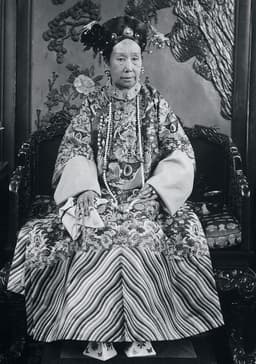
Empress Dowager Cixi
Politician · Modern
55.0Total
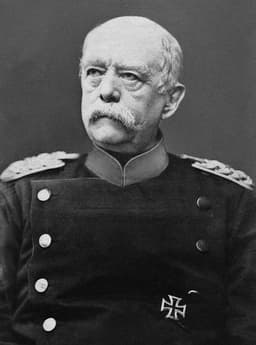
Otto von Bismarck
Politician · Modern
65.8Total
Basic Information
Born
1835
1815
Died
1908
1898
Era
Modern
Modern
Nationality
China
Germany
Occupation
Politician
Politician
Civilization
Eastern
Western
Score Comparison
Military (10%)
25.9
55.0
Political (20%)
53.8
85.0
Influence (20%)
58.3
82.0
Legacy (20%)
52.0
40.0
Leadership (15%)
72.0
80.0
Strategy (15%)
60.0
50.0
TOTAL
55.0
65.8
Empress Dowager Cixi — Complete Timeline
1861 AD
Self-Strengthening MovementReform◆ Major
Cixi supported the Self-Strengthening Movement, which modernized China's military and infrastructure. Arsenals, shipyards, and railways were built, and the Tongwen Guan language school was established. However, the movement avoided political reform, limiting its effectiveness.
Qing dynastyModernizationReform
Impact: nationalconstructive
Xinyou CoupPolitical Action
Cixi, with Prince Gong, staged a coup against the eight regents appointed by the dying Xianfeng Emperor. She had the regents arrested and executed, establishing herself as co-regent for the young Tongzhi Emperor. This began her effective control over the Qing government.
Qing dynastyCoupRegency
Impact: national
1898 AD
Hundred Days' Reform CoupPolitical Action◆ Major
Cixi staged a coup to end the Hundred Days' Reform, a series of modernization edicts by the Guangxu Emperor. She imprisoned the emperor, executed six reform leaders, and rescinded most reforms. This reversed political liberalization and strengthened conservative forces.
Qing dynastyReform suppressionCoup
Impact: nationaldestructive
1900 AD
Boxer RebellionWar◆ Major
Cixi declared war on eight foreign powers after the Boxers besieged foreign legations in Beijing. The Eight-Nation Alliance invaded, defeated Qing forces, and occupied Beijing. Cixi fled to Xi'an. The resulting Boxer Protocol imposed heavy reparations and further weakened the Qing.
Qing dynastyForeign interventionWar
Impact: globaldestructive
1901 AD
Late Qing ReformsReform◆ Major
After the Boxer Rebellion, Cixi initiated the Late Qing Reforms, including abolition of the civil service examination, establishment of modern schools, and military modernization. These reforms aimed to strengthen the dynasty but came too late to prevent its collapse.
Qing dynastyModernizationReform
Impact: nationalconstructive
Otto von Bismarck — Complete Timeline
1870 AD
Franco-Prussian WarWar
Bismarck provoked France into declaring war by editing the Ems Dispatch to appear insulting. The resulting conflict saw Prussia and its allies decisively defeat France, leading to the fall of Napoleon III, the capture of Paris, and the annexation of Alsace-Lorraine.
WarProvocationAnnexation
Impact: globaldestructive
1871 AD
Unification of Germany ProclaimedPolitical Action
Following the Franco-Prussian War, Bismarck orchestrated the proclamation of the German Empire in the Hall of Mirrors at Versailles. King Wilhelm I of Prussia was declared German Emperor, uniting the German states under Prussian leadership and establishing the Second Reich.
UnificationGerman EmpireNationalism
Impact: globalconstructive
1878 AD
Enactment of the Anti-Socialist LawsPolitical Action◆ Major
After two assassination attempts on Kaiser Wilhelm I, Bismarck pushed through laws banning socialist organizations, publications, and meetings. The laws remained in force until 1890, suppressing the Social Democratic Party while Bismarck simultaneously introduced welfare reforms to undercut its appeal.
RepressionSocialismWelfare State
Impact: nationaldestructive
Congress of BerlinPolitical Action◆ Major
Bismarck hosted the Congress of Berlin to revise the Treaty of San Stefano and resolve the Eastern Crisis. He acted as 'honest broker,' reducing Russian gains, granting independence to Romania, Serbia, and Montenegro, and placing Bosnia-Herzegovina under Austro-Hungarian administration.
DiplomacyBalkansBalance of Power
Impact: global
1883 AD
Establishment of the Welfare StateReform◆ Major
Bismarck introduced the Health Insurance Bill (1883), Accident Insurance Bill (1884), and Old Age and Disability Insurance Bill (1889). These laws created the first modern welfare state, providing workers with social security and aiming to reduce support for socialist movements.
Social ReformWelfareInsurance
Impact: globalprogressive
1890 AD
Dismissal as ChancellorPolitical Action◆ Major
Emperor Wilhelm II forced Bismarck to resign due to policy disagreements, particularly over anti-socialist laws and foreign policy. Bismarck's departure marked the end of an era, leading to a more aggressive German foreign policy and the eventual unraveling of his alliance system.
ResignationWilhelm IIPolicy Shift
Impact: global
Expert Analysis
Otto von Bismarck vs Empress Dowager Cixi
# The Iron Chancellor and the Dragon Lady
In the winter of 1890, two aging rulers faced very different fates. In Berlin, Otto von Bismarck, the architect of German unification, was summarily dismissed by a young emperor who had grown tired of his overbearing presence. He retreated to his estate at Friedrichsruh, a bitter old man watching his life's work slowly unravel. In Beijing, Empress Dowager Cixi, having just crushed the Hundred Days' Reform and imprisoned her own nephew, tightened her grip on the Dragon Throne. She would rule for another eighteen years, absolute until her final breath. One was forced out; the other never let go. What drove these two titans of the late nineteenth century down such different paths?
Origins
Otto von Bismarck was born in 1815 into the Junker aristocracy of Prussia, a class defined by land, military service, and an almost religious devotion to the monarchy. His father was a country squire; his mother came from a bourgeois intellectual family. Bismarck himself was a wild youth—a duelist, a drinker, a man who seemed destined for obscurity. But he possessed a mind of cold, calculating brilliance. He entered politics not out of idealism but because he saw it as the only arena worthy of his ambition.
Empress Dowager Cixi began life in 1835 as a daughter of a minor Manchu official. At sixteen, she entered the Forbidden City as a low-ranking concubine—one of thousands of women whose lives were measured in whispers and shadows. But she bore the Xianfeng Emperor a son, the only male heir. When the emperor died in 1861, she staged the Xinyou Coup against the eight regents appointed to rule for her six-year-old child. Within weeks, she had seized power. She was illiterate in her youth but possessed an instinct for power that no education could provide.
Rise to Power
Bismarck’s ascent was calculated and opportunistic. Appointed Minister President of Prussia in 1862, he famously declared that the great questions of the day would be decided not by speeches and majority resolutions—"but by blood and iron." He engineered three wars in seven years: against Denmark in 1864, Austria in 1866, and France in 1870. Each was meticulously provoked, ruthlessly executed, and brilliantly concluded. The Franco-Prussian War began when Bismarck edited the Ems Dispatch to make it appear that King Wilhelm I had insulted the French ambassador. France declared war; Prussia crushed her. In January 1871, in the Hall of Mirrors at Versailles, the German Empire was proclaimed. Bismarck had unified Germany from above, through force.
Cixi’s rise was more precarious. She could not command armies or declare war in her own name—she was a woman in a Confucian patriarchy. Instead, she ruled through proxies: first her son, then her nephew. She mastered the art of the coup. In 1898, when the Guangxu Emperor attempted the Hundred Days' Reform—a sweeping modernization program that threatened her power—she moved with devastating speed. She imprisoned the emperor, executed six reform leaders, and declared herself regent once more. Where Bismarck used armies, Cixi used eunuchs, palace intrigue, and the careful manipulation of faction.
Leadership & Governance
Bismarck governed with a philosophy he called "Realpolitik"—politics based on practical realities rather than ideology. He was a master of the European balance of power, hosting the Congress of Berlin in 1878 to settle the Eastern Crisis, acting as "honest broker" between the great powers. Domestically, he was both progressive and reactionary. He enacted the Anti-Socialist Laws in 1878, banning socialist organizations after assassination attempts on the Kaiser. But he also established the world's first modern welfare state—health insurance in 1883, accident insurance in 1884, old-age pensions in 1889. It was a strategy of "state socialism": give the workers enough to keep them from revolution.
Cixi’s governance was more defensive. She supported the Self-Strengthening Movement after 1861, building arsenals, shipyards, and a modern army. But she never allowed reform to threaten her authority. When the Boxer Rebellion erupted in 1900, she made a catastrophic miscalculation: she declared war on eight foreign powers simultaneously. The Eight-Nation Alliance marched on Beijing, and she fled the Forbidden City disguised as a peasant woman. After the humiliation, she belatedly embraced the Late Qing Reforms—abolishing the civil service examination, modernizing education, sending students abroad. But it was too little, too late.
Triumph & Tragedy
Bismarck’s greatest triumph was the unification of Germany—a nation that would dominate Europe for a century. His greatest tragedy was that he built a system that depended entirely on him. Wilhelm II, young and impetuous, dismissed him in 1890. Bismarck’s intricate alliances collapsed; his careful balance of powers unraveled. Germany careened toward Weltpolitik, naval rivalry with Britain, and eventually, the First World War. Bismarck had once warned: "Jena came twenty years after the death of Frederick the Great. The collapse will come twenty years after my departure." He was off by only four years.
Cixi’s tragedy was that she preserved her own power at the expense of her dynasty. She crushed the Hundred Days' Reform when it might have saved the Qing. She backed the Boxers, who brought foreign invasion. She died in 1908, just one day after the Guangxu Emperor—poisoned, many historians believe, on her orders. Three years later, the Qing dynasty fell. China descended into chaos. She had ruled for forty-seven years, but she left nothing behind but a broken empire.
Character & Destiny
Bismarck was a man of immense will and equally immense insecurity. He suffered from psychosomatic illnesses, insomnia, and bouts of weeping. He was paranoid, vindictive, and utterly convinced of his own superiority. Yet he also possessed a genius for knowing when to stop. After defeating Austria in 1866, he insisted on lenient terms, against the wishes of the Prussian military. He understood that a humiliated enemy would seek revenge. He was a man who could restrain himself—a quality his successors lacked.
Cixi was different. She was pragmatic but never principled. She could be generous to loyal officials and merciless to rivals. She loved luxury—the Forbidden City was filled with her peacocks, her precious stones, her elaborate gardens. But she also possessed a peasant’s toughness. When the foreign armies entered Beijing in 1900, she fled in a cart, eating millet porridge, sleeping in the dirt. She survived because she was willing to do anything to survive.
Legacy
Bismarck is remembered as the Iron Chancellor, the unifier of Germany, the father of the welfare state. His statue stands in cities across Germany. His name is synonymous with Realpolitik. But his legacy is deeply ambiguous. He created a Germany that was powerful but brittle, authoritarian at home and aggressive abroad. The welfare state he built survived; the political culture he fostered did not.
Cixi is remembered as a tyrant and a reactionary, the woman who let China fall behind while she clung to power. But recent scholarship has been more nuanced. She was a woman ruling in a world that denied women power; she had to be ruthless to survive. She did support modernization—just not the kind that would threaten her. Her tragedy was that she could not imagine a China without the Qing, and the Qing could not survive with her.
Conclusion
Bismarck and Cixi were both masters of power in an age of transformation. One built a nation; the other held an empire together. One was forced out; the other died in office. One’s creation lasted; the other’s collapsed. But both understood something that their successors did not: that power requires not just strength, but restraint. Bismarck knew when to stop. Cixi knew how to hold on. In the end, neither was enough. The forces they tried to control—nationalism, modernization, the demands of ordinary people—overwhelmed them both. They were giants, but they stood on ground that was already shifting beneath their feet.
Rankings
🥇
Otto von BismarckLeader
Mil: 55.0Pol: 85.0Inf: 82.0
65.8
🥈
Empress Dowager Cixi
Mil: 25.9Pol: 53.8Inf: 58.3
55.0
+10.8 behind
How This Comparison Works
Algorithm
Each figure is scored on 6 dimensions (0—100 scale) based on structured historical data: Military (10%), Political (20%), Influence (20%), Legacy (20%), Leadership (15%), Strategy (15%). The weighted total produces the final ranking.
Data Sources
Scores are computed from structured sub-indicators in the database. Scale factors adjust for era (Ancient ×0.85, Modern ×1.0) and civilization size (Eastern ×1.05, Other ×0.80) to account for differences in population and military scale.
Maximum 3 Figures
Comparisons are limited to 2—3 figures to ensure readability and statistical meaningfulness.
Error Margins
±5 points per dimension — Sub-scores are derived from historical records with inherent uncertainty. Two figures within 5 points on a dimension should be considered roughly equivalent in that area.
Total Score Accuracy
±3 points overall — The weighted combination of 6 dimensions produces a total score with approximately ±3 points of uncertainty. Differences of less than 3 points are not statistically significant— the figures are effectively tied.
Known Limitations
- Historical records are incomplete and uneven across civilizations
- Figures from oral-tradition societies may be underrepresented
- Occupation labels can misclassify multi-role figures
- Scores measure capability and impact, not moral character
- Quantitative scoring is a comparison tool, not absolute truth
Capability Radar
Military (10%) — Battles & Warfare
Battles
30
60
Win Rate
25
70
Expansion
15
80
Political (20%) — Governance & Reform
Reform
65
90
Diplomacy
60
95
Economy
50
80
Influence (20%) — Cultural & Global Reach
Cultural
60
65
Global
60
75
Legacy (20%) — Historical Impact
Historical
75
85
Longevity
55
70
Leadership (15%) — Power & Stability
Tenure
85
85
Stability
40
70
Strategy (15%) — Tactics & Innovation
Strategy
55
85
Tactics
40
55
Reform
70
75
Similar Comparisons
Comments & Discussion
JunkerGhost6/16/2026
Bismarck's forced retirement actually saved his reputation: by 1890, his foreign policy web was collapsing. The Reinsurance Treaty with Russia was about to expire, and Kaiser Wilhelm II inherited a ticking time bomb. Cixi, on the other hand, crushed reformers who genuinely wanted to modernize China's military. The Beiyang Fleet was already destroyed by then. One man got thrown out before his house of cards fell; the other personally tore down the last chance for her empire to survive the next ce
数据挖坟人6/16/2026
说Cixi“统治到最后一口气”纯属美化。她1908年死前三天才立溥仪,之前从戊戌到庚子,决策全是灾难性赌注。对比 Bismarck 至少设计了德国社保体系,Cixi 有什么?挪用海军军费修颐和园是事实。两个独裁者一个被赶走时留下了制度遗产,一个把王朝带进坟墓还觉得自己赢了。别拿“铁血”和“铁腕”相提并论,差着时代呢。