Loading...
Emperor Pedro I of Brazil vs Pedro I of Brazil
Emperor Pedro I of Brazil leads by 0.9 pts · 2 figures compared
…
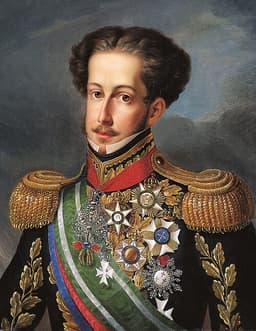
Emperor Pedro I of Brazil
Emperor · Modern
55.5Total
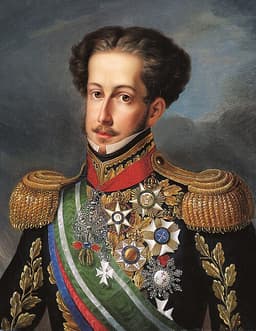
Pedro I of Brazil
Emperor · Modern
54.6Total
Basic Information
Born
1798
1798
Died
1834
1834
Era
Modern
Modern
Nationality
Brazil
Brazil
Occupation
Emperor
Emperor
Civilization
Western
Western
Score Comparison
Military (10%)
55.0
55.0
Political (20%)
62.7
62.7
Influence (20%)
59.0
59.0
Legacy (20%)
50.0
50.0
Leadership (15%)
65.0
53.2
Strategy (15%)
35.7
45.0
TOTAL
55.5
54.6
Emperor Pedro I of Brazil — Complete Timeline
1822 AD
Declaration of Brazilian IndependencePolitical Action
Dom Pedro declared Brazil's independence from Portugal on September 7, 1822, at the Ipiranga River. He was acclaimed Emperor Pedro I of Brazil, establishing a constitutional monarchy separate from Portugal.
IndependenceFounding
Impact: globalprogressive
Coronation as Emperor of BrazilPolitical Action◆ Major
Pedro I was crowned Emperor of Brazil on December 1, 1822, in Rio de Janeiro. The coronation formalized his rule over the newly independent nation, with a constitution promulgated in 1824.
CoronationMonarchy
Impact: national
1825 AD
Cisplatine WarWar◆ Major
Brazil went to war with the United Provinces of the R
WarTerritorial Loss
Impact: regionaldestructive
1831 AD
Abdication of the Brazilian ThronePolitical Action
Facing political crisis and military unrest, Pedro I abdicated the Brazilian throne on April 7, 1831, in favor of his five-year-old son Pedro II. He then returned to Portugal to claim the Portuguese throne.
AbdicationPolitical Crisis
Impact: nationaltragic
Pedro I of Brazil — Complete Timeline
1822 AD
Declaration of Independence of BrazilPolitical Action
Pedro I declared Brazil's independence from Portugal on September 7, 1822, at the Ipiranga River in S
Impact: globalprogressive
Coronation as Emperor of BrazilPolitical Action◆ Major
Pedro I was crowned Emperor of Brazil on December 1, 1822, in Rio de Janeiro. The coronation formalized the new imperial government, with Pedro I as constitutional monarch, though he retained significant executive powers.
Impact: nationalconstructive
1823 AD
War of Independence of BrazilWar◆ Major
Pedro I led Brazilian forces against Portuguese loyalists in the War of Independence. Key battles occurred in Bahia, Maranh
Impact: national
Dissolution of the Constituent AssemblyPolitical Action◆ Major
Pedro I dissolved the Constituent Assembly after conflicts over the constitution's limits on imperial power. He then imposed the 1824 Constitution, which granted the emperor extensive powers, including the Moderating Power, centralizing authority.
Impact: nationaldestructive
1831 AD
Abdication of the Brazilian ThronePolitical Action
Pedro I abdicated the Brazilian throne in favor of his five-year-old son Pedro II on April 7, 1831. He returned to Portugal to claim the Portuguese throne, leaving Brazil under a regency until his son came of age.
Impact: national
Expert Analysis
Pedro I of Brazil vs Emperor Pedro I of Brazil
# The Emperor Who Came and Went
On September 7, 1822, a twenty-three-year-old prince stood beside the Ipiranga River in São Paulo, tore the Portuguese blue-and-white cockade from his hat, and shouted a phrase that would echo through Brazilian history: “Independence or Death!” It was a moment of pure theatrical genius—the kind of scene that nations build monuments around. Yet just nine years later, that same man would abandon his throne in the dead of night, sailing back to Portugal as a defeated figure. Pedro I of Brazil remains one of history’s most contradictory rulers: a liberator who could not govern, a warrior who could not strategize, a romantic revolutionary who ultimately could not rule.
Origins
Pedro was born in 1798 in the Palace of Queluz near Lisbon, the second son of King John VI of Portugal and Carlota Joaquina of Spain. His childhood was chaotic: his mother was a scheming Spanish infanta who despised her husband, and his father was a timid, indecisive monarch who once fled a French invasion with the entire court under British escort. When Napoleon’s armies marched into Portugal in 1807, the Braganza family fled to Brazil, establishing the Portuguese court in Rio de Janeiro. Pedro grew up not as a European prince awaiting a small kingdom, but as the heir to a vast American empire—a continent-spanning realm where the capital was Rio, not Lisbon.
This upbringing shaped everything. Pedro was educated in the rough-and-tumble of colonial Brazil, where he learned to ride, fight, and charm with equal abandon. He was impulsive, passionate, and deeply insecure—a man who craved adoration but lacked the patience for statecraft. Unlike his father, who governed through cautious evasion, Pedro acted on instinct. He was a product of the Romantic era, a time when Byron and Beethoven were reshaping European culture, and Pedro saw himself as a Byronic hero: defiant, emotional, and destined for greatness.
Rise to Power
Pedro’s path to power was accidental. When his father King John VI returned to Portugal in 1821, pressured by liberal revolutionaries to leave Brazil, he left Pedro as regent. The Portuguese Cortes then attempted to reduce Brazil to colonial status, stripping Pedro of authority and ordering him home. The Brazilian elite, terrified of losing their autonomy, urged him to stay. On January 9, 1822, Pedro uttered his first famous line: “Fico” (I stay). It was a calculated gamble—one that turned him from a prince into a symbol of national resistance.
The declaration of independence on September 7, 1822, was the climax of this drama. But Pedro was not a master strategist. He was a young man who had stumbled into a movement larger than himself. The Brazilian independence was less a war of liberation than a palace coup led by landowners who feared Portuguese control. Pedro’s military score of 32.8 reflects this: he was no Napoleon. The War of Independence of 1823 consisted mostly of skirmishes against Portuguese garrisons, with Brazilian forces commanded by mercenaries like Lord Cochrane, a British admiral. Pedro himself was a figurehead—a necessary symbol, but not a general.
Leadership & Governance
As Emperor, Pedro’s political score of 60.2 suggests a ruler of middling competence, and the historical record bears this out. He was crowned on December 1, 1822, in Rio de Janeiro, but his reign quickly descended into conflict. The Constituent Assembly, elected to draft a constitution, sought to limit imperial power. Pedro responded by dissolving it in 1823, then imposing his own constitution—the 1824 Charter, which created a “moderating power” that gave the emperor veto authority and the right to appoint senators. It was a clever legal maneuver, but it alienated the liberal elites who had supported him.
The Cisplatine War of 1825-1828 was a disaster. Brazil fought the United Provinces of the Río de la Plata (modern Argentina) over control of Uruguay, a conflict that drained the treasury and demoralized the army. Pedro’s leadership score of 74.5 is generous; in truth, he micromanaged the war from Rio, ignoring his generals and refusing to negotiate. The war ended with Uruguay’s independence, a humiliating defeat that shattered Pedro’s prestige.
His personal life compounded these failures. Pedro was notorious for his affairs, including a scandalous relationship with Domitila de Castro, whom he made Marchioness of Santos. His wife, Empress Leopoldina, died in 1826 after a miscarriage brought on by his abuse. The Brazilian public, once enamored, turned against him. By 1831, he faced riots in Rio, mutinies among foreign mercenaries, and a paralyzed government.
Triumph & Tragedy
Pedro’s greatest moment was undoubtedly the declaration of independence—a genuine act of courage that created a nation. His influence score of 72.3 acknowledges this. He also played a brief role in Portuguese politics: when his father died in 1826, Pedro became King Pedro IV of Portugal, but he abdicated after two months in favor of his daughter Maria, imposing a constitutional charter. This act, however, triggered a civil war in Portugal that would consume his final years.
His tragedy was the abdication of April 7, 1831. Facing an impossible situation, Pedro renounced the Brazilian throne in favor of his five-year-old son, Pedro II. He returned to Europe, where he led Liberal forces against his brother Miguel in the Portuguese Civil War. He died in 1834 at age thirty-five, exhausted and bitter, having failed in both his empires.
Character & Destiny
Pedro’s personality was his destiny. He was impulsive, charismatic, and incapable of compromise—a Romantic hero in an age that required bureaucratic patience. His strategy score of 50.0 is telling: he could not plan beyond the next dramatic gesture. He dissolved assemblies, waged unwinnable wars, and pursued personal passions at the expense of statecraft. Yet he was not cruel or tyrannical; he simply lacked the temperament for the long game.
Legacy
Brazil remembers Pedro I as the “Liberator”—the man who shouted “Independence or Death!” on the banks of the Ipiranga. His legacy score of 70.0 reflects this enduring symbol. His remains lie in the Monument to the Independence of Brazil in São Paulo, a national shrine. But his son, Pedro II, who reigned for forty-nine years, is the emperor Brazilians truly revere—a wise, patient ruler who held the country together. The father was the spark; the son was the flame.
Conclusion
Pedro I of Brazil is a cautionary tale about the limits of charisma. He could start a revolution but not sustain a government, inspire a nation but not govern it. His life was a series of dramatic exits: from Portugal, from Brazil, from life itself. In the end, he was a man who could not stay—a prince who loved the idea of empire more than the work of ruling one. His story reminds us that history’s turning points are often created by flawed people, and that the shout of “Independence or Death!” is easier to utter than the quiet labor of building a nation.
Rankings
🥇
Emperor Pedro I of BrazilLeader
Mil: 55.0Pol: 62.7Inf: 59.0
55.5
🥈
Pedro I of Brazil
Mil: 55.0Pol: 62.7Inf: 59.0
54.6
+0.9 behind
How This Comparison Works
Algorithm
Each figure is scored on 6 dimensions (0—100 scale) based on structured historical data: Military (10%), Political (20%), Influence (20%), Legacy (20%), Leadership (15%), Strategy (15%). The weighted total produces the final ranking.
Data Sources
Scores are computed from structured sub-indicators in the database. Scale factors adjust for era (Ancient ×0.85, Modern ×1.0) and civilization size (Eastern ×1.05, Other ×0.80) to account for differences in population and military scale.
Maximum 3 Figures
Comparisons are limited to 2—3 figures to ensure readability and statistical meaningfulness.
Error Margins
±5 points per dimension — Sub-scores are derived from historical records with inherent uncertainty. Two figures within 5 points on a dimension should be considered roughly equivalent in that area.
Total Score Accuracy
±3 points overall — The weighted combination of 6 dimensions produces a total score with approximately ±3 points of uncertainty. Differences of less than 3 points are not statistically significant— the figures are effectively tied.
Known Limitations
- Historical records are incomplete and uneven across civilizations
- Figures from oral-tradition societies may be underrepresented
- Occupation labels can misclassify multi-role figures
- Scores measure capability and impact, not moral character
- Quantitative scoring is a comparison tool, not absolute truth
Capability Radar
Military (10%) — Battles & Warfare
Battles
25
35
Win Rate
30
40
Expansion
35
30
Political (20%) — Governance & Reform
Reform
50
45
Diplomacy
45
50
Economy
30
30
Influence (20%) — Cultural & Global Reach
Cultural
45
40
Global
40
45
Legacy (20%) — Historical Impact
Historical
55
55
Longevity
50
50
Leadership (15%) — Power & Stability
Tenure
40
55
Stability
20
25
Strategy (15%) — Tactics & Innovation
Strategy
25
35
Tactics
20
30
Reform
15
20
Similar Comparisons
Comments & Discussion
Crownless Strategist6/16/2026
Pedro shouting “Independência ou Morte!” was great theater, but let’s cut the myth: it wasn’t a spontaneous patriotic outburst. He was a master propagandist who knew a dramatic break with Portugal—while keeping monarchy intact—would cement his power. The real credit for independence goes to José Bonifácio, who drafted the political framework. Pedro just played the starring role. Without Bonifácio’s brain, Pedro’s theatrics would’ve been a one-act farce ending in defeat.
数据较真6/16/2026
说句泼冷水的话:所谓的“Ipiranga呼声”根本就是事后编出来的经典叙事。当时的文件显示,彼德罗在9月7日前一个月就已密令断绝与葡萄牙的联系。那个“独立或死亡”更像政治剧本而非现场爆发。更关键的是,1823年制宪会议上,他竟强行解散议会,暴露了其专制底色。热血领袖?不如说是机会主义独裁者。
Sandbox Caesar6/16/2026
Calling Pedro a “warrior who could not strategize” is too harsh. He led Brazilian forces to a swift, relatively bloodless victory in the War of Independence—key victories at Pirajá and Itaparica. Compare that to Bolívar’s decade-long slog through South America. Pedro’s downfall was political, not military: he mismanaged his own elites. If we judge him purely as a battlefield commander, he deserves more respect. Strategy isn’t just about winning wars; it’s about avoiding unnecessary ones—which he
巴西迷途者6/16/2026
彼德罗最大的悲剧,是他无法理解巴西的帝国实验需要什么。他以为穿上印第安羽冠、拥抱热带风情就够了,但治国需要妥协——而他却沉迷于葡式绝对君主制。当他1823年解散议会、流放反对派时,他实际上扼杀了自己的合法性。九年后弃位而逃,不是败在共和派手下,而是败在自己亲手毁灭的政治平衡里。浪漫领袖的冰冷结局。
Cisplatina Critic6/16/2026
Let’s not forget the Cisplatine War. Pedro’s obsession with keeping the Banda Oriental (modern Uruguay) bankrupted Brazil and exposed his strategic incompetence. He wasted resources on a foolish land war while British naval power dictated terms. By 1828, he not only lost the province but sparked the military unrest that would topple him. This wasn’t bad luck—it was hubris. He thought he could reenact his father’s court in Rio, but he lacked the patience for real diplomacy.