Loading...
Ehud Barak vs Prem Tinsulanonda
Ehud Barak leads by 2.7 pts · 2 figures compared
…
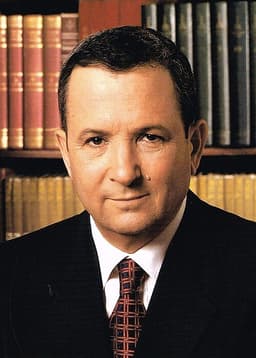
Ehud Barak
General · Modern
59.9Total
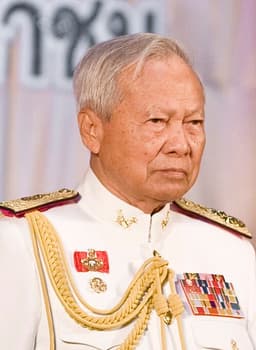
Prem Tinsulanonda
General · Modern
57.2Total
Basic Information
Born
1942
1920
Died
—
—
Era
Modern
Modern
Nationality
Israel
Thailand
Occupation
General
General
Civilization
Middle Eastern
Eastern
Score Comparison
Military (10%)
63.3
50.0
Political (20%)
72.0
59.3
Influence (20%)
55.0
54.9
Legacy (20%)
52.0
47.5
Leadership (15%)
66.0
78.0
Strategy (15%)
61.2
60.0
TOTAL
59.9
57.2
Ehud Barak — Complete Timeline
1973 AD
Awarded Medal of Distinguished ServiceOther
Barak received the Medal of Distinguished Service, Israel's highest military decoration, for his actions during the Yom Kippur War. He led a commando raid deep into Egyptian territory, destroying radar installations. This was part of a broader operation to open a supply route.
Military DecorationYom Kippur War
Impact: nationalconstructive
1976 AD
Led Operation Thunderbolt (Entebbe Raid)War◆ Major
As Chief of Staff, Barak planned and oversaw the Entebbe raid, a rescue of hostages hijacked by Palestinian and German militants in Uganda. Israeli commandos rescued 102 hostages. The operation was a major military success and boosted Israeli morale and international standing.
EntebbeHostage RescueCounterterrorism
Impact: globalconstructive
1991 AD
Appointed Chief of Staff of the IDFPolitical Action◆ Major
Barak was appointed the 14th Chief of Staff of the Israel Defense Forces. He served until 1995, overseeing military operations during the First Intifada and the Oslo Accords period. His tenure included the 1993 Operation Accountability in Lebanon.
Military CommandIDF
Impact: national
1999 AD
Elected Prime Minister of IsraelPolitical Action◆ Major
Barak was elected Prime Minister of Israel, defeating incumbent Benjamin Netanyahu. He campaigned on a platform of peace negotiations and domestic reform. His government pursued the Camp David Summit with Palestinians and withdrew from southern Lebanon.
ElectionPeace Process
Impact: regionalconstructive
2000 AD
Camp David Summit with ArafatPolitical Action
Barak participated in the Camp David Summit with Palestinian leader Yasser Arafat and U.S. President Bill Clinton. The summit aimed to reach a final status agreement but failed. Barak offered territorial concessions that were rejected. The failure contributed to the Second Intifada.
Peace NegotiationsCamp DavidIsraeli-Palestinian Conflict
Impact: global
Withdrew from Southern LebanonPolitical Action◆ Major
Barak ordered the unilateral withdrawal of Israeli forces from the security zone in southern Lebanon, ending 18 years of occupation. The withdrawal was completed in May 2000. Hezbollah claimed victory, and the move was criticized by some as a retreat under fire.
WithdrawalLebanonHezbollah
Impact: regional
Prem Tinsulanonda — Complete Timeline
1980 AD
Appointed Prime Minister after a coupPolitical Action◆ Major
Prem Tinsulanonda was appointed Prime Minister of Thailand by the military after a coup. He served for over eight years, overseeing a period of political stability and economic growth.
Prime MinisterMilitary RuleStability
Impact: national
1981 AD
Survived a coup attemptPolitical Action◆ Major
Prem survived a coup attempt by military officers loyal to the 'Young Turks' faction. The coup failed due to lack of support and the loyalty of key military units, allowing Prem to remain in power.
Coup AttemptPolitical CrisisMilitary
Impact: national
1988 AD
Resigned as Prime MinisterPolitical Action◆ Major
Prem resigned as Prime Minister after the general election, handing over power to a civilian government led by Chatichai Choonhavan. His resignation marked a rare peaceful transition of power in Thai politics.
ResignationDemocratic TransitionPeaceful
Impact: nationalconstructive
2016 AD
Appointed Regent of ThailandPolitical Action
After the death of King Bhumibol, Prem was appointed Regent of Thailand until the ascension of King Maha Vajiralongkorn. He served as a key figure in the transition of the monarchy.
RegentMonarchyTransition
Impact: national
Expert Analysis
Prem Tinsulanonda vs Ehud Barak
# The General Who Governed: Prem Tinsulanonda and Ehud Barak
On a humid Bangkok evening in April 1981, Prem Tinsulanonda sat in his office, listening to the rumble of tanks approaching the capital. Across the world, in a different decade, Ehud Barak stood in a darkened hangar in Uganda, watching commandos load freed hostages onto a Hercules aircraft. One man was defending his seat of power; the other had just pulled off one of the most daring rescues in military history. Both were generals who became prime ministers. Yet their paths diverged so sharply that they seem to belong to different species of leadership. What drove these two men—one a quiet survivor of palace intrigue, the other a decorated warrior turned peacemaker—to such different outcomes?
Origins
Prem Tinsulanonda was born in 1920 in Songkhla, southern Thailand, into a world where monarchy and military defined the limits of possibility. His father was a provincial official, his mother a homemaker. The young Prem grew up in the shadow of King Rama VII's abdication and the 1932 revolution that transformed Siam into a constitutional monarchy. He attended military school, learned discipline, and absorbed a culture where loyalty to the throne was not merely a virtue but a survival instinct. By contrast, Ehud Barak, born Ehud Brog in 1942 on Kibbutz Mishmar HaSharon, came of age in a fledgling nation fighting for its existence. His parents were Jewish immigrants from Eastern Europe, and his childhood was defined by the 1948 Arab-Israeli War and the constant threat of annihilation. Where Prem learned patience and deference, Barak learned action and audacity.
Rise to Power
Prem's ascent was gradual, almost invisible. He served in the Korean War, held staff positions, and quietly climbed the ranks of the Thai army. In 1980, after a coup ousted Prime Minister Kriangsak Chamanan, the military turned to Prem—a man with no political base, no enemies, and a reputation for integrity. He was appointed prime minister not because he sought power, but because he was the least threatening option. Barak's rise was the opposite: a blaze of glory. In 1973, he was awarded the Medal of Distinguished Service, Israel's highest military honor, for leading a commando raid disguised as a woman in Beirut. In 1976, as Chief of Staff, he planned Operation Thunderbolt—the Entebbe raid—which rescued over 100 hostages. By 1991, he was Chief of the IDF. When he entered politics, he did so with the confidence of a man who had never failed.
Leadership & Governance
Prem governed Thailand for eight years, from 1980 to 1988, by doing as little as possible. He was a master of balance, not reform. His strategy was to stay alive politically, which meant appeasing the military, the monarchy, and the civilian bureaucracy simultaneously. He survived a coup attempt in 1981 by the "Young Turks" faction—not by crushing them, but by outlasting them. The coup failed because Prem had the king's support and the plotters lacked it. His political wisdom was negative: he knew what not to do. Barak, by contrast, governed as if every day were a mission. Elected prime minister in 1999 on a peace platform, he immediately pushed for the Camp David Summit with Yasser Arafat in 2000. He withdrew Israeli forces from southern Lebanon, ending an 18-year occupation. He took risks that would have made Prem blanch. Yet his military genius—planning, precision, decisiveness—became a political liability. He could not compromise because he had never needed to.
Triumph & Tragedy
Prem's greatest triumph was simply surviving. He resigned in 1988 after a general election, handing power to a civilian government led by Chatichai Choonhavan—a peaceful transition rare in Thai history. His greatest tragedy was that his legacy was one of stasis, not progress. He kept Thailand stable, but he did not transform it. Barak's triumph was the Entebbe raid, a moment of pure Israeli heroism that still resonates. His tragedy was Camp David. The summit collapsed, the Second Intifada erupted, and Barak lost the 2001 election to Ariel Sharon. He had staked everything on peace and lost. Where Prem's failures were silent and survivable, Barak's were public and devastating.
Character & Destiny
Prem was a man of shadows. He avoided speeches, cultivated anonymity, and let others take credit. His leadership score of 89.0 reflects not charisma but endurance—the ability to be indispensable without being visible. Barak, with a military score of 63.7 and a political score of 72.0, was the opposite: a man of action who believed that problems could be solved by force of will. Prem's personality was shaped by a culture where power flowed from the throne; Barak's by a nation where power flowed from the gun. One man's destiny was to hold the center; the other's was to charge the front.
Legacy
Today, Prem is remembered as the regent who held the throne after King Bhumibol's death in 2016, a quiet guardian of continuity. His legacy score of 66.8 reflects a life that was steady but not transformative. Barak, with a legacy score of 67.9, is remembered as the soldier who almost made peace—a tragic figure whose ambition exceeded his political reality. One man preserved a system; the other tried to change one.
Conclusion
Standing at the end of their lives, Prem and Barak offer a stark lesson: that leadership is not about being better or worse, but about being right for the moment. Prem was right for a Thailand that needed stability. Barak was right for an Israel that needed heroism. But both were wrong in the ways that matter most—Prem for not daring enough, Barak for daring too much. In the end, the general who governs is always a contradiction, and history judges not by intention, but by outcome.
Rankings
🥇
Ehud BarakLeader
Mil: 63.3Pol: 72.0Inf: 55.0
59.9
🥈
Prem Tinsulanonda
Mil: 50.0Pol: 59.3Inf: 54.9
57.2
+2.7 behind
How This Comparison Works
Algorithm
Each figure is scored on 6 dimensions (0—100 scale) based on structured historical data: Military (10%), Political (20%), Influence (20%), Legacy (20%), Leadership (15%), Strategy (15%). The weighted total produces the final ranking.
Data Sources
Scores are computed from structured sub-indicators in the database. Scale factors adjust for era (Ancient ×0.85, Modern ×1.0) and civilization size (Eastern ×1.05, Other ×0.80) to account for differences in population and military scale.
Maximum 3 Figures
Comparisons are limited to 2—3 figures to ensure readability and statistical meaningfulness.
Error Margins
±5 points per dimension — Sub-scores are derived from historical records with inherent uncertainty. Two figures within 5 points on a dimension should be considered roughly equivalent in that area.
Total Score Accuracy
±3 points overall — The weighted combination of 6 dimensions produces a total score with approximately ±3 points of uncertainty. Differences of less than 3 points are not statistically significant— the figures are effectively tied.
Known Limitations
- Historical records are incomplete and uneven across civilizations
- Figures from oral-tradition societies may be underrepresented
- Occupation labels can misclassify multi-role figures
- Scores measure capability and impact, not moral character
- Quantitative scoring is a comparison tool, not absolute truth
Capability Radar
Military (10%) — Battles & Warfare
Battles
65
20
Win Rate
70
25
Expansion
55
10
Political (20%) — Governance & Reform
Reform
50
55
Diplomacy
60
60
Economy
45
50
Influence (20%) — Cultural & Global Reach
Cultural
50
30
Global
55
30
Legacy (20%) — Historical Impact
Historical
55
40
Longevity
45
35
Leadership (15%) — Power & Stability
Tenure
55
65
Stability
40
60
Strategy (15%) — Tactics & Innovation
Strategy
70
30
Tactics
75
30
Reform
60
35
Similar Comparisons
Comments & Discussion
No comments yet. Be the first to share your thoughts!