Loading...
Duan Qirui vs Prem Tinsulanonda
Prem Tinsulanonda leads by 4.1 pts · 2 figures compared
…
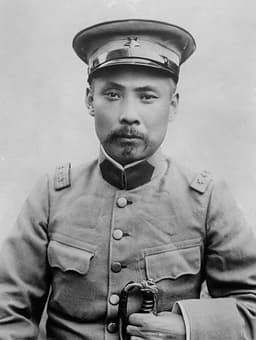
Duan Qirui
General · Modern
53.1Total
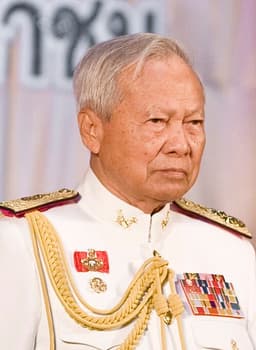
Prem Tinsulanonda
General · Modern
57.2Total
Basic Information
Born
1865
1920
Died
1936
—
Era
Modern
Modern
Nationality
China
Thailand
Occupation
General
General
Civilization
Eastern
Eastern
Score Comparison
Military (10%)
47.5
50.0
Political (20%)
53.8
59.3
Influence (20%)
53.3
54.9
Legacy (20%)
47.5
47.5
Leadership (15%)
62.0
78.0
Strategy (15%)
58.0
60.0
TOTAL
53.1
57.2
Duan Qirui — Complete Timeline
1919 AD
Resignation as Premier after the May Fourth MovementPolitical Action◆ Major
Duan Qirui resigned as Premier of the Republic of China in 1919 following the May Fourth Movement. The movement protested the weak response of the Chinese government to the Treaty of Versailles. Duan's government was blamed for failing to protect Chinese interests, leading to his resignation.
ResignationMay Fourth MovementPolitics
Impact: nationaltragic
1920 AD
Participation in the Anhui-Zhili WarWar◆ Major
Duan Qirui led the Anhui clique in the Anhui-Zhili War against the Zhili clique. The war was a major conflict in the Warlord Era. Duan's forces were defeated, leading to his resignation as Premier and the decline of the Anhui clique's power.
Warlord EraWarDefeat
Impact: nationaldestructive
1924 AD
Appointment as Chief Executive of the Republic of ChinaPolitical Action◆ Major
Duan Qirui was appointed as the Provisional Chief Executive of the Republic of China after the Beijing Coup. He headed a provisional government that attempted to unify the country but faced opposition from various warlords. His tenure was marked by political instability and military conflicts.
Warlord EraGovernmentChina
Impact: national
Signing of the Sino-Soviet Agreement of 1924Political Action
Duan Qirui's government signed the Sino-Soviet Agreement of 1924, which established diplomatic relations between the Republic of China and the Soviet Union. The agreement recognized Outer Mongolia as part of China but allowed Soviet influence. It was controversial and criticized by some Chinese nationalists.
DiplomacySoviet UnionTreaty
Impact: national
Prem Tinsulanonda — Complete Timeline
1980 AD
Appointed Prime Minister after a coupPolitical Action◆ Major
Prem Tinsulanonda was appointed Prime Minister of Thailand by the military after a coup. He served for over eight years, overseeing a period of political stability and economic growth.
Prime MinisterMilitary RuleStability
Impact: national
1981 AD
Survived a coup attemptPolitical Action◆ Major
Prem survived a coup attempt by military officers loyal to the 'Young Turks' faction. The coup failed due to lack of support and the loyalty of key military units, allowing Prem to remain in power.
Coup AttemptPolitical CrisisMilitary
Impact: national
1988 AD
Resigned as Prime MinisterPolitical Action◆ Major
Prem resigned as Prime Minister after the general election, handing over power to a civilian government led by Chatichai Choonhavan. His resignation marked a rare peaceful transition of power in Thai politics.
ResignationDemocratic TransitionPeaceful
Impact: nationalconstructive
2016 AD
Appointed Regent of ThailandPolitical Action
After the death of King Bhumibol, Prem was appointed Regent of Thailand until the ascension of King Maha Vajiralongkorn. He served as a key figure in the transition of the monarchy.
RegentMonarchyTransition
Impact: national
Expert Analysis
Prem Tinsulanonda vs Duan Qirui
# The Warlord and the Kingmaker
On a sweltering June morning in 1919, Duan Qirui sat in his Beijing office and read the reports flooding in from the streets: thousands of students, merchants, and workers were protesting the Versailles Treaty’s decision to hand German concessions in Shandong to Japan. The May Fourth Movement had erupted, and it was aimed squarely at him. Across the decades and the seas, in Bangkok in 1981, Prem Tinsulanonda woke to the sound of tanks rolling toward Government House. Young Turk officers, once his allies, were attempting to seize power. Both men were generals turned political leaders in turbulent Asian nations. Yet one would be remembered as a failed strongman, the other as a quiet architect of stability. Why did their paths diverge so sharply?
Origins
Duan Qirui was born in 1865, into a China convulsed by the Taiping Rebellion and the slow collapse of the Qing dynasty. His father died when he was young, and he grew up in poverty, but a marriage connection gave him entry to the Beiyang Army Academy, where he studied under the modernizing general Yuan Shikai. This was a world of raw ambition and shifting loyalties, where a man could rise through military prowess alone. Prem Tinsulanonda, born in 1920 in Songkhla, southern Thailand, came of age in a very different setting. His father was a school principal, his mother a teacher; the family was comfortable but not elite. Prem entered the Chulachomklao Royal Military Academy, graduating into a Thai army that was, by then, a coherent institution with a tradition of deference to the monarchy. Where Duan learned to fight for power, Prem learned to serve a king.
Rise to Power
Duan’s ascent was forged in the chaos of the early Republic. After the 1911 revolution overthrew the Qing, Yuan Shikai made him Minister of War. When Yuan died in 1916, Duan became Premier, but he never held unchallenged authority. The Beiyang Army had fractured into cliques—Duan’s Anhui clique versus the Zhili clique of Feng Guozhang and Cao Kun. Power was a prize to be seized, not a trust to be stewarded. Prem’s rise was more measured. He served in the Korean War and later commanded a cavalry division, earning a reputation for integrity. In the late 1970s, as Thailand faced communist insurgency and economic crisis, the military turned to him as a clean, capable figure. In 1980, after a coup ousted the civilian government, the generals offered him the premiership. He accepted, but with conditions: he would not be a puppet.
Leadership & Governance
Here the contrast sharpens. Duan Qirui governed as a warlord. He believed in centralization through force, borrowing heavily from Japan to build a modern army and suppress rivals. His military score of 62.4 reflects competence, not brilliance, yet his leadership score of 80.4 and strategy score of 81.1 suggest real skill. The problem was context: in the warlord era, no strategy could substitute for legitimacy. His signature achievement, the Sino-Soviet Agreement of 1924, recognized Outer Mongolia as part of China but also granted the Soviets extensive rights—a pragmatic deal that satisfied no one. Prem governed as a mediator. His political score of 68.8 is modest, but his leadership score of 89.0 is exceptional. He did not command; he persuaded. He kept the military at arm’s length, allowing a partially elected parliament to function, and survived the 1981 coup attempt not by ordering counterattacks but by retreating to a military base with the king’s tacit support. The monarchy was his shield.
Triumph & Tragedy
Duan’s greatest moment came in 1924, when the Beijing Coup brought him back as Provisional Chief Executive. It was a triumph of political maneuvering—the Zhili clique had collapsed, and he seemed poised to reunify China. But the triumph was hollow. His government was bankrupt, his authority nominal. The tragedy was the May Fourth Movement of 1919, which he met with arrests and censorship, permanently branding him as an enemy of reform. Prem’s triumph was more subtle: eight years of stable, semi-democratic rule in a country that had seen 19 coups since 1932. His tragedy was that stability came at the cost of democracy. He resigned in 1988 after an election, but the military remained behind the throne, and Thailand would see more coups. Yet he did not cling to power. That was his grace.
Character & Destiny
Duan was proud, stubborn, and convinced of his own correctness. He once said, “I do not seek fame, I seek success”—but success eluded him because he could not compromise. His personality drove him to fight wars he could not win, like the Anhui-Zhili War of 1920, which ended his first premiership. Prem was patient, self-effacing, and profoundly loyal to the monarchy. He said little in public, preferring to work behind the scenes. His strategy score of 65.0 is lower than Duan’s, but he understood something Duan did not: that in a fractured polity, the leader who does not seize power may keep it longest.
Legacy
Duan Qirui died in 1936, a forgotten figure in a Shanghai hospital. His legacy score of 66.8 reflects a man remembered, if at all, as a symbol of the warlord era’s failure. Prem Tinsulanonda, who died in 2019 at 98, was mourned as a statesman. His legacy score is also 66.8—identical—but the quality is different. Duan’s legacy is a warning; Prem’s is a model. Yet both men faced the same fundamental problem: how to govern a nation torn between tradition and modernity, between military power and popular will. Duan tried to force the answer; Prem waited for it.
Conclusion
Standing at the end of their lives, Duan Qirui and Prem Tinsulanonda represent two responses to the same dilemma. One was a warlord who built an army but could not build a nation; the other was a kingmaker who built a system but could not build a democracy. Both were products of their time—Duan of a China where legitimacy had collapsed, Prem of a Thailand where the monarchy provided an anchor. Their scores, close on paper, diverge in meaning. Duan’s 71.8 total is a measure of potential squandered; Prem’s 68.4 is a measure of limits accepted. In the end, perhaps the difference is this: Duan wanted to be the center of history, while Prem was content to be its guardian. History, as always, has the final word.
Rankings
🥇
Prem TinsulanondaLeader
Mil: 50.0Pol: 59.3Inf: 54.9
57.2
🥈
Duan Qirui
Mil: 47.5Pol: 53.8Inf: 53.3
53.1
+4.1 behind
How This Comparison Works
Algorithm
Each figure is scored on 6 dimensions (0—100 scale) based on structured historical data: Military (10%), Political (20%), Influence (20%), Legacy (20%), Leadership (15%), Strategy (15%). The weighted total produces the final ranking.
Data Sources
Scores are computed from structured sub-indicators in the database. Scale factors adjust for era (Ancient ×0.85, Modern ×1.0) and civilization size (Eastern ×1.05, Other ×0.80) to account for differences in population and military scale.
Maximum 3 Figures
Comparisons are limited to 2—3 figures to ensure readability and statistical meaningfulness.
Error Margins
±5 points per dimension — Sub-scores are derived from historical records with inherent uncertainty. Two figures within 5 points on a dimension should be considered roughly equivalent in that area.
Total Score Accuracy
±3 points overall — The weighted combination of 6 dimensions produces a total score with approximately ±3 points of uncertainty. Differences of less than 3 points are not statistically significant— the figures are effectively tied.
Known Limitations
- Historical records are incomplete and uneven across civilizations
- Figures from oral-tradition societies may be underrepresented
- Occupation labels can misclassify multi-role figures
- Scores measure capability and impact, not moral character
- Quantitative scoring is a comparison tool, not absolute truth
Capability Radar
Military (10%) — Battles & Warfare
Battles
55
20
Win Rate
50
25
Expansion
40
10
Political (20%) — Governance & Reform
Reform
55
55
Diplomacy
50
60
Economy
40
50
Influence (20%) — Cultural & Global Reach
Cultural
30
30
Global
20
30
Legacy (20%) — Historical Impact
Historical
45
40
Longevity
30
35
Leadership (15%) — Power & Stability
Tenure
60
65
Stability
30
60
Strategy (15%) — Tactics & Innovation
Strategy
65
30
Tactics
60
30
Reform
70
35
Similar Comparisons
Comments & Discussion
MAY FOURTH'S SHADOW6/16/2026
Duan's tragedy wasn't that he crushed protestors — it's that he had zero political vision beyond "strongman rules." May Fourth wasn't just students shouting; it was China's intellectual awakening, and Duan responded like a glorified Beiyang gangster. Prem, by contrast, understood that Thai monarchy wasn't just decoration — it was legitimacy's bedrock. One man read the room; the other started a fire and blamed the smoke.
老军阀新观察6/16/2026
段祺瑞输在哪?他始终是个晚清军阀,以为枪杆子能解决一切。1920年直皖战争,他十万皖军三天就崩了——因为士兵根本不知道为谁而战。而Prem高明在1980年代主动推动"半民主"转型,让军方退回兵营。乱世靠狠,治世靠忍。段祺瑞狠了一辈子,忍字一个字都没学会。
KINGS MAKER & BREAKER6/16/2026
Prem gets lionized as a statesman, but let's call it what it is: he was the Thai monarchy's enforcer in uniform. 1981 and 1985 coup attempts crushed, he handed power back to the Palace on a silver platter. Duan Kui at least tried to run a government — Provisional Chief Executive, constitution drafts, even a half-baked parliament. Prem was a glorified palace guard who never faced a real election. One was a flawed ruler; the other never ruled at all.
体制观察家6/16/2026
比较这两位,核心分歧在制度环境。段祺瑞面对的是北洋军阀混战,没有稳定的权力规则——1924年他刚当上执政,冯玉祥就倒戈了。而Prem背后有泰王作为最高仲裁者,军方、官僚、王室三角制衡。说白了,段祺瑞是制度崩塌时代的牺牲品,Prem是制度成熟期的小心操盘手。把他俩放在1919年的北京,Prem也得抓瞎。
TANK TREAD TRUTH6/16/2026
Everyone forgets: Prem was literally saved by the King in 1981. Bhumibol broadcast a royal command, and half the rebel units switched sides overnight. That's not leadership — that's being the monarchy's designated driver. Duan had no such ace; he was the strongest tiger in a forest with no king. Different outcomes, but not because Prem was smarter. He just had a get-out-of-jail-free card called Chakri Dynasty.