Loading...
Duan Qirui vs Hideki Tojo
Hideki Tojo leads by 0.8 pts · 2 figures compared
…
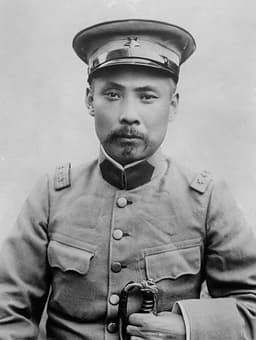
Duan Qirui
General · Modern
53.1Total
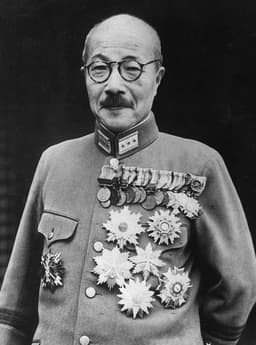
Hideki Tojo
General · Modern
53.9Total
Basic Information
Born
1865
1884
Died
1936
1948
Era
Modern
Modern
Nationality
China
Japan
Occupation
General
General
Civilization
Eastern
Eastern
Score Comparison
Military (10%)
47.5
70.0
Political (20%)
53.8
48.0
Influence (20%)
53.3
55.0
Legacy (20%)
47.5
50.0
Leadership (15%)
62.0
53.2
Strategy (15%)
58.0
55.0
TOTAL
53.1
53.9
Duan Qirui — Complete Timeline
1919 AD
Resignation as Premier after the May Fourth MovementPolitical Action◆ Major
Duan Qirui resigned as Premier of the Republic of China in 1919 following the May Fourth Movement. The movement protested the weak response of the Chinese government to the Treaty of Versailles. Duan's government was blamed for failing to protect Chinese interests, leading to his resignation.
ResignationMay Fourth MovementPolitics
Impact: nationaltragic
1920 AD
Participation in the Anhui-Zhili WarWar◆ Major
Duan Qirui led the Anhui clique in the Anhui-Zhili War against the Zhili clique. The war was a major conflict in the Warlord Era. Duan's forces were defeated, leading to his resignation as Premier and the decline of the Anhui clique's power.
Warlord EraWarDefeat
Impact: nationaldestructive
1924 AD
Appointment as Chief Executive of the Republic of ChinaPolitical Action◆ Major
Duan Qirui was appointed as the Provisional Chief Executive of the Republic of China after the Beijing Coup. He headed a provisional government that attempted to unify the country but faced opposition from various warlords. His tenure was marked by political instability and military conflicts.
Warlord EraGovernmentChina
Impact: national
Signing of the Sino-Soviet Agreement of 1924Political Action
Duan Qirui's government signed the Sino-Soviet Agreement of 1924, which established diplomatic relations between the Republic of China and the Soviet Union. The agreement recognized Outer Mongolia as part of China but allowed Soviet influence. It was controversial and criticized by some Chinese nationalists.
DiplomacySoviet UnionTreaty
Impact: national
Hideki Tojo — Complete Timeline
1941 AD
Attack on Pearl HarborWar
As Prime Minister, Hideki Tojo authorized the attack on the US naval base at Pearl Harbor, Hawaii. The surprise attack brought the United States into World War II. Tojo's decision was based on the belief that war with the US was inevitable due to resource embargoes and diplomatic failures.
World War IIPearl HarborUS-Japan War
Impact: globaldestructive
Appointment as Prime MinisterPolitical Action◆ Major
Hideki Tojo was appointed Prime Minister of Japan, replacing Fumimaro Konoe. He retained his position as Army Minister and later took on other portfolios, consolidating power. His appointment marked the ascendancy of the military faction in the Japanese government and the shift towards total war.
Prime MinisterMilitary GovernmentWorld War II
Impact: national
1942 AD
Fall of SingaporeWar◆ Major
Under Tojo's leadership, Japanese forces captured Singapore from the British in a swift campaign. The fall of Singapore was one of the worst British military defeats in history. It demonstrated Japanese military prowess and led to the occupation of a key strategic location in Southeast Asia.
World War IISingaporeJapanese Victory
Impact: global
1948 AD
Execution by the International Military Tribunal for the Far EastPolitical Action◆ Major
Hideki Tojo was found guilty of war crimes by the International Military Tribunal for the Far East and sentenced to death. He was executed by hanging on December 23, 1948. His trial and execution symbolized the Allied effort to hold Japanese leaders accountable for wartime atrocities.
War CrimesExecutionTokyo Trials
Impact: globaltragic
Expert Analysis
Hideki Tojo vs Duan Qirui
# The General as Statesman: Hideki Tojo and Duan Qirui
On a December morning in 1941, Hideki Tojo stood before Japan’s war cabinet and gave the final nod for an attack that would shatter the Pacific peace. Half a world away and two decades earlier, Duan Qirui sat in a Beijing office, watching students flood the streets to protest his government’s weakness before foreign powers. Both men were generals who reached the pinnacle of political power in East Asia. Both believed military discipline could solve national crises. Yet one ended his life on a gallows, while the other died in relative obscurity, a warlord who outlived his era. What drove such different fates?
Origins
Hideki Tojo was born in 1884 into a samurai family in Tokyo. His father, a lieutenant general in the Imperial Japanese Army, drilled into him the values of bushido—loyalty, honor, and absolute obedience. Tojo graduated from the Imperial Japanese Army Academy in 1904, just in time for the Russo-Japanese War, where he witnessed how modern industrial warfare could elevate a small island nation into a global power. The lesson stuck: Japan’s future lay in expansion, and the army was its instrument.
Duan Qirui, born in 1865 in Hefei, China, came of age in a crumbling empire. The Qing Dynasty was reeling from foreign invasions and internal rebellions. Unlike Tojo’s orderly military education, Duan studied at the Tianjin Military Academy, a school founded by Li Hongzhang to train Chinese officers in Western tactics. Duan saw firsthand how China’s weakness invited exploitation. His early career was shaped by the Boxer Rebellion and the subsequent humiliation of the Boxer Protocol—events that convinced him only military strength could restore Chinese sovereignty.
The difference in their origins was not merely personal but structural. Tojo grew up in a rising Japan, confident and expansionist. Duan matured in a declining China, defensive and fractured. One man inherited a nation on the ascent; the other, one in free fall.
Rise to Power
Tojo’s path was linear. He served as a military attaché in Germany, studied the Prussian general staff system, and rose through the ranks of the Kwantung Army in Manchuria. By 1937, he was chief of staff of the Kwantung Army, directing operations in China. His reputation for efficiency and ruthlessness caught the attention of Emperor Hirohito’s inner circle. In 1941, with Japan locked in a stalemate in China and facing American oil sanctions, Prime Minister Fumimaro Konoe resigned. Tojo—already Army Minister—stepped into the vacuum. He was appointed Prime Minister in October 1941, combining military and civilian authority in a way no Japanese leader had before.
Duan’s rise was more chaotic. After the 1911 Revolution that toppled the Qing, he became a key figure in the Beiyang Army, the most powerful military force in the new Republic. He served as Premier multiple times under President Li Yuanhong, but his power rested on his control of the Anhui clique, one of several warlord factions. Unlike Tojo, who had a unified state apparatus, Duan operated in a China where no single leader commanded total authority. His rise was a series of bargains and betrayals, alliances and breakups.
The key difference: Tojo ascended through institutional channels in a centralized empire. Duan climbed through personal networks in a disintegrating republic.
Leadership & Governance
As Prime Minister, Tojo ruled with an iron fist. He tightened control over the economy, suppressed dissent, and pushed the Imperial General Headquarters to approve the Pearl Harbor attack in December 1941. Under his leadership, Japanese forces swept through Southeast Asia, capturing Singapore in February 1942—a stunning victory that humiliated the British Empire. Tojo’s strategy was aggressive, relying on speed and surprise. But he micromanaged the war, ignoring intelligence failures and underestimating American industrial capacity. By 1944, Japan was losing on every front, and Tojo’s refusal to consider peace led to catastrophic losses.
Duan’s governance was different. As Provisional Chief Executive from 1924, he tried to unify China through diplomacy. His government signed the Sino-Soviet Agreement of 1924, reestablishing relations with the Soviet Union and securing recognition for his regime. But Duan’s authority was hollow. He could not control the warlords who nominally supported him, and the May Fourth Movement of 1919—a student-led protest against the Treaty of Versailles—had already exposed his government’s weakness. Duan resigned in 1919, returned in 1924, and was eventually forced out by the Northern Expedition in 1926. His governance was a balancing act, not a dictatorship.
Tojo had absolute power but used it badly. Duan had limited power and used it cautiously. One drove his nation to destruction; the other merely failed to save his.
Triumph & Tragedy
Tojo’s greatest triumph was the fall of Singapore, a victory that seemed to confirm Japan’s invincibility. His greatest tragedy was the Battle of Midway in June 1942, where Japan lost four aircraft carriers and the initiative in the Pacific. Tojo’s refusal to acknowledge defeat turned a temporary setback into a death spiral. By 1945, Japan was in ruins, and Tojo attempted suicide before being arrested. In 1948, the International Military Tribunal for the Far East sentenced him to death for war crimes. He was hanged, leaving a legacy of destruction.
Duan’s triumph was the Sino-Soviet Agreement, which gave his government a veneer of legitimacy. His tragedy was the Anhui-Zhili War of 1920, where his Anhui clique was decisively defeated, shattering his military power. He spent his final years in Shanghai, a retired warlord watching China descend into civil war. He died in 1936, before the full horrors of the Japanese invasion began.
Tojo’s tragedy was self-inflicted; Duan’s was systemic. The general who had everything lost everything. The general who had little merely faded away.
Character & Destiny
Tojo was rigid, authoritarian, and paranoid. He believed that willpower could overcome material reality. His leadership score of 81.2 reflects tactical competence, but his political score of 65.0 reveals a man who could not adapt to changing circumstances. He was a product of a militarist culture that valued resolve over reflection.
Duan was pragmatic, cautious, and adaptable. His strategy score of 81.1 shows a man who understood the limits of force. But his political score of 65.0 mirrors Tojo’s—both men were soldiers first, politicians second. Duan’s tragedy was that he lacked the power to implement his vision; Tojo’s was that he had too much.
Legacy
Tojo is remembered as a war criminal, the face of Japanese militarism. His legacy score of 68.3 reflects a global consensus that he led his nation into catastrophe. In Japan, he remains a controversial figure—reviled by some, quietly respected by ultranationalists.
Duan is largely forgotten outside China. His legacy score of 66.8 is slightly lower, but he is remembered more neutrally: a warlord who tried to hold China together during its weakest moment. Historians see him as a transitional figure, not a villain.
Conclusion
Tojo and Duan both believed that military men could save their nations. Tojo had the power to act on that belief and destroyed his country. Duan lacked the power and watched his country fall apart anyway. Their stories suggest that leadership is not just about will or strategy, but about the constraints of history. Tojo’s Japan was a sword aimed outward; Duan’s China was a shield crumbling inward. The difference between triumph and tragedy, in the end, was not the men themselves, but the worlds they inherited.
Rankings
🥇
Hideki TojoLeader
Mil: 70.0Pol: 48.0Inf: 55.0
53.9
🥈
Duan Qirui
Mil: 47.5Pol: 53.8Inf: 53.3
53.1
+0.8 behind
How This Comparison Works
Algorithm
Each figure is scored on 6 dimensions (0—100 scale) based on structured historical data: Military (10%), Political (20%), Influence (20%), Legacy (20%), Leadership (15%), Strategy (15%). The weighted total produces the final ranking.
Data Sources
Scores are computed from structured sub-indicators in the database. Scale factors adjust for era (Ancient ×0.85, Modern ×1.0) and civilization size (Eastern ×1.05, Other ×0.80) to account for differences in population and military scale.
Maximum 3 Figures
Comparisons are limited to 2—3 figures to ensure readability and statistical meaningfulness.
Error Margins
±5 points per dimension — Sub-scores are derived from historical records with inherent uncertainty. Two figures within 5 points on a dimension should be considered roughly equivalent in that area.
Total Score Accuracy
±3 points overall — The weighted combination of 6 dimensions produces a total score with approximately ±3 points of uncertainty. Differences of less than 3 points are not statistically significant— the figures are effectively tied.
Known Limitations
- Historical records are incomplete and uneven across civilizations
- Figures from oral-tradition societies may be underrepresented
- Occupation labels can misclassify multi-role figures
- Scores measure capability and impact, not moral character
- Quantitative scoring is a comparison tool, not absolute truth
Capability Radar
Military (10%) — Battles & Warfare
Battles
55
65
Win Rate
50
40
Expansion
40
70
Political (20%) — Governance & Reform
Reform
55
30
Diplomacy
50
35
Economy
40
25
Influence (20%) — Cultural & Global Reach
Cultural
30
30
Global
20
55
Legacy (20%) — Historical Impact
Historical
45
55
Longevity
30
40
Leadership (15%) — Power & Stability
Tenure
60
60
Stability
30
20
Strategy (15%) — Tactics & Innovation
Strategy
65
50
Tactics
60
55
Reform
70
45
Similar Comparisons
Comments & Discussion
Samurai General6/16/2026
Calling Tojo a "statesman" whitewashes his record. He was a military dictator who seized power through assassination plots and political bullying, not democratic process. Duan Qirui at least inherited chaos from the Qing collapse—Tojo actively manufactured crises to justify aggression. The comparison breaks down when you consider Tojo personally approved the Bataan Death March while Duan's worst sin was indecisiveness during the May Fourth protests. One was a war criminal; the other was just inc
军阀算盘6/16/2026
说段祺瑞是“二战同级别人物”实在抬举他了。他连直皖战争都打不赢,靠日本借款续命,签的二十一条比袁世凯还多。日本人都笑话他是“北洋晚节不保的活化石”。而东条英机好歹真把大半个亚洲打下来了。段祺瑞那种“安福国会”的腐败,根本不配和战时日本的内阁效率比。
Data Driller6/16/2026
The analysis glosses over numbers that matter. Under Tojo, Japan's military budget hit 75% of GDP by 1944—unsustainable for any nation. Duan's government, by contrast, collected only 40% of its tax revenue due to warlord autonomy. Tojo was a competent administrator building a death machine; Duan was a failed collector. Different leagues of failure entirely.
历史模糊派6/16/2026
你们总爱拿东条和段祺瑞比,却忘了最重要的北京政变。段祺瑞1926年敢让卫兵向请愿学生开枪,这在当时中国政府里算罕见的强硬手段。后来他拒绝日本人拉拢,死在天津,比汪精卫干净太多。东条呢?1945年还拿手枪自杀未遂,家人都被他连累。人格高度不一样。
Revisionist Lens6/16/2026
Tojo doesn't deserve the gallows, and Duan doesn't deserve obscurity. Both were products of their time—Tojo fighting Western colonialism with Asian imperialism, Duan trying to centralize a fractured republic. The West demonizes Tojo while ignoring his land reform policies that broke up zaibatsu monopolies in occupied territories. And Duan's railway diplomacy? He built 800km of track in two years. Neither is pure villain.