Loading...
Duan Qirui vs Fuad Chehab
Duan Qirui leads by 3.2 pts · 2 figures compared
…
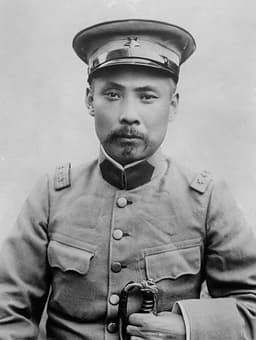
Duan Qirui
General · Modern
53.1Total
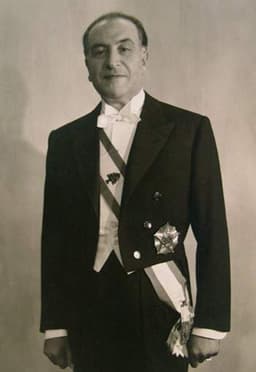
Fuad Chehab
General · Modern
49.9Total
Basic Information
Born
1865
1902
Died
1936
1973
Era
Modern
Modern
Nationality
China
Lebanon
Occupation
General
General
Civilization
Eastern
Middle Eastern
Score Comparison
Military (10%)
47.5
10.2
Political (20%)
53.8
70.0
Influence (20%)
53.3
54.1
Legacy (20%)
47.5
44.2
Leadership (15%)
62.0
72.0
Strategy (15%)
58.0
30.3
TOTAL
53.1
49.9
Duan Qirui — Complete Timeline
1919 AD
Resignation as Premier after the May Fourth MovementPolitical Action◆ Major
Duan Qirui resigned as Premier of the Republic of China in 1919 following the May Fourth Movement. The movement protested the weak response of the Chinese government to the Treaty of Versailles. Duan's government was blamed for failing to protect Chinese interests, leading to his resignation.
ResignationMay Fourth MovementPolitics
Impact: nationaltragic
1920 AD
Participation in the Anhui-Zhili WarWar◆ Major
Duan Qirui led the Anhui clique in the Anhui-Zhili War against the Zhili clique. The war was a major conflict in the Warlord Era. Duan's forces were defeated, leading to his resignation as Premier and the decline of the Anhui clique's power.
Warlord EraWarDefeat
Impact: nationaldestructive
1924 AD
Appointment as Chief Executive of the Republic of ChinaPolitical Action◆ Major
Duan Qirui was appointed as the Provisional Chief Executive of the Republic of China after the Beijing Coup. He headed a provisional government that attempted to unify the country but faced opposition from various warlords. His tenure was marked by political instability and military conflicts.
Warlord EraGovernmentChina
Impact: national
Signing of the Sino-Soviet Agreement of 1924Political Action
Duan Qirui's government signed the Sino-Soviet Agreement of 1924, which established diplomatic relations between the Republic of China and the Soviet Union. The agreement recognized Outer Mongolia as part of China but allowed Soviet influence. It was controversial and criticized by some Chinese nationalists.
DiplomacySoviet UnionTreaty
Impact: national
Fuad Chehab — Complete Timeline
1958 AD
Launched Chehabist reforms and modernizationReform◆ Major
President Chehab implemented a series of reforms known as Chehabism, including administrative modernization, economic planning, and strengthening state institutions. He established the Central Bank of Lebanon and the Civil Service Board.
ReformModernizationState Building
Impact: nationalconstructive
Elected President of LebanonPolitical Action◆ Major
Fuad Chehab was elected President of Lebanon on September 23, 1958, succeeding Camille Chamoun. His election ended the 1958 crisis and was supported by both Christian and Muslim factions seeking stability.
PresidencyElectionStabilization
Impact: nationalconstructive
Created the Deuxième Bureau intelligence agencyPolitical Action
Chehab expanded the role of the Deuxi
IntelligenceSecurityAuthoritarianism
Impact: national
1960 AD
Presided over the 1960s economic boomOther
Under Chehab's presidency, Lebanon experienced a period of economic growth and stability, with Beirut becoming a major financial and tourism hub. His policies attracted foreign investment and expanded the middle class.
Economic GrowthBeirutProsperity
Impact: nationalconstructive
1964 AD
Refused to amend constitution for a second termPolitical Action
Chehab declined to seek a second term as president, respecting the constitutional limit. He retired from politics in 1964, setting a precedent for peaceful transitions of power in Lebanon.
ConstitutionTerm LimitRetirement
Impact: nationalconstructive
Expert Analysis
Fuad Chehab vs Duan Qirui
# The General and the Statesman: Duan Qirui and Fuad Chehab in the Crucible of Modernity
On a spring day in 1919, Duan Qirui sat in his Beijing office, the weight of a nation pressing against his shoulders. Thousands of students had flooded Tiananmen Square, their chants against the Treaty of Versailles echoing through the corridors of power. Across the world, forty years later in Beirut, another general—Fuad Chehab—faced his own crisis: a civil war that threatened to tear Lebanon apart. Both men were soldiers who became rulers. Both inherited fractured nations. Yet one would be remembered as a warlord who failed to unite his country, the other as a reformer who laid foundations for a fragile peace. Why did their paths diverge so sharply?
Origins
Duan Qirui was born in 1865, the twilight of China’s Qing Dynasty, into a family of modest means in Hefei. His father died when he was young, and Duan was raised in an era of humiliation—foreign concessions, the Opium Wars, and the Taiping Rebellion. He found his calling in the military, studying at the Beiyang Military Academy under Yuan Shikai, the man who would later betray the Republic. Duan’s world was one of shifting loyalties, where power flowed from the barrel of a gun and alliances crumbled as quickly as they formed. He rose through the ranks of the Beiyang Army, a force that was less a national institution than a personal fiefdom. By 1912, when the Qing fell, Duan was a general without a country—only a faction.
Fuad Chehab, born in 1902 in Beirut, grew up in a Lebanon still part of the Ottoman Empire, but his family belonged to the Maronite Christian elite. Unlike Duan, Chehab was educated in a French military academy, absorbing Western ideas of statecraft and institutional loyalty. He served in the French Army during the Mandate period, learning the art of administration as much as warfare. His Lebanon was a mosaic of sects—Christians, Muslims, Druze—held together by a delicate power-sharing system. Chehab’s formative years were marked not by civil war but by colonial rule, which taught him that stability required negotiation, not conquest.
Rise to Power
Duan’s ascent was a product of chaos. After Yuan Shikai’s death in 1916, the Republic of China splintered into warlord cliques. Duan, as head of the Anhui clique, seized control of the Beijing government, serving as Premier multiple times between 1916 and 1918. His power rested on military force and backroom deals. The turning point came in 1919, when the May Fourth Movement erupted against Japan’s seizure of Shandong. Duan, seen as weak and pro-Japanese, was forced to resign—a humiliation that revealed the fragility of his rule. Yet he clawed back, and by 1924, after the Beijing Coup, he was appointed Provisional Chief Executive. His rise was a series of falls and recoveries, each driven by violence and opportunism.
Chehab’s path was quieter. In 1958, Lebanon was engulfed in a crisis: President Camille Chamoun’s attempt to amend the constitution for a second term sparked a rebellion. The U.S. Marines landed in Beirut to restore order. Chehab, then commander of the Lebanese Army, refused to take sides, keeping his troops neutral. This restraint earned him trust from all factions. On September 23, 1958, he was elected President by a parliament desperate for unity. His rise was not a coup but a consensus—a stark contrast to Duan’s violent maneuvering.
Leadership & Governance
Duan Qirui ruled as a warlord, not a statesman. His military score of 62.4 and political score of 65.0 reflect a man who understood force better than governance. He tried to centralize power but failed to build institutions. In 1920, he led the Anhui clique into the Anhui-Zhili War against the Zhili clique, a conflict that devastated northern China and ended in his defeat. His signing of the Sino-Soviet Agreement of 1924, which normalized relations with the USSR, was a diplomatic gain, but it came at the cost of recognizing Outer Mongolia’s autonomy—a betrayal to nationalists. Duan’s leadership was reactive, driven by survival rather than vision. His reforms were shallow: he promised democracy but relied on secret police and patronage.
Chehab, by contrast, governed with a philosophy later called “Chehabism.” His political score of 68.8 and leadership score of 75.4 hint at a man who saw the state as a referee, not a weapon. He launched administrative modernization, creating a civil service based on merit, and economic planning that fueled the 1960s boom—Beirut becoming a financial hub. He also created the Deuxième Bureau, an intelligence agency meant to monitor sectarian extremists. Critically, he balanced sects, appointing Muslims and Christians to key posts. His military score of 19.9 is misleading: Chehab was not a warrior but a peacemaker, using the army as a neutral force. His reforms were structural, not personal.
Triumph & Tragedy
Duan’s greatest moment was his survival: after losing the Anhui-Zhili War in 1920, he fled to the Japanese concession in Tianjin, only to return as Chief Executive in 1924. But this was a hollow triumph. His tragedy was the May Fourth Movement—a national awakening that he failed to understand. By suppressing protests and clinging to power, he alienated the intellectuals and youth who could have legitimized his rule. His legacy was stained by corruption and defeat; by 1926, he was forced into retirement, his clique destroyed.
Chehab’s triumph was the 1960s economic boom, when Lebanon became the “Switzerland of the Middle East.” His refusal to amend the constitution for a second term in 1964 was his finest act—a voluntary surrender of power that stabilized the system. But his tragedy was the Deuxième Bureau, which grew into a surveillance state, alienating many Lebanese. His reforms also failed to address deep sectarian inequalities, and after he left office, the tensions he managed exploded into civil war in 1975. Chehab’s peace was a pause, not a cure.
Character & Destiny
Duan was a man of iron will but narrow vision. His strategy score of 81.1 shows tactical brilliance, but he lacked the empathy to see beyond his clique. He once said, “The nation is like a chessboard; the pieces are the armies.” He saw politics as a game of conquest. This made him a tragic figure: a general in an age that needed a builder.
Chehab was introspective, almost reluctant. He refused a second term, saying, “Power is a burden, not a prize.” His character was shaped by Lebanon’s diversity—he knew that force could not hold the country together. Where Duan sought dominance, Chehab sought balance. Their destinies flowed from these choices: Duan’s China descended into the Warlord Era and later the Sino-Japanese War; Chehab’s Lebanon enjoyed a golden decade before unraveling.
Legacy
Duan Qirui is remembered as a footnote—a warlord who failed to bridge China’s transition from empire to republic. His legacy score of 66.8 places him in the shadows of Sun Yat-sen and Chiang Kai-shek. He appears in history books as a cautionary tale: a man with power but no purpose.
Chehab’s legacy is more complex. His influence score of 71.3 reflects his lasting impact on Lebanese politics: the “Chehabist” model of state intervention and sectarian balance is still debated. He is revered as a honest leader in a corrupt region, but his methods—including surveillance—are criticized. He gave Lebanon a blueprint, but nobody followed it.
Conclusion
Duan Qirui and Fuad Chehab were both generals who became rulers, but they inhabited different worlds. Duan’s China was a shattered empire, where legitimacy came from guns; Chehab’s Lebanon was a fragile mosaic, where legitimacy came from trust. One fought for power; the other built institutions. One fell into oblivion; the other left a template. Their stories remind us that leadership is not about the sword but about the vision to see beyond the battlefield—and the courage to put down the sword. In the end, Duan Qirui conquered nothing but defeat, while Fuad Chehab won something rarer: a moment of peace.
Rankings
🥇
Duan QiruiLeader
Mil: 47.5Pol: 53.8Inf: 53.3
53.1
🥈
Fuad Chehab
Mil: 10.2Pol: 70.0Inf: 54.1
49.9
+3.2 behind
How This Comparison Works
Algorithm
Each figure is scored on 6 dimensions (0—100 scale) based on structured historical data: Military (10%), Political (20%), Influence (20%), Legacy (20%), Leadership (15%), Strategy (15%). The weighted total produces the final ranking.
Data Sources
Scores are computed from structured sub-indicators in the database. Scale factors adjust for era (Ancient ×0.85, Modern ×1.0) and civilization size (Eastern ×1.05, Other ×0.80) to account for differences in population and military scale.
Maximum 3 Figures
Comparisons are limited to 2—3 figures to ensure readability and statistical meaningfulness.
Error Margins
±5 points per dimension — Sub-scores are derived from historical records with inherent uncertainty. Two figures within 5 points on a dimension should be considered roughly equivalent in that area.
Total Score Accuracy
±3 points overall — The weighted combination of 6 dimensions produces a total score with approximately ±3 points of uncertainty. Differences of less than 3 points are not statistically significant— the figures are effectively tied.
Known Limitations
- Historical records are incomplete and uneven across civilizations
- Figures from oral-tradition societies may be underrepresented
- Occupation labels can misclassify multi-role figures
- Scores measure capability and impact, not moral character
- Quantitative scoring is a comparison tool, not absolute truth
Capability Radar
Military (10%) — Battles & Warfare
Battles
55
5
Win Rate
50
5
Expansion
40
5
Political (20%) — Governance & Reform
Reform
55
65
Diplomacy
50
60
Economy
40
50
Influence (20%) — Cultural & Global Reach
Cultural
30
30
Global
20
25
Legacy (20%) — Historical Impact
Historical
45
35
Longevity
30
30
Leadership (15%) — Power & Stability
Tenure
60
55
Stability
30
45
Strategy (15%) — Tactics & Innovation
Strategy
65
10
Tactics
60
10
Reform
70
20
Similar Comparisons
Comments & Discussion
**The Warlord’s Ledger**6/16/2026
Duan Qirui wasn't just a victim of history; he was a financial catastrophe in uniform. Look at the Nishihara Loans—¥145 million from Japan, collateralized with China's national railways and mines. He didn't modernize, he liquidated. Meanwhile, Chehab modernized Beirut’s port and expanded the Litani River project with actual development banks. One man sold futures on his country; the other invested in concrete.
**甲寅刀笔吏**6/16/2026
说穿了,段祺瑞和福阿德·谢哈布的最大分野不在才干,而在“兵”与“民”的观念。段氏执政时,北洋军是他私产,马厂誓师也好,讨伐张勋也罢,打仗就是争地盘。谢哈布呢?1958年黎巴嫩危机时,他命令军队不进贝鲁特市区,怕激化教派冲突。一个靠枪杆子立威,一个靠克制立信。这是武夫与政治家的本质之别。
**Papyrus Pedant**6/16/2026
Classics scholars must note the fascinating architectural parallel: Chehab rebuilt the Beirut Souks in a neo-Phoenician style that rewrote urban history, while Duan built… what exactly? Not a monument, not a road. The Chehabist state envisioned itself as a new Carthage—iconic, imperial, imaginary. Duan’s state was just a temporary address on a warlord’s business card.
**暴民与选票**6/16/2026
自由派总爱把“五四”与谢哈布改革相提并论,简直荒谬。五四运动是学生冲进曹汝霖宅邸放火,是街头政治暴力。谢哈布面对的则是1958年已全面教派内战的黎巴嫩,他靠强化宪兵队与情报局重建秩序。段祺瑞根本不懂现代治理的基本要素——情报收集与官僚理性化。他用私谊治国,谢哈布用制度控盘。
**Warlord as Bureaucrat**6/16/2026
The Chehab myth is overblown. Let’s be precise: his “reforms” gave Lebanon a secret police (Deuxième Bureau) that crushed dissent for decades. Duan at least tried to convene a legitimate parliament in 1917—admittedly a coalition of warlords and factional hacks, but still an elected body. Both men failed the liberal test. One gets a romanticized Lebanese saint status; the other gets a textbook footnote as “warlord.”
**枪杆子里的银行家**6/16/2026
你们都在谈政治,我算算经济账。谢哈布任内黎巴嫩镑对美元保持稳定,国家GDP年均增长约5%,这在中东是奇迹。段祺瑞呢?他执政期间中国外