Loading...
Duan Qirui vs Feng Guozhang
Duan Qirui leads by 4.0 pts · 2 figures compared
…
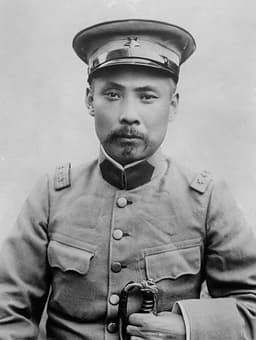
Duan Qirui
General · Modern
53.1Total
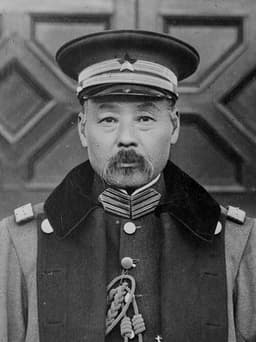
Feng Guozhang
General · Modern
49.1Total
Basic Information
Born
1865
1859
Died
1936
1919
Era
Modern
Modern
Nationality
China
China
Occupation
General
General
Civilization
Eastern
Eastern
Score Comparison
Military (10%)
47.5
30.0
Political (20%)
53.8
61.3
Influence (20%)
53.3
54.9
Legacy (20%)
47.5
45.8
Leadership (15%)
62.0
40.0
Strategy (15%)
58.0
57.5
TOTAL
53.1
49.1
Duan Qirui — Complete Timeline
1919 AD
Resignation as Premier after the May Fourth MovementPolitical Action◆ Major
Duan Qirui resigned as Premier of the Republic of China in 1919 following the May Fourth Movement. The movement protested the weak response of the Chinese government to the Treaty of Versailles. Duan's government was blamed for failing to protect Chinese interests, leading to his resignation.
ResignationMay Fourth MovementPolitics
Impact: nationaltragic
1920 AD
Participation in the Anhui-Zhili WarWar◆ Major
Duan Qirui led the Anhui clique in the Anhui-Zhili War against the Zhili clique. The war was a major conflict in the Warlord Era. Duan's forces were defeated, leading to his resignation as Premier and the decline of the Anhui clique's power.
Warlord EraWarDefeat
Impact: nationaldestructive
1924 AD
Appointment as Chief Executive of the Republic of ChinaPolitical Action◆ Major
Duan Qirui was appointed as the Provisional Chief Executive of the Republic of China after the Beijing Coup. He headed a provisional government that attempted to unify the country but faced opposition from various warlords. His tenure was marked by political instability and military conflicts.
Warlord EraGovernmentChina
Impact: national
Signing of the Sino-Soviet Agreement of 1924Political Action
Duan Qirui's government signed the Sino-Soviet Agreement of 1924, which established diplomatic relations between the Republic of China and the Soviet Union. The agreement recognized Outer Mongolia as part of China but allowed Soviet influence. It was controversial and criticized by some Chinese nationalists.
DiplomacySoviet UnionTreaty
Impact: national
Feng Guozhang — Complete Timeline
1912 AD
Command of the Beiyang ArmyPolitical Action◆ Major
Feng Guozhang became a key commander of the Beiyang Army under Yuan Shikai. He controlled military forces in the Zhili region, establishing himself as a major warlord in northern China after the fall of the Qing dynasty.
Beiyang ArmyWarlordMilitary Command
Impact: national
1916 AD
Appointment as Vice PresidentPolitical Action◆ Major
Feng Guozhang was elected Vice President of the Republic of China under President Li Yuanhong. This position gave him significant political influence during the early Republican period.
Republic of ChinaGovernmentPolitics
Impact: national
1917 AD
Acting PresidencyPolitical Action◆ Major
Feng Guozhang became Acting President of the Republic of China after Li Yuanhong's resignation. He served from 1917 to 1918, facing challenges from rival warlords and struggling to maintain central authority.
Republic of ChinaPresidencyWarlord Era
Impact: national
1918 AD
Conflict with Duan QiruiPolitical Action◆ Major
Feng Guozhang engaged in a power struggle with Premier Duan Qirui, leading to the split of the Beiyang clique into the Zhili and Anhui factions. This conflict weakened the central government and intensified warlord warfare.
Beiyang CliquePower StruggleWarlord Era
Impact: nationaldestructive
Expert Analysis
Feng Guozhang vs Duan Qirui
# The Two Faces of Beiyang: Duan Qirui and Feng Guozhang
In the summer of 1918, two men sat on opposite sides of a table in Beijing, their shared history as comrades under Yuan Shikai now a bitter memory. One, Duan Qirui, was Premier of the Republic, a man of iron will who believed China could be saved only through military strength. The other, Feng Guozhang, had just been elected Vice President—a position he would soon parlay into the presidency itself. Their rivalry would tear apart the Beiyang Army, the most powerful military force in China, and set the stage for decades of warlord chaos. How did two men who once served the same master come to represent such different paths—and what drove them to such divergent fates?
Origins
Duan Qirui was born in 1865, into a China still reeling from the Taiping Rebellion. His father, a minor official, died when Duan was young, leaving him to be raised by his grandfather, a soldier who instilled in him a rigid sense of discipline. Duan entered the Beiyang Military Academy at sixteen, where he excelled in strategy and engineering. He was a product of the self-strengthening movement—a man who believed China’s salvation lay in modernizing its military.
Feng Guozhang, born in 1859, came from a slightly more privileged background. His father was a scholar-official, and Feng received a classical Confucian education before entering the same military academy. But where Duan was austere and unyielding, Feng was pragmatic and diplomatic. He learned early that power in China was not just about winning battles—it was about building alliances, managing egos, and knowing when to bend.
The era shaped them both. The late Qing dynasty was collapsing under internal rebellion and foreign humiliation. The Boxer Rebellion of 1900, the fall of the Qing in 1912, and the chaos of the early Republic created a world where military men held the keys to power. Duan and Feng were among the first generation of Chinese officers trained in modern warfare, and both served under Yuan Shikai, the man who would briefly become President and then Emperor.
Rise to Power
Duan Qirui’s rise was meteoric but narrow. He became Yuan Shikai’s chief of staff and won a reputation as a brilliant strategist. In 1912, he played a key role in forcing the Qing emperor to abdicate, a moment that cemented his loyalty to Yuan—and to the idea of a strong central government. But Duan’s power was always tethered to the military. He commanded the Beiyang Army’s loyalty, but he had little patience for politics or compromise.
Feng Guozhang rose more slowly but more broadly. In 1912, he became a key commander under Yuan, controlling forces in the Zhili region around Beijing. But Feng understood that military power alone was not enough. He cultivated relationships with civilian politicians, with foreign diplomats, and with the merchant class. When Yuan Shikai died in 1916, Feng was elected Vice President under Li Yuanhong—a position that gave him legitimacy beyond the barracks.
The turning point came in 1917. When Li Yuanhong resigned after a confrontation with Duan over whether to join World War I, Feng became Acting President. He served from 1917 to 1918, a period that saw him trying to balance the competing demands of the Beiyang factions, the southern warlords, and the foreign powers. For Feng, this was a delicate dance. For Duan, it was a betrayal of the principle that the military should rule.
Leadership & Governance
Duan Qirui governed as a general. He believed that China’s weakness stemmed from disunity, and that only a strong, centralized military could restore order. As Premier, he pushed for war with Germany in 1917, hoping to win foreign support and strengthen his own position. He signed the Sino-Soviet Agreement of 1924, which established diplomatic relations with the Soviet Union, a move that was pragmatic but deeply unpopular with nationalists. His leadership style was authoritarian: he saw dissent as weakness, and he crushed it with force.
Feng Guozhang governed as a politician. As Acting President, he tried to mediate between the factions, to build coalitions, and to avoid outright civil war. He was more willing to compromise with the southern warlords, and he even considered a federal system that would grant more autonomy to the provinces. But his political wisdom came at a cost: he was seen as indecisive, a man who could not commit to a course of action. His strategy was to survive, not to conquer.
Their military styles reflected their personalities. Duan was a strategist who planned campaigns meticulously, as he did in the Anhui-Zhili War of 1920, where he led the Anhui clique against Feng’s Zhili clique. But his rigidity made him inflexible on the battlefield. Feng, by contrast, was a commander who relied on personal loyalty and local alliances. He was less brilliant as a tactician—his military score is lower—but he was more adept at holding his forces together.
Triumph & Tragedy
Duan Qirui’s greatest moment came in 1924, when he was appointed Provisional Chief Executive after the Beijing Coup. For a brief moment, he seemed to have achieved his dream: a unified China under military rule. But his triumph was hollow. The same year, he signed the Sino-Soviet Agreement, which many saw as a sellout to foreign interests. And his refusal to compromise with the southern nationalists led to the rise of Chiang Kai-shek, who would ultimately destroy the Beiyang system.
Duan’s greatest failure came earlier, in 1919, when he resigned as Premier after the May Fourth Movement. The movement, a massive protest against Chinese weakness at the Treaty of Versailles, exposed the deep unpopularity of his government. Duan had backed the decision to accept Japanese demands in Shandong, and the students and intellectuals who marched against him would never forgive him. He resigned in disgrace, a man who had lost the trust of the people he sought to rule.
Feng Guozhang’s triumph was the presidency itself. For a man who had risen from the ranks to the highest office in the land, it was a remarkable achievement. But his tragedy was that he could not hold it. His power struggle with Duan Qirui escalated into the Anhui-Zhili War, a conflict that devastated northern China and left Feng isolated. He died in 1919, just months after stepping down, a man who had seen his dream of a peaceful China shattered by the very forces he had tried to control.
Character & Destiny
Duan Qirui was a man of iron and fire. His leadership score of 80.4 reflects his ability to command loyalty, but his political score of 65.0 reveals his weakness: he could not build bridges. He saw the world in black and white, and he treated opponents as enemies. This rigidity made him a formidable general but a disastrous politician. His destiny was to be a warlord in an age that demanded statesmen.
Feng Guozhang was a man of silk and shadow. His political score of 81.7 is his highest, reflecting his skill at navigating the treacherous waters of Republican politics. But his military score of 62.6 shows that he lacked the force to back up his diplomacy. He was a man who could win friends but not wars. His destiny was to be a president in name only, a figurehead in a world of guns.
Their personalities shaped their decisions. Duan’s refusal to compromise led to the May Fourth Movement disaster. Feng’s willingness to compromise led to his being seen as weak. One was too strong, the other too flexible. Both, in their own way, failed.
Legacy
Duan Qirui is remembered as a warlord, a man who contributed to China’s fragmentation. His legacy score of 66.8 is modest, a reflection of his failure to unify the country. But he is also remembered as a patriot, a man who believed in a strong China even if his methods were flawed. Some historians credit him with laying the groundwork for the modern Chinese military.
Feng Guozhang is remembered as a transitional figure, a man who tried to preserve the Republic but could not. His legacy score of 64.4 is even lower, in part because he left no lasting institutions. But he is also remembered as a moderate, a man who could have been a bridge between the old order and the new—if only the times had been different.
Neither man achieved what he set out to do. Duan wanted a unified, militarized China; he left a divided, war-torn nation. Feng wanted a stable, constitutional republic; he left a presidency that was a shadow of its former self. Yet their rivalry—the clash between the general and the politician, the iron will and the silk diplomacy—defined an era.
Conclusion
Standing at the edge of the Republican era, one cannot help but wonder: what if Duan had been more flexible, or Feng more forceful? The answer, perhaps, is that neither could have succeeded. The forces that tore China apart—foreign imperialism, regional warlordism, social revolution—were too strong for any one man to control. Duan and Feng were not villains or heroes; they were products of their time, men who tried to steer a ship that was already sinking. Their story is a reminder that history is not made by great men alone, but by the currents that carry them—and sometimes drown them.
Rankings
🥇
Duan QiruiLeader
Mil: 47.5Pol: 53.8Inf: 53.3
53.1
🥈
Feng Guozhang
Mil: 30.0Pol: 61.3Inf: 54.9
49.1
+4.0 behind
How This Comparison Works
Algorithm
Each figure is scored on 6 dimensions (0—100 scale) based on structured historical data: Military (10%), Political (20%), Influence (20%), Legacy (20%), Leadership (15%), Strategy (15%). The weighted total produces the final ranking.
Data Sources
Scores are computed from structured sub-indicators in the database. Scale factors adjust for era (Ancient ×0.85, Modern ×1.0) and civilization size (Eastern ×1.05, Other ×0.80) to account for differences in population and military scale.
Maximum 3 Figures
Comparisons are limited to 2—3 figures to ensure readability and statistical meaningfulness.
Error Margins
±5 points per dimension — Sub-scores are derived from historical records with inherent uncertainty. Two figures within 5 points on a dimension should be considered roughly equivalent in that area.
Total Score Accuracy
±3 points overall — The weighted combination of 6 dimensions produces a total score with approximately ±3 points of uncertainty. Differences of less than 3 points are not statistically significant— the figures are effectively tied.
Known Limitations
- Historical records are incomplete and uneven across civilizations
- Figures from oral-tradition societies may be underrepresented
- Occupation labels can misclassify multi-role figures
- Scores measure capability and impact, not moral character
- Quantitative scoring is a comparison tool, not absolute truth
Capability Radar
Military (10%) — Battles & Warfare
Battles
55
45
Win Rate
50
40
Expansion
40
35
Political (20%) — Governance & Reform
Reform
55
30
Diplomacy
50
45
Economy
40
25
Influence (20%) — Cultural & Global Reach
Cultural
30
30
Global
20
20
Legacy (20%) — Historical Impact
Historical
45
40
Longevity
30
25
Leadership (15%) — Power & Stability
Tenure
60
55
Stability
30
20
Strategy (15%) — Tactics & Innovation
Strategy
65
55
Tactics
60
50
Reform
70
40
Similar Comparisons
Comments & Discussion
和平冯国璋6/16/2026
冯国璋才是真正的务实派!他反对段祺瑞的“武力统一”,主张“和平统一”,这不就是预见性吗?1918年他当总统后,力促南北议和,虽然失败了,但方向没错。他看得很清楚,中国那时根本经不起内战。段祺瑞只会用枪杆子说话,冯国璋至少懂得政治需要妥协。可惜,懂政略的不如会打仗的。
Data Skeptic Li6/16/2026
Everyone romanticizes these two, but look at the numbers. Duan's "victories" in Hunan in 1918 cost 30,000 soldiers for what? A stalemate. Feng's "peaceful" approach? He signed the 1918 Sino-Japanese Joint Defense Agreement, handing over Manchuria's railways. Both men failed their country. They're not rivals—they're two sides of the same incompetent coin, just one was louder about it.
北洋双雄论6/16/2026
别把段祺瑞和冯国璋简单对立。他们都是袁世凯的学生,本质都是军阀系统的产物。段祺瑞造出“皖系”,冯国璋建起“直系”,表面上主义不同,骨子里都是争地盘。段祺瑞的三次组阁和冯国璋的代理总统,不过是北洋系统内斗的两个版本。要说区别,段更极端,冯更圆滑,但都逃不脱军阀政治的宿命。民国早期就是这样——没有绝对的坏人,也没有真正的好人。
历史局外人6/16/2026
我读近代史最厌烦的就是冯段之争这种叙事。两人都是袁世凯的老部下,1912-1916年间没少替老袁镇压革命党。段祺瑞在二次革命时屠杀江西讨袁军,冯国璋在南京镇压过民军。后来吵的“武力统一”vs“和平统一”根本是分赃不均后的遮羞布。历史教科书把他们塑造成不同路线的代表,其实是把军阀内部权力斗争美化成理念之争。真是够了。
Chronicler76096/16/2026
Duan Qirui wasn't just a warlord—he was a militarist with a vision. His 1917 re-occupation of the Peking-Hankou Railway after Zhang Xun's restoration showed he understood logistics as warfare's backbone. But his stubborn reliance on Japanese loans, especially the Nishihara Loans totaling ¥145 million, turned China into a colonial pawn. Iron will without strategic restraint? That's not leadership—it's self-destruction.