Loading...
Douglas MacArthur vs Suharto
Douglas MacArthur leads by 8.5 pts · 2 figures compared
…
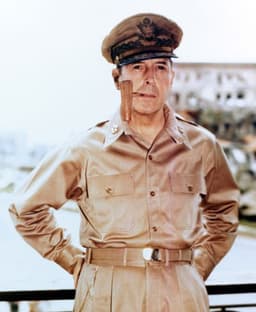
Douglas MacArthur
General · Modern
65.7Total
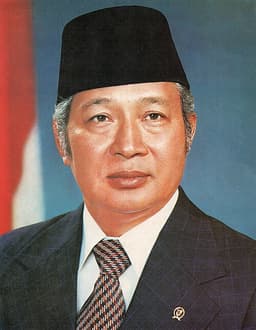
Suharto
General · Modern
57.2Total
Basic Information
Born
1880
1921
Died
1964
—
Era
Modern
Modern
Nationality
United States
Indonesia
Occupation
General
General
Civilization
Western
Eastern
Score Comparison
Military (10%)
85.0
20.0
Political (20%)
78.0
59.3
Influence (20%)
68.0
60.0
Legacy (20%)
40.0
52.0
Leadership (15%)
78.0
82.0
Strategy (15%)
68.0
60.0
TOTAL
65.7
57.2
Douglas MacArthur — Complete Timeline
1942 AD
Battle of Bataan and CorregidorWar◆ Major
MacArthur commanded US and Filipino forces defending the Bataan Peninsula and Corregidor Island against Japanese invasion. After months of resistance, he was ordered to evacuate to Australia, leaving his troops who later surrendered and endured the Bataan Death March.
World War IIPacific TheaterDefeat
Impact: regionaltragic
1944 AD
Return to the PhilippinesWar◆ Major
MacArthur led the Allied invasion of Leyte Gulf, fulfilling his promise 'I shall return.' The campaign liberated the Philippines from Japanese occupation, a major strategic victory in the Pacific War.
World War IIPacific TheaterVictory
Impact: regionalconstructive
1945 AD
Surrender of JapanWar
MacArthur, as Supreme Commander for the Allied Powers, accepted Japan's formal surrender aboard USS Missouri in Tokyo Bay. This ended World War II and began the Allied occupation of Japan under his leadership.
World War IIJapanOccupation
Impact: globalconstructive
Occupation of Japan ReformsReform◆ Major
MacArthur oversaw the Allied occupation of Japan, implementing sweeping reforms including a new constitution, land redistribution, women's suffrage, and demilitarization. These changes transformed Japan into a democratic and pacifist state.
JapanPost-WarDemocratization
Impact: globalprogressive
1950 AD
Inchon LandingWar◆ Major
MacArthur planned and executed a bold amphibious assault at Inchon, South Korea, behind North Korean lines. The operation cut North Korean supply lines and recaptured Seoul, turning the tide of the Korean War.
Korean WarAmphibious AssaultVictory
Impact: regionalconstructive
1951 AD
Dismissal by President TrumanPolitical Action◆ Major
President Harry S. Truman relieved MacArthur of command for insubordination after MacArthur publicly advocated for expanding the Korean War into China. The dismissal sparked a political controversy in the US and ended MacArthur's military career.
Korean WarCivil-Military RelationsDismissal
Impact: nationaldestructive
Suharto — Complete Timeline
1966 AD
Supersemar and Transfer of PowerPolitical Action
President Sukarno signed the Supersemar order, delegating authority to General Suharto to restore order after the 30 September Movement. Suharto used this to ban the Communist Party, purge leftists, and gradually assume executive power, effectively beginning his New Order regime.
SupersemarNew OrderIndonesia
Impact: nationaldestructive
1967 AD
New Order Economic DevelopmentReform◆ Major
Suharto implemented the New Order's economic policies, focusing on foreign investment, agricultural self-sufficiency, and industrialization. The government achieved high growth rates, reduced poverty, and stabilized the economy, but also fostered crony capitalism and corruption.
Economic GrowthDevelopmentIndonesia
Impact: nationalconstructive
1975 AD
Invasion of East TimorWar◆ Major
Suharto ordered the invasion of East Timor after Portugal withdrew. Indonesian forces occupied the territory, leading to a 24-year occupation marked by widespread human rights abuses, including massacres and forced displacement, resulting in an estimated 100,000-200,000 deaths.
East TimorOccupationHuman Rights
Impact: regionaldestructive
1998 AD
Asian Financial Crisis and Fall from PowerPolitical Action
The Asian Financial Crisis devastated Indonesia's economy, leading to massive unemployment and food shortages. Widespread protests and riots forced Suharto to resign in May 1998 after 31 years in power, ending his authoritarian rule and ushering in the Reformasi era.
Financial CrisisResignationReformasi
Impact: nationaltragic
Expert Analysis
Douglas MacArthur vs Suharto
# The General and the Strongman
In the summer of 1945, Douglas MacArthur stood aboard the USS Missouri in Tokyo Bay, accepting the surrender of an empire. In the winter of 1998, Suharto sat alone in a Jakarta mansion, stripped of power, his face a mask of disbelief. Both were generals who became rulers—one of a conquered nation, the other of his own country. Yet their paths diverged like rivers splitting at a continental divide. Why did the American general, who never held elected office, become the architect of modern Japan, while the Indonesian general, who ruled for three decades, left a nation still struggling to exhume his ghost?
Origins
MacArthur was born into military aristocracy in 1880, the son of a Civil War hero. His mother raised him with a single ambition: greatness. He entered West Point at seventeen, graduating first in his class. The world he inherited was one of empires and manifest destinies—a world where white men carried civilization in their knapsacks.
Suharto was born in 1921 in a thatched hut in Java, the son of a minor irrigation official. His childhood was marked by poverty and a fractured family. He joined the Dutch colonial army as a teenager, then switched to the Japanese-sponsored forces during World War II. His world was one of colonialism, occupation, and survival. Where MacArthur saw a stage for glory, Suharto saw a jungle where only the cunning survived.
Rise to Power
MacArthur’s ascent was a study in institutional patronage. He became the youngest superintendent of West Point, then Army Chief of Staff. His command in the Philippines during World War II seemed destined—until the Japanese invasion. The fall of Bataan and Corregidor in 1942 became his crucible. He escaped by PT boat, vowing “I shall return.” That promise, delivered with theatrical gravity, transformed him into a living symbol of American determination.
Suharto’s rise followed a darker script. In 1965, Indonesia was convulsed by a failed coup that the military blamed on the Communist Party. General Suharto, then a relatively obscure officer, seized the moment. In March 1966, President Sukarno signed the Supersemar order, delegating emergency authority to Suharto. The transfer of power was not a battle but a bureaucratic coup—clean, quiet, and absolute. Within a year, Suharto had sidelined Sukarno and launched the New Order.
Leadership & Governance
MacArthur’s rule over Japan from 1945 to 1951 was a masterpiece of enlightened autocracy. As Supreme Commander for the Allied Powers, he wielded absolute authority but used it to impose democracy. He drafted a new constitution that renounced war, granted women voting rights, and redistributed land. He reformed education, labor, and the economy. His strategy was clear: transform a feudal enemy into a peaceful ally. The Inchon Landing in 1950, his boldest military stroke, nearly won the Korean War in a single gamble.
Suharto’s New Order was a different creature. His economic policies, launched in 1967, invited foreign investment and achieved remarkable growth—Indonesia became self-sufficient in rice, and poverty halved. But this prosperity came at a price: a vast patronage network that enriched his family and cronies. His invasion of East Timor in 1975, ordered after Portugal’s withdrawal, led to a brutal occupation that killed perhaps 200,000 people. Where MacArthur built institutions, Suharto built a family business.
Triumph & Tragedy
MacArthur’s greatest triumph was the occupation of Japan itself—a peaceful revolution that reshaped an entire civilization. His greatest tragedy came in Korea. His public demands to expand the war into China, against President Truman’s orders, led to his dismissal in April 1951. “Old soldiers never die,” he told Congress, “they just fade away.” But he never forgave the insult.
Suharto’s triumph was economic transformation. For three decades, Indonesia grew faster than almost any developing nation. His tragedy was the Asian Financial Crisis of 1997-1998. The currency collapsed, banks failed, and millions lost their jobs. Students filled the streets. His own generals abandoned him. In May 1998, after 31 years, Suharto resigned—not with a speech, but with a whisper.
Character & Destiny
MacArthur was a man of grand gestures and fatal pride. He believed himself chosen by history. That pride made him a brilliant commander but an impossible subordinate. He could not share credit or accept limits. His dismissal was not a political accident but a character inevitability.
Suharto was a man of silence and calculation. He spoke rarely, trusted no one, and built a system that depended entirely on his control. His restraint—his refusal to shoot the students in 1998—was both wisdom and weakness. He could not imagine a system that outlasted him. When the crisis came, he had no successors, only dependents.
Legacy
MacArthur is remembered as a flawed giant—the architect of modern Japan, the hero of the Pacific, the general who defied a president. His legacy is a democracy that has endured for seventy years.
Suharto’s legacy is ambiguous. Indonesia’s economy grew under him, but its institutions rotted. The corruption he institutionalized still infects politics. East Timor remains a wound. His name is rarely spoken in praise, but his shadow covers everything.
Conclusion
Both men were generals who became rulers. But MacArthur ruled a conquered nation as a liberator, while Suharto ruled his own people as a father who never let them grow up. One built a democracy; the other built a dependency. In the end, the difference was not just in their policies but in their souls. MacArthur believed in something larger than himself—even if he thought he was that something. Suharto believed only in survival. History, as always, judges both by what they left behind.
Rankings
🥇
Douglas MacArthurLeader
Mil: 85.0Pol: 78.0Inf: 68.0
65.7
🥈
Suharto
Mil: 20.0Pol: 59.3Inf: 60.0
57.2
+8.5 behind
How This Comparison Works
Algorithm
Each figure is scored on 6 dimensions (0—100 scale) based on structured historical data: Military (10%), Political (20%), Influence (20%), Legacy (20%), Leadership (15%), Strategy (15%). The weighted total produces the final ranking.
Data Sources
Scores are computed from structured sub-indicators in the database. Scale factors adjust for era (Ancient ×0.85, Modern ×1.0) and civilization size (Eastern ×1.05, Other ×0.80) to account for differences in population and military scale.
Maximum 3 Figures
Comparisons are limited to 2—3 figures to ensure readability and statistical meaningfulness.
Error Margins
±5 points per dimension — Sub-scores are derived from historical records with inherent uncertainty. Two figures within 5 points on a dimension should be considered roughly equivalent in that area.
Total Score Accuracy
±3 points overall — The weighted combination of 6 dimensions produces a total score with approximately ±3 points of uncertainty. Differences of less than 3 points are not statistically significant— the figures are effectively tied.
Known Limitations
- Historical records are incomplete and uneven across civilizations
- Figures from oral-tradition societies may be underrepresented
- Occupation labels can misclassify multi-role figures
- Scores measure capability and impact, not moral character
- Quantitative scoring is a comparison tool, not absolute truth
Capability Radar
Military (10%) — Battles & Warfare
Battles
85
40
Win Rate
75
45
Expansion
85
30
Political (20%) — Governance & Reform
Reform
85
55
Diplomacy
75
60
Economy
70
65
Influence (20%) — Cultural & Global Reach
Cultural
70
40
Global
80
50
Legacy (20%) — Historical Impact
Historical
85
55
Longevity
70
45
Leadership (15%) — Power & Stability
Tenure
80
85
Stability
65
50
Strategy (15%) — Tactics & Innovation
Strategy
90
40
Tactics
80
35
Reform
70
50
Similar Comparisons
Comments & Discussion
Generalissimo's Ghost6/16/2026
MacArthur may have been a brilliant administrator, but let's not whitewash his record. He actively suppressed the Japanese emperor's war crimes tribunal, protecting Hirohito to maintain stability. Suharto at least had the decency to come from nothing and outmaneuver the PKI communists in '65—MacArthur was a silver-spoon general whose "greatness" was inherited, not earned. Both were authoritarians, but Suharto's Sukarno-era purge actually saved Indonesia from Soviet domination.
军略之狐6/16/2026
拿麦克阿瑟和印尼独裁者对比,本身就是对历史的侮辱。道格拉斯在东京湾签字受降时,苏哈托还在日军训练的爪哇保卫军里当小兵呢!一个是盟军最高统帅,用七年时间把日本变成民主国家;另一个靠屠杀五十万左派上台,搞了三十年家族腐败。别把解放者和军阀混为一谈——两者唯一的共同点就是都留着那种滑稽的小胡子。
Chronos's Apprentice6/16/2026
The real distinction here is institutional legacy. MacArthur rebuilt Japan's entire legal framework, land ownership, and education system—structures that remain intact today. Suharto built nothing but a patronage network. When MacArthur left Tokyo in 1951, he handed power to an elected government. When Suharto fell in 1998, Indonesia's entire political system collapsed because it was just him and his golf buddies. One created lasting institutions; the other created a cult of personality that eva
数据真相者6/16/2026
看数字说话:麦克阿瑟主导的日本土地改革让佃农比例从70%骤降到10%,1947年宪法至今未被修改。苏哈托呢?他执政32年,印尼人均GDP从70美元涨到1100美元——听起来不错,但别忘了全是石油美元和外资贷款堆的,1997年金融危机一来,他家族囤积的200亿美元资产直接蒸发。一个建了制度骨架,一个只留下空壳和3000亿外债。
Lotus Eater's Echo6/16/2026
You're all missing the cultural dimension. MacArthur understood that to govern Japan, you had to become a living symbol—he cultivated that imperial aura deliberately, from the corncob pipe to the "old soldiers never die" speech. Suharto tried the same approach with Javanese mysticism and wayang puppet imagery, but he never grasped that symbols without substance are just noise. MacArthur's theater had real legislative weight behind it; Suharto's was all shadow puppetry and empty ritual. That's wh