Loading...
Donald Tusk vs Midhat Pasha
Midhat Pasha leads by 7.5 pts · 2 figures compared
…

Donald Tusk
Politician · Modern
56.8Total
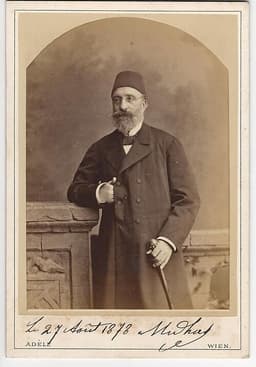
Midhat Pasha
Politician · Modern
64.3Total
Basic Information
Born
1957
1822
Died
—
1884
Era
Modern
Modern
Nationality
Poland
Ottoman Empire
Occupation
Politician
Politician
Civilization
Western
Middle Eastern
Score Comparison
Military (10%)
47.8
10.0
Political (20%)
62.7
78.0
Influence (20%)
55.0
82.0
Legacy (20%)
52.0
72.0
Leadership (15%)
78.0
62.0
Strategy (15%)
42.1
38.3
TOTAL
56.8
64.3
Donald Tusk — Complete Timeline
2007 AD
Tusk becomes Prime Minister of PolandPolitical Action◆ Major
Donald Tusk became Prime Minister of Poland after his Civic Platform party won the parliamentary election. He formed a coalition government, succeeding Jaros
Polish PoliticsCivic Platform2007 Election
Impact: national
2008 AD
Tusk's government during the 2008 financial crisisPolitical Action◆ Major
Tusk's government managed Poland's economy through the global financial crisis, avoiding recession through stimulus measures and a flexible currency. Poland was the only EU country to post positive GDP growth in 2009.
Economic PolicyFinancial CrisisEU
Impact: nationalconstructive
2014 AD
Tusk elected President of the European CouncilPolitical Action◆ Major
Donald Tusk was elected President of the European Council, becoming the first Eastern European to hold the post. He served two terms until 2019, overseeing EU responses to the migration crisis and Brexit negotiations.
EU LeadershipEuropean CouncilInternational Politics
Impact: global
2023 AD
Tusk returns as Polish Prime MinisterPolitical Action◆ Major
After eight years in opposition, Tusk led the Civic Coalition to victory in the 2023 parliamentary election. He formed a pro-European coalition government, ending the rule of the Law and Justice party and restoring democratic norms.
Polish Politics2023 ElectionDemocracy
Impact: nationalconstructive
Midhat Pasha — Complete Timeline
1864 AD
Governorship of the Danube VilayetReform◆ Major
As governor of the Danube Vilayet from 1864 to 1868, Midhat Pasha implemented extensive reforms. He built roads, bridges, and schools, established a provincial bank, and promoted agricultural development. His administration became a model for Tanzimat provincial governance.
GovernorshipReformInfrastructure
Impact: regionalconstructive
1872 AD
Appointment as Grand VizierPolitical Action◆ Major
Midhat Pasha was appointed Grand Vizier for the first time in 1872. He had previously served as governor of the Danube Vilayet and was known for his reformist ideas. His tenure was short-lived due to opposition from conservative factions and the sultan.
AppointmentReformOttoman Politics
Impact: nationalconstructive
1876 AD
Proclamation of the Ottoman Constitution of 1876Reform
Midhat Pasha was the chief architect of the first Ottoman Constitution, proclaimed on December 23, 1876. The constitution established a bicameral parliament, guaranteed civil liberties, and limited the sultan's powers. It was a landmark in Ottoman modernization, though it was suspended in 1878.
ConstitutionReformParliament
Impact: nationalprogressive
1881 AD
Exile and TrialPolitical Action◆ Major
Midhat Pasha was arrested in 1881 on charges of involvement in the murder of Sultan Abd
ExileTrialExecution
Impact: nationaltragic
Expert Analysis
Origins
Donald Tusk was born on April 22, 1957, in Gdańsk, Poland, to a family with Kashubian heritage. His father was a carpenter, and his mother worked as a nurse. Tusk grew up under communist rule and studied history at the University of Gdańsk, becoming involved in the Solidarity movement in the 1980s. He co-founded the Liberal Democratic Congress and later the Civic Platform party.
Midhat Pasha was born in 1822 in Istanbul, Ottoman Empire, to a family of religious scholars. His father was a qadi (judge). Midhat studied Islamic law and administration, entering the Ottoman civil service at a young age. He rose through the ranks due to his administrative skills, serving as governor in various provinces before becoming Grand Vizier.
Rise to Power
Tusk's political rise began after the fall of communism. He was elected to the Polish Sejm in 1991 and served as Deputy Speaker. In 2001, he co-founded the Civic Platform, which became a major centrist party. In the 2007 parliamentary election, Civic Platform won a plurality, and Tusk became Prime Minister on November 16, 2007. He was re-elected in 2011, serving until 2014.
Midhat Pasha's rise came through administrative excellence. He was appointed governor of the Danube Vilayet in 1864, where he implemented reforms that modernized the province. His success led to his appointment as Grand Vizier in 1872, but political intrigue forced him out. He returned to prominence in 1876, when he became the leading figure behind the Ottoman Constitution, proclaimed on December 23, 1876. He was again appointed Grand Vizier, but his tenure was short-lived due to opposition from Sultan Abdul Hamid II.
Leadership & Governance
Tusk's leadership style was pragmatic and consensus-oriented. As Prime Minister, he focused on economic liberalization, privatization, and strengthening Poland's ties with NATO and the EU. During the 2008 financial crisis, his government implemented stimulus measures and maintained a flexible currency, helping Poland avoid recession. He also pursued social reforms, such as raising the retirement age. As President of the European Council from 2014 to 2019, he managed EU responses to the migrant crisis and Brexit. His political score is 62.7, reflecting his effectiveness in coalition governance.
Midhat Pasha was a reformist and modernist. As governor of the Danube Vilayet, he built infrastructure, established a provincial bank, and introduced a secular school system. He believed in constitutionalism and the rule of law. His greatest achievement was drafting the Ottoman Constitution, which created a bicameral parliament and guaranteed civil liberties. However, his governance was hampered by the autocratic nature of the Ottoman sultanate. Sultan Abdul Hamid II suspended the constitution in 1878 and exiled Midhat. Midhat's political score is 78.0, higher than Tusk's, due to his foundational role in constitutional governance.
Triumph & Tragedy
Tusk's greatest triumph was steering Poland through the 2008 financial crisis without recession, a rare achievement in Europe. He also successfully represented the EU on the global stage during his tenure as Council President. His tragedy came in 2015, when his Civic Platform lost power to the Law and Justice party (PiS), which reversed many of his reforms. Tusk later returned as Prime Minister in 2023, but faced a deeply polarized political landscape.
Midhat Pasha's triumph was the proclamation of the Ottoman Constitution, a landmark in Islamic constitutionalism. He also modernized the Danube Vilayet, setting a model for provincial governance. His tragedy was his downfall: after the constitution was suspended, he was arrested in 1881, tried for the murder of Sultan Abdülaziz, and sentenced to death. The sentence was commuted to exile in Ta'if, where he was murdered in 1884. His constitutional experiment lasted only two years.
Character & Destiny
Tusk is known for his calm, calculated demeanor and ability to build coalitions. His character—pragmatic, moderate, and patient—enabled him to navigate Poland's volatile politics and EU diplomacy. However, his centrism sometimes alienated more ideological voters, contributing to his party's 2015 defeat.
Midhat Pasha was idealistic and principled, believing that constitutionalism could save the Ottoman Empire. His character—bold, reformist, and uncompromising—led him to push for change in an autocratic system. This ultimately sealed his fate, as Sultan Abdul Hamid II saw him as a threat. His destiny was tragic: he died in exile, his constitution abandoned for decades.
Legacy
Tusk's legacy is mixed. He modernized Poland's economy and strengthened its position in the EU, but many of his reforms were undone by the PiS government. His role as EU Council President solidified his international reputation. His legacy score is 52.0, reflecting his significant but reversible impact.
Midhat Pasha's legacy is more enduring. He is remembered as the "Father of the Ottoman Constitution," and his ideas influenced later constitutional movements in Turkey and other Muslim countries. The 1876 Constitution, though brief, set a precedent for parliamentary governance. His legacy score is 72.0, higher than Tusk's, due to the foundational nature of his contributions.
Conclusion
Midhat Pasha had a greater historical impact than Donald Tusk. His total score of 64.3 versus Tusk's 56.8 reflects this. While Tusk was a skilled politician who managed Poland's EU integration and economic stability, his achievements were within an established democratic framework. Midhat Pasha, by contrast, pioneered constitutionalism in an autocratic empire, risking his life for reform. His influence score of 82.0 and legacy score of 72.0 dwarf Tusk's 55.0 and 52.0. Midhat Pasha's constitutional vision, though crushed, laid the groundwork for Turkey's eventual transition to a republic. Tusk's work, while important, was more about management than foundational change. Therefore, Midhat Pasha is the more significant historical figure.
Rankings
🥇
Midhat PashaLeader
Mil: 10.0Pol: 78.0Inf: 82.0
64.3
🥈
Donald Tusk
Mil: 47.8Pol: 62.7Inf: 55.0
56.8
+7.5 behind
How This Comparison Works
Algorithm
Each figure is scored on 6 dimensions (0—100 scale) based on structured historical data: Military (10%), Political (20%), Influence (20%), Legacy (20%), Leadership (15%), Strategy (15%). The weighted total produces the final ranking.
Data Sources
Scores are computed from structured sub-indicators in the database. Scale factors adjust for era (Ancient ×0.85, Modern ×1.0) and civilization size (Eastern ×1.05, Other ×0.80) to account for differences in population and military scale.
Maximum 3 Figures
Comparisons are limited to 2—3 figures to ensure readability and statistical meaningfulness.
Error Margins
±5 points per dimension — Sub-scores are derived from historical records with inherent uncertainty. Two figures within 5 points on a dimension should be considered roughly equivalent in that area.
Total Score Accuracy
±3 points overall — The weighted combination of 6 dimensions produces a total score with approximately ±3 points of uncertainty. Differences of less than 3 points are not statistically significant— the figures are effectively tied.
Known Limitations
- Historical records are incomplete and uneven across civilizations
- Figures from oral-tradition societies may be underrepresented
- Occupation labels can misclassify multi-role figures
- Scores measure capability and impact, not moral character
- Quantitative scoring is a comparison tool, not absolute truth
Capability Radar
Military (10%) — Battles & Warfare
Battles
29
0
Win Rate
34
0
Expansion
37
0
Political (20%) — Governance & Reform
Reform
70
85
Diplomacy
80
70
Economy
70
60
Influence (20%) — Cultural & Global Reach
Cultural
40
55
Global
65
55
Legacy (20%) — Historical Impact
Historical
55
70
Longevity
45
60
Leadership (15%) — Power & Stability
Tenure
75
65
Stability
65
40
Strategy (15%) — Tactics & Innovation
Strategy
37
0
Tactics
40
0
Reform
44
10
Similar Comparisons
Comments & Discussion
No comments yet. Be the first to share your thoughts!