Loading...
Deodoro da Fonseca vs To Lam
To Lam leads by 1.8 pts · 2 figures compared
…
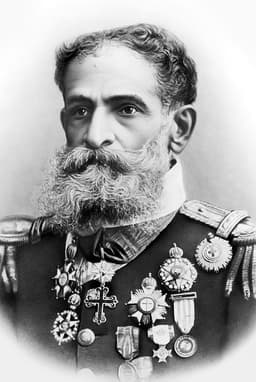
Deodoro da Fonseca
General · Modern
48.8Total

To Lam
General · Modern
50.6Total
Basic Information
Born
1827
1957
Died
1892
—
Era
Modern
Modern
Nationality
Brazil
Vietnam
Occupation
General
General
Civilization
Western
Eastern
Score Comparison
Military (10%)
50.0
25.9
Political (20%)
45.1
68.0
Influence (20%)
54.1
51.8
Legacy (20%)
44.2
41.7
Leadership (15%)
57.6
72.0
Strategy (15%)
38.6
36.8
TOTAL
48.8
50.6
Deodoro da Fonseca — Complete Timeline
1889 AD
Proclamation of the Brazilian RepublicPolitical Action
Deodoro da Fonseca led a military coup that overthrew Emperor Pedro II on November 15, 1889. He proclaimed the Republic of the United States of Brazil, ending 67 years of imperial rule.
CoupRepublic
Impact: globalprogressive
1891 AD
Election as First President of BrazilPolitical Action◆ Major
Deodoro da Fonseca was elected the first President of Brazil by the Constituent Congress on February 25, 1891. He took office under the new republican constitution, but his rule was brief and authoritarian.
ElectionPresidency
Impact: national
Dissolution of the National CongressPolitical Action◆ Major
Facing political opposition, Deodoro da Fonseca dissolved the National Congress on November 3, 1891, and declared a state of siege. This authoritarian act triggered a naval revolt and his eventual resignation.
AuthoritarianismPolitical Crisis
Impact: nationaldestructive
Resignation from the PresidencyPolitical Action◆ Major
Deodoro da Fonseca resigned the presidency on November 23, 1891, after a naval rebellion threatened his government. He handed power to Vice President Floriano Peixoto, ending his 9-month rule.
ResignationPolitical Crisis
Impact: nationaltragic
To Lam — Complete Timeline
2016 AD
Appointed Minister of Public SecurityPolitical Action◆ Major
To Lam was appointed Minister of Public Security of Vietnam, overseeing the country's police and internal security forces. He played a key role in maintaining public order and combating crime.
Ministerial AppointmentSecurity Leadership
Impact: national
2024 AD
Elected President of VietnamPolitical Action◆ Major
To Lam was elected President of Vietnam by the National Assembly, succeeding Vo Van Thuong. He transitioned from security chief to head of state, continuing his influence in national politics.
PresidencyGovernment Leadership
Impact: national
Expert Analysis
Deodoro da Fonseca vs To Lam
# The General as President: Deodoro da Fonseca and To Lam
On a November morning in 1891, the first president of Brazil sat in his palace in Rio de Janeiro, watching warships gather in the harbor below. Deodoro da Fonseca had declared himself dictator just twenty days earlier, dissolving the National Congress he had sworn to uphold. Now the navy was demanding his resignation. Across the world and more than a century later, another general-turned-president would face no such rebellion. In Hanoi, To Lam stood at the pinnacle of a system he had spent decades securing from within, his rise as smooth as Deodoro’s fall was sudden. Both men were generals who became presidents. But their paths, their eras, and their fates could not have been more different.
Origins
Deodoro da Fonseca was born in 1827 in Alagoas, a poor province in northeastern Brazil, into a military family of modest means. The Brazil of his youth was an empire—the only monarchy in the Americas—ruled by the enlightened but aging Emperor Pedro II. Deodoro grew up in a world of plantations, slavery, and a fragile parliamentary system that barely contained the ambitions of army officers and coffee barons. His education was military, his worldview shaped by the positivist philosophy that had swept through Latin America: order and progress, science over superstition, republic over monarchy.
To Lam was born in 1957 in Hưng Yên province, in the Red River Delta of North Vietnam. The Vietnam of his childhood was at war—first against the French, then against the Americans, then in a brutal civil conflict that did not end until 1975. Lam grew up in a world of revolutionary discipline, communist ideology, and a security state that demanded absolute loyalty. He joined the Ministry of Public Security young, learning not the arts of open battle but the quieter, more patient craft of surveillance, interrogation, and political control.
The difference in their origins is the difference between a collapsing empire and a rising party-state. Deodoro inherited a system that had grown brittle; To Lam inherited one that was still being forged.
Rise to Power
Deodoro’s rise was the story of a loyal soldier who became a reluctant revolutionary. He fought in the Paraguayan War (1864–1870), the bloodiest conflict in South American history, where he distinguished himself as a competent commander. But the war also radicalized him. He saw the empire’s incompetence, the corruption, the way the monarchy favored the landed elite over the army. By the late 1880s, Deodoro had become a rallying point for disgruntled officers. On November 15, 1889, he led a bloodless coup that deposed Emperor Pedro II. He did not seek the presidency—he was pushed into it by his fellow conspirators. His rise was improvised, the product of a moment.
To Lam’s rise was anything but improvised. Appointed Minister of Public Security in 2016, he spent eight years consolidating power within Vietnam’s vast security apparatus, building networks of loyalty, purging rivals, and positioning himself as the indispensable guardian of the party’s stability. When President Vo Van Thuong resigned abruptly in 2024 amid a corruption crackdown, Lam was the natural successor. The National Assembly elected him with the kind of unanimous approval that signals not democracy but discipline. His rise was methodical, patient, and designed from the start.
Deodoro stumbled into power. To Lam climbed into it.
Leadership & Governance
As president, Deodoro was a disaster. He had no experience in politics, no patience for compromise, and no understanding of how to govern a country as vast and divided as Brazil. His military score of 35.9 and strategy score of 40.2 reflect a man who was never a great general and an even worse politician. When the Constituent Congress drafted a constitution that limited presidential power, Deodoro accepted it reluctantly. When the new Congress opposed his policies, he dissolved it by decree on November 3, 1891, declaring a state of siege. It was the act of a man who believed that order could be imposed by force.
To Lam governs very differently. His political score of 74.6 and leadership score of 81.0 suggest a leader who understands that power in a one-party state is maintained not by open confrontation but by quiet control. As president, he has continued the anti-corruption campaign that brought him to power, using it to consolidate authority and eliminate rivals. He does not dissolve parliaments—he ensures they vote the right way. He does not declare states of siege—he has spent decades building a security state so pervasive that open dissent is nearly impossible. His governance is the triumph of bureaucratic surveillance over military bravado.
Triumph & Tragedy
Deodoro’s greatest moment was also the beginning of his end. The proclamation of the Republic on November 15, 1889, was a triumph of will: a tired old general, a band of conspirators, and a monarchy that collapsed without a shot. But the triumph was hollow. He had no plan for what came next. His tragedy was the naval rebellion of November 1891, when the Brazilian Navy—still loyal to the monarchy—turned its guns on his government. On November 23, 1891, just twenty days after dissolving Congress, Deodoro resigned. He had been president for less than nine months.
To Lam has known no such tragedy—yet. His career has been a steady ascent, unbroken by defeat or rebellion. But the tragedy of men like Lam is not a single event; it is the slow corrosion of a system where power is absolute and accountability absent. He may never face a naval rebellion, but he will face the quiet erosion of trust, the hollowing out of institutions, the loneliness of a leader who has no one left to fear.
Character & Destiny
Deodoro was impulsive, honorable in his own way, but fundamentally unsuited for the role history thrust upon him. He was a man of action who needed to be a man of politics, and he failed. His personality—proud, stubborn, and easily frustrated—shaped his decisions. He dissolved Congress because he could not bear opposition. He resigned because he could not bear humiliation.
To Lam is the opposite: patient, calculating, and utterly opaque. His personality does not shape events; it adapts to them. He is a product of the system he now leads—a system that rewards conformity, punishes ambition, and produces leaders who are interchangeable. His destiny is not to fall dramatically but to fade quietly, replaced by another general, another minister, another face of the same machine.
Legacy
Deodoro da Fonseca is remembered today as a founder, but a flawed one. His legacy score of 60.6 reflects the ambivalence of history: he ended the monarchy and began the republic, but he also showed how fragile that republic could be. Streets and squares bear his name in Brazil, but few Brazilians know his story. He is a statue in a park, a footnote in textbooks.
To Lam is still writing his legacy. His score of 58.4 suggests a leader who may be remembered not for great achievements but for the quiet consolidation of power. In Vietnam, he will be praised for stability and order. Outside, he may be remembered as the security chief who became president, a symbol of a system that has traded revolutionary idealism for bureaucratic control.
Conclusion
The comparison between Deodoro da Fonseca and To Lam is a comparison between two ways of failing. Deodoro failed dramatically, quickly, and visibly—a general who could not govern, a president who could not compromise. To Lam may succeed quietly, slowly, and invisibly—a general who governs through surveillance, a president who needs no compromise because he tolerates no opposition. Both are generals who became presidents. But one was a soldier who could not adapt to peace, and the other is a policeman who has made peace into a prison. The difference between them is the difference between a man who tried to change his country and failed, and a man who changed his country into a machine that no longer needs changing.
Rankings
🥇
To LamLeader
Mil: 25.9Pol: 68.0Inf: 51.8
50.6
🥈
Deodoro da Fonseca
Mil: 50.0Pol: 45.1Inf: 54.1
48.8
+1.8 behind
How This Comparison Works
Algorithm
Each figure is scored on 6 dimensions (0—100 scale) based on structured historical data: Military (10%), Political (20%), Influence (20%), Legacy (20%), Leadership (15%), Strategy (15%). The weighted total produces the final ranking.
Data Sources
Scores are computed from structured sub-indicators in the database. Scale factors adjust for era (Ancient ×0.85, Modern ×1.0) and civilization size (Eastern ×1.05, Other ×0.80) to account for differences in population and military scale.
Maximum 3 Figures
Comparisons are limited to 2—3 figures to ensure readability and statistical meaningfulness.
Error Margins
±5 points per dimension — Sub-scores are derived from historical records with inherent uncertainty. Two figures within 5 points on a dimension should be considered roughly equivalent in that area.
Total Score Accuracy
±3 points overall — The weighted combination of 6 dimensions produces a total score with approximately ±3 points of uncertainty. Differences of less than 3 points are not statistically significant— the figures are effectively tied.
Known Limitations
- Historical records are incomplete and uneven across civilizations
- Figures from oral-tradition societies may be underrepresented
- Occupation labels can misclassify multi-role figures
- Scores measure capability and impact, not moral character
- Quantitative scoring is a comparison tool, not absolute truth
Capability Radar
Military (10%) — Battles & Warfare
Battles
20
10
Win Rate
25
10
Expansion
10
10
Political (20%) — Governance & Reform
Reform
40
40
Diplomacy
25
40
Economy
15
30
Influence (20%) — Cultural & Global Reach
Cultural
20
20
Global
15
20
Legacy (20%) — Historical Impact
Historical
35
20
Longevity
20
20
Leadership (15%) — Power & Stability
Tenure
30
50
Stability
10
40
Strategy (15%) — Tactics & Innovation
Strategy
25
10
Tactics
20
10
Reform
15
10
Similar Comparisons
Comments & Discussion
Deodoro's Duplicate6/16/2026
Comparing these two is like comparing a sledgehammer to a scalpel. Deodoro’s 1891 coup was a theatrical farce—he resigned after 9 months, defeated by a navy that could actually shoot back. To Lam spent 40 years climbing the secret police ladder in a single-party state where rivals vanish into re-education camps without a shot fired. One man’s incompetence toppled him; the other’s institutional mastery made him untouchable. There’s no parallel, only a lesson in how brutal systems evolve.
铁血拆台者6/16/2026
这俩放一块儿比较?一个是在1891年搞政变结果九个月后就被海军逼宫的喜剧演员,另一个是花了四十年从公安系统爬上来的铁腕人物。福塞卡连个像样的权力基础都建不起来,解散国会后立马翻车。而苏林呢?在越南,他可是亲手清洗过竞争对手的,压根不需要军舰示威。说白了,一个是乱世里的莽夫,一个是冷战老练的棋手,拿他们比简直侮辱了‘阴谋’这个词。
Statistician's Fury6/16/2026
Let’s talk numbers: Deodoro led a country of ~14 million in 1890, with a GDP per capita around $700 (1990 dollars). To Lam inherited Vietnam’s ~100 million people, GDP per capita ~$4,000. Deodoro’s Brazil was 88% rural; Vietnam today is 63% urbanizing. Deodoro collapsed after a 20-day dictatorship; Lam has consolidated power for half a decade so far. These structures aren’t comparable—one was a flailing agrarian state, the other a Leninist apparatus. To force a parallel is to ignore every releva
伪善的对比者6/16/2026
历史不是填空题,把两个将军总统塞进同一个框里就能得出答案。福塞卡的垮台是民主戏码里的一场乌龙,他那个年代巴西还有奴隶制(1888年才废除),而苏林的时代是高科技监控和媒体审查。咱别光看军装和头衔——福塞卡是被报纸和炮舰赶下台的,苏林控制着全国每一条短信。前者是19世纪乱局里的过客,后者是现代权力机器的引擎,这俩的‘相似’纯粹是你想象出来的。